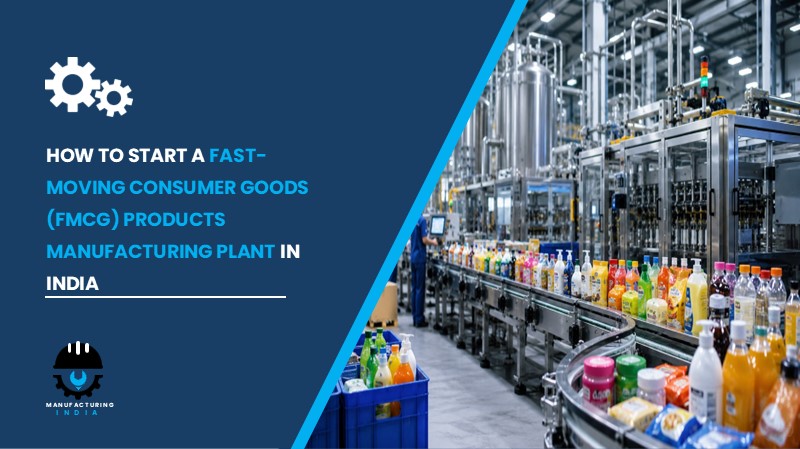
Setting up a fast moving consumer goods (FMCG) products manufacturing plant in India presents a compelling investment case for entrepreneurs and corporates looking to serve one of the largest consumption markets in the world. Demand is driven by household, personal care, food & beverage, pharmaceuticals, and health & wellness industries, all of which depend on a steady, high-volume supply of everyday essentials such as laundry detergents, dishwashing tablets, vitamin supplements, instant drink powders, medicinal tablets, and cleaning bars. Because FMCG products are essential, non-durable goods consumed rapidly and replenished frequently, they form the backbone of daily consumption and remain critical to India’s broader economic activity and organized distribution networks.
India’s fast growing digital retail and e-commerce landscape adds further weight to the case for local production. According to the International Trade Administration, the online business in India is estimated to be worth USD 46.2 Billion, with growth expected at 18.29 percent to reach USD 136.47 Billion by 2026. Supported by government initiatives such as Make in India and PLI schemes for food processing, India offers a strategically sound environment for this manufacturing plant to serve both domestic and export markets.
This investment case is anchored in strong policy support through Make in India and PLI schemes, cost-competitive production economics, and consistent demand from household, personal care, food & beverage, pharmaceutical, and health & wellness sectors. With gross margins reported between 30-45% and net margins between 15-25%, an FMCG manufacturing plant in India offers a viable and scalable path to break-even and sustained profitability.
What is FMCG Products?
Fast-moving consumer goods, or FMCG products, are essential, non-durable products that sell quickly at relatively low costs, with high inventory turnover. They are staples of daily life, consumed rapidly and replenished within days, weeks, or months, and include packaged foods, beverages, toiletries, cosmetics, over-the-counter medicines, and cleaning supplies. Because they represent low-involvement purchases, FMCG products depend heavily on strong brand presence, extensive advertising, and wide distribution networks. The industry is defined by fierce competition, high sales volumes, and comparatively low profit margins per unit, with profitability achieved through mass-scale production.
The FMCG products manufacturing process relies on mixing, granulation, compression, coating, and packaging as its primary production stages. These stages convert base ingredients and functional additives into finished goods such as tablets, powders, bars, and liquid formulations, serving end-use industries that include household, personal care, food & beverage, pharmaceuticals, and health & wellness.
Cost of Setting Up a FMCG Products Manufacturing Plant in India
The cost of setting up this facility depends on capacity, technology, location, automation levels, and regulatory compliance requirements.
1. Capital Expenditure (CapEx)
Capital expenditure begins with land and site development, which can be pursued through industrial estates depending on investor preference, along with charges for land registration and boundary development. Civil works and construction costs follow, covering the production shed, quality testing labs, storage areas, and the administrative block, designed with plant layout optimization in mind to enhance workflow efficiency and future expansion capacity.
Machinery represents the largest share of capital expenditure for this type of plant. Key machinery required includes:
- Mixers and blenders
- Processing and formulation units
- Filling and sealing machines
- Labeling systems
- Quality testing labs
- Automated packaging and warehousing solutions
Other capital costs cover effluent treatment systems, pre-operative expenses, and commissioning costs that ensure the facility is fully compliant with safety and environmental standards before commercial production begins.
Request a Sample Report for In-Depth Market Insights: https://www.imarcgroup.com/fast-moving-consumer-goods-products-manufacturing-plant-project-report/requestsample
2. Operational Expenditure (OpEx)
Raw material cost forms the dominant share of operating expenditure, accounting for approximately 60-80% of total OpEx. Raw materials required include base ingredients, functional additives, fragrances/flavors, treated water, and packaging materials. Given this weight, securing long-term supplier contracts is essential to mitigate price volatility and ensure a stable supply of materials.
Utility costs, covering electricity, water, and steam, account for approximately 5-15% of OpEx. Other operating costs include transportation, packaging, salaries and wages, repairs and maintenance, depreciation, and taxes. By the fifth year of operations, total operational cost is expected to increase substantially due to inflation, market fluctuations, and rises in the cost of key materials.
3. Plant Capacity
The proposed FMCG products manufacturing facility is designed with an annual production capacity ranging between 50,000 and 200,000 tons, allowing operators to achieve economies of scale while retaining operational flexibility. Plant capacity for the facility can be customized based on investor requirements, and profitability generally improves as capacity utilization increases, spreading fixed costs across a larger production base.
4. Profit Margins and Financial Projections
Financial projections are developed around capital investment, operating costs, capacity utilization, pricing, and demand outlook, covering net present value (NPV), internal rate of return (IRR), payback period, and profit and loss projections. Gross profit margins typically range between 30-45%, while net profit margins range between 15-25%, supported by stable demand and value-added applications.
Why Set Up a FMCG Products Plant in India?
Essential Everyday Consumption Category: FMCG products such as food, beverages, personal care, and household essentials are integral to daily life, ensuring consistent, non-cyclical demand across urban and rural markets. This positions the plant as a resilient, high-volume consumption driver.
Megatrend Alignment: Rising disposable incomes, urbanisation, changing lifestyles, and growing preference for convenience and packaged goods are fuelling sustained demand. Premiumisation, health-conscious consumption, and e-commerce expansion are further accelerating category growth.
Policy and Regulatory Tailwinds: Government initiatives supporting food processing, rural development, retail infrastructure, and domestic manufacturing, including Make in India and PLI schemes for food processing, are strengthening the FMCG ecosystem and boosting organized sector participation.
Cost-Competitive Manufacturing: Companies with strong last-mile distribution, regional customization, and agile supply chains are well-positioned to capture market share, and local manufacturing helps reduce logistics costs and improve margins.
Active Industry Investment: In February 2026, Hindustan Unilever Limited (HUL) announced a proposed investment of up to ₹2,000 crore to expand manufacturing capacity in Beauty & Wellbeing and Home Care liquids over two years across multiple locations. In July 2025, ITC released plans to invest ₹20,000 crore across businesses over the medium term, following the recent setup of eight manufacturing plants for FMCG, sustainable packaging, and export-oriented value-added agricultural products.
Local Supply Chain Preference: Moderate but defensible entry barriers mean that while entry is relatively accessible compared to heavy industries, success requires strong brand building and distribution networks, favouring investors who establish local sourcing relationships early.
Manufacturing Process – Step by Step
The FMCG products manufacturing process uses mixing, granulation, compression, coating, and packaging as the primary production method.
- Mixing: Base ingredients, functional additives, and fragrances/flavors are combined using mixers and blenders.
- Granulation: The mixed formulation is processed through processing and formulation units for shaping.
- Compression: The formulated material is compressed into tablets, bars, or other solid forms.
- Coating: Products undergo a coating stage to enhance stability and shelf life.
- Filling and Sealing: Finished formulations are processed using filling and sealing machines.
- Labeling: Labeling systems apply product, batch, and regulatory information.
- Quality Testing: Products pass through quality testing labs to verify safety specifications.
- Packaging and Dispatch: Automated packaging and warehousing solutions prepare finished goods for dispatch to household, personal care, food & beverage, pharmaceutical, and health & wellness industries.
Key Applications
The FMCG products manufacturing plant serves a broad set of end-use industries reliant on daily consumer essentials.
- Food & Beverage Processing: Handling, mixing, packaging, and preservation of consumable products such as instant drink powders.
- Personal Care & Hygiene: Manufacturing of soaps, shampoos, toothpaste, and skincare items.
- Household Products: Production of detergents, cleaners, and disinfectants, including laundry detergents and cleaning bars.
- Packaging & Distribution: High-speed filling, labeling, and logistics support for mass consumer goods such as dishwashing tablets and medicinal tablets.
Leading Manufacturers
The global FMCG products industry includes several multinational companies with extensive production capacities and diverse application portfolios. Key players include:
- Nestlé
- Procter & Gamble (P&G)
- Unilever
- PepsiCo
- The Coca-Cola Company
Timeline to Start the Plant
- Feasibility study and project report preparation
- Land acquisition and site development
- Regulatory approvals and environmental clearances
- Factory licence and fire safety compliance
- Machinery procurement and installation
- Raw material supplier agreements and supply chain setup
- Trial production and quality testing
- Commercial production launch
Licences and Regulatory Requirements
Starting a FMCG products manufacturing unit in India requires several approvals:
- Business registration (Proprietorship, LLP, or Pvt Ltd)
- Factory Licence under the Factories Act
- Environmental Clearance from State Pollution Control Board
- GST Registration
- Fire Safety NOC
- Effluent Treatment Plant (ETP) operational clearance
- Occupational Health and Safety compliance
Key Challenges to Consider
High Capital Requirements: Machinery costs account for the largest portion of total capital expenditure, so investors must plan for substantial upfront outlay before commercial production begins.
Raw Material Price Volatility: With base ingredients, functional additives, fragrances/flavors, treated water, and packaging materials accounting for 60-80% of OpEx, any fluctuation in these input costs directly affects profitability.
Regulatory Compliance: Environmental clearances, effluent treatment obligations, and factory licensing requirements demand sustained attention throughout the operating life of the unit.
Competition: Global players such as Nestlé, Procter & Gamble (P&G), Unilever, PepsiCo, and The Coca-Cola Company command extensive production capacities, creating a competitive environment for new entrants.
Skilled Manpower: Consistent product quality across mixing, granulation, compression, coating, and packaging depends on trained personnel and robust standard operating procedures.
Distribution and Supply Chain Complexity: Success requires strong distribution networks and agile supply chains, which can be demanding to build without established regional presence.
Frequently Asked Questions
1. How much does it cost to set up a FMCG products manufacturing plant in India?
The total investment depends on capacity, technology, location, automation levels, and regulatory compliance requirements. Capital expenditure is spread across land and site development, civil works and construction, machinery (the largest single component), and other capital costs such as effluent treatment systems and pre-operative expenses. A detailed capital cost breakdown is available on request.
2. Is FMCG products manufacturing profitable in India in 2026?
Yes. The sector demonstrates healthy profitability potential, with gross profit margins typically between 30-45% and net profit margins between 15-25%, supported by stable demand across household, personal care, food & beverage, pharmaceutical, and health & wellness categories.
3. What machinery is required for a FMCG products plant in India?
Key machinery includes mixers and blenders, processing and formulation units, filling and sealing machines, labeling systems, quality testing labs, and automated packaging and warehousing solutions.
4. What licences and approvals are required to start a FMCG products plant in India?
Requirements include business registration (Proprietorship, LLP, or Pvt Ltd), a Factory Licence under the Factories Act, Environmental Clearance from the State Pollution Control Board, GST Registration, a Fire Safety NOC, Effluent Treatment Plant (ETP) operational clearance, and Occupational Health and Safety compliance.
5. What raw materials are needed for FMCG products manufacturing?
The process requires base ingredients, functional additives, fragrances/flavors, treated water, and packaging materials, which together account for approximately 60-80% of total operating expenditure.
6. What are the environmental compliance requirements for a FMCG products plant in India?
Plants must secure Environmental Clearance from the State Pollution Control Board, operate an Effluent Treatment Plant (ETP) with valid clearance, and maintain Occupational Health and Safety compliance alongside monitoring systems to detect process deviations and minimize environmental impact.
7. What is the best location to set up a FMCG products plant in India?
The ideal site offers easy access to key raw materials such as base ingredients, functional additives, fragrances/flavors, treated water, and packaging materials, along with proximity to target markets to minimize distribution costs. Robust infrastructure, including reliable transportation, utilities, and waste management systems, and compliance with local zoning and environmental regulations, are also essential.
8. What is the break-even period for this type of plant in India?
Break-even and payback period depend on plant capacity, capacity utilization, pricing trends, and operating cost structure. Financial projections covering payback period, net present value (NPV), and internal rate of return (IRR) are developed based on realistic assumptions and detailed in the full financial analysis.
9. What government incentives are available for manufacturers in India?
Government initiatives supporting food processing, rural development, retail infrastructure, and domestic manufacturing include Make in India and PLI schemes for food processing, both of which strengthen the FMCG ecosystem and encourage organized sector participation.
Key Takeaways for Investors
This investment opportunity is backed by consistent demand from household, personal care, food & beverage, pharmaceutical, and health & wellness sectors across India. Financial viability holds across a wide range of capacities, from 50,000 to 200,000 tons annually, with gross margins of 30-45% and net margins of 15-25%. With APAC holding over 40.0% of the global market share and India’s online business projected to grow from USD 46.2 Billion to USD 136.47 Billion by 2026, demand fundamentals remain strong. Backed by active investment from HUL and ITC, and continuing policy support through Make in India and PLI schemes, the outlook points toward durable, long-term demand sustainability.
About the Author