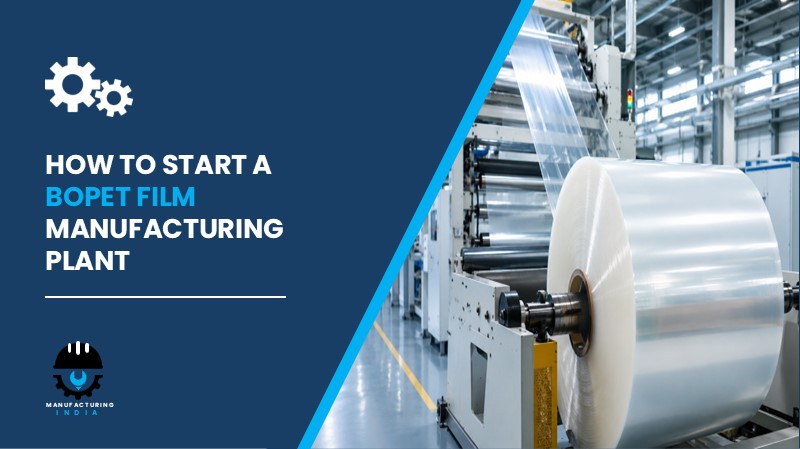
A BOPET film manufacturing plant setup in India presents a compelling investment case for entrepreneurs targeting the flexible packaging landscape. Biaxially Oriented Polyethylene Terephthalate (BOPET) film is a high-performance polyester film that serves the flexible packaging industry, the food and beverage sector, pharmaceutical and healthcare packaging, the electrical and electronics industry, and industrial laminates and insulation materials. Rising demand for flexible packaging, growth in food and beverage consumption, expansion of pharmaceutical and personal care packaging, increasing use of high-performance films in electronics and insulation, and the shift toward lightweight, high-barrier, recyclable materials are collectively driving strong momentum for this venture.
India’s packaging and industrial sectors continue to see active investment, as reflected in recent developments in this space. Domestic manufacturers such as Dhunseri Poly Films and Cosmo Films are expanding capacity and product portfolios to meet rising demand from packaging, industrial, and specialty segments. Against a global market volume at 8.49 Million Tons in 2025 and projected to reach 11.03 Million Tons by 2034 at a CAGR of 3.0%, a new production unit is strategically positioned to capture this expanding demand base while serving both domestic and export markets.
This investment combines steady demand from flexible packaging, food and beverage, pharmaceutical, and electronics sectors with gross margins of 20-30% and net margins of 8-12%, supported by active industry investment and a scalable production model suited to long-term break-even viability.
What is a BOPET Film?
BOPET film is a high-performance polyester film manufactured by stretching PET resin in both machine and transverse directions, creating a biaxial orientation. This process significantly enhances mechanical strength, dimensional stability, clarity, and chemical resistance while improving barrier properties against moisture, gases, and oils. Owing to these characteristics, it is widely used across packaging, electrical insulation, imaging, and industrial applications, offering excellent thermal stability, high tensile strength, and durability for demanding environments.
The film is available in various grades, including plain, coated, metallized, heat-sealable, and specialty functional variants, allowing the facility to meet diverse end-use requirements. The primary production method is biaxial stretching, beginning with PET resin drying and feeding, followed by extrusion and melt filtration, flat die casting, longitudinal stretching, transverse stretching, heat setting, surface treatment or coating, slitting, inspection, and roll packaging. End-use industries served include flexible packaging, food and beverage, pharmaceutical and healthcare packaging, electrical and electronics, and industrial laminates and insulation materials.
Cost of Setting Up a BOPET Film Manufacturing Plant in India
Cost depends on capacity, technology, location, automation level, and regulatory compliance requirements.
1. Capital Expenditure (CapEx)
Land and site development form a foundational cost component, and investors can evaluate industrial estates or dedicated economic zones to reduce compliance timelines. Civil works cover the production shed, quality control laboratory, storage areas, and administrative block.
Machinery and equipment represent the largest share of capital investment for a BOPET film manufacturing plant. Key machinery required includes:
- Resin dryers
- Extruders
- Flat dies
- Stretching units
- Heat-setting ovens
- Coating systems
- Slitting machines
- Quality inspection systems
Other capital costs include effluent treatment plant (ETP) installation, pre-operative and commissioning expenses, and applicable import duties on specialized machinery sourced internationally.
Request a Sample Report for In-Depth Market Insights: https://www.imarcgroup.com/bopet-film-manufacturing-plant-project-report/requestsample
2. Operational Expenditure (OpEx)
Raw material cost is the single largest component of operating expenditure for a BOPET film manufacturing plant, with PET resin, along with additives such as slip agents and anti-block agents, accounting for approximately 75-85% of total OpEx. Investors are advised to negotiate long-term supplier contracts to stabilize pricing and secure consistent supply.
Utility costs, covering electricity, water, and steam, account for approximately 10-15% of operating expenditure. Other operating costs include transportation, packaging, salaries and wages, maintenance, depreciation, and taxes, all of which are factored into the overall income and expenditure projections prepared for the plant. By the fifth year, total operational cost is expected to rise substantially due to inflation, market fluctuations, potential increases in feedstock cost, supply chain disruptions, and rising demand, and investors should build these variables into long-term financial planning rather than relying on first-year assumptions alone.
3. Plant Capacity
A BOPET film manufacturing plant is typically designed with an annual capacity ranging between 30,000 and 60,000 MT, enabling economies of scale while maintaining operational flexibility. Capacity can be customized based on individual investor requirements, and profitability generally improves with higher capacity utilization.
4. Profit Margins and Financial Projections
Financial projections for a BOPET film manufacturing plant are developed based on capital investment, operating costs, production capacity utilization, pricing trends, and demand outlook, and typically include net present value (NPV), internal rate of return (IRR), and payback period calculations. The project demonstrates healthy profitability potential under normal operating conditions, with gross profit margins of 20-30% and net profit margins of 8-12%.
Why Set Up a BOPET Film Plant in India?
Rising Demand for Flexible Packaging: Growth in packaged food, beverages, and consumer goods is driving strong demand, directly supporting higher capacity utilization for a new unit.
Superior Material Properties: High tensile strength, clarity, thermal resistance, and barrier performance make the film suitable for demanding industrial and packaging applications across multiple end-use sectors.
Expanding End-Use Industries: Increasing applications in electronics, renewable energy, and pharmaceuticals are broadening the demand base, which a new facility can capture through its range of functional film grades.
Active Industry Investment: In January 2026, Dhunseri Poly Films placed an order for what it says is the world’s fastest BOPET line, capable of speeds up to 700 meters per minute, to expand its polyester film production capacity and meet rising demand from packaging, industrial, and specialty film segments. In December 2025, Cosmo Films launched a new range of pet food packaging films in India, including BOPP, CPP, and BOPET variants designed for moisture and oxygen protection.
Strategic Site and Supply Chain Advantages: Selecting a site close to raw material suppliers and target markets helps minimize distribution costs. Sourcing PET resin and additives from nearby, reliable suppliers under long-term contracts further supports supply chain stability.
Manufacturing Process – Step by Step
The BOPET film manufacturing process uses biaxial stretching as its primary method:
- PET Resin Drying and Feeding: Resin is dried and fed into the extrusion system to remove moisture before processing.
- Extrusion and Melt Filtration: The dried resin is melted and filtered to remove impurities.
- Flat Die Casting: The molten polymer is cast into a flat, uncured film sheet.
- Longitudinal Stretching: The cast film is stretched in the machine direction to enhance strength.
- Transverse Stretching: The film is stretched in the transverse direction, completing biaxial orientation.
- Heat Setting: The stretched film is heat-set to stabilize its dimensions and properties.
- Surface Treatment or Coating: The surface is treated to enhance functional properties.
- Slitting: The finished film is slit into rolls of required widths.
- Inspection: Quality inspection systems check for defects and consistency.
- Roll Packaging: Finished rolls are packaged and dispatched to flexible packaging, food and beverage, pharmaceutical, and electrical and electronics customers.
Key Applications
The facility serves a broad set of industries through diverse film grades and functional coatings.
- Food and Beverage Packaging: High barrier, strength, and shelf-life protection for flexible packaging.
- Pharmaceutical and Healthcare Packaging: Ensures product safety, moisture resistance, and chemical stability.
- Electrical and Electronics: Used as insulation film for excellent dielectric properties.
- Industrial and Specialty Applications: Applied in laminates, imaging, solar panel back sheets, and protective films.
- Printing, Lamination and Magnetic Media: Used for high-clarity printing, lamination, and as a base film in magnetic recording products.
Leading Manufacturers
Leading manufacturers in the global BOPET film industry include:
- Jindal Poly Films Limited
- Uflex Ltd.
- SRF Limited
- Mitsubishi Polyester Film, Inc.
- Futamura Chemical Co. Ltd.
- RETAL Industries Ltd.
- Fatra A.S
Timeline to Start the Plant
Setting up production typically follows a phased sequence, from initial planning through to commercial launch:
- Feasibility study and project report preparation
- Land acquisition and site development
- Regulatory approvals and environmental clearances
- Factory licence and fire safety compliance
- Machinery procurement and installation
- Raw material supplier agreements and supply chain setup
- Trial production and quality testing
- Commercial production launch
Licences and Regulatory Requirements
Starting a BOPET film manufacturing unit in India requires several approvals across business, environmental, and safety categories before commercial operations can begin:
- Business registration (Proprietorship, LLP, or Pvt Ltd)
- Factory Licence under the Factories Act
- Environmental Clearance from State Pollution Control Board
- GST Registration
- Fire Safety NOC
- Effluent Treatment Plant (ETP) operational clearance
- Occupational Health and Safety compliance
Key Challenges to Consider
High Capital Requirements: Machinery costs, particularly for extrusion, stretching, and heat-setting lines used in the BOPET film manufacturing process, account for the largest share of total capital expenditure.
Raw Material Price Volatility: PET resin and additives make up 75-85% of operating expenditure, making the unit sensitive to feedstock price fluctuations.
Regulatory Compliance: Environmental clearances, effluent treatment requirements, and safety protocols must be maintained throughout production.
Technology and Innovation Pressure: Competitors are investing in higher-speed lines, such as Dhunseri Poly Films’ 700 meters-per-minute BOPET line announced in January 2026, raising the bar for operational efficiency.
Competition: Established players including Jindal Poly Films Limited, Uflex Ltd., SRF Limited, and Mitsubishi Polyester Film, Inc. hold significant capacity and diverse application portfolios.
Skilled Manpower: Operating advanced extrusion, stretching, and coating equipment requires trained technical staff, a key part of project economics.
Frequently Asked Questions
1. How much does it cost to set up a BOPET film manufacturing plant in India?
Cost depends on capacity, technology, location, automation, and regulatory compliance, covering land, civil works, machinery, and other capital costs.
2. Is BOPET film manufacturing profitable in India in 2026?
Yes, it demonstrates healthy profitability potential, with gross profit margins of 20-30% and net profit margins of 8-12% under normal operating conditions.
3. What machinery is required for a BOPET film plant in India?
Key machinery includes resin dryers, extruders, flat dies, stretching units, heat-setting ovens, coating systems, slitting machines, and quality inspection systems.
4. What licences and approvals are required to start a BOPET film plant in India?
Requirements include business registration, a Factory Licence, Environmental Clearance, GST Registration, Fire Safety NOC, ETP clearance, and Occupational Health and Safety compliance.
5. What raw materials are needed for BOPET film manufacturing?
The primary raw material is PET resin, along with additives such as slip agents and anti-block agents.
6. What are the environmental compliance requirements for a BOPET film plant in India?
Requirements include Environmental Clearance from the State Pollution Control Board, an operational Effluent Treatment Plant, and adherence to emission and safety monitoring standards.
7. What is the best location to set up a BOPET film plant in India?
Sites should offer proximity to raw material suppliers, access to target markets to minimize distribution costs, and robust infrastructure including transportation, utilities, and waste management systems.
8. What is the break-even period for this type of plant in India?
The break-even period is determined through payback period analysis within the project’s financial projections, based on capital investment, operating cost assumptions, and achieved capacity utilization over the initial years of operation.
9. What government incentives are available for manufacturers in India?
Investors should evaluate applicable regulatory and compliance frameworks, including factory licensing and environmental clearance processes, when planning the facility.
Key Takeaways for Investors
This BOPET film manufacturing plant offers a strong investment opportunity, driven by demand from flexible packaging, food and beverage, pharmaceutical and healthcare, and electrical and electronics sectors. Financial viability is supported across the proposed capacity range of 30,000-60,000 MT annually, with gross margins of 20-30% and net margins of 8-12%. The global market, volumed at 8.49 Million Tons in 2025 and projected to reach 11.03 Million Tons by 2034 at a CAGR of 3.0%, points to sustained long-term demand. With active investment from players such as Dhunseri Poly Films and Cosmo Films, the outlook for this manufacturing process in India remains positive.
About the Author