Introduction
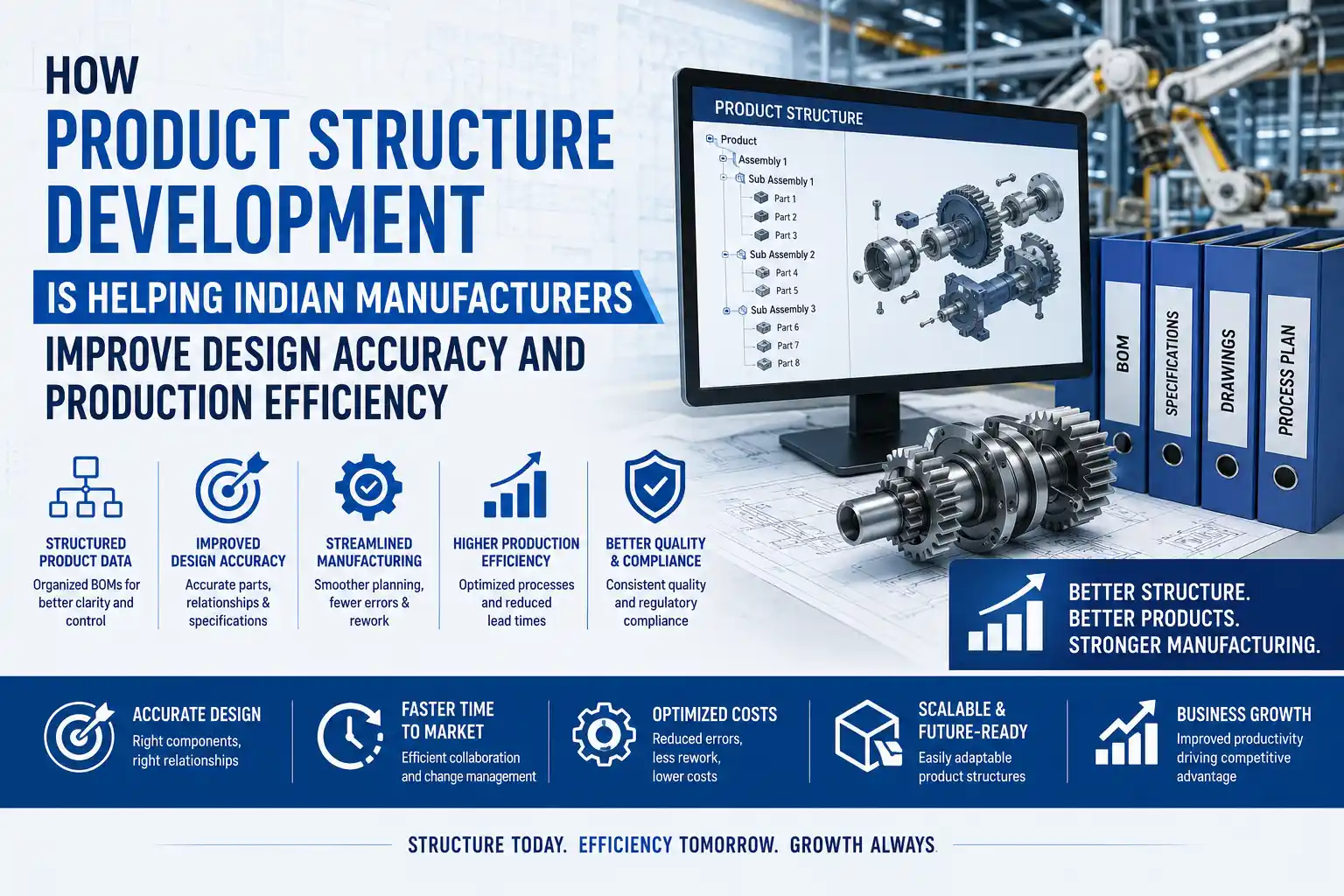
As Indian manufacturers scale production, manage increasing product variants, and serve more demanding quality requirements, maintaining accurate engineering data becomes critical. Product structure development creates a structured link between product architecture, bills of materials (BOMs), CAD data, tolerances, and manufacturing processes, enabling smoother transition from design to production.
A well-structured product architecture enables manufacturers to move from prototype development to repeatable, accurate commercial production. It improves collaboration across engineering and manufacturing teams, strengthens design consistency, and ensures products can be assembled correctly, every time, at scale.
Why Product Structure Development Is Becoming Critical for Indian Manufacturers
Several data points make the case for structured product development as India’s manufacturing base scales and formalises:
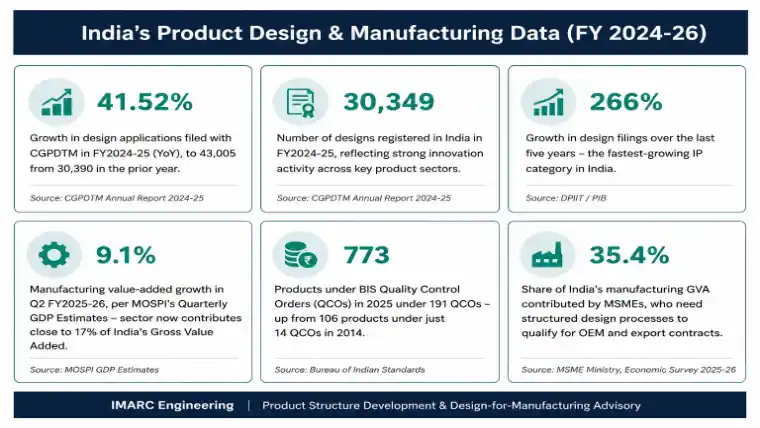
- Manufacturing growth: Manufacturing value added grew 9.1% in Q2 FY2025-26, per MOSPI’s quarterly GDP estimates, and the sector now contributes close to 17% of India’s Gross Value Added.
- Design filings surging: Design applications filed with the Patent Office rose 41.52% in FY2024-25 to 43,005, with 30,349 designs registered, per the CGPDTM Annual Report 2024-25.
- Fastest-growing IP category: Design filings have grown 266% over the past five years the fastest-growing category among all IP filings in India, per DPIIT/PIB data.
- PLI-linked investment: The Production Linked Incentive scheme carries a ₹1.97 lakh crore outlay across 14 sectors; cumulative investment crossed ₹2.16 lakh crore with 836 applications approved as of December 2025, per PIB.
- Rising conformity requirements: BIS Quality Control Orders now cover 773 products under 191 QCOs in 2025, up from 106 products under just 14 QCOs in 2014 each requiring manufacturers to demonstrate compliance with defined product quality and testing standards.
- MSME dependency: MSMEs contribute 35.4% of India’s manufacturing GVA, per the MSME Ministry and Economic Survey 2025-26, and increasingly need structured design processes to qualify for OEM and export contracts.
Product structure development is no longer simply an engineering exercise. It determines whether a product can be manufactured accurately, certified against applicable standards, and scaled without costly redesigns or repeated qualification cycles.
What Happens When Product Structure Is Weak
Weak product structures often remain hidden during early design reviews and become visible only during prototyping, production, or supplier scaling:
- Design-manufacturing mismatch: CAD models that don’t reflect shop-floor tolerances lead to fitment failures at assembly.
- Uncontrolled BOM versions: Multiple “final” bills of materials in circulation cause wrong-part builds and inventory errors.
- Tolerance stack-up errors: Undocumented GD&T leads to parts that pass individual inspection but fail at assembly.
- Change management gaps: Engineering changes implemented on the floor without a formal ECN/ECO record, breaking traceability.
- Supplier data inconsistency: Vendors working from outdated drawings or specifications can produce components that fail quality requirements.
- Scale-up failure: A structure built for prototype quantities collapses once production volume increases.
Key Areas Where Product Structure Development Improves Design and Manufacturing Accuracy
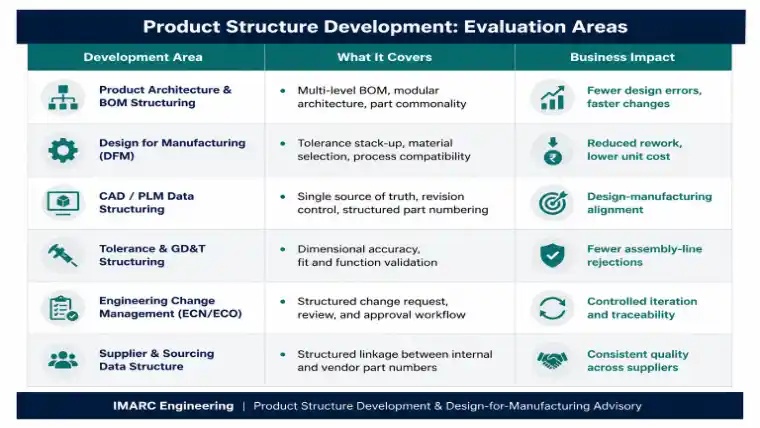
A credible product structure development process addresses six interconnected areas. Weakness in any one of them can undermine an otherwise sound design.
1. Product Architecture and Modular BOM Structuring
- Multi-level BOM aligned to how the product is actually built, not just how it was designed
- Modular architecture separating common, variant, and custom components
- Clear part numbering and revision logic traceable across engineering and production
2. Design for Manufacturing (DFM) Integration
- Material and process compatibility checked at the design stage, not after tooling is committed
- Tolerance stack-up analysis performed before parts reach the shop floor
- Elimination of features that are difficult or costly to manufacture at scale
3. CAD/PLM Data Structuring
- A single source of truth for design data across engineering, quality, and procurement
- Structured revision control that prevents outdated drawings from reaching production
- Linked documentation between 3D models, drawings, and specifications
4. Tolerance and GD&T Structuring
- Geometric dimensioning and tolerancing applied consistently across the assembly
- Fit and function validated through structured tolerance stack-up before production
- Fewer assembly-line rejections caused by undocumented tolerance conflicts
5. Engineering Change Management (ECN/ECO Structuring)
- A formal change request, review, and approval workflow
- Impact assessment across BOM, suppliers, and tooling before a change is released
- Full traceability of what changed, when, and why
6. Supplier and Sourcing Data Structuring
- Structured linkage between internal part numbers and supplier part numbers
- Consistent specification sharing across multiple vendors for the same component
- Reduced variation in incoming part quality across the supply base
Government Support for Design-Led Manufacturing in India
India’s manufacturing ecosystem is increasingly encouraging structured product development through design support programmes, quality initiatives, and production-linked incentives. These initiatives help manufacturers strengthen engineering processes, improve product quality, and accelerate commercial production.
- Design Clinic Scheme (Ministry of MSME): Funding support of up to 75% for design projects, with project funding of ₹15 lakh to ₹40 lakh per intervention, implemented through the National Institute of Design.
- PLI Scheme: ₹1.97 lakh crore outlay across 14 sectors, directly rewarding manufacturers with disciplined, scalable production structures.
- MSME Sustainable (ZED) Certification: Reimbursement of up to 75% of certification cost (capped at ₹50,000), with additional subsidy of 80% for micro, 60% for small, and 50% for medium enterprises.
- BIS Quality Control Orders: 191 QCOs now cover 773 products requiring standard-linked design and process conformity, up from just 14 QCOs in 2014.
How IMARC Engineering Supports Product Structure Development
IMARC Engineering supports manufacturers, OEMs, and product companies in developing structured product architectures that improve design control, manufacturing accuracy, and production scalability. Our approach connects engineering data, manufacturing requirements, and supplier specifications to create a reliable foundation for commercial production.
Contact IMARC Engineering’s team for product structure development and design-for-manufacturing support across India: https://www.imarcengineering.com/contact?service=bill-of-materials-preparation
Conclusion
As manufacturing becomes more complex, accurate product structures are becoming essential for reducing engineering errors, improving collaboration, and achieving consistent production quality. By integrating product architecture, BOM management, CAD data, and manufacturing requirements, companies can create a stronger foundation for scalable and reliable product development.
Frequently Asked Questions
What is product structure development?
Product structure development is the process of organising a product’s design data parts, assemblies, tolerances, and bills of materials into a structure that engineering, quality, and manufacturing teams can use consistently.
Why does product structure affect manufacturing accuracy?
If the BOM, CAD data, and tolerances are not structured consistently, manufacturing teams work from incomplete or conflicting information, which leads to fitment errors, rework, and inconsistent output.
What is Design for Manufacturing (DFM)?
DFM is the practice of evaluating a design for manufacturability material choice, tolerances, and process compatibility before tooling and production begin.
How does BOM structuring reduce production errors?
A structured, multi-level BOM aligned to actual build sequence reduces the chance of wrong-part builds, version conflicts, and inventory mismatches.
What role does GD&T play in structured product design?
Geometric dimensioning and tolerancing ensure that individual part tolerances, when combined during assembly, produce components that fit and function as intended.
How long does a product structure assessment take?
Timelines vary with product complexity, but a structured assessment covering BOM, CAD data, tolerances, and change management typically takes two to six weeks.
Can IMARC Engineering help with product structure development in India?
Yes. IMARC Engineering supports product architecture assessments, DFM reviews, PLM/data structuring, tolerance audits, change management setup, and supplier data alignment across India.
IMARC Engineering
Product Structure Development | Design-for-Manufacturing | CAD/PLM Data Structuring | Tolerance & GD&T Audits
Contact Us:
IMARC Engineering
Phone: +91-120-433-0800
Email: sales@imarcengineering.com
India: C-130, Sector 2, Noida, Uttar Pradesh 201301
LinkedIn: https://www.linkedin.com/showcase/imarc-engineering/
About the Author