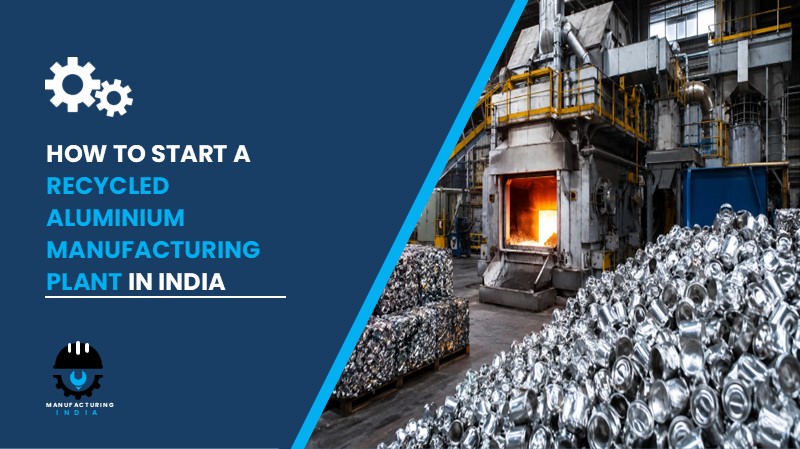
Setting up a recycled aluminium manufacturing plant in India is a compelling investment opportunity for entrepreneurs in India entering a sustainability-driven metals segment. Demand is pulled forward by the automotive, construction and infrastructure, packaging, electrical and electronics, and consumer durables sectors, all of which rely on secondary aluminium for lighter, cost-efficient, lower-emission products. The material keeps nearly all the physical and chemical properties of primary aluminium while consuming far less energy to produce, which is why manufacturers increasingly prefer it. This makes it critical to India’s broader push toward resource efficiency and circular economy practices.
India’s rapid urbanisation, expanding infrastructure, and the Make in India initiative all support domestic production. Growth in automotive manufacturing, construction, and packaging consumption creates a steady base of demand for ingots, billets, sheets, extrusions, and cast components. Combined with the lower energy footprint of secondary aluminium processing versus primary smelting, India is a strategically sound location for this type of unit.
This investment benefits from strong policy support around sustainability and circular economy goals, cost-competitive production driven by significantly lower energy requirements than primary aluminium, and steady demand from the automotive, construction, packaging, and electrical sectors. With gross margins in the 15-25% range and net margins of 5-10%, this type of plant offers a financially viable and scalable investment opportunity with a realistic path to break-even.
What is Recycled Aluminium?
This material is defined as aluminium that is smelted, remelted, and reused from scrap generated by industrial waste, consumer products, and end-of-life materials. Main scrap sources include beverage cans, car parts, building materials, and wires. Recycling involves sorting, shredding, cleaning, and melting before the material is drawn into ingots, billets, or molten metals for reuse. Output from the plant retains nearly all the physical and chemical properties of primary aluminium while requiring far less energy, making it attractive for manufacturers seeking efficiency and sustainability. It supports circular economy projects, reduces landfill waste, and lowers greenhouse gas emissions compared with primary production.
The recycled aluminium manufacturing process includes scrap collection and sorting, shredding and decoating, melting and alloying, casting, finishing, quality inspection, and storage. Owing to its flexibility, this material is drawn upon by automotive manufacturing, construction and infrastructure, packaging, electrical and electronics, and consumer durables industries, which use the output as ingots, billets, sheets, extrusions, cast components, and secondary alloy products.
Cost of Setting Up a Recycled Aluminium Manufacturing Plant in India
The cost of setting up this facility depends on capacity, technology, location, automation level, and regulatory compliance requirements specific to India.
1. Capital Expenditure (CapEx)
Capital expenditure begins with land and site development, which can be pursued through an SEZ, dedicated industrial estate, or a standalone site. This covers land registration, boundary development, and related charges forming a substantial part of the overall investment. Civil works follow, covering the production shed, quality-testing laboratory, storage areas, and the administrative block. Machinery costs account for the largest portion of total capital expenditure. Key machinery required includes:
- Scrap shredders
- Decoating systems
- Reverberatory or rotary furnaces
- Casting machines
- Filtration units
- Emission control systems
Other capital costs include effluent treatment systems, pre-operative expenses, commissioning costs, and applicable import duties on specialised equipment.
Request a Sample Report for In-Depth Market Insights: https://www.imarcgroup.com/recycled-aluminium-manufacturing-plant-project-report/requestsample
2. Operational Expenditure (OpEx)
Raw material cost is the largest driver of operating expenditure, with aluminium scrap, fluxes, alloying elements, and furnace fuel accounting for approximately 80-85% of total OpEx. Investors are advised to secure long-term supplier contracts to mitigate price volatility. Utility costs, covering electricity, water, and steam, make up roughly 10-15% of operating expenditure. Other operating costs include transportation, packaging, salaries, maintenance, depreciation, and taxes. By the fifth year, total operational cost is expected to rise substantially due to inflation, market fluctuations, supply chain disruptions, and shifts in the global economy.
3. Plant Capacity
This type of unit is typically designed with an annual production capacity ranging between 50,000 and 100,000 MT, enabling economies of scale while maintaining operational flexibility. Capacity can be customised according to individual investor requirements, and profitability generally improves as capacity utilisation increases.
4. Profit Margins and Financial Projections
Financial projections are built on capital investment, operating costs, capacity utilisation, pricing trends, and demand outlook, covering net present value (NPV), internal rate of return (IRR), payback period, and profit and loss projections. Gross profit margins typically range between 15-25%, while net profit margins fall between 5-10%, supported by stable demand and value-added applications.
Why Set Up a Recycled Aluminium Plant in India?
Energy Efficiency Advantage: Producing secondary aluminium consumes 95-98% less energy than producing aluminium from raw materials, which translates directly into lower operating costs for the plant. This efficiency advantage is a core reason manufacturers prefer secondary aluminium over primary production.
Strong Sustainability Demand: Environmental regulations and corporate sustainability targets continue to provide strong, steady demand for recycled metal solutions. This regulatory and corporate push supports long-term offtake for secondary aluminium output.
Growing End-Use Industries: The automotive, construction, and packaging sectors are all expanding, keeping demand for secondary aluminium products steady across ingots, billets, sheets, and cast components.
Circular Economy Alignment: Aluminium recycling supports waste reduction, material recovery, and long-term resource efficiency, aligning production with India’s broader sustainability and circular economy priorities.
Active Industry Investment: In May 2025, CMR Green Technologies Ltd. announced a strategic investment and joint venture with Japan’s Nippon Light Metal Company Limited aimed at advancing aluminium recycling technology and improving the quality of recycled aluminium billets. Separately, in November 2025 at COP30, the International Aluminium Institute reported that aluminium beverage cans reached a global recycling rate of 75% in 2023, advancing the Global Beverage Can Circularity Alliance’s 80% target by 2030.
Scalable Industrial Operations: Modular furnace systems give manufacturers the flexibility to increase or decrease production based on market demand and scrap availability, supporting a plant that can grow alongside India’s industrial base.
Manufacturing Process – Step by Step
The recycled aluminium manufacturing process uses scrap collection, shredding, melting, and casting as the primary production stages within a recycled aluminium manufacturing plant. The process proceeds as follows:
- Scrap Collection and Sorting: Aluminium scrap is collected from sources such as beverage cans, car parts, building materials, and wires, then sorted by grade and alloy type.
- Shredding and Decoating: Sorted scrap is shredded and passed through decoating systems to remove coatings, paints, and contaminants before melting.
- Melting and Alloying: Cleaned scrap is melted in reverberatory or rotary furnaces and alloyed to achieve the required composition.
- Casting: Molten aluminium is cast into ingots, billets, or other semi-finished forms using casting machines.
- Finishing: Cast products undergo finishing operations to meet dimensional and surface quality requirements.
- Quality Inspection: Finished products pass through quality inspection using filtration units and emission control systems to ensure compliance with industry standards.
- Storage and Dispatch: Finished ingots, billets, sheets, extrusions, and cast components are stored before being dispatched to automotive, construction, packaging, electrical, and consumer durables customers.
Key Applications
This material serves a wide range of end-use industries that depend on secondary aluminium for lightweight, cost-efficient, and recyclable materials.
- Automotive Industry: These alloys support the design of lighter vehicles, improving fuel efficiency and reducing emissions across car bodies and engine parts.
- Construction and Infrastructure: Aluminium’s corrosion resistance and durability make it widely used in windows, doors, roofing, and other structural applications.
- Packaging Industry: This material is a main ingredient in beverage cans, foils, and containers due to its recyclability and cost efficiency.
- Electrical and Consumer Goods: Conductors, cables, appliances, and electronic housings use this material for its conductivity and lightweight properties.
Leading Manufacturers
The global industry for this material includes several multinational companies with extensive production capacities and diverse application portfolios. Key players include:
- Speira GmbH
- Matalco Inc.
- Novelis Inc.
- Raffmetal
- Norsk Hydro ASA
Timeline to Start the Plant
- Feasibility study and project report preparation
- Land acquisition and site development
- Regulatory approvals and environmental clearances
- Factory licence and fire safety compliance
- Machinery procurement and installation
- Raw material supplier agreements and supply chain setup
- Trial production and quality testing
- Commercial production launch
Licences and Regulatory Requirements
Starting a recycled aluminium manufacturing unit in India requires several approvals:
- Business registration (Proprietorship, LLP, or Pvt Ltd)
- Factory Licence under the Factories Act
- Environmental Clearance from State Pollution Control Board
- GST Registration
- Fire Safety NOC
- Effluent Treatment Plant (ETP) operational clearance
- Occupational Health and Safety compliance
Key Challenges to Consider
High Capital Requirements: Machinery costs for furnaces, shredders, and emission control systems account for the largest share of capital expenditure, requiring substantial upfront investment.
Raw Material Price Volatility: Aluminium scrap, fluxes, alloying elements, and furnace fuel prices can fluctuate, and since raw materials represent 80-85% of OpEx, price swings directly affect margins.
Regulatory Compliance: Environmental clearances, effluent treatment requirements, and emission control standards demand ongoing attention.
Competition: Established global players such as Speira GmbH, Matalco Inc., Novelis Inc., Raffmetal, and Norsk Hydro ASA operate with extensive capacities, creating a competitive landscape for new entrants.
Skilled Manpower: Operating furnaces, casting machines, and inspection systems requires trained personnel, and building this workforce takes time.
Frequently Asked Questions
1. How much does it cost to set up a recycled aluminium manufacturing plant in India?
The total capital investment depends on plant capacity, technology, automation level, and location, and covers land and site development, civil works, machinery (scrap shredders, decoating systems, furnaces, casting machines, filtration units, and emission control systems), and other capital costs such as pre-operative and commissioning expenses. Exact cost figures vary by project scope; detailed CapEx breakdowns are available on request.
2. Is recycled aluminium manufacturing profitable in India in 2026?
Yes. The business model shows healthy profitability potential, with gross profit margins typically ranging between 15-25% and net profit margins between 5-10%, supported by stable demand from the automotive, construction, packaging, electrical, and consumer durables sectors and the significantly lower energy costs of secondary aluminium production compared with primary smelting.
3. What machinery is required for a recycled aluminium plant in India?
Key machinery includes scrap shredders, decoating systems, reverberatory or rotary furnaces, casting machines, filtration units, and emission control systems. Equipment must be corrosion-resistant and comply with industry standards for safety, efficiency, and reliability.
4. What licences and approvals are required to start a recycled aluminium plant in India?
Setting up the unit requires business registration (Proprietorship, LLP, or Pvt Ltd), a Factory Licence under the Factories Act, Environmental Clearance from the State Pollution Control Board, GST Registration, a Fire Safety NOC, Effluent Treatment Plant (ETP) operational clearance, and Occupational Health and Safety compliance.
5. What raw materials are needed for recycled aluminium manufacturing?
The primary raw materials are aluminium scrap, fluxes, alloying elements, and furnace fuel. Aluminium scrap is sourced mainly from beverage cans, car parts, building materials, and wires, and together these raw materials account for approximately 80-85% of total operating expenditure.
6. What are the environmental compliance requirements for a recycled aluminium plant in India?
The plant must have effluent treatment systems to minimise environmental impact, emission control systems to manage air pollutants from furnace operations, advanced monitoring systems to detect leaks or process deviations, and Environmental Clearance from the State Pollution Control Board, along with adherence to emission standards throughout production.
7. What is the best location to set up a recycled aluminium plant in India?
The site should offer easy access to key raw materials such as aluminium scrap, fluxes, alloying elements, and furnace fuel, along with proximity to target markets to minimise distribution costs. Robust infrastructure — reliable transportation, utilities, and waste management systems — along with compliance with local zoning laws and environmental regulations are essential site-selection criteria. Options such as SEZs or industrial estates can also be considered.
8. What is the break-even period for this type of plant in India?
The break-even period depends on capacity utilisation, pricing trends, and demand outlook, and is calculated as part of the financial analysis covering net present value (NPV), internal rate of return (IRR), and payback period. Profitability improves as capacity utilisation increases, which shortens the path to break-even.
9. What government incentives are available for manufacturers in India?
Government support for the sector centres on policies, extended producer responsibility frameworks, and investments in scrap collection infrastructure that back metal recycling. Since aluminium recycling directly supports circular economy and decarbonisation goals, it aligns with broader sustainability-linked manufacturing initiatives such as Make in India.
Key Takeaways for Investors
This investment taps into steady demand from India’s automotive, construction and infrastructure, packaging, electrical, and consumer durables sectors, all of which depend on secondary aluminium for cost-efficient and lower-emission products. Financial viability holds across capacities, with gross margins of 15-25% and net margins of 5-10% supporting a scalable case from smaller units up to facilities in the 50,000-100,000 MT range. The global market for this material, valued at USD 54.46 Billion in 2025, is projected to reach USD 94.39 Billion by 2034 at a CAGR of 6.3%, reflecting sustained global demand growth. With automotive manufacturers and recycling bodies actively investing in improved technology and higher recycling rates, demand for this output is set to remain strong for years to come.
About the Author