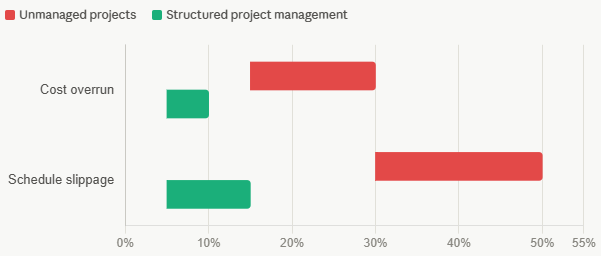
A typical greenfield manufacturing project in India takes 18 to 36 months from site finalisation to operational handover, and pharmaceutical and food processing facilities, which carry the heaviest compliance load, often sit at the upper end of that range. With no existing infrastructure to build around, every greenfield project starts fresh across land conversion, environmental clearance, utility installation, and equipment commissioning, which is exactly why unmanaged greenfield builds report cost overruns of 15 to 30% and schedule slippage of 30 to 50% against original plans.
What Sets Greenfield Projects Apart
Unlike brownfield expansions, which work within existing structures and utilities, greenfield projects begin on undeveloped land with no legacy constraints and no shortcuts. This gives manufacturers complete design freedom to optimise plant layout, utility routing, and future expansion capacity, but it also means every regulatory clearance, from land conversion to factory plan approval, has to be secured from a standing start. A greenfield project management consultant exists to hold this entire sequence together under one accountable framework, rather than leaving manufacturers to coordinate a dozen separate agencies and contractors on their own.
The Four-Phase Greenfield Delivery Methodology
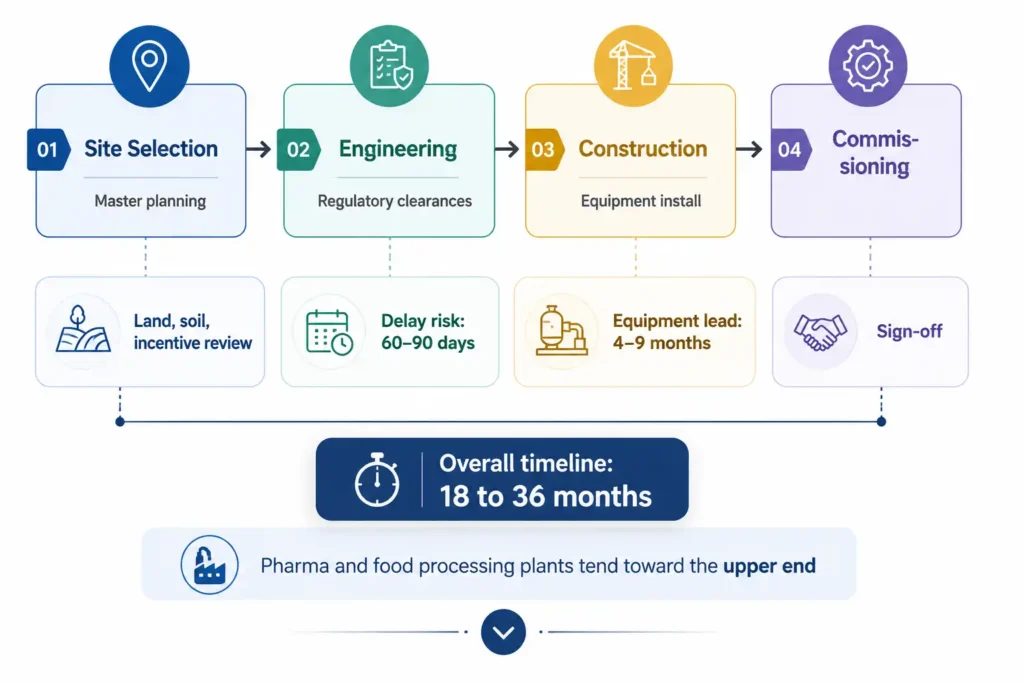
Phase 1: Site Selection and Master Plan Development
Site selection decisions made in the first few months determine a large share of a project’s eventual operating cost and expansion flexibility. A structured evaluation typically weighs:
- Road, rail, and port connectivity relative to raw material sources and target markets
- Power and water availability, including grid capacity and groundwater or municipal supply reliability
- Labour market depth and wage benchmarks specific to the region
- State-level incentive structures, including capital subsidy and stamp duty exemption schemes
- Land title status, soil bearing capacity, and flood or seismic risk exposure
Master planning at this stage sizes the plot for current production needs while reserving capacity for phased expansion, since retrofitting utility and layout constraints after construction begins typically costs several times more than designing for future capacity upfront.
Phase 2: Detailed Engineering and Regulatory Clearances
Greenfield projects in India require a wider and more sequential set of approvals than brownfield expansions. Core clearances include:
- Environmental clearance under the EIA Notification 2006, required before construction begins
- Consent to Establish from the CPCB or the relevant State Pollution Control Board
- Land use conversion approval from state revenue authorities
- Factory plan approval under the Factories Act 1948
- Fire safety NOC conforming to NBC 2016
- IBR approval for pressure systems, where applicable
- Sector-specific clearances, such as CDSCO for pharmaceutical plants, FSSAI for food processing facilities, and PESO for chemical and hazardous material handling operations
Missing the sequencing on any one of these, such as starting civil work before Consent to Establish is granted, can trigger a stop-work order and delay the overall schedule by a full approval cycle, often 60 to 90 days.
Phase 3: Construction and Equipment Installation
This phase runs earthworks, civil construction, utility installation, and equipment delivery in parallel tracks rather than sequentially, which is what compresses greenfield timelines that would otherwise stretch well beyond 36 months. Key coordination priorities during this phase include:
- Sequencing earthworks and foundation work against soil test results and structural design finalisation
- Tracking equipment delivery lead times alongside civil completion, since imported process equipment can carry lead times of 4 to 9 months
- Running utility installation, including power, water, compressed air, and effluent treatment systems, in parallel with civil and structural work
- Maintaining safety and quality oversight across multiple contractor packages working simultaneously on the same site
A mismatch between structural readiness and equipment arrival either idles site crews or forces expensive storage and re-handling, which is why this phase depends on continuous cross-checking between the construction schedule and the procurement timeline.
On-site supervision during this phase typically holds well-managed greenfield builds to schedule slippage of 5 to 15%, compared with the 30 to 50% delays reported on projects without dedicated construction oversight.
Phase 4: Commissioning and Operational Handover
Commissioning includes equipment validation, trial production runs, performance testing against design specifications, and compilation of the documentation package needed for regulatory sign-off. Core activities in this phase typically include:
- Mechanical completion checks and system-by-system equipment validation
- Trial production runs to verify output against design capacity and quality specifications
- Performance testing of utilities, including power, water, and effluent treatment systems, under actual operating loads
- Compilation of as-built drawings, test certificates, and compliance documentation required for regulatory sign-off
- Qualification runs specific to regulated sectors, such as process validation batches for pharmaceutical plants
For pharmaceutical and food processing plants, this phase also includes qualification runs required before CDSCO or FSSAI grants operating licences, and incomplete documentation at this stage is one of the more common reasons operational start-up gets pushed back even after physical construction is finished.
Read Our Latest Guide: https://www.imarcengineering.com/blog/how-to-set-up-a-greenfield-plant-in-india
Site Selection and Regulatory Complexity by Sector
Regulatory and technical complexity varies significantly across manufacturing sectors, which is why sector-specific experience matters as much as general project management capability:
- Pharmaceutical plants require clean room design, HVAC validation, and multi-agency approval spanning CDSCO and often FDA or EMA for export-oriented facilities
- Food and beverage plants require HACCP and FSSAI certification alongside hygienic equipment design and temperature-controlled zone construction
- Chemical and agrochemical plants require PESO clearance, hazardous area classification, and effluent treatment system design before Consent to Operate is granted
- Electronics and semiconductor facilities require cleanroom-grade utilities and precision power and cooling infrastructure not found in standard industrial construction
- Automotive component and assembly plants require materials handling system design and supplier park coordination alongside the core facility build
Cost Control and Risk Management in Greenfield Delivery
Cost discipline on greenfield projects starts at the feasibility stage with bottom-up cost estimation and value engineering, not at contract award. Structured cost management typically includes:
- Detailed cost baselines built by work package, validated through competitive bidding rather than single-source quotes
- Fixed-price contracting wherever technically feasible, to transfer schedule and cost risk to contractors
- Real-time tracking of budget-to-actual variance, with contingency funds released only against verified scope changes
- Formal change management protocols that evaluate every variation claim against original contract scope before approval
Given that unmanaged greenfield projects report cost overruns of 15 to 30%, disciplined cost control typically holds well-managed projects within 5 to 10% of the original budget, a difference that on a large industrial build can represent several crore rupees in avoided overrun.
Risk exposure on greenfield sites is broader than on brownfield expansions, since ground conditions, infrastructure gaps in industrial zones, and multi-agency regulatory coordination are all unknowns until site work begins. Structured risk assessment at the feasibility stage, combined with contingency planning built into the schedule rather than added after a delay occurs, is what keeps these unknowns from compounding into major cost and time overruns later in the project.
Greenfield Project Management Trends in India 2026
Greenfield project delivery in India is being reshaped by the scale of current industrial investment and by new planning and execution tools entering standard practice.
- Surging industrial land demand: The Production Linked Incentive scheme, spanning 14 sectors with a combined outlay exceeding INR 1.97 lakh crore, has driven a wave of new greenfield facilities in semiconductors, electric vehicle components, pharmaceuticals, and specialty chemicals, intensifying competition for serviced industrial land and skilled EPCM talent
- Digital twin-led planning: Plant digital twins are increasingly used during the design phase itself, not only post-commissioning, to validate utility routing and equipment clearances before construction starts, reducing costly field rework
- Prefabrication and modular construction: Structural steel modules and skid-mounted utility packages are being used more widely to compress on-site construction duration, particularly for pharmaceutical and food processing greenfield builds with tight commissioning windows
- State-level single-window clearance systems: A growing number of states are consolidating environmental, factory, and fire approvals under single-window portals, cutting clearance timelines that previously required separate applications to multiple departments
- ESG-linked project financing: IFC Performance Standards and Equator Principles compliance are increasingly built into greenfield design from the outset, since lenders now assess environmental and social safeguards as a routine part of project finance due diligence rather than a closing formality
- Rising preference for EPCM delivery over lump-sum EPC: Owners of complex, first-of-kind greenfield facilities, particularly in semiconductors and battery manufacturing, are increasingly choosing EPCM structures to retain flexibility over evolving technical scope during construction
Benefits of Greenfield Project Management
Structured greenfield project management delivers measurable advantages that extend well beyond basic site coordination:
- Design freedom without legacy constraints: Layouts, utility routing, and process flow can be optimised from a blank slate, rather than compromised by existing structures
- Faster time to production: Parallel-track execution across civil, procurement, and commissioning typically compresses delivery timelines that would otherwise extend well past 36 months on poorly sequenced projects
- Cost predictability: Disciplined baseline costing and change control hold well-managed projects within 5 to 10% of original budget, against 15 to 30% overruns on unmanaged builds
- Regulatory continuity: A single approval tracker spanning environmental, factory, fire, and sector-specific clearances reduces the risk of a stop-work order caused by sequencing errors
- Built-in expansion capacity: Master planning that reserves land and utility headroom for future phases avoids the higher cost of retrofitting capacity after commissioning
- Single point of accountability: An integrated project management framework consolidates site development, design, procurement, and construction oversight, reducing the coordination burden that would otherwise fall on in-house teams managing a dozen separate contractors and agencies
How IMARC Engineering Delivers End-to-End Greenfield Project Success
IMARC Engineering delivers end-to-end greenfield project management across pharmaceuticals, food processing, chemicals, FMCG, medical devices, agrochemicals, automotive, and industrial manufacturing sectors in India. The methodology spans feasibility studies and site selection, detailed engineering and statutory approvals, procurement support and construction supervision, through to commissioning and production readiness, all coordinated under a single accountable delivery framework so manufacturers are not left managing multiple agencies and contractor interfaces independently.
Consult Our Greenfield Project Experts: https://www.imarcengineering.com/contact?service=greenfield-project-management
Conclusion
Greenfield projects offer manufacturers a clean slate, but that same freedom brings a wider set of regulatory, technical, and coordination risks than brownfield expansion. A structured methodology spanning site selection, engineering, construction, and commissioning, backed by disciplined cost and risk control, is what keeps an 18 to 36 month build on schedule and ready for compliant, commercial production.
Contact Us:
IMARC Engineering
Phone: +91-120-433-0800
Email: sales@imarcengineering.com
India: C-130, Sector 2, Noida, Uttar Pradesh 201301
LinkedIn: https://www.linkedin.com/showcase/imarc-engineering/
About the Author