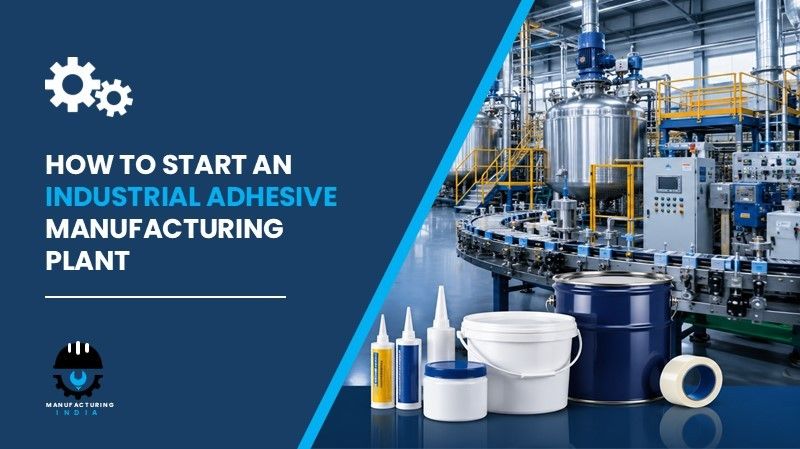
An industrial adhesive manufacturing plant setup in India presents a compelling investment case for entrepreneurs eyeing high-growth industrial input segments. Demand is anchored in construction, automotive manufacturing, and packaging, where these formulations are used for structural bonding, sealing, laminating, assembly fastening, and vibration damping. Built on resin chemistries that steadily displace mechanical fasteners, they distribute stress uniformly, reduce weight, and eliminate rusting, making an industrial adhesive manufacturing plant a strategically relevant addition to India’s industrial base.
India’s advantage stems from rapid urbanisation, infrastructure development, and rising demand for energy-efficient buildings, all of which sustain construction-linked demand. The shift toward electric and lightweight vehicles is pushing automotive usage for structural bonding and thermal management, while e-commerce growth drives packaging demand for fast-setting, high-strength solutions. Recent investments, including Henkel’s Chennai centre and Pune expansion, alongside Tex Year Group’s Maharashtra facility, confirm that India is becoming a strategically sound base for this production.
This investment aligns with construction, automotive, and packaging demand growth, backed by expanding localisation efforts and multinational capacity additions in India. With gross margins of 35-45% and net margins of 15-20% typically achievable, the plant offers cost-competitive, break-even viable economics for investors entering this space.
What is Industrial Adhesive?
Industrial adhesives are chemical bonding agents formulated to join materials, similar or different, primarily through surface adhesion rather than mechanical fastening. Their composition draws on polymer resin blends combined with additives that deliver strength, flexibility, heat resistance, and chemical stability. These properties explain their widespread use across manufacturing industries, since bonded materials achieve uniform stress distribution, lighter assemblies, and no rusting. Formulations are engineered for specific needs, including structural bonding, pressure-sensitive application, hot-melt application, and moisture curing.
Core unit operations include polymer blending, resin compounding, mixing, curing, filtration, and packaging, serving construction, automotive, packaging, and industrial manufacturing as primary end-use industries.
Cost of Setting Up an Industrial Adhesive Manufacturing Plant in India
This cost depends on capacity, technology, location, automation level, and regulatory compliance.
1. Capital Expenditure (CapEx)
Capital investment for the industrial adhesive manufacturing plant covers land acquisition, site preparation, and infrastructure, with options including industrial estates and designated manufacturing zones for faster clearance. Civil works costs cover shed construction, laboratory space, storage, and administrative blocks.
Key machinery required includes:
- High-shear mixers
- Reactors
- Blending tanks
- Filtration units
- Temperature control systems
- Automated filling lines
Machinery costs represent the largest portion of capital expenditure, with the scale of production and automation level determining the final outlay. Other capital costs include land registration, boundary development, and pre-operative and commissioning expenses that prepare the facility for trial production.
Request a Sample Report for In-Depth Market Insights: https://www.imarcgroup.com/industrial-adhesive-manufacturing-plant-project-report/requestsample
2. Operational Expenditure (OpEx)
Raw material cost dominates the operating expenditure structure, with epoxy/polyurethane resins, hardeners, fillers, solvents, and additives accounting for approximately 70-80% of total OpEx. Long-term supplier contracts help mitigate price volatility.
Utility costs, covering electricity, water, and steam, make up around 5-10% of operating expenditure. Other costs include transportation, packaging, salaries, maintenance, depreciation, and taxes. By the fifth year, total operational cost is expected to rise due to inflation, market fluctuations, and material cost increases.
3. Plant Capacity
The proposed industrial adhesive manufacturing plant is designed with an annual capacity ranging between 20,000-50,000 MT, allowing economies of scale while retaining operational flexibility. Capacity can be customised to match investor requirements, and profitability tends to improve as utilisation rises toward the upper end of this range.
4. Profit Margins and Financial Projections
Financial projections are built on capital investment, operating costs, capacity utilisation, pricing trends, and demand outlook, and are used to evaluate ROI, net present value (NPV), and long-term viability. Gross profit margins typically range between 35-45%, supported by stable demand and value-added applications, while net profit margins fall between 15-20%. A detailed financial analysis, including payback period and profit and loss projections, is essential for securing funding before construction begins.
Why Set Up an Industrial Adhesive Plant in India?
Construction-Led Demand Growth: Urbanisation, infrastructure development, and rising demand for energy-efficient buildings continue to drive consumption in flooring systems, insulation panels, wall cladding, and structural bonding applications.
Automotive Lightweighting Trends: The shift toward electric and lightweight vehicles is accelerating usage for structural bonding and thermal management, as manufacturers bond metals, composites, and plastics to improve fuel efficiency and crash performance.
Policy and Infrastructure Support: Construction activity, automotive manufacturing incentives, and industrial localisation programs together stimulate steady demand across India’s manufacturing base.
Cost-Competitive, Localised Production: A regional supply chain cuts down import costs, shortens delivery timelines, and allows for customised formulations for OEMs and contractors.
Active Industry Investment: In February 2025, Henkel inaugurated an Application Engineering Center in Chennai and expanded manufacturing capacity at its Kurkumbh site near Pune. In December 2025, Tex Year Group commenced mass production at its second Maharashtra facility, lifting capacity from 3,400 to 10,000 tons.
Local Supply Chain Preference: Construction, automotive, and packaging companies increasingly favour suppliers who can deliver customised formulations locally, reducing lead times and import dependence for high-volume applications.
Manufacturing Process – Step by Step
The industrial adhesive manufacturing process uses polymer blending, resin compounding, mixing, curing, and filtration as its primary stages.
- Polymer Blending: Base resins are combined to form the foundational adhesive matrix.
- Resin Compounding: Additives are incorporated into the resin base to achieve targeted strength, flexibility, heat resistance, and chemical stability.
- Mixing: High-shear mixers and blending tanks process the compounded formulation to ensure uniform consistency.
- Curing: Reactors and temperature control systems manage the curing behavior required for final performance characteristics.
- Filtration: Filtration units remove impurities to meet the quality assurance criteria required for industrial applications.
- Packaging: Automated filling lines package the finished product for dispatch to construction, automotive, packaging, and industrial manufacturing customers.
Key Applications
Products from an industrial adhesive manufacturing plant serve a range of manufacturing-intensive industries, each relying on distinct bonding performance.
- Construction: Used for flooring systems, insulation panels, wall cladding, and structural bonding, offering durability and reduced installation time.
- Automotive: Supports lightweight vehicle design by bonding metals, composites, and plastics, improving fuel efficiency and crash performance.
- Packaging: Enables high-speed carton sealing, labeling, and flexible packaging lamination with strong adhesion and fast setting times.
- Industrial Manufacturing: Used for equipment assembly, component fixation, and vibration-resistant bonding.
Leading Manufacturers
Key players in the global industry, with extensive production capacities and diverse application portfolios, include:
- Sika AG
- Jowat SE
- Dow Inc.
- 3M Company
- H.B. Fuller Company
- Pidilite Industries Ltd.
- Arkema Group (Bostik)
- Henkel AG & Co. KGaA
- Avery Dennison Corporation
- Illinois Tool Works Inc. (ITW)
Timeline to Start the Plant
The typical path for this plant runs through these phases:
- Feasibility study and project report preparation
- Land acquisition and site development
- Regulatory approvals and environmental clearances
- Factory licence and fire safety compliance
- Machinery procurement and installation
- Raw material supplier agreements and supply chain setup
- Trial production and quality testing
- Commercial production launch
Licences and Regulatory Requirements
Starting an industrial adhesive manufacturing unit in India requires several approvals:
- Business registration (Proprietorship, LLP, or Pvt Ltd)
- Factory Licence under the Factories Act
- Environmental Clearance from State Pollution Control Board
- GST Registration
- Fire Safety NOC
- Hazardous/Chemical compliance for resin and solvent handling
- Effluent Treatment Plant (ETP) operational clearance
- Occupational Health and Safety compliance
Key Challenges to Consider
Investors evaluating an industrial adhesive manufacturing plant should weigh the following factors before committing capital.
High Capital Requirements: Machinery costs, including high-shear mixers, reactors, and automated filling lines, represent a significant share of total capital expenditure.
Raw Material Price Volatility: Hardeners, fillers, solvents, and resin inputs together account for 70-80% of operating expenditure, making the facility sensitive to feedstock price swings.
Regulatory Compliance: Environmental clearances, effluent treatment obligations, and chemical handling regulations require ongoing monitoring and documentation.
Technology and Formulation Pressure: Performance formulation, curing behavior, and compliance with safety standards create a technical barrier that separates leading manufacturers from smaller entrants.
Competition from Established Players: Companies such as Henkel, 3M, Sika, and Pidilite maintain extensive production capacities and diverse application portfolios that new entrants must compete against.
Skilled Manpower: Formulation, quality assurance, and process control functions require trained personnel, and building this workforce takes time.
Frequently Asked Questions
1. How much does it cost to set up an industrial adhesive manufacturing plant in India?
Cost depends on capacity, technology, and location, with machinery forming the largest share of capital expenditure for a facility sized between 20,000-50,000 MT annually.
2. Is industrial adhesive manufacturing profitable in India in 2026?
Yes, gross profit margins of 35-45% and net profit margins of 15-20% are achievable under normal operating conditions.
3. What machinery is required for an industrial adhesive plant in India?
Essential machinery includes high-shear mixers, reactors, blending tanks, filtration units, temperature control systems, and automated filling lines.
4. What licences and approvals are required to start an industrial adhesive plant in India?
Requirements include business registration, a Factory Licence, Environmental Clearance, GST Registration, Fire Safety NOC, and ETP operational clearance.
5. What raw materials are needed for industrial adhesive manufacturing?
Core inputs include epoxy/polyurethane resins, hardeners, fillers, solvents, and additives, together accounting for 70-80% of operating expenditure.
6. What are the environmental compliance requirements for an industrial adhesive plant in India?
Plants must secure Environmental Clearance from the State Pollution Control Board, maintain ETP operations, and comply with hazardous/chemical handling regulations.
7. What is the best location to set up an industrial adhesive plant in India?
Site selection should prioritise proximity to raw material sources, target markets, transportation infrastructure, and utilities.
8. What is the break-even period for this type of plant in India?
Break-even depends on capacity utilisation, pricing trends, and cost structure, calculated as part of the financial analysis covering payback period and net present value.
9. What government incentives are available for manufacturers in India?
Industrial localisation programs and automotive manufacturing incentives support demand and production activity, encouraging investment in domestic capacity.
Key Takeaways for Investors
This investment taps into sustained demand from construction, automotive, and packaging sectors, which rely on adhesives for structural bonding, sealing, and lightweight assembly. Financial viability holds across the 20,000-50,000 MT capacity range, with gross margins of 35-45% and net margins of 15-20% achievable under normal operating conditions. The global market, valued at USD 58.8 Billion in 2025, is projected to reach USD 92.0 Billion by 2034 at a CAGR of 5.1%. With Henkel and Tex Year Group already expanding capacity within India, the outlook for new entrants remains supported by sustained industrial and infrastructure growth.
About the Author