A nickel nitrate production plant setup in India presents a compelling investment case in India as demand strengthens across electroplating, battery manufacturing, ceramics, catalysts, textiles, and electronics – the core industries that consume this versatile inorganic salt. Nickel nitrate serves as a precursor for nickel catalysts and is widely used to apply nickel coatings in electroplating, making it a critical intermediate chemical for India’s expanding industrial base. As battery material research accelerates alongside interest in advanced energy storage systems, nickel compounds are gaining relevance in precursor development, positioning this as a forward-looking investment opportunity.
India’s broader industrial momentum adds further weight to this opportunity. Rising automobile exports, expanding electronics production, and steady growth in specialty chemical consumption support demand for nickel-based intermediates, while government initiatives such as Make in India and advanced chemistry cell incentive programs indirectly strengthen the case for domestic nickel compound production. Given these dynamics, India stands out as a strategically sound base for this investment.
This nickel nitrate production plant investment case rests on stable global demand across electroplating, battery, and catalyst applications, policy support through India’s electrification and chemical localization push, healthy gross margins of 24-32%, and a cost structure where efficient raw material sourcing can materially improve break-even viability.
What is Nickel Nitrate?
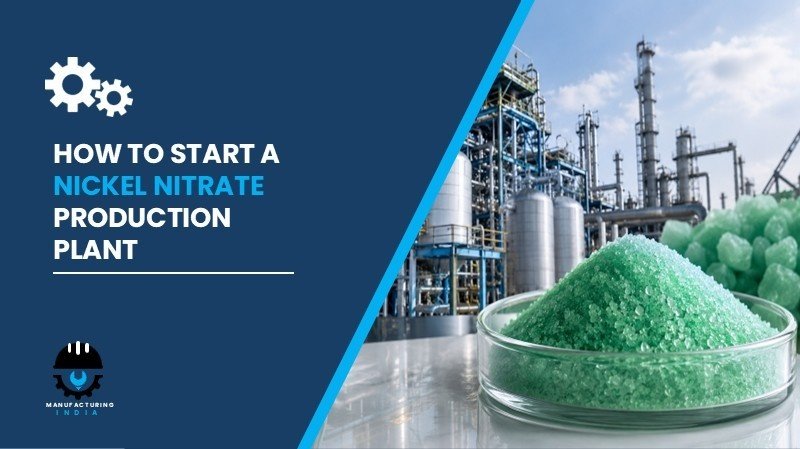
Nickel nitrate hexahydrate, the compound’s typical emerald-green commercial form, is an inorganic, hygroscopic, crystalline salt that is highly soluble in water and ethanol. It acts as a precursor for creating nickel catalysts and is widely applied in electroplating to deposit nickel coatings. Because it is a strong oxidizer, it can accelerate the combustion of other materials, requiring cautious storage. It also serves as a mordant in textile dyeing and is used in ceramic glaze preparation.
The nickel nitrate production process relies on dissolution, purification, crystallization, and drying as its core unit operations. This sequence converts nickel-bearing raw materials into a purified, crystalline end product suitable for industrial use. The plant’s output serves end-use industries including electroplating, battery manufacturing, ceramics, catalysts, textiles, and electronics, reflecting the compound’s broad industrial relevance.
Cost of Setting Up a Nickel Nitrate Production Plant in India
The cost of setting up a nickel nitrate production plant depends on capacity, technology, location, automation level, and regulatory compliance requirements.
1. Capital Expenditure (CapEx)
Machinery costs account for the largest portion of total capital expenditure for a nickel nitrate production plant. Land and site development costs – including land registration and boundary development – form a substantial part of the overall investment, and investors can evaluate notified industrial estates or SEZ zones to streamline approvals. Civil works cover construction of the production shed, quality control laboratory, storage areas, and the administrative block, accommodating the corrosion-resistant equipment the process demands.
Key machinery required includes:
- Ore crushers
- Leaching tanks
- Filtration units
- Neutralization reactors
- Evaporators
- Crystallizers
- Drying ovens
- Packaging machines
Beyond machinery and civil works, other capital costs cover infrastructure and utility connections, effluent treatment plant installation, and pre-operative and commissioning expenses.
Request a Sample Report for In-Depth Market Insights: https://www.imarcgroup.com/nickel-nitrate-manufacturing-plant-project-report/requestsample
2. Operational Expenditure (OpEx)
Raw material consumption drives the bulk of operating costs, with nitric acid alone accounting for approximately 55-65% of total OpEx. The core raw materials – nickel metal/oxide/carbonate, nitric acid, and water – must be sourced from reliable suppliers, with long-term supply contracts recommended to stabilise pricing given the sensitivity of margins to feedstock cost swings.
Utility costs, covering electricity, water, and steam, represent roughly 7-11% of OpEx. Beyond raw materials and utilities, costs also include transportation, packaging, salaries and wages, depreciation, taxes, and maintenance. By the fifth year of operations, total operational cost is expected to rise substantially due to inflation, market fluctuations, and supply chain pressures, so financial planning should build in this escalation from year one.
3. Plant Capacity
The proposed facility is designed around an annual capacity of 3,000 MT, enabling economies of scale while preserving operational flexibility. Capacity can be customised based on individual investor requirements, and profitability generally improves as utilisation rises, since fixed costs are spread across a larger production volume.
4. Profit Margins and Financial Projections
Financial projections for a nickel nitrate production plant are built on capital investment, operating costs, capacity utilisation, pricing trends, and demand outlook, and are used to assess ROI, net present value (NPV), internal rate of return (IRR), and payback period. Gross profit margins for the plant typically range between 24-32%, while net profit margins fall between 13-19%, reflecting healthy profitability potential under normal operating conditions supported by stable demand and value-added applications.
Why Set Up a Nickel Nitrate Plant in India?
Crucial Industrial and Battery Material: Nickel nitrate is an important intermediate chemical used in catalysts, electroplating, ceramics, specialty chemicals, and increasingly in battery precursor materials for EV and energy storage applications, positioning it as a strategic product for electrification ecosystems.
Moderate but Justifiable Entry Barriers: Nickel nitrate production requires stringent purity control, chemical handling expertise, and consistent process quality. Long qualification cycles with industrial and specialty chemical buyers create barriers that favour reliable, technically capable producers.
Megatrend Alignment: The rapid expansion of electric vehicles, renewable energy storage, specialty catalysts, and advanced electronics is driving sustained demand for nickel-based compounds, with global investments in battery supply chains supporting long-term growth in nickel chemical consumption.
Policy and Regulatory Tailwinds: Government initiatives supporting EV adoption, battery manufacturing, renewable energy, and chemical sector localisation – including Make in India and advanced chemistry cell incentives – indirectly strengthen demand for nickel nitrate and related compounds.
Localization and Dependability in Supply Chains: Manufacturers increasingly seek dependable regional suppliers to reduce import dependence, manage raw material volatility, and ensure secure sourcing of critical chemical intermediates, creating opportunities for domestic producers with strong quality systems.
Active Industry Investment and Demand Signals: Automobile exports from India rose 19% to over 5.3 million units in FY25, reinforcing demand for durable, corrosion-resistant nickel coatings across the automotive sector. Separately, an October 2025 review published in Nano-Micro Letters examined cobalt-based electrocatalysts, highlighting structural engineering approaches to improve the electrocatalytic nitrate reduction reaction.
Manufacturing Process – Step by Step
The nickel nitrate production process uses dissolution, purification, crystallization, and drying as the primary production method.
- Raw Material Handling: Nickel metal, oxide, or carbonate is prepared alongside nitric acid and water for processing.
- Dissolution: The nickel-bearing raw material is dissolved in nitric acid to form a nickel nitrate solution.
- Purification: The resulting solution undergoes purification to remove impurities and ensure product quality.
- Crystallization: The purified solution is processed through evaporators and crystallizers to form nickel nitrate crystals.
- Drying: Crystals pass through drying ovens to achieve the required moisture content and stability.
- Quality Assurance: Technical tests and quality checks confirm the product meets purity and performance specifications.
- Packaging and Dispatch: The finished nickel nitrate is packed using dedicated packaging machines and dispatched to electroplating, battery, ceramics, catalyst, textile, and electronics end users.
Key Applications
Nickel nitrate serves a broad set of industries that depend on its plating, catalytic, and pigment-forming properties.
- Battery Manufacturing: Used as a precursor material for nickel-based rechargeable batteries such as lithium-ion and NiMH batteries.
- Electroplating: Acts as a source of nickel for metal coating and surface finishing applications.
- Catalysts: Used in the preparation of nickel catalysts for chemical and petrochemical industries.
- Chemical Synthesis: Serves as a raw material for producing other nickel compounds, pigments, and specialty chemicals.
- Ceramics and Textiles: Applied in ceramic glaze preparation and as a mordant in textile dyeing.
Leading Manufacturers
Leading producers in the global nickel nitrate industry include several companies with established production capacities and diverse application portfolios.
- Greenfield Chemicals Co., Limited
- Junsei Chemical Co., Ltd.
- Kishida Chemical Co., Ltd.
- Shree Ramanand Bharti Industries
- MUBY CHEMICALS
Timeline to Start the Plant
- Feasibility study and project report preparation
- Land acquisition and site development
- Regulatory approvals and environmental clearances
- Factory licence and fire safety compliance
- Machinery procurement and installation
- Raw material supplier agreements and supply chain setup
- Trial production and quality testing
- Commercial production launch
Licences and Regulatory Requirements
Starting a nickel nitrate production unit in India requires several approvals:
- Business registration (Proprietorship, LLP, or Pvt Ltd)
- Factory Licence under the Factories Act
- Environmental Clearance from State Pollution Control Board
- GST Registration
- Fire Safety NOC
- Hazardous/Chemical compliance for nitric acid and oxidiser handling
- Effluent Treatment Plant (ETP) operational clearance
- Occupational Health and Safety compliance
Key Challenges to Consider
High Capital Requirements: Machinery costs, including corrosion-resistant reactors, evaporators, and crystallizers, form the largest share of capital expenditure and require careful funding planning.
Raw Material Price Volatility: Nitric acid, which drives 55-65% of OpEx, along with nickel feedstock, exposes margins to price swings, making long-term supplier contracts important.
Regulatory Compliance: Environmental clearances, effluent treatment obligations, and hazardous chemical handling rules demand ongoing monitoring.
Competition from Established Players: Companies such as Greenfield Chemicals, Junsei Chemical, Kishida Chemical, Shree Ramanand Bharti Industries, and MUBY Chemicals represent established competition.
Skilled Manpower: Chemical handling expertise and trained quality-control personnel are essential given the hygroscopic, oxidising nature of the product.
Frequently Asked Questions
1. How much does it cost to set up a nickel nitrate production plant in India?
Total cost depends on capacity, technology, land and site development, civil works, machinery, and other capital costs, alongside first-year operating expenses covering raw materials, utilities, and labour.
2. Is nickel nitrate production profitable in India in 2026?
Yes, the plant demonstrates healthy profitability potential, with gross profit margins of 24-32% and net profit margins of 13-19% under normal operating conditions.
3. What machinery is required for a nickel nitrate plant in India?
Key machinery includes ore crushers, leaching tanks, filtration units, neutralization reactors, evaporators, crystallizers, drying ovens, and packaging machines.
4. What licences and approvals are required to start a nickel nitrate plant in India?
Requirements include business registration, a Factory Licence, Environmental Clearance, GST Registration, Fire Safety NOC, hazardous chemical compliance, ETP clearance, and occupational health and safety compliance.
5. What raw materials are needed for nickel nitrate production?
The core raw materials are nickel metal/oxide/carbonate, nitric acid, and water.
6. What are the environmental compliance requirements for a nickel nitrate plant in India?
Plants require Environmental Clearance from the State Pollution Control Board, an operational Effluent Treatment Plant, and adherence to hazardous chemical handling and emission standards.
7. What is the best location to set up a nickel nitrate plant in India?
Sites should offer easy access to nickel metal/oxide/carbonate, nitric acid, and water, along with proximity to target markets, robust transportation infrastructure, and utilities, while complying with local zoning and environmental regulations.
8. What is the break-even period for this type of plant in India?
Break-even depends on capital investment, operating cost structure, and capacity utilisation; detailed payback period and NPV analysis form part of the plant’s financial projections.
9. What government incentives are available for manufacturers in India?
Programs such as Make in India and advanced chemistry cell incentives indirectly support nickel compound producers by strengthening demand from EV, battery, and electronics manufacturing sectors.
Key Takeaways for Investors
India’s nickel nitrate production plant opportunity taps into steady demand across electroplating, battery manufacturing, catalysts, ceramics, textiles, and electronics – sectors that continue to rely on this compound for coating, precursor, and pigment applications. Financial viability holds up well across capacity levels, with gross margins of 24-32% and net margins of 13-19% supported by stable demand and value-added end uses, while capacity can be scaled to around 3,000 MT annually to suit investor requirements. With APAC accounting for about 42.2% of the global nickel nitrate market and India’s automobile exports rising 19% to over 5.3 million units in FY25, demand fundamentals for nickel-based coatings and compounds appear well positioned to sustain long-term growth for a domestic production facility.
About the Author