Setting up a copper anodes manufacturing plant in India represents a highly attractive investment proposition underpinned by robust and structurally growing demand from copper smelting and refining operators, the electroplating industry, the electrical and electronics sector, the automotive industry, and the renewable energy value chain. As global investment in copper mining, smelting, and refining capacity accelerates to improve supply security and meet long-term demand for refined copper, copper anodes cast, high-purity intermediate plates used as the positive electrode in electrolytic refining occupy an increasingly critical position across the copper value chain, electroplating operations, and printed circuit board manufacturing. This growth trajectory, combined with rising global electrification, grid modernisation, and electric vehicle adoption, creates a highly favourable manufacturing environment for new entrants with efficient smelting, casting, and quality control systems.
What are Copper Anodes?
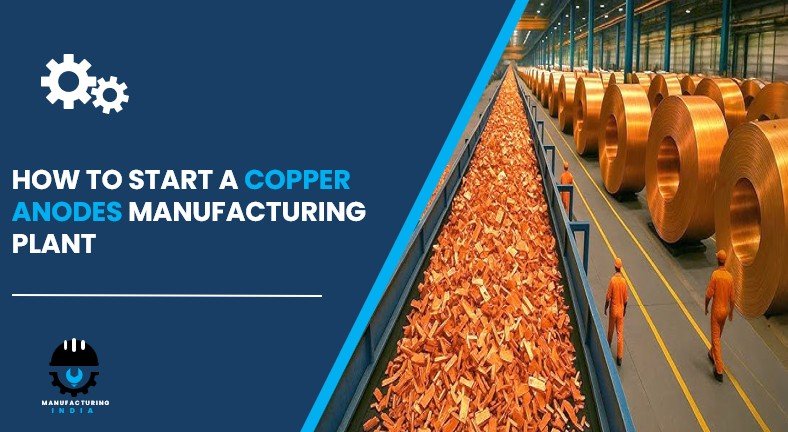
A copper anode is a positive electrode cast from fire-refined blister copper, used to supply copper ions into an electrolyte bath during electrolytic refining and electroplating processes. Anodes are produced by melting and fire-refining blister copper, treating the melt with flux to remove residual impurities, and casting the refined metal into flat, uniform plates suited to suspension in electrolytic cells.
Copper anodes serve as the essential feedstock for electrolytic refining, in which they are dissolved to deposit high-purity copper cathode on the opposite electrode, and are also consumed directly in electroplating operations for automotive components, electronics, hardware, and decorative metal finishes, as well as in the deposition of conductive copper pathways during printed circuit board manufacturing. Because the purity, flatness, and grain structure of the cast anode directly influence downstream refining efficiency and cathode quality, consistent process control across melting, refining, and casting is central to product quality.
The global copper anodes market was valued at approximately USD 3.50 Billion in 2025 and is expected to reach USD 5.67 Billion by 2034, exhibiting a CAGR of 5.5% from 2026 to 2034, supporting expanding copper smelting and refining capacity, rising electrification, and sustained growth in electronics and renewable energy applications.
Cost of Setting Up a Copper Anodes Manufacturing Plant
The total capital investment required to establish a copper anodes manufacturing plant is shaped by several key parameters: annual production capacity (typically ranging from 10,000 to 50,000 MT per annum), the technology and automation level adopted across melting, fire refining, and casting sections, facility specification, raw material sourcing strategy, and applicable environmental and industrial safety compliance requirements. Below is a structured breakdown of the major cost components.
1. Capital Expenditure (CapEx)
Total capital investment in a copper anodes manufacturing plant covers the following major heads:
Land and Site Development
This encompasses land acquisition or lease, site preparation, boundary development, and utilities connectivity. Site selection should prioritise proximity to blister copper suppliers and smelting clusters to ensure a steady, low-transport-cost supply of feedstock, together with access to target electroplating, refining, and electronics markets to minimise distribution costs. Reliable power and fuel gas supply infrastructure for melting and fire refining operations, strong road and rail logistics for inbound raw material and outbound cast anodes, availability of process water and effluent management systems, and a skilled workforce for furnace operations and quality control are critical site selection criteria. Compliance with industrial zoning regulations, environmental clearance requirements, and emission and effluent control frameworks must be assessed from project initiation.
Civil Works and Construction
Building costs cover the main processing facility including the blister copper reception and storage yard, melting and fire refining furnace bay, flux dosing and treatment area, anode casting and mould-handling section, cooling and stripping area, quality control laboratory, administrative block, and utility infrastructure including fuel gas supply systems, power backup, cooling water systems, emission control and gas scrubbing systems, and effluent treatment plant. Construction must comply with applicable factory act requirements, industrial fire and safety norms for high-temperature melting operations, and environmental clearance and emission control guidelines.
Machinery and Equipment
Machinery represents the single largest CapEx component. Key equipment required for a copper anodes manufacturing plant includes:
- Blister Copper Reception and Handling Systems: Material handling equipment, cranes, and conveyors for receiving and staging incoming blister copper, copper scrap, and cathode feedstock prior to melting
- Melting Furnaces: High-capacity melting furnaces to liquefy blister copper and other copper-bearing feedstock ahead of fire refining, designed for efficient thermal performance and reliable continuous operation
- Fire Refining Furnaces: Furnaces that oxidise and remove residual impurities such as sulphur and other volatile elements from the molten copper through controlled air and reducing-gas treatment cycles
- Flux Dosing Systems: Systems for the controlled addition of flux to bind residual impurities and support slag formation during the refining cycle
- Anode Casting Machines and Moulds: Casting wheels or stationary mould systems that cast the refined molten copper into flat, uniform anode plates of consistent thickness and weight suited to electrolytic cell suspension
- Cooling Systems: Water spray or immersion cooling systems to solidify cast anodes rapidly and consistently prior to handling
- Anode Stripping and Handling Equipment: Automated stripping systems, cranes, and conveyors to remove solidified anodes from moulds and transfer them for finishing and storage
- Surface Cleaning and Trimming Equipment: Equipment for trimming lugs and edges and cleaning cast anode surfaces to meet dimensional and quality specifications ahead of dispatch
- Emission Control and Gas Scrubbing Systems: Dust collectors, gas scrubbers, and stack monitoring systems designed to control particulate and gaseous emissions from melting and refining operations in line with environmental standards
- Water Treatment Units: Systems for treating process and cooling water and managing plant effluent prior to discharge or recycling
- Quality Control Laboratory Equipment: Equipment for assaying copper purity, trace element content, and physical dimensions to verify compliance with quality standards required by downstream refiners and electroplating customers
- Material Handling and Warehousing: Cranes, conveyors, and finished goods warehousing with systematic stock management for outbound anode dispatch
Other Capital Costs
These include pre-operative expenses, commissioning charges, import duties on specialised melting, refining, and casting equipment, staff training and competency development, initial raw material and consumable inventory for production commissioning, and environmental and industrial safety compliance setup including factory licensing and pollution control clearances.
Request a Sample Report for In-Depth Market Insights: https://www.imarcgroup.com/copper-anodes-manufacturing-plant-project-report/requestsample
2. Operational Expenditure (OpEx)
Raw materials principally blister copper, along with natural gas, propane, or ammonia used in melting and refining, and flux constitute the dominant operating cost, typically representing 70–78% of total OpEx. Utility costs, driven primarily by fuel gas and electricity consumption of melting, refining, and casting equipment, account for 14–18% of OpEx. Labour, maintenance, quality control, packaging, transportation, depreciation, taxes, and overhead costs constitute the remainder of the operating cost base.
3. Plant Capacity
The proposed copper anodes manufacturing facility is designed with an annual production capacity ranging between 10,000–50,000 MT, enabling economies of scale while maintaining operational flexibility. This capacity range supports supply to copper smelting and refining operators, electroplating businesses, and electronics and printed circuit board manufacturers across domestic and export markets.
4. Profit Margins and Financial Projections
The project demonstrates healthy profitability potential under normal operating conditions. Financial projections encompass capital investment, operating costs, capacity utilisation ramp-up schedule, and forward demand outlook underpinned by rising electrification and refined copper consumption. A comprehensive feasibility analysis includes sensitivity analysis, Net Present Value (NPV), Internal Rate of Return (IRR), and Payback Period calculations. Gross profit margins for copper anodes manufacturing typically range from 28–38%, supported by stable demand and value-added downstream applications. Net profit margins of 10–18% are achievable with disciplined cost management, optimal capacity utilisation, and effective raw material cost control.
Why Set Up a Copper Anodes Manufacturing Plant?
Critical Intermediate for Copper Refining
Copper anodes are an essential feedstock in the electrolytic refining process, enabling the production of high-purity cathode copper used across electrical, automotive, electronics, construction, and renewable energy industries. Their position as a mandatory intermediate step in producing refinery-grade copper makes them a structurally important component of the global copper value chain, supporting stable long-term offtake from smelters and refiners.
Moderate but Justifiable Entry Barriers
Manufacturing copper anodes requires significant investment in smelting and casting infrastructure, stringent process control, impurity management, and compliance with quality and environmental standards. These technical and operational requirements create barriers to entry that favour experienced and efficient producers, limiting the pool of credible competitors and supporting attractive returns for well-run operations.
Megatrend Alignment with Electrification
Rapid expansion in electric vehicles, renewable energy systems, power transmission networks, electronics manufacturing, and urban infrastructure is driving sustained demand for refined copper, consequently supporting long-term consumption of copper anodes as a key refining intermediate. As grid modernisation and clean energy deployment accelerate globally, the underlying demand base for copper anode-derived refined copper continues to broaden.
Policy and Infrastructure Push
Government initiatives promoting domestic metal production, renewable energy deployment, power grid modernisation, electric mobility, and industrial self-reliance are indirectly strengthening demand for copper anodes. Programmes supporting domestic electronics and automotive manufacturing further reinforce downstream demand for refined copper sourced through the anode-to-cathode refining route.
Localisation and Dependability in Supply Chains
Copper refiners and downstream manufacturers are increasingly prioritising reliable regional suppliers to reduce supply chain risks, optimise logistics, manage raw material price volatility, and ensure a consistent supply of high-quality copper anodes. This shift toward supply chain localisation creates meaningful opportunities for competitive domestic producers able to offer consistent quality and dependable delivery.
Diversified End-Use Demand Base
Beyond electrolytic refining, copper anodes are consumed directly in electroplating operations for automotive components, electronics, hardware, and decorative metal finishes, as well as in the deposition of conductive copper pathways during printed circuit board manufacturing. This diversified demand base across refining, electroplating, and electronics applications provides resilience against volatility in any single end-use segment.
Manufacturing Process Overview
The copper anodes manufacturing operation transforms blister copper and other copper-bearing feedstock into cast anode plates through a sequence of melting, refining, casting, and finishing operations. The key process stages are:
- Raw Material Reception and Preparation: Blister copper, recycled copper scrap, and other copper-bearing feedstock received from smelters and suppliers are staged and verified against quality specifications ahead of melting.
- Melting: Blister copper and other feedstock are charged into melting furnaces and heated to liquefy the metal, forming the molten charge that proceeds to fire refining.
- Fire Refining: The molten copper undergoes a controlled oxidation and reduction cycle using air and reducing gases such as natural gas, propane, or ammonia to remove residual sulphur and other volatile impurities, raising the purity of the melt ahead of casting.
- Flux Treatment: Flux is added to the refined melt to bind remaining impurities and promote slag formation, which is skimmed off to leave a cleaner molten copper charge.
- Anode Casting: The refined molten copper is cast into flat, uniform anode plates using casting wheels or stationary moulds, with lugs formed for suspension in electrolytic cells.
- Cooling and Solidification: Cast anodes are cooled using water spray or immersion systems to solidify the plates consistently prior to stripping and handling.
- Stripping and Handling: Solidified anode plates are stripped from the moulds and transferred by automated handling systems or cranes for finishing.
- Surface Cleaning and Trimming: Anode surfaces are cleaned and edges and lugs are trimmed to meet the dimensional and weight tolerances required for downstream electrolytic cell operation.
- Quality Inspection: Cast anodes are inspected and tested for copper purity, trace element content, dimensional accuracy, and surface quality to verify compliance with specifications required by refining and electroplating customers.
- Packaging and Dispatch: Inspected anodes are stacked, packaged, and dispatched to copper refiners, electroplating operations, and electronics manufacturers by road, rail, or bulk freight as required.
Major Applications
The copper anodes market serves several major end-use segments across the copper value chain and downstream manufacturing sectors:
- Copper Refining: Copper anodes are the primary feedstock for the electrolytic refining process, in which they are dissolved to deposit high-purity cathode copper used across electrical, construction, and industrial applications.
- Electroplating: Copper anodes supply copper ions for electroplating of automotive components, electronics, hardware, and decorative metal finishes, providing conductive, corrosion-resistant, and aesthetically consistent coatings.
- Printed Circuit Boards (PCBs): Copper anodes are used in the electrodeposition of conductive copper pathways during PCB manufacturing, a critical process step for the electronics industry.
- Metal Finishing: Beyond decorative and electronics uses, copper anodes support surface coating, corrosion protection, and wear resistance improvements for a range of industrial components.
Global Copper Anodes Market Outlook
The global copper anodes market was valued at approximately USD 3.50 Billion in 2025. According to IMARC Group estimates, the market is expected to reach USD 5.67 Billion by 2034, exhibiting a CAGR of 5.5% from 2026 to 2034. The copper anodes market benefits from multiple structural demand drivers:
- Continued investment in copper mining, smelting, and refining capacity globally to improve supply security and meet long-term demand for refined copper
- Rapid expansion of electric vehicle production, requiring substantial volumes of refined copper for motors, batteries, and charging infrastructure
- Ongoing power grid modernisation and transmission network expansion, which is copper-intensive and dependent on a steady supply of refinery-grade cathode copper
- Growth in renewable energy deployment, including solar and wind installations, which rely on refined copper for wiring, generators, and transformers
- Expansion of electronics and printed circuit board manufacturing, sustaining direct demand for copper anodes in PCB electrodeposition processes
- Government programmes supporting domestic metal production, electric mobility, and industrial self-reliance, which indirectly strengthen demand for copper anodes
- Increasing emphasis on supply chain localisation among copper refiners and downstream manufacturers, favouring reliable regional anode producers
- Advancements in sustainable smelting technologies, recycling integration, and energy-efficient refining processes, creating new opportunities for anode producers
Major players in the global copper anodes manufacturing industry include Univertical, Brenntag, Tongling Nonferrous Metals Group Holding, Highnic Group, and Yunnan Copper, serving end-use sectors including copper smelting and refining, electroplating, electrical and electronics, automotive, renewable energy, and industrial manufacturing.
Latest Industry Developments
- Electric Vehicle Charging Infrastructure Investment: According to the U.S. Department of Transportation, the Bipartisan Infrastructure Law (the Infrastructure Investment and Jobs Act) includes approximately USD 7.5 Billion in new funding for EV charging stations, making EV charging infrastructure eligible for additional federal funding programmes, a development expected to indirectly support copper demand across the charging equipment supply chain.
- Continued Capacity Expansion by Established Smelters and Refiners: Investment in copper smelting and refining capacity by established industry players continues globally, reflecting confidence in long-term demand growth for refined copper and the copper anodes that underpin the electrolytic refining process.
Licenses and Regulatory Requirements
Establishing a copper anodes manufacturing unit requires a range of approvals and certifications, which may vary by country and jurisdiction, including:
- Business registration and company incorporation under applicable company law
- Factory License under applicable state Factories Act provisions for manufacturing operations involving high-temperature melting and refining
- Environmental Clearance and Consent to Establish (CTE) / Consent to Operate (CTO) from the applicable Pollution Control Board for melting, refining, and effluent-generating operations
- Fire Safety Certification for facilities operating high-temperature melting and fire refining furnaces
- Air and Emission Control Compliance for particulate and gaseous emissions from melting, refining, and casting operations
- Hazardous Materials Handling compliance for fuel gases such as natural gas, propane, or ammonia used in melting and refining processes
- ISO 9001:2015 Quality Management System Certification for quality management infrastructure compliance
- ISO 14001 Environmental Management System Certification for environmental compliance infrastructure
- Occupational Health and Safety management compliance (ISO 45001 / Factories Act provisions) for manufacturing worker safety in high-temperature and material handling areas
- Weights and Measures (Legal Metrology) registration for packaged and dispatched product labelling and net quantity declaration
- Export-Import Code (IEC) for international market access
- Trademark and Brand Registration for proprietary branded product launch
Key Challenges to Consider
Raw Material Supply Consistency and Price Volatility
Blister copper, which accounts for a large majority of total operating costs, is subject to global copper commodity price cycles and supply availability from smelters. Securing long-term supply arrangements with reliable blister copper and feedstock suppliers, and negotiating contracts that mitigate exposure to price volatility, are critical operational priorities for maintaining stable margins.
High-Temperature Process Safety
Melting and fire refining operations involve high-temperature molten metal handling that introduces burn, fire, and occupational health hazards requiring rigorous safety protocols, protective equipment, and well-maintained furnace and handling infrastructure. Any lapse in safety practice increases operational risk and can result in costly downtime or regulatory exposure.
Environmental and Emission Compliance
Melting, fire refining, and casting operations generate particulate and gaseous emissions that must be managed through dust collectors, gas scrubbers, and continuous emission monitoring systems compliant with applicable environmental regulations. Maintaining consistent compliance requires ongoing investment in emission control system maintenance and monitoring infrastructure.
Capital Intensity of Melting and Refining Infrastructure
Establishing melting furnaces, fire refining systems, casting equipment, and emission control infrastructure represents a substantial capital commitment. New entrants must carefully evaluate capacity, automation level, and technology choices against available capital and target market requirements to optimise the investment-to-return profile of the project.
Quality Consistency for Downstream Refining Customers
Copper refiners and electroplating customers require anodes of consistent purity, dimensional accuracy, and surface quality, as variability directly affects downstream electrolytic refining efficiency and cathode quality. Maintaining rigorous process control across melting, refining, and casting stages, supported by disciplined quality assurance systems, is essential to sustaining customer relationships and market access.
Competitive Pressure from Established Global Producers
The copper anodes manufacturing industry includes several established multinational producers with significant scale and long-standing customer relationships. New entrants must differentiate through reliable quality, competitive cost structures, and dependable supply chain positioning to secure offtake agreements in a moderately consolidated competitive landscape.
Frequently Asked Questions (FAQs)
1. How much capital is required to set up a copper anodes manufacturing plant?
Capital requirements generally include land acquisition, civil construction, equipment procurement and installation, pre-operative expenses, and initial working capital, and vary with plant capacity (10,000–50,000 MT per annum), technology and automation level, and location. A comprehensive feasibility study from IMARC Group provides detailed, capacity-specific cost estimates covering all CapEx and OpEx components.
2. Is copper anodes manufacturing a profitable business in 2026?
Yes. Sustained demand from copper refiners, electroplating operations, and electronics manufacturers combined with gross margins of 28–38% and net profit margins of 10–18% make copper anodes manufacturing financially attractive, with profitability improving further as capacity utilisation and operational efficiency increase.
3. What machinery and equipment are required for a copper anodes manufacturing plant?
Key equipment includes melting furnaces, fire refining furnaces, flux dosing systems, anode casting machines and moulds, cooling systems, anode stripping and handling equipment, surface cleaning and trimming equipment, emission control and gas scrubbing systems, water treatment units, and quality control laboratory equipment.
4. What raw materials are required for copper anodes manufacturing?
The primary raw material is blister copper, produced through smelting of copper concentrate, along with recycled copper scrap and copper cathode feedstock in some operations. Natural gas, propane, or ammonia are used as reducing gases during fire refining, and flux is used to bind residual impurities.
5. What licenses and approvals are required?
Required approvals include company registration, Factory License, environmental clearance and Pollution Control Board consents, fire safety certification, hazardous materials handling compliance for fuel gases, and ISO 9001/14001 quality and environmental management system certification, among other jurisdiction-specific requirements.
6. How long does it take to commission a copper anodes manufacturing plant?
Typically, 18–24 months from project initiation to commercial production launch, depending on project scale, site development, machinery installation and procurement lead times, environmental clearances, and safety measures and trial runs, which should be initiated early in the project to avoid delays to commercial launch.
7. What are the key steps involved in copper anodes manufacturing?
The main steps include blister copper reception and preparation, melting, fire refining, flux treatment, anode casting, cooling and solidification, stripping and handling, surface cleaning and trimming, quality inspection, and packaging and dispatch.
8. What is the break-even period for a copper anodes manufacturing plant?
The break-even period typically ranges from 4 to 7 years, depending on plant scale, regulatory compliance costs, raw material price trends, and market demand. Efficient manufacturing practices and access to export markets can help accelerate the timeline to break-even.
9. What are the biggest challenges in starting a copper anodes manufacturing business?
Key challenges include high capital requirements, securing regulatory and environmental approvals, ensuring consistent blister copper supply at manageable price volatility, skilled manpower availability, high-temperature process safety, and competition from established global producers.
10. What government incentives are available for copper anodes manufacturers?
Governments may offer incentives such as capital subsidies, tax exemptions, reduced utility tariffs, export benefits, or interest subsidies to promote domestic metal manufacturing under various national or regional industrial policies, alongside programmes supporting electric mobility and renewable energy that indirectly benefit copper anode producers.
Key Takeaways for Investors
The copper anodes manufacturing industry represents a structurally resilient and financially attractive investment opportunity positioned at the intersection of global electrification, expanding renewable energy deployment, and continued investment in copper mining, smelting, and refining capacity. Copper anodes’ role as an essential intermediate in the electrolytic refining process, combined with direct consumption in electroplating and printed circuit board manufacturing, provides a diversified demand base that offers resilience against single-segment volatility. Moderate entry barriers created by the technical and capital requirements of melting, refining, and casting infrastructure favour experienced and efficient producers, while the industry’s growing emphasis on supply chain localisation and dependable regional sourcing creates meaningful opportunities for competitive domestic entrants. Alignment with long-term megatrends including electric vehicle adoption, grid modernisation, and clean energy deployment provides a durable demand tailwind, supporting confidence in the long-term growth and profitability of the category for well-positioned new entrants.
About the Author