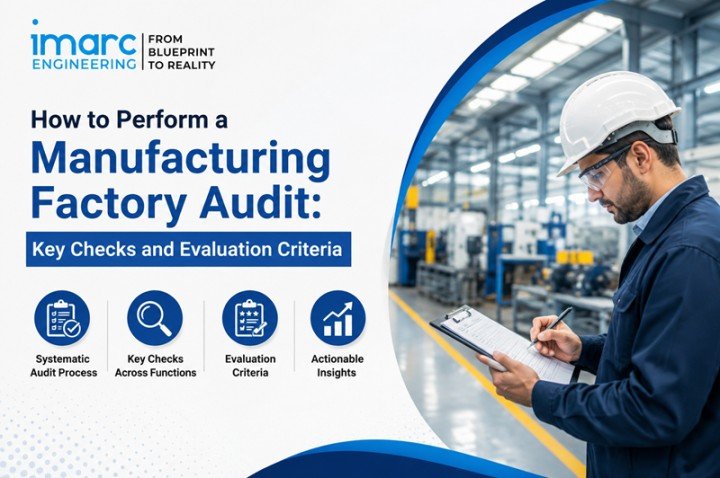
Manufacturing Factory Audit
A production sample can look perfect. An ISO certificate or product-quality certificate can look impressive. Neither tells you whether a supplier can actually deliver 50,000 consistent units a month, six months from now, during peak season, with a new operator on the line. That gap between what a supplier shows you and what a supplier can sustain is exactly what a manufacturing factory audit is designed to close.
Most buyers know they should audit a supplier before signing a contract. What trips them up is treating the audit as a box-ticking walkthrough instead of a structured verification exercise. A checklist tells you what exists, not whether it is adequate, repeatable, or safe to depend on. This guide covers how to actually run that verification: what to check, how to score it, and how to turn findings into a defensible supplier decision.
What a Factory Audit Is Really Measuring
Strip away the paperwork and a manufacturing factory audit answers one question: can this supplier consistently produce the required product, at the required quality, quantity, cost, and delivery schedule, while staying within applicable legal and safety obligations?
That breaks down into eight measurable components:
- Infrastructure adequacy for the contracted volume
- Process control and repeatability
- Genuine (not paper-only) quality management
- Verified , not claimed , production capacity
- Workforce competency and dependency risk
- Regulatory and statutory compliance
- Traceability from raw material to dispatch
- Delivery and logistics reliability
A supplier can score well on some of these and fail badly on others , modern machines with no maintenance discipline, a certificate with weak shop-floor implementation, or a great sample batch never replicated at scale. The audit’s job is to find that mismatch before it becomes your production problem.
Audit vs. Certification: Know the Difference
An ISO 9001 or industry certification confirms that a defined management system, process, product or requirement has been assessed against the applicable standard and scope.. It does not replace buyer due diligence. During the audit, verify:
- The certificate’s validity and expiry
- The certified site or location
- The certified scope and any exclusions
- The certification body’s credentials, where relevant
Treat certification as supporting evidence, not proof that the supplier can meet your specific quality, capacity, delivery, and technical requirements.
When You Actually Need One
Before approval, trigger an audit for:
- A new or first-time supplier for a critical component
- Sole-source or single-location dependency
- A high-value, long-term, or strategic agreement
- Unverified specialised-capability claims
- A regulatory-sensitive product (pharma, food, electrical, automotive)
After the relationship has started, re-audit when you see:
- Repeated quality escapes or complaints
- Delivery slippage without clear explanation
- Sudden capacity shortfalls
- Unresolved corrective actions from a previous audit
- A major process, location, or ownership change
Match audit depth to risk , a low-value, non-critical component doesn’t need the scrutiny a sole-source, line-feeding supplier does.
Preparing Before You Travel
Audit quality is decided before the site visit, not during it.
- Set a specific objective , “verify whether the supplier can sustain 40,000 units/month at the quoted defect rate,” not “audit the factory.”
- Define scope precisely , production lines, QC lab, warehousing, subcontracted processes, EHS, or all of the above.
- Request documents in advance, so on-site time goes to verification, not paperwork:
- Company registration and organisation chart
- Quality certificates and CAPA history
- Plant layout, machine list, and process flow
- Capacity and utilisation data
- Calibration certificates
- Applicable statutory licences and environmental consents
- Approved subcontractor list, with details of any outsourced manufacturing, testing, or finishing processes
What to Verify on the Shop Floor
- Infrastructure and machinery: Machine age, rated versus actual output, maintenance condition, and backup availability for bottleneck equipment. One unmaintained critical machine with no redundancy is often the real ceiling on capacity.
- Production capacity , with numbers, not assurances: Practical Output Capacity = Available Production Hours × Sustainable Production Rate × Yield Available hours should account for planned downtime, changeovers, maintenance, shift constraints, and actual staffing , not nameplate hours. Example: 20 available hours/day × 25 days × 100 units/hour sustainable rate × 95% yield ≈ 47,500 units/month. Compare this against current order load and bottleneck operations , the gap between installed and realistically available capacity is often where commitments break down.
- Process control: Physically trace one production order , receipt, in-process inspection, testing, packaging, dispatch. Ask to see the work instructions, not just hear a description, to judge whether quality depends on a repeatable process or on one or two individuals who may not always be on shift.
- Quality systems and the lab: Review the quality manual against what’s actually practised. Check calibration status and traceability , equipment past its due date undermines every result generated on it.
- Traceability, tested rather than described: Trace one finished product backward to its raw material lot and supplier, then forward again. This can expose record-control weaknesses that may not be apparent from a conventional document review.
- CAPA, workforce, and EHS: Ask to see a specific recent non-conformance (Corrective and Preventive Action, or CAPA) and how it was closed, rather than whether a CAPA process exists. Talk to operators directly , gaps between management’s account and shop-floor practice are a strong implementation signal. Check EHS basics against applicable central and state laws, rules, licences, permits, and sector-specific requirements, not a generic global checklist.
- Financial and business-continuity risk: For strategic or sole-source suppliers, also assess financial stability indicators, customer-concentration dependence, recent ownership changes, backup power and utilities, single-source raw-material exposure, and any documented business-continuity or disaster-recovery plan. A supplier can pass every operational check and still fail here.
Red Flags Worth Deeper Investigation
- Idle machinery presented as available capacity
- Missing, inconsistent, or recently-created records
- Overdue calibration on critical equipment
- Undisclosed subcontracting of key processes
- Restricted access to specific areas
- Answers that shift depending on who’s asked
- Heavy dependence on one raw-material source with no contingency
Scoring the Audit
Weight each area by risk rather than treating every finding equally:
| Audit Area | Suggested Weight |
| Quality Management | 20% |
| Production Capacity | 15% |
| Process Control | 15% |
| Regulatory & EHS Compliance | 15% |
| Infrastructure & Equipment | 10% |
| Traceability | 10% |
| Supply Chain & Business Continuity | 10% |
| Workforce Competency | 5% |
Adjust weights based on how critical the supplier and component are to your operations. Classify individual findings by consequence:
- Critical , threatens safety, compliance, or core capability
- Major , a system gap likely to cause repeated failure
- Minor , a limited gap without immediate risk
- Observation , requirement met, process could be tightened
What the Audit Report Should Include
- Supplier details, audit objective, and scope
- Audit date and team
- Documents reviewed
- Production capacity assessment
- Process and quality-system observations
- EHS/compliance findings and supporting evidence
- Finding classifications with corrective-action requirements and target dates
- Overall recommendation
The recommendation should land in one of five categories:
- Approved
- Conditionally Approved (pending specific corrective actions)
- Supplier Development Required
- Rejected
- Re-Audit Required Before Final Approval
Common Mistakes to Avoid
- Auditing documentation only, without a shop-floor walkthrough
- Accepting supplier-provided capacity data without independent verification
- Interviewing management only, skipping operators and supervisors
- Ignoring subcontracted or outsourced processes
- Overlooking calibration and maintenance history
- Missing single-source dependencies further up the supply chain
- Closing the audit without assigned corrective-action deadlines
- Approving a supplier without re-verifying closure of prior findings
Industry Context Matters
- Pharmaceutical: GMP, batch records, data integrity
- Food processing: hygiene, allergen control, cold-chain traceability
- Automotive: process capability and defect prevention
- Chemicals: process safety and effluent handling
- Electrical/electronics: component traceability, applicable BIS requirements, product-specific conformity obligations, and relevant testing controls , which vary by product category and should always be confirmed against current regulations rather than assumed
How IMARC Engineering Can Help
Running a rigorous factory audit takes technical depth across process engineering, quality systems, and regulatory compliance , resources most procurement teams don’t have in-house for every supplier decision. IMARC Engineering supports manufacturers across pharmaceutical, chemical, food processing, automotive, electronics, and heavy engineering sectors with:
- New supplier qualification and pre-contract due diligence
- On-site factory audits
- Production capacity verification against actual utilisation data
- Regulatory compliance checks aligned with applicable Indian requirements
- Corrective-action tracking
- Multi-vendor audit coordination for larger industrial projects
Request a Factory Audit Assessment – https://www.imarcengineering.com/contact?service=vendor-audits-and-compliance-checks
Conclusion
A factory audit earns its value when it moves a buyer from believing a supplier’s claims to independently verifying them , testing capacity with numbers, tracing a product’s batch history instead of trusting a statement, and talking to the shop floor rather than relying solely on management’s account. Done this way, the audit stops being a compliance formality and becomes what it should be: a structured way to reduce real supply-chain risk before it reaches your production line.
Contact Us:
IMARC Engineering
Phone: +91-120-433-0800
Email: sales@imarcengineering.com
India: C-130, Sector 2, Noida, Uttar Pradesh 201301
LinkedIn: https://www.linkedin.com/showcase/imarc-engineering/
About the Author