Most Indian manufacturing plants are not short of machines, manpower or orders. What they are often short of is flow. A plant can invest in a new CNC line, add a shift, or upgrade its ERP system, and still find that output per operator, on-time delivery and rejection rates don’t move much. That’s usually not a technology problem — it’s a waste problem: material waiting, operators walking, batches piling up between processes, and changeovers eating into run time. This is the gap that Lean consulting is built to close.
Lean consulting for manufacturing plants is a structured, data-led process of finding where value is being lost on the shop floor and fixing it in a sequence that sticks — not a one-time 5S drive or a slogan on the notice board. Plants that bring in Lean Consulting Services in India typically do so because internal teams are busy running production and don’t have the bandwidth, baseline data, or outside perspective to diagnose recurring bottlenecks objectively. A good starting point is understanding what the engagement actually covers, before deciding whether it’s needed.
Why Lean Consulting Matters for Indian Manufacturing
The Ministry of MSME’s Economic Survey 2025-26 places MSMEs at approximately 35.4 percent of manufacturing, 31.1 percent of GDP, and around 48.58 percent of exports, underlining how much of India’s industrial output rides on small and mid-sized manufacturing units rather than large integrated plants. Competitiveness at this scale depends less on capital intensity and more on how well existing capacity is used — precisely the gap Lean addresses. Recognising this, the Ministry of MSME launched the MSME Competitive (LEAN) Scheme to help units reduce waste, standardise operations and become audit-ready for larger OEM supply chains, treating Lean as a competitiveness and readiness programme rather than a cost-cutting exercise.
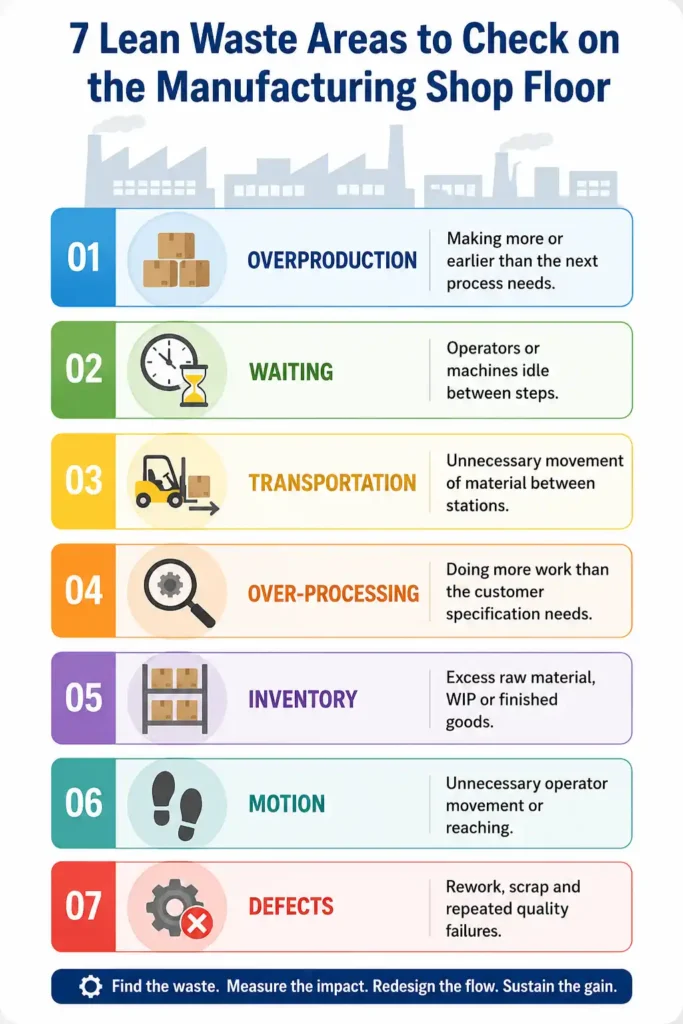
7 Lean Waste Areas to Check on the Manufacturing Shop Floor
What Lean Consulting Covers
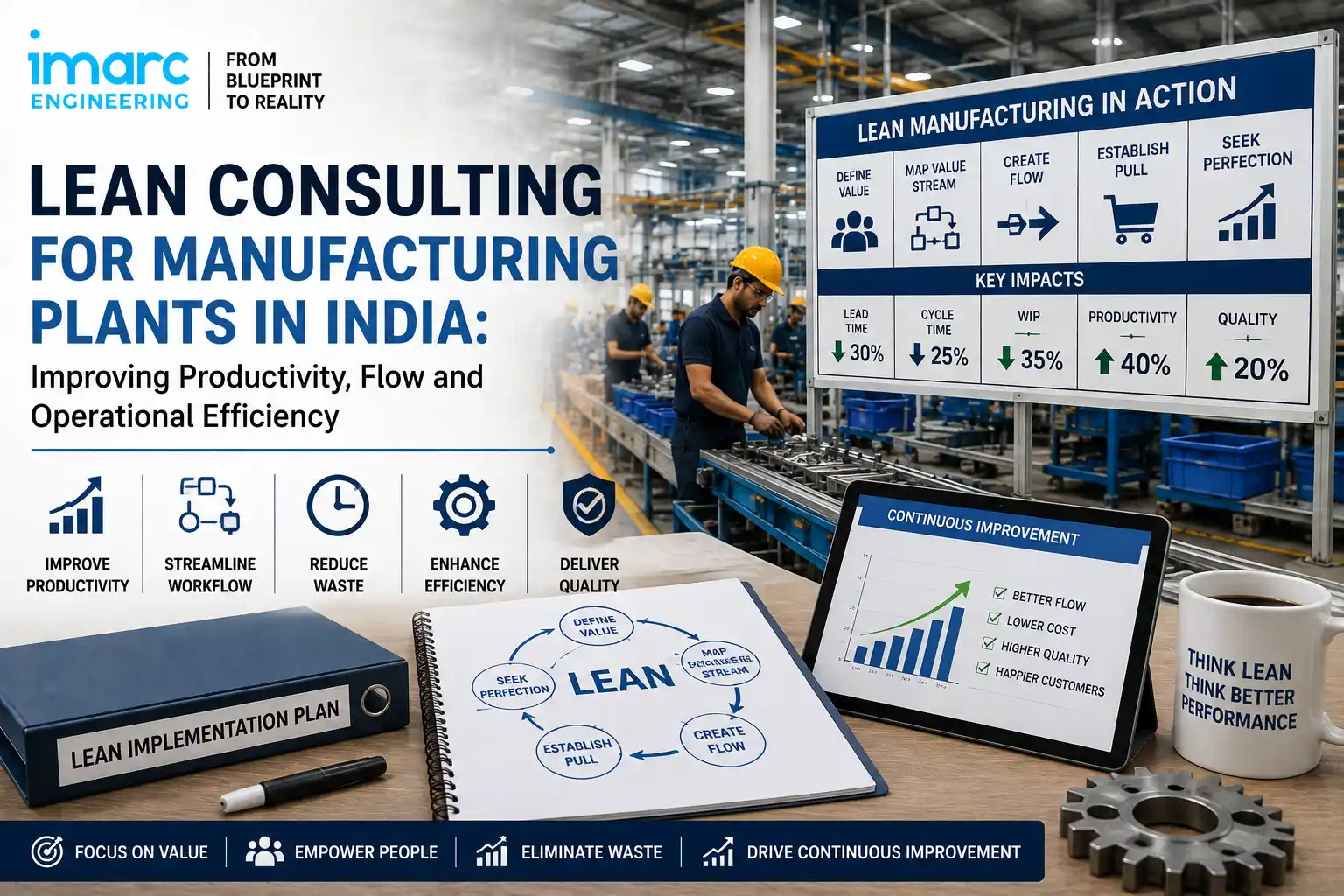
A Lean consulting engagement starts with a current-state assessment: walking the floor, observing processes, and talking to operators and supervisors before touching any tool. From there, cycle-time analysis and Value Stream Mapping (VSM) show where material and information actually flow versus how the process is documented on paper — this is where bottlenecks and waste usually surface first.
Once the diagnosis is clear, consultants select interventions to match the problem rather than applying a standard toolkit. Line balancing and layout changes address flow issues; 5S and visual management fix workplace disorganisation; SMED reduces changeover time; TPM and OEE tracking target machine losses; Kaizen and poka-yoke address recurring defects. Standard work is documented so improvements don’t drift back to the old way of working, and a KPI baseline is set up so results can be measured rather than assumed. Training runs alongside implementation so operators and supervisors own the change, not just the consultant.
Where Manufacturing Plants Commonly Lose Productivity
Productivity leaks rarely show up as one big problem — they accumulate from several smaller ones:
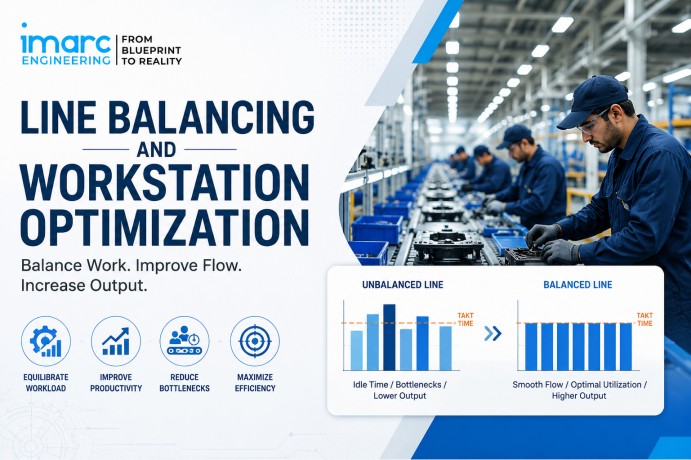
- Waiting and uneven workload between stations, often from poor line balancing
- Excess material movement caused by layouts built around equipment purchase order, not process flow
- Long changeovers that eat into available run time between product variants
- High rework and rejection from inconsistent process adherence
- Unplanned downtime due to reactive rather than preventive maintenance
- Excess WIP and inventory used as a buffer against unreliable upstream processes
- Poor information flow — production plans, quality alerts and priorities not reaching the floor in time
Each of these is measurable, and each has a fairly specific Lean response — which is why diagnosis has to come before tool selection.
How Lean Consultants Identify Waste and Bottlenecks
The diagnostic sequence is deliberately simple: observe the floor first, then map the process, then measure it. Consultants typically spend time on the shop floor before opening a spreadsheet, because operator behaviour and material flow reveal problems that documentation hides. This is followed by current-state VSM, cycle-time measurement at each station, and bottleneck analysis to find the constraint that actually limits output. Root-cause tools — 5-Why, fishbone diagrams, Pareto analysis — separate symptoms from causes, and findings are prioritised by business impact so the plant fixes what moves the needle first, not what’s easiest.
Lean Tools and When to Use Them
| Problem | Lean Approach |
|---|---|
| Excess movement | VSM / layout-flow improvement |
| Long changeover | SMED |
| Workplace disorder | 5S |
| Defects | Root-cause analysis / Poka-yoke |
| Machine losses | TPM / OEE |
| Excess WIP | Pull system / Kanban |
| Uneven workload | Line balancing |
| Process variation | Standard work / SPC |
| Ongoing improvement | Kaizen |
The tool is chosen to fit the diagnosed cause — using SMED on a layout problem, for instance, will not move the needle.
How to Measure Lean Improvement
Improvement claims are only meaningful against a documented baseline. Plants typically track productivity (output per person or per hour), cycle time, lead time, OEE, first-pass yield, rejection and rework rates, changeover time, WIP levels, inventory turns, on-time delivery, and space utilisation. Measuring before intervention — not after — is what separates a credible Lean engagement from an anecdotal one; without a baseline, there’s no honest way to say what actually improved.
Greenfield vs Brownfield Lean Consulting
Greenfield projects allow flow, layout and material movement to be designed in from the start — cell layouts, one-piece flow and pull systems can be built into the plant rather than retrofitted. Brownfield or live-plant engagements work within existing walls, equipment placement and production commitments, so implementation has to be sequenced around ongoing output, often starting with a pilot line or a single bottleneck before scaling. Both need the same diagnostic rigour; only the constraints differ.
Government of India MSME Competitive (LEAN) Scheme
The MSME Competitive (LEAN) Scheme, launched by the Ministry of MSME, guides eligible MSMEs through Basic, Intermediate and Advanced Lean levels under empanelled Lean consultants, using tools such as 5S, Kaizen, Kanban, visual workplace management and poka-yoke. As per the Ministry’s official announcement, the Government contributes up to 90 percent of implementation cost, with intermediate-level support capped at approximately ₹1,08,000 and advanced-level support at approximately ₹2,16,000, plus an additional 5% GoI contribution for eligible MSMEs under the applicable scheme provisions. Intermediate and Advanced levels require MSMEs to form a Group of Enterprises to apply. This is a government support mechanism, not automatic — eligibility, group formation and empanelled-consultant assignment are determined through the scheme’s official portal, and it should not be confused with a private Lean consulting engagement, which a plant can commission independently regardless of scheme eligibility.
A Government-Documented Lean Case History
Under the earlier Lean Manufacturing Competitiveness Scheme, implemented by the National Productivity Council (NPC) as National Monitoring and Implementing Unit, a small auto-components unit in Faridabad, Haryana (part of a Tata Motors vendor cluster) used SMED and Kaizen to address high changeover-related downtime. A diagnostic study found the unit’s monthly setup time across machine categories totalled around 6,800 minutes; after root-cause analysis and corrective action on setup sequencing, this fell to roughly 5,440 minutes, saving about 1,360 minutes a month, alongside a parallel Kaizen-led reduction in cutting-tool cost. This is historical, NPC-documented evidence from that specific engagement — not a guaranteed outcome for every plant, since results depend on each unit’s starting condition and implementation discipline.
Why Lean Programs Fail
Most failed Lean initiatives share recognisable patterns: treating Lean as a 5S housekeeping drive rather than a flow and waste-elimination discipline; starting implementation without baseline KPIs; management sponsoring the programme without staying involved in reviews; operators and supervisors left out of problem-solving; too many initiatives launched at once instead of prioritised sequencing; picking tools before diagnosing the actual cause; no follow-up measurement once initial changes are made; improvements never standardised into documented work, so old habits return; and no clear ownership once the consultant’s engagement ends. A diagnostic report without implementation discipline changes nothing on the floor.
Practical Lean Implementation Roadmap
A structured engagement typically runs: diagnostic assessment → baseline KPIs → waste and bottleneck identification → current-state mapping → prioritisation by impact → future-state design → quick wins → phased Lean implementation → operator and supervisor training → ongoing KPI monitoring → continuous improvement (Kaizen) built into daily routines rather than run as a one-time event.
| Manufacturing Problem | What to Examine | Lean Intervention |
|---|---|---|
| High WIP | Flow and bottlenecks | VSM / Pull |
| Long changeovers | Setup activities | SMED |
| Excess movement | Material routes | Layout / Flow |
| Machine losses | Availability and downtime | TPM / OEE |
| High rejection | Root causes | RCA / Poka-yoke |
| Workplace inefficiency | Organisation / visual control | 5S |
| Uneven output | Workload balance | Line Balancing |
How IMARC Engineering Supports Lean Consulting for Manufacturing Plants
IMARC Engineering supports manufacturing plants with:
- Current-state assessment and Value Stream Mapping
- Waste and bottleneck identification using shop-floor observation and cycle-time data
- Lean implementation support, including line balancing, 5S, SMED, TPM/OEE and Kaizen
- KPI baselining to measure improvement against a documented starting point
- Greenfield and brownfield Lean advisory aligned with plant-specific constraints
- Operator and supervisor capability building to help sustain improvements after implementation
Outcomes depend on each plant’s starting condition, data quality and internal follow-through; IMARC Engineering does not present guaranteed productivity or financial results.
Looking to identify process waste, bottlenecks or productivity losses in your manufacturing plant? Discuss your Lean consulting requirements with IMARC Engineering: https://www.imarcengineering.com/contact?service=process-optimization-lean-consulting
Conclusion
Lean consulting for manufacturing plants in India helps manufacturers identify waste, remove bottlenecks and improve productivity through structured, measurable operational improvement.
The strongest Lean programmes do more than introduce tools such as 5S, Kaizen or SMED. They begin with a clear understanding of the current process, establish performance baselines, prioritise high-impact problems and involve operators and supervisors in sustaining the improvements.
For Indian manufacturers facing pressure on productivity, quality, delivery and resource utilisation, Lean consulting can provide a practical framework for improving existing operations without relying only on additional capacity or capital investment.
Through process optimisation and Lean consulting, IMARC Engineering helps manufacturing plants improve flow, reduce operational waste and build a stronger foundation for continuous improvement.
Contact Us:
IMARC Engineering
Phone: +91-120-433-0800
Email: sales@imarcengineering.com
India: C-130, Sector 2, Noida, Uttar Pradesh 201301
LinkedIn: https://www.linkedin.com/showcase/imarc-engineering/
About the Author