Introduction
Technology selection is one of the highest-stakes decisions in a CBG project, yet it is often influenced more by equipment price and peer references than by actual process requirements.
Once digesters and purification systems are ordered, the hidden problems surface: feedstock that does not match design assumptions, gas yield below the model, unstable operations, higher energy and chemical use, and expensive fixes that should have been avoided at the selection stage. These issues are rarely visible in a technology brochure. They become clear only when process choice is tested against real biomass quality, seasonal variation, gas specification and operating capability before CapEx is locked.
IMARC Engineering provides CBG feasibility and technology evaluation support across India. This article examines the main technology selection risks in CBG projects and how process-fit evaluation can protect yield, uptime and project economics.
Why Technology Choice Matters in India’s CBG Build-Out
India’s CBG sector is expanding under clear policy targets and structured demand.
- SATAT targets 5,000 CBG plants with 15 million metric tonnes of annual production capacity.
- More than 100 plants have been commissioned; 1,000+ LOIs have been issued by Oil Marketing Companies.
- The CBG Blending Obligation, phased from FY 2025-26, supports demand from the CNG and PNG network.
- Support continues under the National Bioenergy Programme (MNRE) for biomass aggregation and related project elements.
Policy creates a large project pipeline. Technology selection determines whether an individual plant can convert available feedstock into consistent, specification-compliant CBG at a lifecycle cost the project can sustain.
What Technology Selection Must Cover in a CBG Plant
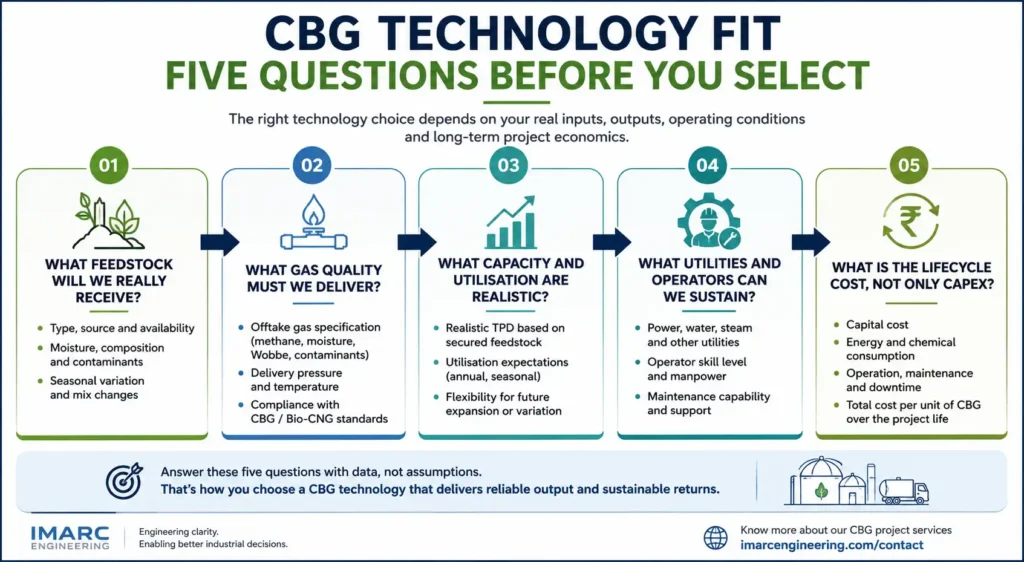
CBG technology should be evaluated as an integrated process chain rather than as a single equipment package. Key elements typically include:
- Feedstock pre-treatment and handling
- Anaerobic digestion system and operating mode
- Biogas cleaning and purification to CBG specifications
- Compression, storage and dispatch systems
- Controls, instrumentation and utility interfaces
Selection must fit feedstock characteristics, target gas quality, capacity, site utilities, operating skill level and lifecycle cost — not only capital cost of the main package.
Why CBG Technology Choices Go Wrong
1. Choosing on CapEx alone
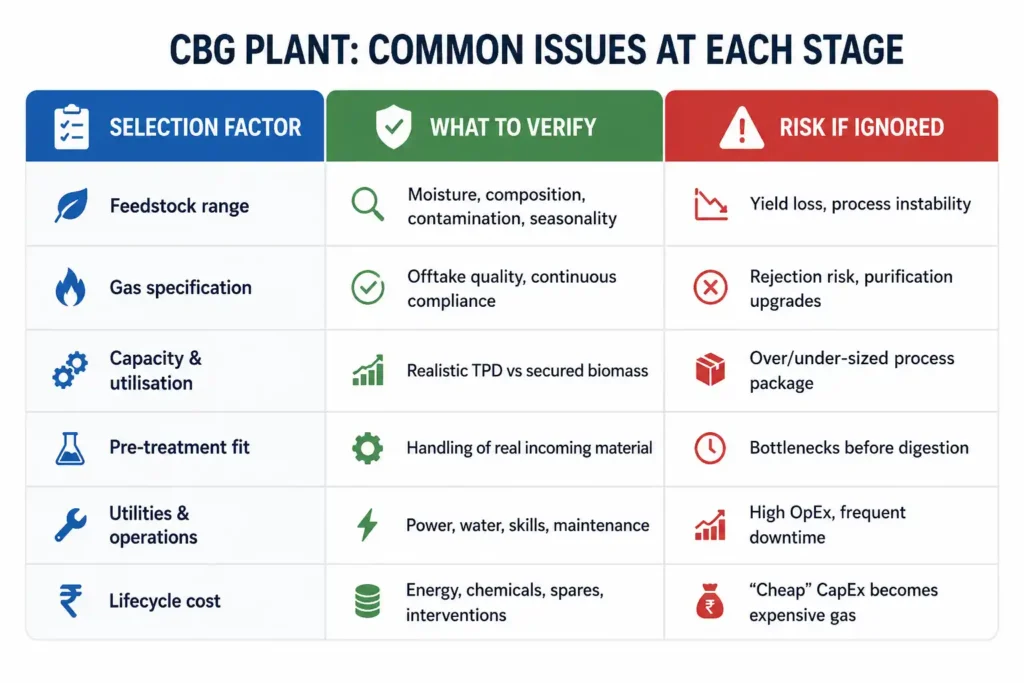
A lower equipment price can appear attractive initially, but higher energy consumption, maintenance requirements or lower yield can quickly eliminate the upfront saving.
2. Designing around ideal feedstock
Technology selected from limited or idealised samples may perform poorly when moisture, contamination and seasonal feedstock composition vary during actual operations.
3. Freezing capacity before feedstock is validated
When TPD is fixed before realistic biomass availability is established, the selected process package can become oversized or undersized for actual operating conditions.
4. Leaving gas specifications unclear
Purification systems should be evaluated against defined offtake specifications. Otherwise, additional treatment or upgrades may be required later to meet quality requirements.
5. Underestimating operating requirements
Advanced systems may require reliable utilities, trained operators and disciplined maintenance. If these capabilities are unavailable, technology performance can suffer after commissioning.
6. Relying on references from dissimilar feedstock
Performance references from plants using different biomass types, feedstock characteristics or operating conditions are treated as proof of suitability without validating performance against the proposed project’s actual feedstock.
7. Interfaces ignored
Pre-treatment, digestion, purification and utility systems are evaluated or procured independently without adequately validating how the complete process chain will perform as one integrated system.
How Wrong Technology Shows Up After Commissioning
A technology mismatch can become visible through:
- Lower methane yield than the feasibility model
- Unstable digester operation and longer stabilisation
- Higher pre-treatment, chemical or energy cost
- Difficulty maintaining consistent gas quality within offtake specifications
- Frequent intervention and higher maintenance burden
- Expensive retrofits or capacity derating
The plant may still produce gas. It does not produce gas at the rate, cost or reliability used to justify the investment.
A Structured Approach to CBG Technology Selection
A stronger approach starts with process requirements and works backward to the technology package.
- Establish the real feedstock range, including quality, seasonality and contaminants.
- Define offtake gas specifications and delivery conditions.
- Establish realistic capacity and utilisation scenarios.
- Compare process routes against these operating requirements.
- Compare lifecycle cost — CapEx, energy, chemicals, maintenance, downtime risk.
- Check utility, land and operator requirements for each option.
- Validate references on similar feedstock, not only similar nameplate capacity.
- Freeze technology only after feedstock and offtake evidence are solid.
Technology should follow process duty. When duty is unclear, selection becomes a guess priced as a certainty.
Technology Selection Focus Areas at a Glance
How IMARC Engineering Supports CBG Technology Selection
IMARC Engineering helps project sponsors evaluate CBG technology based on feedstock characteristics, process requirements, operating conditions, and project economics, rather than equipment specifications or vendor claims alone.
- Feedstock characterisation linked to suitable process-route options
- Technology comparison based on expected yield, gas quality, utility requirements, and operating complexity
- Integration of technology selection with plant capacity, utilities, and CapEx–OpEx planning
- Evaluation of process and technology options as part of project feasibility
- Support for CBG / Bio-CNG projects across India
Contact IMARC Engineering’s team for CBG technology and feasibility support: https://www.imarcengineering.com/contact-us
Common Technology Selection Mistakes
- Buying on lowest equipment price without lifecycle comparison
- Using ideal feedstock samples as the design basis
- Freezing technology before feedstock contracts and quality ranges are clear
- Ignoring offtake gas specifications in purification design
- Overlooking operator skill and utility needs
- Accepting references from dissimilar feedstock without local validation
- Treating pre-treatment, digestion and purification as unrelated purchases
Conclusion
CBG projects face technology-related performance risks when process choices are separated from real feedstock, offtake quality and operating conditions. India’s SATAT target of 5,000 plants and 15 MMT capacity, blending obligations and bioenergy support create substantial room for investment. Sustained performance still depends on whether digesters, purification and handling systems match the biomass the plant will actually receive.
Projects that define feedstock range, gas specification and utilisation first — then select technology against lifecycle cost and operating reality — protect yield and returns. Projects that select technology first and discover feedstock reality later pay for the gap in output, OpEx and retrofits.
Contact Us:
IMARC Engineering
Phone: +91-120-433-0800
Email: sales@imarcengineering.com
India: C-130, Sector 2, Noida, Uttar Pradesh 201301
LinkedIn: https://www.linkedin.com/showcase/imarc-engineering/
About the Author