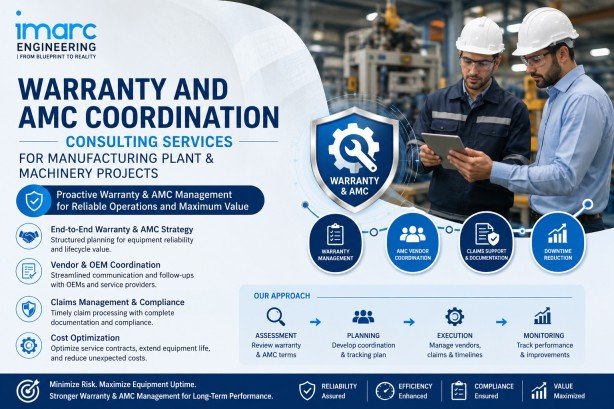
Warranty and AMC Coordination Consulting Services for Manufacturing Plant
Most manufacturing plants own equipment that is still under warranty or covered by an active maintenance contract , and still pay out of pocket when it breaks down. This isn’t because the coverage doesn’t exist or the contract has lapsed. It’s because nobody is actively managing it: nobody checks warranty status before authorizing a repair, nobody tracks which AMC terms actually apply, and nobody follows through with the OEM to make sure the coverage already paid for actually gets used.
Warranty and AMC Coordination Consulting, coordination sounds like paperwork , something filed away once equipment is installed and forgotten until a renewal notice arrives. In practice, it sits directly between engineering, procurement, finance, and plant operations. When neglected, the cost doesn’t show up as one large loss; it shows up quietly, spread across maintenance invoices that, technically, should never have been raised.
The Problem Isn’t the Coverage. It’s Visibility.
A manufacturing plant can have dozens or hundreds of equipment items, each from different vendors with different warranty periods, AMC terms, and service arrangements. Across a multi-line facility, the gaps compound: no single document shows which machines are still under warranty, nobody tracks which AMC is expiring next month, maintenance teams raise repair requests without checking coverage, vendors get paid for work that should have been free, and claims are filed late , or not at all , because the failure was never linked back to the original purchase.
None of this is negligence. Warranty and AMC data typically lives in scattered purchase orders, vendor emails, and individual engineers’ memory , not in a system anyone checks before approving a repair.
What Good Warranty and AMC Coordination Actually Looks Like
This isn’t just about renewing contracts on time. A properly run coordination function does several distinct jobs, and most plants only do one or two. Worth being clear upfront: this isn’t maintenance execution. It covers planning, vendor coordination, scope review, SLA monitoring, documentation, and claim management; the actual repair work stays with the OEM, the AMC provider, or the plant’s own team.
1. Building and Maintaining a Live Equipment Register
Every covered equipment item needs a record: OEM, purchase date, commissioning date, warranty start and end dates, AMC status, service contact, and criticality. This register is the single reference point maintenance teams check before authorizing any repair spend.
2. Managing Claims as a Workflow, Not a One-Off Event
When equipment fails, there’s a sequence that needs to happen fast: confirm the failure is covered, document it correctly, notify the OEM within the contractual window, track their response, and follow through until the repair or replacement is closed. A claim can be delayed or rejected when documentation, serial numbers, service records, or contractual timelines aren’t met , documentation discipline matters as much as the claim itself.
3. Reviewing AMC Contracts Before Signing, Not After a Bad Experience
AMC pricing differences are rarely about the headline number , they’re buried in scope. Two contracts at similar annual cost can differ enormously in what’s included: PM visits per year, guaranteed response time, whether spares and consumables are billed separately, whether emergency visits are covered, penalty clauses for missed SLAs, and early-termination terms for poor performance.
Normalizing Quotes and Looking at Total Cost, Not Just Price
AMC proposals are often hard to compare because vendors define scope differently. A proper evaluation normalizes each quote against the same criteria , maintenance frequency, labour, spares, consumables, emergency visits, response time, exclusions, escalation , so a plant doesn’t choose a cheaper quote that actually covers less.
The lowest quotation also isn’t necessarily the lowest-cost option once you factor in breakdown frequency, downtime exposure, spare-parts costs, and criticality , that fuller picture gives a more meaningful total-cost-of-ownership view than the contract figure alone.
4. Deciding Between OEM and Third-Party AMC on a Case-by-Case Basis
There’s no universally correct answer , it depends on the equipment. OEM AMC makes sense when the machine involves proprietary technology the OEM controls, genuine parts are hard to source independently, or the equipment is safety-critical with regulatory documentation needs. Third-party AMC can be the better commercial choice when the equipment is mechanically standard, cost flexibility matters more than manufacturer diagnostics, or the plant already has a trusted multi-brand partner. Treating this as a plant-wide policy instead of an equipment-by-equipment decision is a common way manufacturers overspend.
Matching Strategy to Equipment Criticality
Not every machine deserves the same coverage or the same negotiating effort:
| Equipment type | Criticality | Recommended approach |
| Production bottleneck equipment | High | Strong SLA, tight response times, OEM or qualified specialist |
| Utility or backup systems | Medium | Competitive AMC evaluation across providers |
| Non-critical auxiliary equipment | Low | Standard preventive maintenance, multi-brand support |
This directs effort and cost at what actually affects production, rather than treating every asset the same.
The Transition Point Everyone Gets Wrong
Warranty periods and AMC decisions are usually treated as two separate conversations that happen months apart. That gap is where plants lose the most value.
The better sequence looks like this:
- Track warranty expiry dates well in advance , typically 60–90 days out, depending on equipment criticality and contract terms
- Review the equipment’s actual performance and failure history during the warranty period
- Use that failure data to negotiate AMC scope , recurring issues should mean tighter response-time terms
- Get competing quotes before the warranty lapses, not after
- Activate AMC coverage with zero gap between warranty expiry and contract start
Starting this process only after the warranty has expired can reduce the time available to evaluate alternatives, negotiate terms, and avoid a coverage gap.
Greenfield vs Brownfield: Different Starting Points
On greenfield projects, the focus is capturing warranty and AMC information from the start , OEM contacts, warranty terms, commissioning dates , alongside the project schedule, not after handover. On brownfield or expansion projects, the starting point is usually an audit: expired or undocumented warranties, gaps in existing AMC contracts, vendor consolidation, and rebuilding a maintenance history finance and engineering can rely on.
Common Mistakes That Quietly Cost the Most
A few patterns show up repeatedly across plants that haven’t formalized this function:
- Assuming the vendor will flag an expiring warranty. Tracking responsibility should sit within the organization, not with the vendor.
- Filing claims without matching documentation to warranty terms. Getting it right the first time , serial numbers, failure description, timing , matters more than most teams realize.
- Letting AMC renewals run on autopilot. A contract that renews without review keeps paying a vendor with a poor response-time record the same rate regardless of performance.
- Splitting responsibility across departments with no single owner. Gaps between procurement, maintenance, and finance are where claims get missed.
Tracking What Actually Matters
This function is only useful if it’s measured. Worth tracking monthly or quarterly: on the warranty side, claims raised versus closed, average closure time, value of repairs avoided, and equipment approaching expiry; on the AMC side, cost per item benchmarked against similar assets, PM compliance, actual versus contractual response time, repeat breakdown rate, and spares turnaround time.
Where India-Specific Considerations Come In
GST treatment can differ depending on how warranty replacements, repair services, AMC services, and related charges are structured, and should be evaluated based on the underlying contract and invoicing structure , confirmed by the organization’s tax or finance team rather than assumed uniformly across all equipment.
In regulated environments, including pharmaceutical and medical-device manufacturing, maintenance, calibration, and service records may form part of quality-system documentation and inspection evidence, depending on applicable requirements , another reason a clean, equipment-wise register is worth maintaining beyond cost control.
How IMARC Engineering Can Help
IMARC Engineering works with manufacturing plants to build and run warranty and AMC coordination as an ongoing function rather than a one-time cleanup exercise. That support typically includes:
- Building a complete equipment-wise warranty and AMC register from purchase orders and vendor documentation
- Reviewing and normalizing AMC contracts to compare vendors on equal terms, flagging gaps before renewal
- Coordinating with OEMs and third-party providers on active warranty claims through to closure
- Comparing OEM versus third-party AMC per equipment, weighing technical needs against cost and criticality
- Setting up warranty-to-AMC transition timelines so coverage never lapses
- Tracking response times, PM compliance, and failure patterns so renewals reflect actual history
For plants still commissioning new equipment, this can be built in from day one. For existing facilities, the starting point is usually an audit of current contracts and records to establish what’s actually covered today.
Speak With An Expert: https://www.imarcengineering.com/contact?service=warranty-and-amc-coordination
Conclusion
Warranty and AMC coordination rarely gets the attention it deserves because it looks like administrative housekeeping. In reality, it directly affects how much a plant spends on maintenance every year, how quickly equipment gets back online after a breakdown, and how much of the coverage it already paid for actually gets used. Plants that manage this well aren’t doing anything exotic , they’re tracking coverage consistently, comparing AMC contracts on equal terms, matching strategy to criticality, and treating warranty to AMC transitions as planned rather than reactive. That discipline, applied across every piece of equipment on the floor, is what separates plants that get real value from their maintenance spend from those quietly paying for coverage they already have.
Contact Us:
IMARC Engineering
Phone: +91-120-433-0800
Email: sales@imarcengineering.com
India: C-130, Sector 2, Noida, Uttar Pradesh 201301
LinkedIn: https://www.linkedin.com/showcase/imarc-engineering/
About the Author