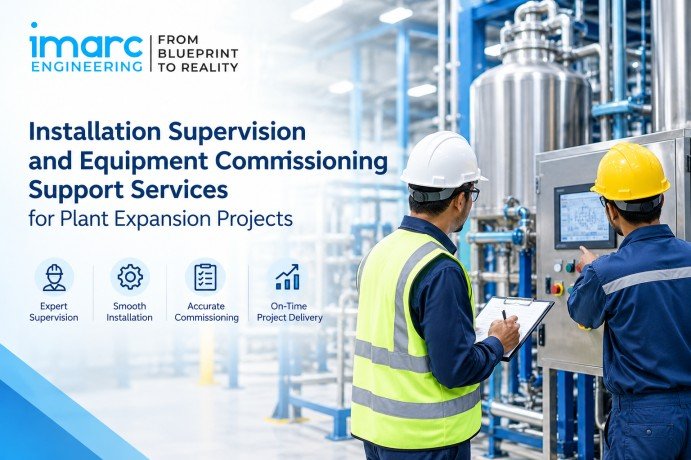
Engineering Installation and Commissioning Support
When a manufacturer expands production capacity, the phase that actually determines success isn’t the day new equipment arrives , it’s the weeks that follow, when it has to be installed correctly, tested properly, and handed over to a production team that can run it reliably. This is a phase where poor coordination can quickly lead to schedule delays, rework, and added costs, yet it typically gets the least planning attention compared to design and procurement.
This guide covers what installation supervision and equipment commissioning services involve, why they matter more in an operating (brownfield) plant than a new one, and how to structure the work so equipment moves from “delivered” to “reliably producing” with minimal rework.
Why This Phase Determines Whether an Expansion Project Succeeds
Most capacity expansion budgets and schedules are built around engineering and procurement milestones, with less attention on what happens once equipment starts arriving. This is where small errors compound:
- A foundation poured to the wrong elevation forces re-grouting weeks later
- A motor wired for the wrong rotation direction can damage a pump during initial startup
- An instrument installed but never loop-checked fails silently during a production trial
- A new line’s utility draw exceeds what the existing compressor or transformer was sized for
None of these are unusual , they’re ordinary, preventable failures from installation and commissioning being handled informally rather than actively supervised.
Installation Supervision and Commissioning Are Not the Same Activity
These two terms are often used interchangeably, but they answer different questions.
Installation supervision asks: was this built correctly? It covers foundations, alignment, piping, cabling, and physical assembly, checked against approved drawings.
Equipment commissioning asks: does this work correctly? It covers energization, functional testing, interlocks, and control logic , and eventually whether the equipment delivers its required output.
A useful way to separate the two:
| Installation Supervision | Commissioning |
| Physical positioning and fastening | Energization and startup |
| Foundation and alignment checks | Functional and interlock testing |
| Cable and piping termination | Loop checks and control logic verification |
| Visual and dimensional inspection | Output and performance verification |
Clients sometimes procure only one of the two. The safer approach is to treat installation supervision and equipment commissioning as one continuous scope, since decisions made during installation , like cable routing or sensor placement , directly affect how smoothly commissioning goes later.
Before Equipment Arrives: The Readiness Check Many Projects Skip
A large share of installation delays trace back to one cause: equipment arrived before the site was ready. A short readiness check before delivery helps avoid this:
- Foundations cured and anchor bolts positioned per the approved layout
- Crane or rigging access confirmed, lifting capacity matched to equipment weight
- Temporary power available where required for testing before permanent supply is energized
- Storage and preservation conditions arranged in case installation is delayed
- Required work permits, access approvals, and site safety controls in place
Skipping it often means equipment sits exposed to weather or dust while waiting, creating warranty complications.
Receiving Inspection: Catching Problems Before They’re Installed
Every piece of equipment should be inspected on arrival, not assumed to be fine because it looks intact. A basic check should confirm:
- Model, serial number, and quantity match the purchase order
- No shipping damage, corrosion, or missing components
- Accessories, spare parts, and special tools accounted for
- Documentation (manuals, certificates, datasheets) arrived with the unit
- Preservation requirements checked against OEM recommendations, especially if stored before installation
Photographing critical equipment at receipt is a small habit that avoids arguments over warranty claims later.
Supervising the Physical Installation
Mechanical Work
Foundation elevation and flatness, anchor-bolt position, shaft or coupling alignment, torque values, and piping stress and support need checking against the vendor’s tolerances, not a generalized assumption, since tolerances vary by equipment type.
Electrical Work
Electrical installation is where the project moves toward energization. Supervision should confirm cable termination, earthing continuity, motor rotation direction, and protection settings , verified with insulation resistance and continuity testing before energizing for real. Rotation should be checked before coupling or load operation, where applicable.
Instrumentation and Controls
This is the area most likely to remain invisible until it fails. A loop-check register , tracking each instrument from installation through calibration, termination, I/O verification, and functional testing , helps distinguish equipment that’s mechanically finished from equipment that’s actually ready to run under automated control.
The Concept That Prevents Most Startup Problems: Mechanical Completion
“Mechanical completion” is a specific, defined project milestone based on agreed criteria , not a general impression that installation “looks done.” It means the agreed scope has been completed, inspected, and documented, including alignment reports, pressure-test records, torque records, and a defined punch list.
Treating mechanical completion as a formal checkpoint, rather than moving straight from “installed” to “commissioning,” prevents commissioning teams from discovering installation gaps mid-startup.
Commissioning: From Energization to Proven Performance
A workable commissioning sequence typically runs:
- Pre-commissioning , cleaning, flushing, calibration, and testing before energization
- System/subsystem readiness checks , confirming each system is genuinely ready, not just physically complete
- Energization , introducing power, instrument air, and utilities in sequence
- Functional testing , checking start/stop sequences, interlocks, alarms, and emergency stops
- Dry runs , operating equipment without production material
- Process trials , introducing real process conditions progressively
- Performance testing , measuring actual output against the criteria the investment was justified on
- Handover , transferring documentation, training, and accountability to the production team
Performance testing is where commissioning earns its value. A machine running for half an hour proves it starts , it doesn’t confirm the expansion delivers the capacity or throughput the business case promised. Performance testing is the step that actually confirms it.
Documents and Records Required During Installation and Commissioning
A commissioning process is only as credible as the records behind it: approved drawings, OEM manuals, inspection checklists, alignment/torque reports, calibration certificates, loop-check sheets, electrical test reports, punch lists, and performance-test/as-built documentation , kept together rather than scattered, since that’s what an audit or warranty claim will need later.
Brownfield Expansion Adds a Layer Most Checklists Miss
Expanding an operating plant differs from building on a clean site. New installation work has to coexist with production that’s still running, introducing risks a greenfield checklist won’t cover:
- Utility competition , new equipment may draw more power, water, or air than the existing supply was sized for
- Shutdown dependency , tie-ins may require downtime on lines still generating revenue
- Automation integration , new PLC/DCS equipment often must interface with older, undocumented controls
- Safety interfaces , new equipment can shift fire load, hazardous-area boundaries, or egress routes unnoticed
- Access conflicts , new installations can unintentionally block maintenance access to existing equipment
Interface management , coordinating what’s new against what’s already running , is one of the most critical aspects of brownfield commissioning, since new systems must operate alongside existing production rather than in isolation.
A Short Checklist Before Declaring the Expansion “Done”
- Startup-critical (Category A) punch items closed, per the project’s classification
- Loop checks and interlock tests documented, not just performed
- Performance results compared against the original business case
- As-built drawings, O&M manuals, and spare-parts lists handed over
- Operators trained on the actual installed configuration
- Warranty documentation and test records filed together
Common Mistakes Worth Avoiding
- Starting installation before the site is genuinely ready, not just “mostly ready”
- Relying solely on OEM supervision without independent coordination of plant-wide interfaces
- Writing the commissioning plan only after construction finishes, instead of letting it shape sequencing
- Ignoring utility capacity until equipment is installed and unable to run
- Carrying major punch items into startup instead of closing them beforehand
- Treating a successful startup as proof of success instead of measuring performance
How IMARC Engineering Can Help
IMARC Engineering supports plant expansion projects through site-readiness verification, independent installation supervision, and structured equipment commissioning across mechanical, electrical, and instrumentation systems, coordinating multiple vendors. For brownfield sites, the focus is managing interfaces with existing production so new equipment is commissioned safely and handed over ready to meet performance targets.
Consult With An Expert: https://www.imarcengineering.com/contact?service=installation-supervision-and-equipment-commissioning
Conclusion
Plant expansion projects are rarely lost at the design or procurement stage , they’re lost during installation and commissioning, where physical work, documentation, and coordination across multiple contractors all have to come together before startup. Treating installation supervision and equipment commissioning as one structured scope, rather than something handled informally, is what separates an expansion that hits its performance targets from one that limps through startup. For brownfield projects, the added discipline around interface management pays for itself.
Frequently Asked Questions
- Is commissioning only relevant for large, complex plants?
Even a single new production line benefits from a defined installation and commissioning sequence, because risks such as incorrect rotation, incomplete testing and uncalibrated instruments can occur regardless of project size.
- Who should supervise installation ,the vendor, contractor, or an independent party?
Vendors know their own equipment; contractors execute the build. An independent supervisor is accountable for the whole interface, including how the system fits with what’s already running.
- How long should performance testing run?
Long enough to represent normal operating conditions, not just a best-case run ,this varies by process.
- What’s the difference between installation supervision and equipment commissioning?
Supervision verifies equipment was physically built correctly; commissioning verifies it functions and performs as intended once energized.
- What documents are required for equipment commissioning?
Calibration certificates, loop-check sheets, electrical test reports, punch lists, and performance-test and as-built documentation, as outlined earlier.
- Why is commissioning more complex in brownfield projects?
New systems must integrate with utilities, automation, and safety systems already serving an operating plant, rather than a blank site.
Contact Us:
IMARC Engineering
Phone: +91-120-433-0800
Email: sales@imarcengineering.com
India: C-130, Sector 2, Noida, Uttar Pradesh 201301
LinkedIn: https://www.linkedin.com/showcase/imarc-engineering/
About the Author