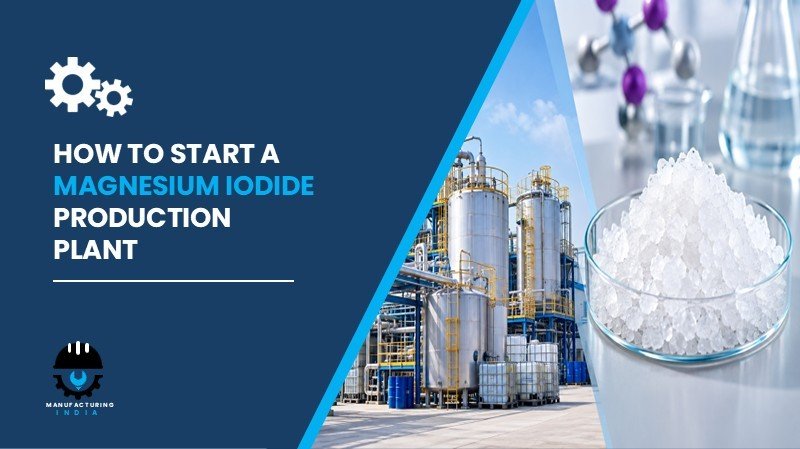
A magnesium iodide production plant setup in India presents a compelling investment case for entrepreneurs targeting the pharmaceutical, specialty chemicals, and laboratory reagent sectors. It serves as a valuable source of iodine and magnesium in chemical synthesis and specialized laboratory applications, supporting its use across pharmaceutical formulations, organic synthesis, research chemicals, and other niche industrial processes. As pharmaceutical manufacturers, chemical companies, and research organizations increasingly demand high-purity inorganic salts, a well-positioned magnesium iodide production plant can capture consistent, value-added demand.
India’s growing pharmaceutical and specialty chemicals base makes the country a strategically sound location for this production. The Indian pharmaceutical market is expected to grow 7-9% in FY26, driven by robust domestic demand, new product innovation, and expansion into Europe, according to IBEF. Asia Pacific as a whole accounts for approximately 40.3% of the global market, with India among the key growth regions on the back of expanding chemical production capacity, pharmaceutical production, and research activity. Government initiatives supporting domestic pharmaceutical and specialty chemicals development further strengthen the case for this production.
Backed by a growing pharmaceutical and specialty chemicals base, favourable policy support, and healthy gross margins of 30-40%, this investment offers a cost-competitive route to serving demanding research and industrial applications, with viable break-even potential for investors who prioritize consistent purity and reliable supply.
What is Magnesium Iodide?
Magnesium iodide is an inorganic chemical compound with the molecular formula MgI₂. It is a highly hygroscopic, odourless, white crystalline solid that readily absorbs ambient moisture, forming hydrates such as its hexahydrate or octahydrate forms, and tends to decompose and turn brown on exposure to air and light due to the release of elemental iodine. Structurally, it forms a layered ionic lattice of magnesium cations sandwiched between stacked layers of iodide anions. Highly soluble in water and alcohols, it is typically synthesized by treating magnesium oxide with hydroiodic acid.
The magnesium iodide production process centers on the neutralization of magnesium oxide (MgO) with hydrogen iodide, followed by filtration, concentration, crystallization, drying, and packaging. It functions primarily as a reagent in organic synthesis, serving end-use industries including pharmaceutical, chemical, laboratory, nutritional supplements, agriculture, and industrial production.
Cost of Setting Up a Magnesium Iodide Production Plant in India
The cost of setting up this facility depends on capacity, technology, automation level, site location, and regulatory compliance requirements.
1. Capital Expenditure (CapEx)
Land and site development form a substantial part of the overall investment, covering land registration, boundary development, and related charges; investors can evaluate industrial estates or dedicated chemical zones to streamline compliance and utility access. Civil works and construction costs cover the production shed, quality-control laboratory, storage areas, and the administrative block, all planned to support safe and efficient operations.
Machinery costs account for the largest portion of total capital expenditure. Key machinery required includes:
- Reaction vessels
- Agitators
- Filtration units
- Evaporators/concentrators
- Crystallizers
- Centrifuges
- Vacuum dryers
- Milling/sieving machines
- Packaging machines
Other capital costs include effluent treatment plant installation, pre-operative expenses, commissioning costs, and import duties on specialized, corrosion-resistant equipment.
Request a Sample Report for In-Depth Market Insights: https://www.imarcgroup.com/magnesium-iodide-production-plant-project-report/requestsample
2. Operational Expenditure (OpEx)
Raw material cost is the single largest component of operating expenditure, with magnesium oxide and hydrogen iodide together accounting for approximately 55-65% of total OpEx. Long-term supplier contracts help mitigate price volatility and ensure a consistent supply.
Utility costs, covering electricity, water, and steam for the reaction, concentration, and drying stages, account for approximately 12-18% of OpEx. Other operating costs include transportation, packaging, salaries, depreciation, taxes, and maintenance. By the fifth year, total operational cost is expected to increase substantially due to inflation, market fluctuations, and rising raw material costs.
3. Plant Capacity
The proposed magnesium iodide production plant is designed with an annual production capacity ranging between 500 and 2,000 MT, enabling economies of scale while maintaining operational flexibility. Capacity can be customized to suit individual investor requirements, and profitability generally improves with higher capacity utilization as fixed costs are spread across greater output.
4. Profit Margins and Financial Projections
The project demonstrates healthy profitability potential under normal operating conditions. Gross profit margins for a magnesium iodide production plant typically range between 30-40%, while net profit margins range between 15-22%, supported by stable demand and value-added applications. Financial projections, including net present value, internal rate of return, and payback period, are developed based on realistic assumptions covering capital investment, operating costs, and demand outlook.
Why Set Up a Magnesium Iodide Plant in India?
Crucial Chemical and Pharmaceutical Intermediate: It serves as a valuable source of iodine and magnesium in chemical synthesis, positioning it as a specialized intermediate with relevance across pharmaceuticals, organic synthesis, and research chemicals.
Megatrend Alignment: The expanding pharmaceutical, specialty chemicals, research, and advanced materials sectors are supporting demand for high-purity inorganic salts. Increasing R&D activity and complex synthesis routes are creating further opportunities for producers in this space.
Policy and Regulatory Tailwinds: Government initiatives supporting domestic pharmaceutical production, specialty chemicals, and research infrastructure are indirectly supporting demand for such intermediates, while investment in local capabilities can reduce dependence on imports.
Cost-Competitive Production: Entry barriers are moderate but real: the facility does not require the capital intensity of large-scale specialty chemical plants, yet stringent purity requirements favour experienced producers who can manage cost-effective land, labour, and supply chain access.
Active Industry Demand Growth: The Indian pharmaceutical market is projected to grow 7-9% in FY26, per IBEF, fueled by domestic demand, new product innovation, and expansion into Europe, while Asia Pacific overall represents approximately 40.3% of the global market.
Local Supply Chain Preference: Pharmaceutical, chemical, and research organizations increasingly favour dependable local suppliers to shorten lead times, maintain purity, and ensure uninterrupted availability, creating opportunities for regional producers with efficient sourcing.
Production Process – Step by Step
The magnesium iodide production process uses the neutralization/reaction of magnesium oxide with hydrogen iodide as the primary production method, involving the following steps:
- Collection of Raw Materials: Sourcing magnesium oxide and hydrogen iodide (magnesium and iodine-based inputs) from qualified suppliers.
- Reaction: Reacting magnesium oxide with hydrogen iodide under controlled conditions.
- Heating and Dissolution: Heating the reaction mixture to promote complete dissolution.
- Neutralization and Filtration: Neutralizing the solution and passing it through filtration units to remove impurities.
- Concentration: Concentrating the filtered solution using evaporators/concentrators.
- Crystallization and Drying: Crystallizing the concentrated solution and drying it using vacuum dryers to obtain the solid product.
- Milling and Sieving: Processing the dried crystals through milling/sieving machines for uniform particle size.
- Quality Testing and Packaging: Conducting quality checks before packaging the finished product for dispatch to pharmaceutical, chemical, laboratory, and agricultural end users.
Key Applications
It serves a range of end-use industries as a source of magnesium and iodide.
- Pharmaceuticals: Iodine-containing compounds, pharmaceutical intermediates, and medicinal formulations.
- Chemical production: Iodination reactions, organic synthesis, and specialty chemical intermediates.
- Laboratory and Research: Chemical synthesis, analytical applications, and research reagents.
- Agriculture: Micronutrient formulations, iodine-based agricultural chemicals, and specialty fertilizers.
Leading Manufacturers
Leading producers in the global industry include several multinational companies with diverse application portfolios:
- Alfa Aesar (Thermo Fisher Scientific)
- American Elements
- Merck KGaA
- Santa Cruz Biotechnology
- Tokyo Chemical Industry Co., Ltd. (TCI)
- Loba Chemie
Timeline to Start the Plant
- Feasibility study and project report preparation
- Land acquisition and site development
- Regulatory approvals and environmental clearances
- Factory licence and fire safety compliance
- Machinery procurement and installation
- Raw material supplier agreements and supply chain setup
- Trial production and quality testing
- Commercial production launch
This timeline typically spans 12 to 36 months, depending on plant scale, environmental permits, and equipment sourcing.
Licences and Regulatory Requirements
Starting this production unit in India requires several approvals:
- Business registration (Proprietorship, LLP, or Pvt Ltd)
- Factory Licence under the Factories Act
- Environmental Clearance from State Pollution Control Board
- GST Registration
- Fire Safety NOC
- Hazardous/Chemical compliance (for iodine and hydrogen iodide handling)
- Effluent Treatment Plant (ETP) operational clearance
- Occupational Health and Safety compliance
Key Challenges to Consider
High Capital Requirements: Capital needs cover land, construction, equipment, installation, pre-operative expenses, and working capital, with the total varying by capacity, technology, and location.
Raw Material Price Volatility: Magnesium oxide and hydrogen iodide prices can fluctuate, directly affecting operating costs since raw materials account for 55-65% of OpEx.
Regulatory Compliance: Securing environmental clearances, factory licences, and chemical-handling permits requires careful planning and ongoing adherence.
Quality and Purity Pressure: Stringent purity requirements and moisture-sensitive handling create operational hurdles that favour experienced producers.
Competition: Established global players such as Alfa Aesar, American Elements, Merck KGaA, and Loba Chemie represent significant competition for new entrants in the magnesium iodide production plant space.
Skilled Manpower: Recruiting skilled labour for chemical handling and quality assurance remains an ongoing operational challenge.
Frequently Asked Questions
1. How much does it cost to set up a magnesium iodide production plant in India?
Costs depend on plant capacity, technology, and location, covering land, construction, equipment, installation, and working capital.
2. Is magnesium iodide production profitable in India in 2026?
Profitability depends on market demand, production efficiency, and raw material cost management, with gross margins typically 30-40% and net margins 15-22%.
3. What machinery is required for a magnesium iodide plant in India?
Essential machinery includes reaction vessels, agitators, filtration units, evaporators/concentrators, crystallizers, centrifuges, vacuum dryers, milling/sieving machines, and packaging machines.
4. What licences and approvals are required to start a magnesium iodide plant in India?
Requirements typically include business registration, environmental clearances, factory licences, fire safety certifications, GST registration, and chemical-handling permits.
5. What raw materials are needed for magnesium iodide production?
The primary raw materials are magnesium oxide and hydrogen iodide, which together account for 55-65% of operating expenses.
6. What are the environmental compliance requirements for a magnesium iodide plant in India?
Plants must secure environmental clearance from the State Pollution Control Board, install an effluent treatment plant, and maintain emission and waste-handling compliance.
7. What is the best location to set up a magnesium iodide plant in India?
Ideal sites offer easy access to raw material supplies, proximity to target markets, and robust transportation and utility infrastructure.
8. What is the break-even period for this type of plant in India?
Break-even for a magnesium iodide production plant typically ranges from 3 to 6 years, depending on raw material costs, purity demands, niche market size, and operational efficiency.
9. What government incentives are available for manufacturers in India?
Incentives may include capital subsidies, tax exemptions, reduced utility tariffs, export benefits, or interest subsidies under national or regional industrial policies.
Key Takeaways for Investors
This production opportunity represents a focused investment anchored in growing demand from the pharmaceutical, chemical production, laboratory, and agricultural sectors. Financial viability holds across capacities ranging from 500 to 2,000 MT annually, with gross margins of 30-40% and net margins of 15-22% supporting healthy returns as capacity utilization improves. With Asia Pacific representing approximately 40.3% of the global market and India’s pharmaceutical sector projected to grow 7-9% in FY26, demand for high-purity MgI₂ is well-positioned for sustained, long-term growth.
About the Author