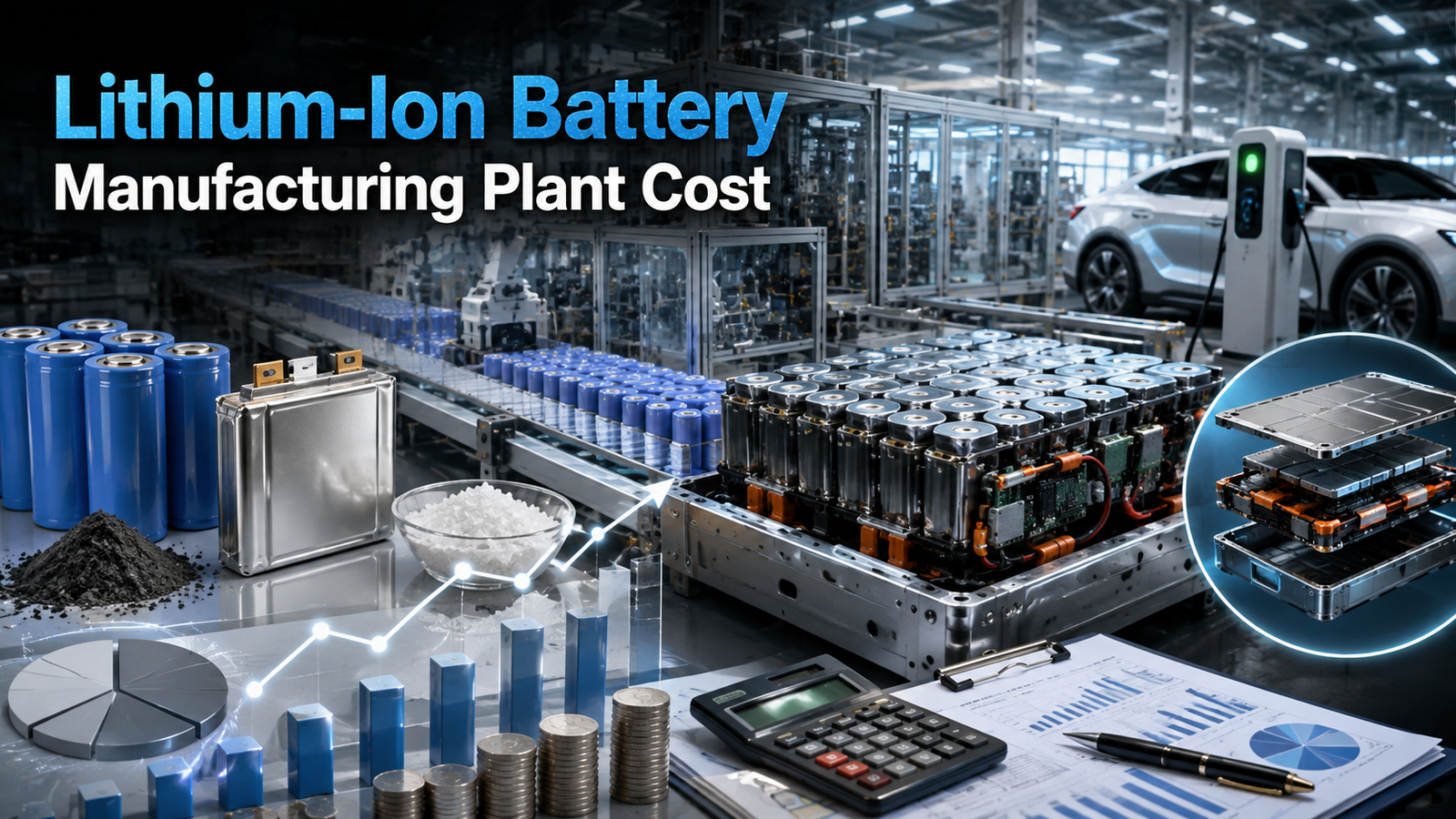
Setting up a lithium-ion battery manufacturing plant in 2026 sits at the intersection of surging global demand and rapidly maturing production technology. The global lithium-ion battery market was valued at USD 59.97 Billion in 2025 and is projected to reach USD 155.16 Billion by 2034, growing at a CAGR of 11.1% between 2026 and 2034. This growth is being driven by the accelerating adoption of electric vehicles (EVs), the rapid expansion of renewable energy storage systems, and the continuing demand from consumer electronics.
For sponsors evaluating a new facility, the lithium-ion battery manufacturing plant cost is shaped by capacity, technology choice, automation level, and site location. A typical proposed facility is designed around an annual production capacity of 5–10 GWh, a scale that balances economies of scale with operational flexibility. Understanding the capital investment, operating cost structure, and profitability outlook before committing to a project is essential for informed decision-making.
This guide answers the investor’s core question: what does it actually cost to set up a lithium-ion battery manufacturing plant, and what factors drive that cost from raw materials to machinery, regulatory approvals, and profitability?
Table of Contents
- Introduction
- Why Lithium-Ion Battery Manufacturing Is a Strategic Investment in 2026
- How to Set Up a Lithium-Ion Battery Manufacturing Plant – Key Considerations
- Lithium-Ion Battery Manufacturing Process Flow
- Lithium-Ion Battery Manufacturing Plant Cost Breakdown
- Raw Material and Machinery Requirements
- Profitability and Financial Outlook
- Regulatory Approvals and Compliance
- Leading Lithium-Ion Battery Manufacturers
- Common Mistakes and Best Practices
- Conclusion
1. Why Lithium-Ion Battery Manufacturing Is a Strategic Investment in 2026
Four structural drivers underpin the strategic case for lithium-ion battery manufacturing investment in 2026.
1.1 Demand Side — EV and Energy Storage Growth
The global push for sustainable transportation and the accelerating adoption of electric vehicles are driving demand for lithium-ion batteries, which offer the energy density and charge cycles required for long-range EVs. In parallel, the growing integration of solar and wind power into electricity grids is increasing the need for battery-based energy storage systems that can bank excess renewable energy for later use.
1.2 Consumer Electronics as a Stable Demand Base
Lithium-ion batteries remain the preferred power source for smartphones, laptops, and tablets, since these devices require lightweight, high-capacity batteries capable of long-lasting power and fast charging. This segment provides a stable, high-volume demand base that complements the faster-growing EV and energy storage segments.
1.3 Technological Advancements
Advancements in battery technology, including improvements in energy density, charging speed, and safety, are expanding the scope of lithium-ion battery applications into industrial equipment, medical devices, and power tools. Manufacturers investing in improved cell chemistry and process automation are better positioned to capture value across a widening set of end-use industries.
1.4 Environmental and Cost Efficiency
Lithium-ion batteries offer a more eco-friendly and energy-efficient alternative to lead-acid and nickel-cadmium batteries, with a longer operational lifespan. This positions lithium-ion technology as the long-term standard across consumer, industrial, and mobility applications, reinforcing sustained investment interest in new manufacturing capacity.
Request for a Sample Report: https://www.imarcgroup.com/lithium-ion-battery-manufacturing-plant-project-report/requestsample
2. How to Set Up a Lithium-Ion Battery Manufacturing Plant — Key Considerations
Setting up a lithium-ion battery manufacturing plant requires evaluating several interconnected factors before construction begins.
2.1 Site Selection
The plant location must offer easy access to key raw materials such as cathode (NMC, LFP), anode graphite, electrolyte, separator, and aluminum/copper foil. Proximity to target markets helps minimize distribution costs, while the site itself must have robust infrastructure — reliable transportation, utilities, and waste management systems — along with compliance with local zoning laws and environmental regulations.
2.2 Plant Layout Optimization
The layout should be optimized to enhance workflow efficiency, safety, and minimize material handling. Separate areas for raw material storage, production, quality control, and finished goods storage must be clearly designated, with space reserved for future capacity expansion.
2.3 Equipment Selection
High-quality, corrosion-resistant machinery tailored for lithium-ion battery manufacturing must be selected, including extruders, electrolyte mixing systems, battery assembly lines, formation equipment, and quality control testing systems. All machinery must comply with industry standards for safety, efficiency, and reliability.
2.4 Raw Material Sourcing
Reliable suppliers must be secured for cathode (NMC, LFP), anode graphite, electrolyte, separator, and aluminum/copper foil to ensure consistent production quality. Sourcing from nearby suppliers helps minimize transportation costs, while long-term supply contracts help stabilize pricing and reduce supply chain risk.
2.5 Safety and Environmental Compliance
Safety protocols must be implemented throughout the manufacturing process, supported by advanced monitoring systems that can detect leaks or process deviations. Effluent treatment systems are necessary to minimize environmental impact and maintain compliance with emission standards.
2.6 Quality Assurance Systems
A comprehensive quality control system should be established across production, using analytical instruments to monitor product concentration, purity, and stability, along with documentation to support traceability and regulatory compliance.
3. Lithium-Ion Battery Manufacturing Process Flow
The manufacturing process is a multi-step operation involving several unit operations, material handling stages, and quality checks.
| Stage | Description |
|---|---|
| Raw Material Sourcing | Procurement of cathode (NMC, LFP), anode graphite, electrolyte, separator, and foil materials |
| Cathode and Anode Preparation | Mixing, coating, and calendaring of electrode materials |
| Electrolyte Preparation | Formulation and handling of the electrolyte solution |
| Cell Assembly | Electrode cutting, stacking or winding, and cell casing |
| Formation and Aging | Initial charge-discharge cycling to stabilize cell chemistry |
| Cell Testing | Performance, safety, and quality verification |
| Packaging | Cell or pack-level packaging for shipment |
| Quality Control and Inspection | Final checks against technical and regulatory specifications |
Beyond the core process stages, a complete feasibility assessment also covers mass balance and raw material requirements, quality assurance criteria, and technical testing protocols specific to lithium-ion cell chemistry.
4. Lithium-Ion Battery Manufacturing Plant Cost Breakdown
Understanding the lithium-ion battery manufacturing plant cost structure enables informed budgeting, financing, and investment planning. The cost structure spans both capital expenditure (CapEx) for setting up the facility and operating expenditure (OpEx) for running it.
4.1 Capital Expenditure (CapEx) Components
| Particulars | Cost Component |
|---|---|
| Land and Site Development Costs | Land acquisition, registration, boundary development |
| Civil Works Costs | Building construction and site infrastructure |
| Machinery Costs | Extruders, mixing systems, assembly lines, formation and testing equipment |
| Other Capital Costs | Pre-operative expenses, installation, and contingencies |
Machinery costs account for the largest portion of total capital expenditure, given the specialized, corrosion-resistant equipment required for electrode production, cell assembly, and formation testing. Land and site development costs, covering registration charges, boundary development, and related expenses, also form a substantial part of the overall investment and help ensure a solid foundation for safe, efficient plant operations. Exact CapEx allocation varies by capacity, automation level, and location — detailed cost splits are available through IMARC Group’s full feasibility report.
4.2 Operating Expenditure (OpEx) Breakdown
| Particulars | Share of OpEx |
|---|---|
| Raw Material Cost | 70-80% |
| Utility Cost | 10-15% |
| Transportation Cost | Available in detailed report |
| Packaging Cost | Available in detailed report |
| Salaries and Wages | Available in detailed report |
| Depreciation | Available in detailed report |
| Taxes | Available in detailed report |
| Other Expenses | Available in detailed report |
Raw material consumption, particularly cathode materials (NMC, LFP), dominates the operating cost structure at 70-80% of total OpEx, making raw material sourcing strategy and long-term supplier contracts one of the most consequential cost-control decisions for any lithium-ion battery manufacturing project. Utility costs — covering electricity, water, and steam for cleanroom and drying operations — account for a further 10-15% of OpEx.
4.3 Investment Scale Considerations
Total capital investment depends primarily on plant capacity, technology selection, and location. The proposed facility scale of 5–10 GWh annual capacity allows sponsors to capture economies of scale in machinery utilization and raw material procurement while retaining operational flexibility to adjust output to market demand. Capital investment covers land acquisition, site preparation, necessary infrastructure, and machinery procurement, with equipment costs representing a significant share of total capital expenditure — driven by the scale of production and the level of automation selected.
5. Raw Material and Machinery Requirements
5.1 Core Raw Materials
Lithium-ion battery production requires key materials including lithium, cobalt, nickel, manganese, and graphite. Additional components include copper and aluminum foils, electrolytes, separators, and casing materials. Because raw materials represent 70-80% of operating costs, securing stable, long-term supply contracts is critical to controlling price volatility and ensuring consistent production quality.
5.2 Machinery and Equipment
A lithium-ion battery factory typically requires mixing and coating machines, calendaring equipment, electrode cutting machines, and stacking or winding machines for cell assembly. Additional equipment includes electrolyte filling stations, formation and testing systems, drying ovens, and cleanroom infrastructure to maintain the controlled environment required for cell production.
5.3 Applications Driving Machinery and Raw Material Demand
- Consumer Electronics: Smartphones, laptops, and tablets, which require lightweight, high-capacity, fast-charging batteries.
- Electric Vehicles (EVs): High energy density cells enabling longer driving ranges.
- Energy Storage Systems: Solar and grid-scale storage supporting renewable energy integration and backup power.
- Industrial Applications: Forklifts, robotics, and power tools that rely on rechargeable, high-output batteries.
6. Profitability and Financial Outlook
6.1 Margin Structure
The project demonstrates healthy profitability potential under normal operating conditions, supported by stable demand and value-added applications.
| Metric | Range |
|---|---|
| Gross Profit Margin | 25-35% |
| Net Profit Margin | 10-15% |
6.2 Break-Even and Payback
Break-even in a lithium-ion battery manufacturing business typically takes 5 to 10 years, depending on plant size, raw material cost management, and market demand. Efficient operations and strong market growth can help shorten this period, while capacity expansion and improved capacity utilization rates generally support margin improvement over time.
6.3 Financial Planning
A detailed financial analysis — covering income projections, expenditure projections, break-even points, liquidity analysis, payback period, net present value (NPV), and internal rate of return (IRR) — is essential to securing project funding and formulating a clear financial strategy. Financing for lithium-ion battery manufacturing projects can be arranged through term loans, government-backed schemes, private equity, venture capital, equipment leasing, or strategic partnerships, with financial viability assessments helping sponsors identify the optimal funding route.
Ask Analyst for Customization: https://www.imarcgroup.com/request?type=report&id=8556&flag=C
7. Regulatory Approvals and Compliance
Setting up a lithium-ion battery manufacturing plant requires navigating a structured set of licenses and approvals, which vary by country, state, and local jurisdiction.
7.1 Core Approval Requirements
Typical requirements include business registration, environmental clearances, factory licenses, fire safety certifications, and industry-specific permits. Local, state, and national regulations may apply depending on plant location, and sponsors should engage regulatory specialists early to avoid commissioning delays.
7.2 Government Incentives
Governments in many jurisdictions offer incentives such as capital subsidies, tax exemptions, reduced utility tariffs, export benefits, or interest subsidies to promote battery manufacturing under national or regional industrial policies. Mapping applicable incentive schemes at the project planning stage can materially improve project economics and financing terms.
7.3 Environmental and Safety Compliance
Effluent treatment systems, emission monitoring, and hazardous material handling protocols must be integrated into plant design from the outset, since lithium-ion cell manufacturing involves solvent handling and process safety considerations that differ from general manufacturing operations.
8. Leading Lithium-Ion Battery Manufacturers
Leading manufacturers in the global lithium-ion battery industry operate extensive production capacities and diverse application portfolios. Key global players include:
- BYD Co., Ltd.
- CALB (China Aviation Lithium Battery Co., Ltd.)
- Contemporary Amperex Technology Co., Ltd. (CATL)
- EVE Energy Co., Ltd.
- LG Energy Solution Ltd.
- Panasonic Holdings Corporation
- Samsung SDI Co., Ltd.
- SK On Co., Ltd.
- Tesla, Inc.
These companies serve end-use sectors spanning consumer electronics, electric vehicles, energy storage systems, industrial equipment, and medical devices, setting the competitive benchmark that new entrants must plan against on cost, quality, and scale.
9. Common Mistakes and Best Practices
9.1 Underestimating Raw Material Exposure
Since raw materials account for 70-80% of operating costs, sponsors who underestimate cathode and critical mineral price volatility face margin compression. Discipline: negotiate long-term supplier contracts early and diversify raw material sourcing across regions.
9.2 Overlooking Utility and Infrastructure Planning
Cleanroom, drying oven, and formation-testing operations are energy-intensive, and utility costs (10-15% of OpEx) can escalate if power and water infrastructure are not planned at the site-selection stage. Discipline: verify utility tie-up and infrastructure capacity before finalizing site selection.
9.3 Underestimating Timeline to Commercial Production
Sponsors that plan commercial revenue immediately on commissioning often face delays, since qualification trials, regulatory approvals, and ramp-up add materially to the project timeline. Discipline: build regulatory approval and customer qualification timelines into the financial model from day one.
9.4 Insufficient Quality and Safety System Investment
Cutting corners on quality assurance and safety monitoring systems increases the risk of costly retrofits, compliance failures, or product recalls. Discipline: integrate quality control instrumentation and safety monitoring into plant design at the engineering phase, not as a retrofit.
Conclusion
Setting up a lithium-ion battery manufacturing plant in 2026 is a capital-intensive but structurally attractive investment, backed by a global market projected to more than double from USD 59.97 Billion in 2025 to USD 155.16 Billion by 2034. A facility sized at 5–10 GWh annual capacity, supported by disciplined raw material sourcing, efficient utility planning, and rigorous quality systems, can achieve gross margins of 25-35% and net margins of 10-15% under normal operating conditions.
Three closing reminders. First, treat raw material sourcing strategy as the single most consequential cost-control decision, given its 70-80% share of operating expenses. Second, plan utility and infrastructure tie-up at the site-selection stage rather than after construction begins. Third, build regulatory approval and customer qualification timelines into the financial model early, since break-even in this industry typically takes 5 to 10 years.
PLANNING A LITHIUM-ION BATTERY MANUFACTURING INVESTMENT?
IMARC Group’s detailed project report provides the complete roadmap for setting up a lithium-ion battery manufacturing unit — covering process flow, raw material and machinery requirements, capital and operating cost structure, profitability analysis, and regulatory considerations needed to evaluate project feasibility with confidence.
Frequently Asked Questions:
How much does it cost to set up a lithium-ion battery manufacturing plant? Capital requirements generally include land acquisition, construction, equipment procurement, installation, pre-operative expenses, and initial working capital. The total amount varies with capacity, technology, and location, with detailed cost breakdowns available through a full feasibility report.
What is the typical capacity of a lithium-ion battery manufacturing plant? A proposed facility is typically designed with an annual production capacity ranging between 5–10 GWh, balancing economies of scale with operational flexibility.
What share of operating costs comes from raw materials? Raw materials, particularly cathode (NMC, LFP), account for approximately 70-80% of total operating expenses, making it the single largest cost driver in lithium-ion battery manufacturing.
What are the profit margins in lithium-ion battery manufacturing? Gross profit margins typically range between 25-35%, while net profit margins range between 10-15%, supported by stable demand and value-added applications.
How long does it take to set up a lithium-ion battery manufacturing plant? The timeline typically ranges from 18-36 months, depending on plant size, technology selection, equipment procurement, regulatory approvals, and infrastructure development.
How long does it take to break even in a lithium-ion battery manufacturing business? Break-even typically takes 5 to 10 years, based on plant size, raw material cost, and market demand, with efficient operations and strong market growth helping shorten this period.
What raw materials are required for lithium-ion battery production? Key materials include lithium, cobalt, nickel, manganese, and graphite, along with copper and aluminum foils, electrolytes, separators, and casing materials.
Are there government subsidies available for lithium-ion battery manufacturing? Governments may offer incentives such as capital subsidies, tax exemptions, reduced utility tariffs, export benefits, or interest subsidies to promote manufacturing under various national or regional industrial policies.
About the Author