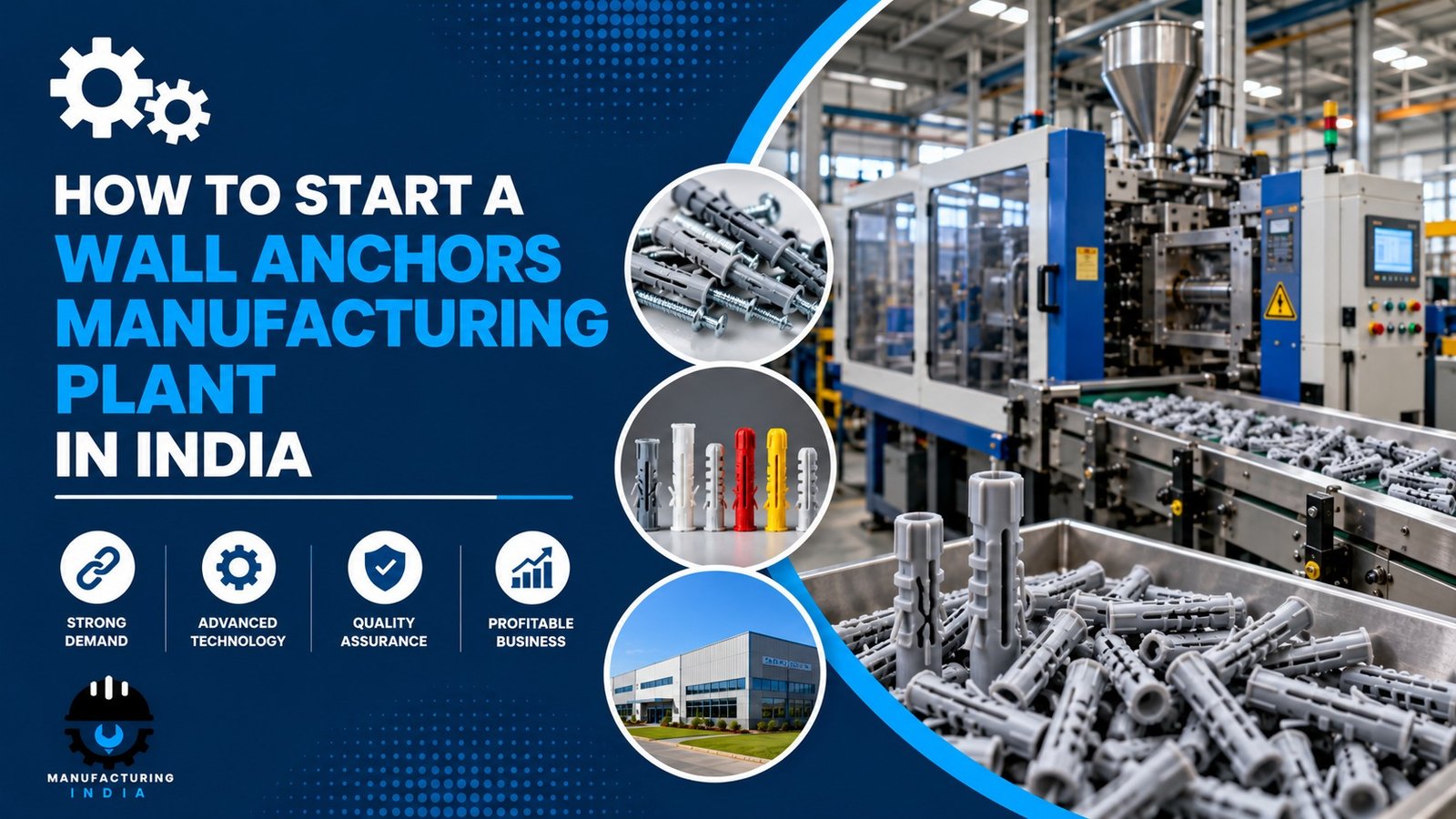
Setting up a wall anchors manufacturing plant in India presents a compelling investment case, driven by demand from construction and building materials, electrical and plumbing installation, furniture and interior fittings, HVAC mounting systems, retail display and shelving installations, and industrial equipment mounting. Wall anchors are fastening components that securely attach screws into substrates that cannot support loads on their own, such as drywall, plaster, hollow block, or masonry, making them essential hardware for mounting fixtures, cabinetry, and structural supports.
The wall anchors market is experiencing sustained growth owing to greater global investments in residential, commercial, and industrial construction, with renovations, fit-outs, and infrastructure upgrades boosting demand for reliable fastening solutions. As more projects move forward, contractors and DIY users require anchors for mounting fixtures, installing drywall, and supporting structural components.
This plant’s investment case is anchored in sustained construction-driven demand, gross margins of 25–30%, and a medium-scale capacity of 250–400 million units per year that lets the facility scale to market reach while working toward measurable payback through NPV and IRR analysis.
What are Wall Anchors?
Wall anchors are fastening components that securely attach screws into substrates that cannot support loads on their own, such as drywall, plaster, hollow block, or masonry. They function by expanding, gripping, or interlocking within the wall material to distribute stress and prevent pull-out failures. Manufactured from plastic, nylon, metal, or fiber-reinforced polymers, they exhibit high tensile strength, dimensional stability, corrosion resistance, and compatibility with various screw types.
Key characteristics include high load-bearing capacity with uniform stress distribution, compatibility with drywall, concrete, and hollow bricks, resistance to vibration-induced loosening, corrosion-resistant surfaces, easy installation with manual or power tools, and the ability to expand, toggle, or interlock for enhanced holding power.
The wall anchors manufacturing process combines injection molding for plastic and nylon anchors with metal forming for metal anchors, followed by heat treatment, surface finishing, assembly, and quality testing, serving construction, electrical and plumbing, furniture, HVAC, retail, and industrial customers.
Cost of Setting Up a Wall Anchors Manufacturing Plant in India
Cost depends on capacity, technology, location, automation, and regulatory compliance.
1. Capital Expenditure (CapEx)
CapEx begins with land and site development, including registration, boundary development, and related expenses, with location analysis and environmental impact assessment shaping the investment. Civil works cover raw material storage, the injection molding section, metal forming area, quality control laboratory, packaging zone, warehouse, and administrative offices.
Machinery costs account for the largest portion of total capital expenditure. Key machinery required includes:
- Injection molding machines
- Precision-engineered molds
- Cooling and ejector systems
- Trimming and deflashing equipment
- Metal stamping, rolling, and machining equipment
- Heat treatment equipment
- Surface coating and plating systems
- Automated assembly lines
- Tensile strength and load testing equipment
- Temperature controllers
- Power distribution and air compression systems
- Automated packaging systems
Other capital costs include utilities, working capital, and pre-operative expenses.
Request a Sample Report for In-Depth Market Insights: https://www.imarcgroup.com/wall-anchors-manufacturing-plant-project-report/requestsample
2. Operational Expenditure (OpEx)
OpEx is dominated by raw material cost. Nylon granules, polypropylene granules, glass fiber, and color masterbatches together account for 55-65% of operating expenses, making raw material price fluctuations the most significant cost factor. Utility cost — electricity, water, fuel, and compressed air — accounts for 8-12% of OpEx. Other costs include transportation, packaging, salaries, and depreciation, with total operational cost expected to rise from year one to year five due to inflation and market fluctuations.
3. Plant Capacity
A medium-scale facility typically runs at an annual capacity of 250-400 million units per year. Capacity can be customised to individual investor requirements, and profitability generally improves with higher capacity utilisation.
4. Profit Margins and Financial Projections
Financial projections cover liquidity assessment, profitability ratios, payback period, NPV, IRR, and sensitivity analysis. Gross and net profit for a typical operation come at around 25-30% and 12-15% respectively, giving a realistic basis for assessing viability.
Why Set Up a Wall Anchors Manufacturing Plant in India?
Sustained Construction-Driven Demand. Greater global investments in residential, commercial, and industrial construction are boosting demand for reliable fastening across renovations, fit-outs, and infrastructure upgrades.
Growing Residential Repair and Retrofit Demand. Rising demand for durable residential foundation repair solutions has brought attention to advanced anchor systems, such as geo-lock systems used to stabilize bowing basement walls without heavy indoor equipment.
Product Innovation and Certification Standards. Manufacturers are integrating advanced polymer engineering and precision molding technologies, exemplified by wedge anchors launched with full ETA certification offering immediate load capacity and high pull-out strength for concrete applications.
Active Global Industry Consolidation. In 2025, Kinderhook Industries announced the acquisition of US Anchors, parent company of TOGGLER®, Wej-It®, and Heckmann®, aiming to accelerate growth across consumer, industrial, and masonry anchoring markets.
Advanced Engineering Fastening Solutions. In February 2025, Fischer introduced HybridPower, the world’s first hybrid anchor combining the simplicity of plastic plugs with the strength of steel anchors, engineered for high load-bearing capacity and fire-resistant performance.
Expanding Industrial and Mining Applications. In October 2025, Sandvik Mining unveiled its Fast Cable Anchor, a rapid-install ground support system that eliminates long grout-curing delays, showing how anchor technology is diversifying into heavy industrial use.
Manufacturing Process – Step by Step
The wall anchors manufacturing process uses injection molding, metal forming, and assembly as its primary production methods.
- Raw Material Preparation: Polymers, metal coils, or alloy stock are inspected and conditioned for purity and mechanical consistency.
- Injection Molding: Thermoplastic pellets are melted and injected into precision-engineered molds to form plastic or nylon anchors with ribs, wings, and expansion sections.
- Cooling and Ejection: The molded anchor cools within the mold, after which automated ejector systems remove the part without deformation.
- Trimming and Deflashing: Excess sprues, runners, and flash are removed to maintain accuracy.
- Metal Forming: Metal sheets or rods undergo stamping, rolling, or machining to create anchor sleeves, toggles, or expansion mechanisms.
- Heat Treatment: Metal components are heat-treated to increase hardness, tensile strength, and durability.
- Surface Finishing: Components are coated, plated, or polished to protect against corrosion.
- Assembly: Parts such as screws, wings, sleeves, or toggles are assembled into a functional anchoring unit using automated assembly lines.
- Quality Testing: Each batch is tested for tensile strength, expansion behavior, dimensional accuracy, and load capacity.
- Packaging and Dispatch: Anchors are packaged in polybags, blister packs, or boxed assortments and dispatched to construction, electrical, plumbing, and industrial customers.
Key Applications
Wall anchor output serves a wide range of downstream industries.
- Fixture Mounting: Secures fixtures to drywall and hollow walls.
- Shelving and Cabinetry: Supports mounted shelves, cabinets, and electrical boxes.
- Plumbing Support: Fastens plumbing brackets and pipe supports.
- Décor Installation: Used for hanging artwork, mirrors, and décor items.
- Ceiling and Toggle Systems: Supports installed ceiling anchors and toggle supports.
- Mechanical and HVAC Mounting: Supports mechanical and HVAC components.
Leading Manufacturers
Leading manufacturers in the global wall anchors industry include several companies with extensive production capacities and diverse application portfolios, including:
- Mueller Industries
- MetTube
- AckBrands
- ARROW
- Hilitchi
- JUIDINTO
- Mechanical Plastics Corp.
- Supply Guru
- The Nutty Company, Inc.
- VIGRUE
- WARMQ
Timeline to Start the Plant
- Feasibility study and project report preparation
- Land acquisition and site development
- Regulatory approvals and environmental clearances
- Factory licence and fire safety compliance
- Machinery procurement and installation
- Raw material supplier agreements and supply chain setup
- Trial production and quality testing
- Commercial production launch
Licences and Regulatory Requirements
Starting a wall anchors manufacturing unit in India requires several approvals:
- Business registration (Proprietorship, LLP, or Pvt Ltd)
- Factory Licence under the Factories Act
- Environmental Clearance from State Pollution Control Board
- GST Registration
- Fire Safety NOC
- Industry-specific certifications for load-bearing and safety compliance
- Effluent Treatment Plant (ETP) operational clearance
- Occupational Health and Safety compliance
Key Challenges to Consider
High Capital Requirements. Injection molding machines, metal forming equipment, and assembly lines represent significant upfront investment.
Raw Material Price Volatility. Nylon, polypropylene, glass fiber, and color masterbatches account for 55-65% of OpEx, making price fluctuations a key risk.
Regulatory Compliance. Environmental clearances, load-bearing certifications, and factory licensing require ongoing attention.
Product Innovation Pressure. Advanced polymer engineering and hybrid anchor designs are raising the bar for load performance and certification.
Competition from Established Players. Producers such as AckBrands, ARROW, Hilitchi, and Mechanical Plastics Corp. operate extensive capacities, creating a competitive landscape.
Skilled Manpower. Operating equipment across molding, metal forming, and testing requires trained staff.
Frequently Asked Questions
1. How much does it cost to set up a wall anchors manufacturing plant in India?
Cost depends on capacity, machinery, automation, and site, covering land, civil works, machinery, and other capital costs.
2. Is wall anchors manufacturing profitable in India in 2026?
Gross and net profit for a typical plant come at around 25-30% and 12-15% respectively, supported by sustained construction demand.
3. What machinery is required for a wall anchors plant in India?
Injection molding machines, molds, metal forming and stamping equipment, heat treatment equipment, surface finishing systems, assembly lines, and testing equipment.
4. What licences and approvals are required to start a wall anchors plant in India?
Business registration, a Factory Licence, Environmental Clearance, GST Registration, Fire Safety NOC, ETP clearance, and occupational health and safety compliance.
5. What raw materials are needed for wall anchors manufacturing?
Nylon 6/nylon 66 granules, polypropylene granules, glass fiber, color masterbatches, and, for metal anchors, metal coils or alloy stock.
6. What are the environmental compliance requirements for a wall anchors plant in India?
Environmental Clearance from the State Pollution Control Board, an operational ETP, and occupational health and safety compliance.
7. What is the best location to set up a wall anchors plant in India?
Sites offering proximity to raw materials, infrastructure and transportation access, and skilled labor, selected through location and environmental impact analysis.
8. What is the break-even period for this type of plant in India?
Break-even depends on capacity utilisation, automation level, and the CapEx-OpEx structure, and is assessed through the plant’s payback period, NPV, and IRR analysis.
9. What government incentives are available for manufacturers in India?
The report’s financial analysis evaluates costs and returns based on location-specific factors; applicable industrial incentive programs should be verified against current policy for the chosen site.
Key Takeaways for Investors
This plant taps into consistent demand from construction and building materials, electrical and plumbing installation, furniture and interior fittings, HVAC mounting systems, retail display and shelving, and industrial equipment mounting. Financial viability holds at the medium-scale 250-400 million units per year range, with gross margins of 25-30% and net margins of 12-15%. The global wall anchors market, valued at USD 3.8 Billion in 2025 and projected to reach USD 5.4 Billion by 2034 at a CAGR of 4.12%, underscores sustained demand that should remain durable beyond the current investment cycle.
About the Author