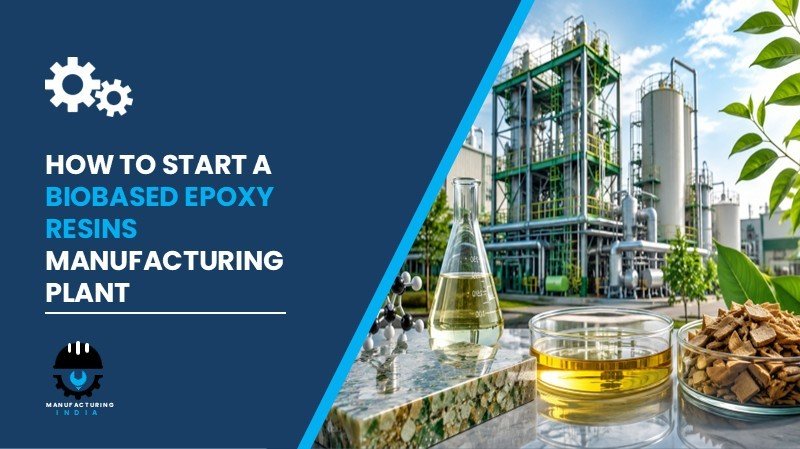
A biobased epoxy resins manufacturing plant setup in India presents a compelling investment case for entrepreneurs seeking to enter a high-growth, sustainability-driven segment of the specialty chemicals industry. Demand is being pulled forward by construction, automotive, electrical & electronics, wind energy, aerospace, marine, coatings, adhesives, and industrial equipment sectors, all of which are steadily replacing petroleum-derived resin systems with renewable alternatives. These bio-based thermosetting polymers have become critical to India’s broader manufacturing economy because they deliver the same mechanical strength, chemical resistance, and adhesive performance as conventional epoxies while cutting volatile organic compound emissions and lowering the carbon footprint of downstream products.
India’s advantages for this kind of production are substantial: rapid urbanisation and infrastructure expansion are driving structural adhesive and coatings demand, the Make in India initiative is encouraging domestic capacity building in specialty polymers, and established chemical manufacturing hubs in states such as Gujarat and Maharashtra offer ready access to feedstock logistics, skilled labour, and export infrastructure. Combined with a growing renewable energy and automotive lightweighting agenda, India is strategically positioned for this kind of facility to serve both domestic and export markets.
This investment benefits from policy support under Make in India, cost-competitive land and labour, strong demand from construction, automotive, wind energy, and electronics sectors, gross margins of 22-32%, and a project structure designed for viable break-even economics.
What are Biobased Epoxy Resins?
Biobased epoxy resins are advanced thermosetting polymers that replace traditional petroleum-derived building blocks with renewable, plant-based materials like vegetable oils, sugars, and lignin. These eco-friendly alternatives match the high mechanical strength, chemical resistance, and strong adhesive qualities of conventional petrochemical epoxies. By utilizing natural feedstocks, manufacturers significantly lower volatile organic compound emissions and reduce their overall carbon footprint.
The primary production route used in a biobased epoxy resins manufacturing plant involves epoxidation of plant oils, bio-based monomer synthesis, glycidylation, blending, curing and purification. This process converts renewable feedstocks such as epoxidized linseed oil (ELO), epoxidized soybean oil (ESBO), lignin-derived vanillin, and glycerol-based epichlorohydrin into performance-grade resin systems. The finished product serves construction, automotive, electrical & electronics, wind energy, aerospace, marine, coatings, adhesives, and industrial equipment industries, where it is used in protective coatings, structural adhesives, electrical insulation, composite materials, wind turbine components, flooring systems, laminates, and corrosion-resistant applications.
Cost of Setting Up a Biobased Epoxy Resins Manufacturing Plant in India
The overall cost of setting up this type of plant depends on capacity, technology, location, automation level, and regulatory compliance requirements.
1. Capital Expenditure (CapEx)
Land and site development form a substantial part of the overall investment, covering land registration, boundary development, and related infrastructure charges; investors can evaluate SEZs or established industrial estates to optimise incentives and utility access. Civil works cover the manufacturing shed, quality control laboratory, storage, and administrative block.
Machinery represents the largest single share of capital expenditure for a biobased epoxy resins manufacturing plant. Key machinery required includes:
- Oil pretreatment and filtration units
- Epoxidation reactors
- Temperature-controlled reaction vessels
- Glycidylation reactors
- Distillation and purification units
- Vacuum systems
- Mixing and blending tanks
- Curing systems
- Filtration units
- Storage tanks
- Packaging machines
Other capital costs include ETP installation, pre-operative expenses, commissioning costs, and import duties on specialised reactor components.
Request a Sample Report for In-Depth Market Insights: https://www.imarcgroup.com/biobased-epoxy-resins-manufacturing-plant-project-report/requestsample
2. Operational Expenditure (OpEx)
Raw material cost is the dominant component of operating expenditure for the facility, accounting for approximately 50-62% of total OpEx. Core inputs include epoxidized plant oils (ELO or ESBO) as the primary biobased epoxy component; vanillin-based diglycidyl ether derived from lignin-derived vanillin; furan diglycidyl ether produced via the HMF-furfural route; and bio-epichlorohydrin derived from glycerol (a biodiesel by-product converted through allyl chloride) combined with a biobased bisphenol-equivalent sourced from fermentation-derived itaconic acid or ferulic acid. Given this concentration, long-term supplier contracts are essential to stabilise pricing and secure consistent feedstock quality.
Utility costs, covering electricity, water, and steam for the epoxidation, glycidylation, and curing stages, account for approximately 12-16% of OpEx. Other operating costs include transportation, packaging, salaries, maintenance, depreciation, and taxes. By the fifth year, total operational cost is expected to rise substantially due to inflation, market fluctuations, and rising raw material and supply chain costs.
3. Plant Capacity
A biobased epoxy resins manufacturing plant is typically designed with an annual manufacturing capacity ranging between 3,000 and 10,000 MT, enabling economies of scale while retaining operational flexibility. Capacity can be customised to individual investor requirements, and profitability generally improves as capacity utilisation increases toward the upper end of this range.
4. Profit Margins and Financial Projections
Financial projections for a biobased epoxy resins manufacturing plant are built on capital investment, operating costs, capacity utilisation, pricing trends, and demand outlook, and cover liquidity analysis, payback period, net present value (NPV), and internal rate of return (IRR). Gross profit margins typically range between 22-32%, supported by stable demand and value-added applications, while net profit margins range between 8-15%. These projections provide a comprehensive view of the project’s financial viability and long-term sustainability.
Why Set Up a Biobased Epoxy Resins Plant in India?
Sustainable High-Performance Material Demand: Biobased epoxy resins provide durable, high-performance alternatives to conventional petroleum-derived epoxy systems, supporting applications that require strong adhesion, chemical resistance, mechanical durability, and thermal stability. This performance parity with petrochemical epoxies makes the product a natural substitution candidate for existing resin buyers.
Megatrend Alignment: Growing adoption of sustainable materials, circular economy practices, low-carbon manufacturing, and environmentally responsible products is driving demand for bio-based alternatives to conventional petrochemical resins across automotive, renewable energy, construction, and electronics industries.
Policy and Sustainability Tailwinds: Government initiatives supporting bio-based materials, carbon reduction, renewable feedstocks, and green manufacturing indirectly support demand growth. India targets reducing its carbon footprint by 30-35% by 2030, per IEA Bioenergy, while corporate ESG commitments push manufacturers toward fossil-free raw materials.
Cost-Competitive Entry with Justifiable Barriers: While formulation capability, consistent bio-based content, and customer qualification create entry hurdles, these favour experienced producers focused on quality – reducing the risk of oversupply from undifferentiated competitors.
Active Industry Innovation: In July 2026, a research study published in Sustainable Materials and Technologies described a bio-based epoxy monomer (GSE-EP) containing dynamic covalent ester bonds, prepared using biomass gallic acid and salicylaldehyde as source materials – signalling continued formulation advancement in the category.
Localization and Supply Chain Preference: Manufacturers and downstream users increasingly favour reliable local suppliers to secure consistent bio-based feedstocks, shorten lead times, and maintain formulation consistency, creating an opening for regional producers with integrated sourcing and strong quality control.
Biobased Epoxy Resins Manufacturing Process – Step by Step
The biobased epoxy resins manufacturing process uses epoxidation of plant oils, bio-based monomer synthesis, glycidylation, blending, curing and purification as the primary production method.
- Raw Material Receipt and Pretreatment: Plant oils and bio-based feedstocks are received and pretreated through oil pretreatment and filtration units.
- Epoxidation of Plant Oils: Pretreated oils such as ELO or ESBO are converted into epoxidized intermediates inside epoxidation reactors under controlled conditions.
- Bio-Based Monomer Synthesis: Additional monomers, including vanillin-based diglycidyl ether and furan diglycidyl ether, are synthesised in temperature-controlled reaction vessels.
- Glycidylation: Epoxidized intermediates and bio-epichlorohydrin undergo glycidylation inside dedicated reactors to build the resin’s reactive epoxy groups.
- Distillation and Purification: Reaction products pass through distillation and purification units alongside vacuum systems to remove residual solvents.
- Blending: Purified resin streams are combined in mixing and blending tanks to achieve target viscosity, reactivity, and mechanical properties.
- Curing and Quality Testing: Sample batches pass through curing systems and undergo testing to verify chemical resistance and thermal stability.
- Filtration, Storage and Packaging: Finished resin is filtered, stored, and packed using packaging machines ahead of dispatch to end-use customers.
Key Applications
Biobased epoxy resins serve a wide base of industries that require durable, chemical-resistant, and increasingly sustainable material solutions.
- Automotive: Used in bio-based composite components, protective coatings, adhesives, and lightweight structural parts.
- Electronics: Applied in encapsulation materials, insulating coatings, circuit board laminates, and electronic adhesives.
- Construction: Deployed in flooring systems, protective coatings, structural adhesives, and composite panels.
- Wind Energy: Used in wind turbine blades, composite components, protective coatings, and structural adhesives.
Leading Manufacturers
The global biobased epoxy resins industry includes several multinational companies with extensive manufacturing capacities and diverse application portfolios. Key players include:
- BASF SE
- Huntsman Corporation
- Olin Corporation
- Hexion Inc.
- Sicomin Epoxy Systems
- Solvay S.A.
Timeline to Start the Plant
- Feasibility study and project report preparation
- Land acquisition and site development
- Regulatory approvals and environmental clearances
- Factory licence and fire safety compliance
- Machinery procurement and installation
- Raw material supplier agreements and supply chain setup
- Trial production and quality testing
- Commercial production launch
Licences and Regulatory Requirements
Starting a biobased epoxy resins manufacturing unit in India requires several approvals:
- Business registration (Proprietorship, LLP, or Pvt Ltd)
- Factory Licence under the Factories Act
- Environmental Clearance from State Pollution Control Board
- GST Registration
- Fire Safety NOC
- Hazardous/Chemical compliance for reactive intermediates such as epichlorohydrin and epoxidation feedstocks
- Effluent Treatment Plant (ETP) operational clearance
- Occupational Health and Safety compliance
Key Challenges to Consider
High Capital Requirements: Machinery such as epoxidation reactors, glycidylation reactors, and distillation and purification units forms a significant share of capital expenditure, requiring phased investment planning.
Raw Material Price Volatility: Prices of epoxidized plant oils, lignin-derived vanillin, and glycerol-based epichlorohydrin can fluctuate with agricultural and biodiesel by-product markets, directly affecting the 50-62% share of OpEx these inputs represent.
Regulatory Compliance: Hazardous chemical handling, environmental clearances, and effluent treatment obligations require ongoing monitoring to remain compliant with state and central regulations.
Technology and Formulation Pressure: Emerging monomer chemistries, such as the GSE-EP bio-based epoxy monomer reported in July 2026, mean producers must continually track formulation research to stay competitive.
Competition from Established Players: Global companies such as BASF SE, Huntsman Corporation, Olin Corporation, Hexion Inc., Sicomin Epoxy Systems, and Solvay S.A. bring scale and diversified portfolios that new entrants must plan around.
Skilled Manpower: Operating epoxidation, glycidylation, and curing systems reliably requires trained process engineers, which can be a constraint in emerging manufacturing clusters.
Frequently Asked Questions
1. How much does it cost to set up a biobased epoxy resins manufacturing plant in India?
Total cost depends on capacity, technology, automation level, and location, with machinery, land and site development, and civil works forming the major capital expenditure components.
2. Is biobased epoxy resins manufacturing profitable in India in 2026?
The segment shows healthy profitability potential, with gross profit margins of 22-32% and net profit margins of 8-15% under normal operating conditions.
3. What machinery is required for a biobased epoxy resins plant in India?
Core machinery includes oil pretreatment and filtration units, epoxidation reactors, temperature-controlled reaction vessels, glycidylation reactors, distillation and purification units, vacuum systems, mixing and blending tanks, curing systems, storage tanks, and packaging machines.
4. What licences and approvals are required to start a biobased epoxy resins plant in India?
Requirements include business registration, a Factory Licence, Environmental Clearance from the State Pollution Control Board, GST Registration, Fire Safety NOC, hazardous chemical compliance, and ETP operational clearance.
5. What raw materials are needed for biobased epoxy resins manufacturing?
Key inputs include epoxidized plant oils (ELO or ESBO), vanillin-based diglycidyl ether, furan diglycidyl ether, and bio-epichlorohydrin combined with a biobased bisphenol-equivalent.
6. What are the environmental compliance requirements for a biobased epoxy resins plant in India?
Plants must secure Environmental Clearance, operate an Effluent Treatment Plant, and maintain hazardous chemical handling protocols in line with State Pollution Control Board norms.
7. What is the best location to set up a biobased epoxy resins plant in India?
Sites should offer easy access to raw material suppliers, proximity to target markets, robust utility infrastructure, and compliance with local zoning rules; established chemical hubs such as Gujarat and Maharashtra are commonly favoured.
8. What is the break-even period for this type of plant in India?
Break-even timing depends on capacity utilisation, pricing, and cost structure, and is assessed as part of the project’s payback period and NPV analysis during feasibility planning.
9. What government incentives are available for manufacturers in India?
Manufacturers can align with the Make in India initiative and national carbon-reduction goals, which target a 30-35% cut in the country’s carbon footprint by 2030, indirectly supporting bio-based material producers through green manufacturing and sustainability-linked programmes.
Key Takeaways for Investors
This investment opportunity taps into strong demand from construction, automotive, electronics, wind energy, and coatings sectors shifting toward sustainable materials. Financial viability holds across the 3,000-10,000 MT capacity range, with gross margins of 22-32% and net margins of 8-15% achievable once raw material and utility costs – together 62-78% of OpEx – are managed through stable supplier contracts. The global biobased epoxy resins market, valued at USD 1.3 Billion in 2025 and projected to reach USD 2.6 Billion by 2034 at a CAGR of 8.0%, points to sustained long-term growth. With policy support and a widening base of sustainability-focused end-users, demand for this type of plant in India is well positioned to remain durable over the coming decade.
About the Author