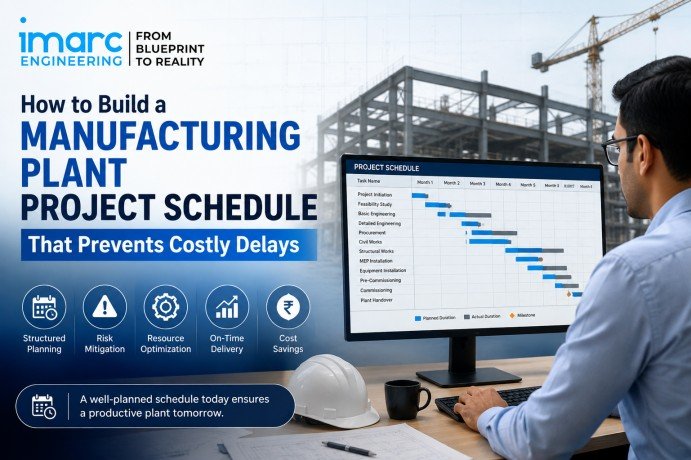
A manufacturing plant project schedule is usually built around one number: the date production must start. Design, procurement, civil works, installation, statutory approvals, and commissioning are then arranged backward from that target. But a target date is not a schedule. A reliable schedule shows how every major activity depends on the others, which resources constrain progress, when long-lead equipment must be available, which approvals can block construction, and how much contingency remains before the production-start date is genuinely at risk. GlobalData’s 2026 tracking shows that 46.6% of Indian construction projects experience delays, a proportion barely moved in a decade despite heavier investment in scheduling software. For both greenfield and brownfield projects, a delay in one workstream quickly spreads into procurement, construction, commissioning, and revenue timing.
This is precisely the gap that structured Manufacturing Plant Project Scheduling services are built to close. Rather than a static Gantt chart handed over at kickoff, these services establish a living schedule baseline tying engineering, procurement, statutory approvals, and construction into one dependency-driven system, monitored continuously rather than reviewed monthly. For sponsors committing significant capital to a new facility, that structure separates a schedule used only for reporting from one actually used to manage risk and protect the production-start date.
Why Manufacturing Plant Schedules Fail
Schedule failures rarely begin with one dramatic event. They begin with weaknesses in how the plan is built and monitored:
- Milestones get mistaken for a dependency network. A schedule listing dates for design completion, foundation work, and commissioning is not a plan that shows what has to happen before each activity can start. A production machine’s real chain runs from purchase order through vendor engineering, drawing approval, manufacturing, FAT, dispatch, installation, and SAT. If those relationships are not built into the master schedule, a vendor delay stays invisible until it hits installation.
- Long-lead procurement gets scheduled too late. Process equipment, transformers, boilers, pressure vessels, and automation packages carry long engineering and manufacturing cycles. A schedule that does not tie these milestones directly to engineering and installation creates downstream risk that only surfaces once it is expensive to fix.
- Regulatory activity gets treated as one generic line item. Environmental clearance, Consent to Establish, Consent to Operate, fire safety approvals, and factory licensing each carry independent submission, query, and resubmission cycles. Deloitte’s 2026 manufacturing risk analysis attributes more than 40% of delays on regulated manufacturing projects to compliance misalignment and documentation gaps rather than engineering or construction failure. Folding all approvals into a single “Statutory Approvals” bar makes that risk invisible until it becomes the critical path.
- Resource constraints get ignored. A schedule may show several activities running in parallel without accounting for whether the project has enough skilled labour, cranes, welding teams, or commissioning specialists to execute them simultaneously.
- Progress gets reported too late. A monthly report may show a project behind schedule, but the slip often started weeks earlier. A 2026 review of Indian construction projects found that most teams discover a delay two to three weeks after it occurred, by which point it has usually compounded.
These weaknesses collectively carry a measurable cost. Roughly 2,000 tracked Indian infrastructure projects above ₹150 crore carried a cumulative overrun of approximately ₹5.66 lakh crore as of April 2026, and capital projects globally run an average of 60% over schedule and more than 70% over budget.
Building a Schedule That Holds Under Pressure
Start From Scope, Not From a Target Date
Begin with a work breakdown structure detailed enough to expose dependencies, constraints, and ownership across engineering, statutory approvals, procurement, civil works, installation, instrumentation, utilities, testing, and commissioning. The goal is not thousands of activities; it is enough granularity that a single vendor drawing delay can be traced to exactly which downstream activities move, and whether that shift touches the critical path.
Map Engineering and Procurement as Schedule-Driving Activities
Engineering deliverables should sit inside the schedule rather than run as a parallel track: process design feeds equipment specifications, which feed vendor enquiry, technical evaluation, purchase order, and vendor drawings. For every critical equipment package, the same baseline as construction should track:
- RFQ issuance and technical bid evaluation
- PO placement and vendor drawing approval
- Manufacturing, inspection, and FAT
- Dispatch and site delivery
- Installation and SAT
so that a supplier’s revised delivery commitment is immediately evaluated against the master schedule rather than surfacing weeks later in an email thread.
Identify the Real Constraint, Not Just the Longest Path
The critical path method identifies the longest sequence of dependent tasks but assumes resources are always available, an assumption that rarely holds on a site sharing labour, cranes, and specialist contractors across activities. Critical chain project management addresses this by identifying the actual constraining resource, a welding capability, a commissioning specialist, a long-lead package, and building buffers around that constraint instead of individual tasks. Eli Lilly and Mazda have used this approach because it exposes resource conflicts a standard Gantt chart hides until they cause a stoppage.
Treat Statutory Approvals as Independent, Float-Bearing Workstreams
Each regulatory activity should carry its own owner, submission date, expected review period, query-response window, and float. This lets a team see whether a clearance is consuming its float before it becomes the critical path itself, which matters most where a plant’s economics depend on qualifying within a PLI or similar calendar-bound incentive window.
Add Schedule Risk Analysis and Earned Value Tracking
Deterministic durations understate uncertainty around equipment delivery, engineering approvals, and vendor performance. Three-point estimating, and Monte Carlo simulation for larger projects, can convert a single completion date into a probability-based one, such as an 80% likelihood of finishing by a given target, a far more useful basis for investment decisions than a fixed date. Alongside this, Earned Value Management compares planned value, earned value, and actual cost to produce Schedule and Cost Performance Index readings that flag deterioration before it shows up as a missed milestone.
Set a Review Cadence That Matches the Detection Lag
A monthly steering committee cannot close a two-to-three-week detection gap. A shorter cadence closes it instead:
- Daily — site-level constraint and safety review
- Weekly — look-ahead planning tied to buffer consumption and earned value trends
- Fortnightly — integrated engineering, procurement, and construction review
- Monthly — management-level review of schedule, cost, risk, and forecast completion
This structure lets project leadership intervene while recovery still means resequencing rather than paying for acceleration.
Greenfield vs Brownfield Scheduling
Greenfield projects allow a relatively clean construction sequence across land development, civil works, procurement, and commissioning, though EPC interfaces still need tight control. Brownfield projects are structurally harder: the schedule must account for existing-asset surveys, shutdown planning, tie-ins, isolation permits, and recommissioning validation, and the production shutdown window itself often becomes the binding constraint, capable of making a minor modification schedule-critical.
Where Technology Is Changing Schedule Reliability
AI-assisted analytics, layered onto platforms such as Primavera P6 and Microsoft Project, flag likely slippage points by comparing a live schedule against outcomes on comparable past projects rather than relying solely on planner judgment. 4D BIM ties the schedule to the physical model, letting teams visualise sequencing and spatial conflicts before they cause field rework. Digital twins are extending beyond post-commissioning facility management into execution itself, giving teams a live reference to test schedule changes before committing them to the field. None of these tools replace project controls; they compress the time between a deviation occurring and becoming visible.
Recovering a Delayed Schedule
Recovery starts with identifying the driving cause, then weighing the available levers against the cost of acceleration:
- Resequencing — reordering activities without compromising safety or quality
- Fast-tracking — overlapping normally sequential activities
- Crashing — adding labour or shifts to compress a duration
- Procurement expediting — accelerating manufacturing, inspection, or dispatch
- Progressive commissioning — starting system-level commissioning before full plant readiness
The right strategy closes the schedule gap most economically, not the one that looks most decisive on a status report.
How IMARC Engineering Supports Manufacturing Plant Scheduling
IMARC Engineering builds manufacturing plant schedules around genuine dependency networks rather than milestone lists, integrates procurement and statutory clearance tracking into the same baseline as construction, and applies buffer and earned value monitoring to surface slippage while it is still cheap to correct. For greenfield and brownfield projects alike, the goal is a schedule that can answer, at any point, what is supposed to happen, what has actually happened, what is preventing the next activity, and what it will cost to recover.
A manufacturing plant schedule is only as reliable as the dependencies it makes visible and the constraints it accounts for before they reach the critical path. That discipline, built in from the outset, costs less than recovering from the alternative.
Speak With An Expert: https://www.imarcengineering.com/contact?service=project-scheduling-and-cost-estimation
Conclusion
A manufacturing plant schedule is only as reliable as the dependencies it makes visible and the constraints it accounts for before they reach the critical path. Milestone lists, generic approvals, and monthly reports hide risk until it is costly to fix. A schedule built on a true dependency network, with procurement, approvals, and resources tracked against one baseline, surfaces slippage while recovery still means resequencing rather than acceleration cost, protecting the production-start date at far less cost than the alternative.
Contact Us:
IMARC Engineering
Phone: +91-120-433-0800
Email: sales@imarcengineering.com
India: C-130, Sector 2, Noida, Uttar Pradesh 201301
LinkedIn: https://www.linkedin.com/showcase/imarc-engineering/
About the Author