Introduction
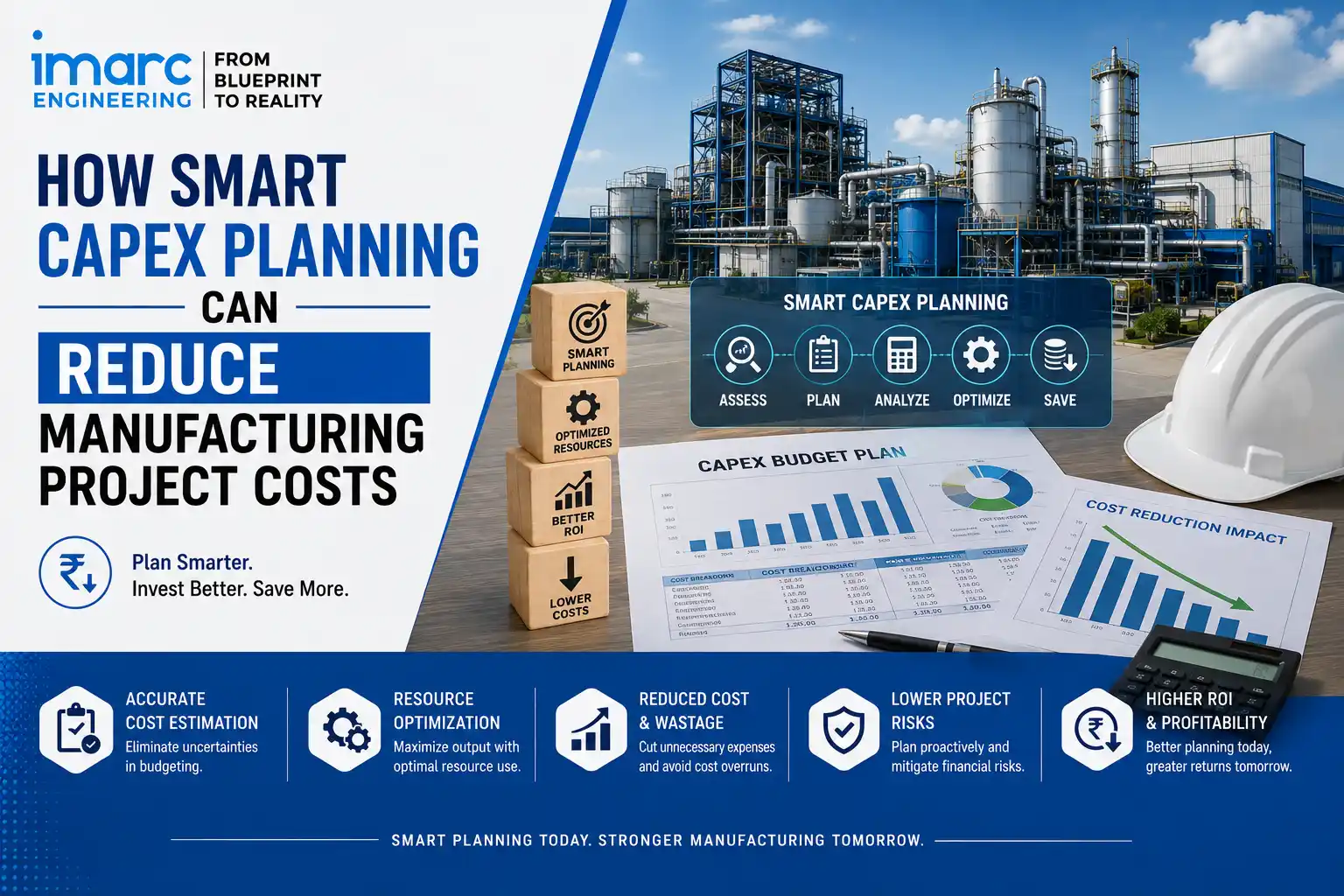
Smart CAPEX planning is one of the most effective ways to control manufacturing project costs — yet it is often reduced to an equipment list and a simple contingency allowance.
Manufacturing plant CAPEX planning provides a structured way to estimate, structure and control these costs before major procurement and construction commitments are made. Once orders are placed and civil work starts, hidden costs can surface through under-scoped utilities, missing soft costs, interface rework, late design changes, and contingency that was never sized for the actual project risk. These problems are rarely visible in a high-level quotation. They become clear only when capital expenditure is planned against full scope, realistic rates and clear risk buffers before major commitments are made.
IMARC Engineering provides CAPEX planning and manufacturing project advisory across India. This article explains how smart CAPEX planning can reduce manufacturing project costs, which cost drivers matter most, and why disciplined estimation protects both budget and schedule.
What Is Manufacturing Plant CAPEX Planning?
Manufacturing plant CAPEX planning is the process of estimating, structuring and controlling the capital required to establish a new manufacturing facility or expand an existing one. It typically covers land and site development, civil and structural works, process equipment, utilities, installation, engineering, approvals, commissioning and contingency.
A reliable CAPEX plan connects these cost elements with the project’s process scope, plant capacity, technology, layout, implementation schedule and financial assumptions. This gives project owners a clearer investment baseline before procurement and construction commitments are made.
Why CAPEX Discipline Matters for Indian Manufacturing Projects
India’s manufacturing investment continues to expand under policy support and rising capacity demand.
- Manufacturing recorded 11.5% real GVA growth in FY 2025-26, according to MoSPI’s provisional estimates released in June 2026.
- FDI into manufacturing rose 18% in FY 2024-25 to US$19.04 billion (Ministry of Commerce & Industry / DPIIT).
- India recorded US$81.04 billion in gross FDI inflows in FY 2024-25, while manufacturing FDI increased 18% to US$19.04 billion, according to government data.
- PLI schemes across 14 sectors had attracted more than ₹2.16 lakh crore in cumulative investment and generated more than ₹20.41 lakh crore in cumulative production/sales as of December 31, 2025.
- India’s logistics cost was estimated at 7.97% of GDP for 2023-24, according to the DPIIT-NCAER assessment.
As more plants are built and expanded, project-level cost control decides whether that capital delivers expected returns. Smart CAPEX planning reduces manufacturing project costs by preventing the overruns that start with incomplete scope and optimistic assumptions.
Where Manufacturing Project Costs Usually Inflate
Most CAPEX overruns follow a familiar pattern:
- Equipment quotations treated as the full project cost
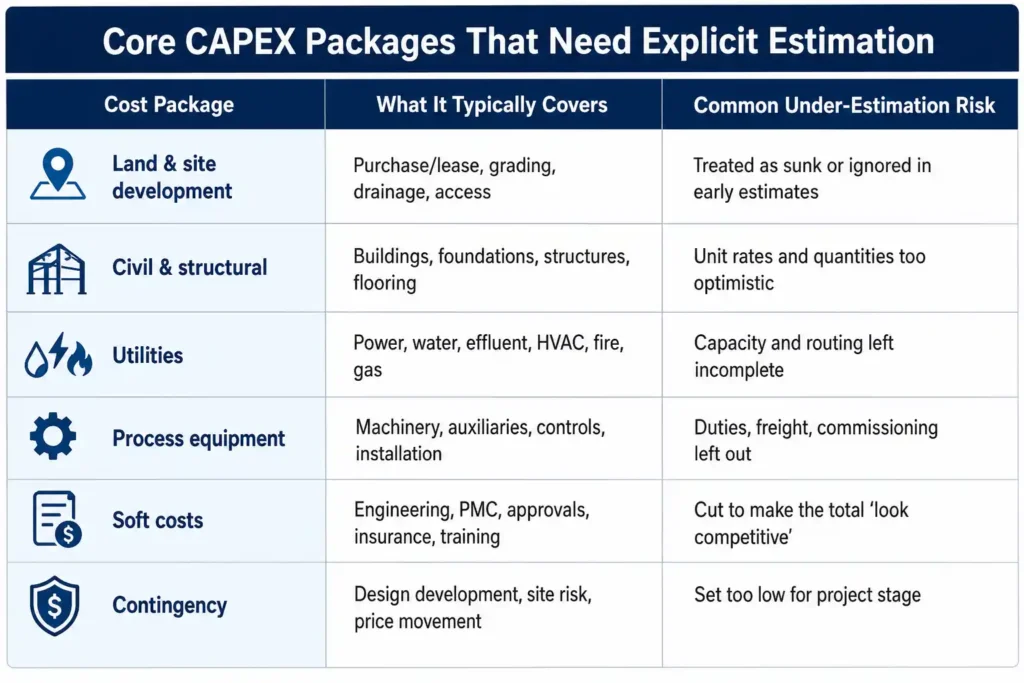
- Civil, structural and utility packages under-estimated
- Soft costs (engineering, approvals, project management, insurance) left thin
- Interface and integration work ignored until site execution
- Contingency set too low for the project stage and risk profile
- Design frozen late, after procurement and construction have started
Each of these gaps adds cost after the budget is approved — when correction is expensive.
What Smart CAPEX Planning Includes
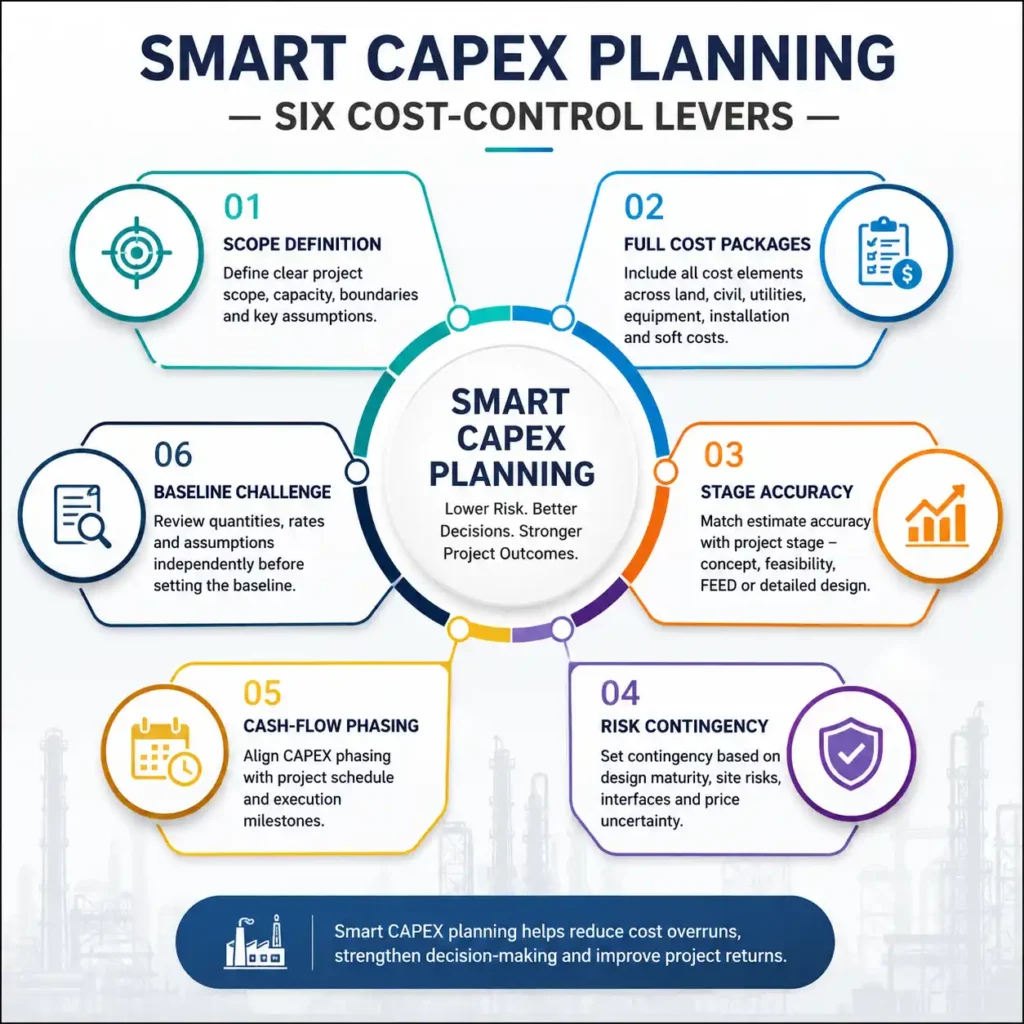
Smart manufacturing plant CAPEX planning is not simply a spreadsheet or equipment quotation. It is a structured build-up of capital cost elements against a defined project scope, design maturity and execution strategy.
1. Clear scope definition
Capacity, technology, layout boundaries, utility demand and what is included or excluded from the estimate.
2. Full cost package coverage
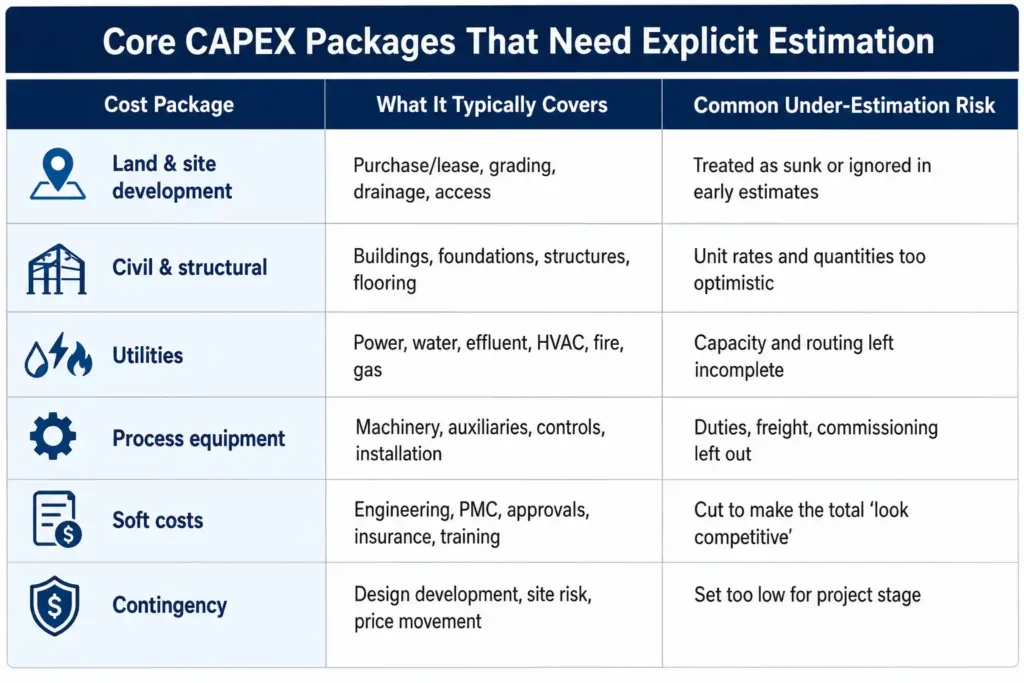
Land and site development, civil and structural works, utilities, process equipment, installation, soft costs and contingency.
3. Stage-appropriate accuracy
Order-of-magnitude at concept stage; refined estimate after process and layout definition; detailed budget before major commitments.
4. Risk-based contingency
Buffer linked to design maturity, site conditions, interface complexity and price uncertainty — not a fixed token percentage.
5. Alignment with schedule and cash flow
Spend phasing matched to engineering, procurement and construction milestones.
6. Challenge and baseline control
Independent review of rates, quantities and assumptions before the budget becomes the project baseline.
How Smart CAPEX Planning Reduces Project Costs
When CAPEX is planned with this discipline, manufacturers can reduce cost-overrun risk and avoid unnecessary project expenditure through:
- Fewer late scope additions — work that should have been in the original budget is not discovered mid-project
- Less rework — civil, structural and MEP packages match process and equipment data earlier
- Better supplier and contractor pricing — clearer packages reduce ambiguity premiums and variation claims
- Right-sized contingency — money is held for real risk instead of hidden in inflated line items or missing entirely
- Stronger change control — a clear baseline makes extras visible and challengeable
- Improved funding confidence — lenders, investors, and internal decision-makers have a clearer cost baseline, reducing the risk of unexpected funding gaps.
Cost reduction here is mostly cost avoidance: preventing spend that incomplete planning would have forced later.
Core CAPEX Packages That Need Explicit Estimation
Greenfield and Brownfield: Where CAPEX Logic Differs
Greenfield and brownfield projects require different CAPEX assumptions because the scope, site conditions and integration risks are not the same.
Brownfield expansions need explicit allowance for integration, temporary arrangements, possible production impact and condition of existing assets.
Greenfield projects require greater allowance for land development, infrastructure creation, utilities, approvals, and longer project timelines, but typically offer more design freedom and fewer live-plant integration constraints.
Applying a greenfield template to a brownfield job — or the reverse — is a frequent source of false comfort and later overruns.
Practical Steps to Put Smart CAPEX Planning in Place
- Freeze scope boundaries before detailed estimating.
- Build costs by package — do not rely on equipment quotes alone.
- Match estimate detail to design maturity.
- Set contingency from risk, not from habit.
- Align CAPEX phasing with the project schedule.
- Challenge the estimate before it becomes the approved baseline.
- Track actuals against that baseline so variances stay visible.
How IMARC Engineering Supports Smart CAPEX Planning
IMARC Engineering helps manufacturers build realistic, investment-grade CAPEX plans by combining engineering scope definition, package-level cost estimation, risk-based contingency, schedule alignment, and baseline cost control for greenfield and brownfield projects.
- Scope definition for greenfield and brownfield projects
- CAPEX build-ups across civil, utilities, equipment and soft costs
- Contingency guidance linked to project stage and project risk
- Alignment of CAPEX with process, layout and project schedule
- Support for internal approvals, investment decisions and project baseline setting
IMARC Engineering works with manufacturers across pharmaceuticals, food and beverage, chemicals, auto components, electronics, FMCG and discrete industrial sectors.
Contact IMARC Engineering’s team for CAPEX planning support across India: https://www.imarcengineering.com/contact?service=capex-opex-planning-support
Common Mistakes That Increase Manufacturing Project Costs
- Using equipment price as a proxy for total project CAPEX
- Freezing budget before process and layout decisions are stable
- Ignoring brownfield integration and temporary works
- Setting contingency too low for early-stage design
- Omitting duties, installation, commissioning and soft costs
- Using a fixed contingency percentage without considering project maturity, site conditions and execution risk
Conclusion
Smart CAPEX planning can reduce manufacturing project costs because most overruns start as planning gaps, not as unavoidable site surprises. In India’s growing manufacturing economy — supported by PLI investment, rising FDI and improving logistics — capital is plentiful relative to the past, but returns still depend on whether that capital is estimated and controlled with discipline.
When scope is clear, all cost packages are explicit, contingency matches risk, and the budget is baselined before major commitments, projects avoid a large share of the rework, claims and emergency funding that inflate final cost. That is the practical link between smart CAPEX planning and lower manufacturing project costs.
Effective manufacturing plant CAPEX planning is therefore not simply about producing a project cost estimate. It creates a defensible investment baseline that can be tested, approved and controlled from project definition through execution. By combining clear scope definition, engineering-based cost build-ups, risk-based contingency and project-aligned cost control, manufacturers can reduce avoidable expenditure and improve confidence in their investment decisions. IMARC Engineering supports greenfield and brownfield manufacturing projects across India with CAPEX planning, cost estimation and project advisory.
Contact Us:
IMARC Engineering
Phone: +91-120-433-0800
Email: sales@imarcengineering.com
India: C-130, Sector 2, Noida, Uttar Pradesh 201301
LinkedIn: https://www.linkedin.com/showcase/imarc-engineering/
About the Author