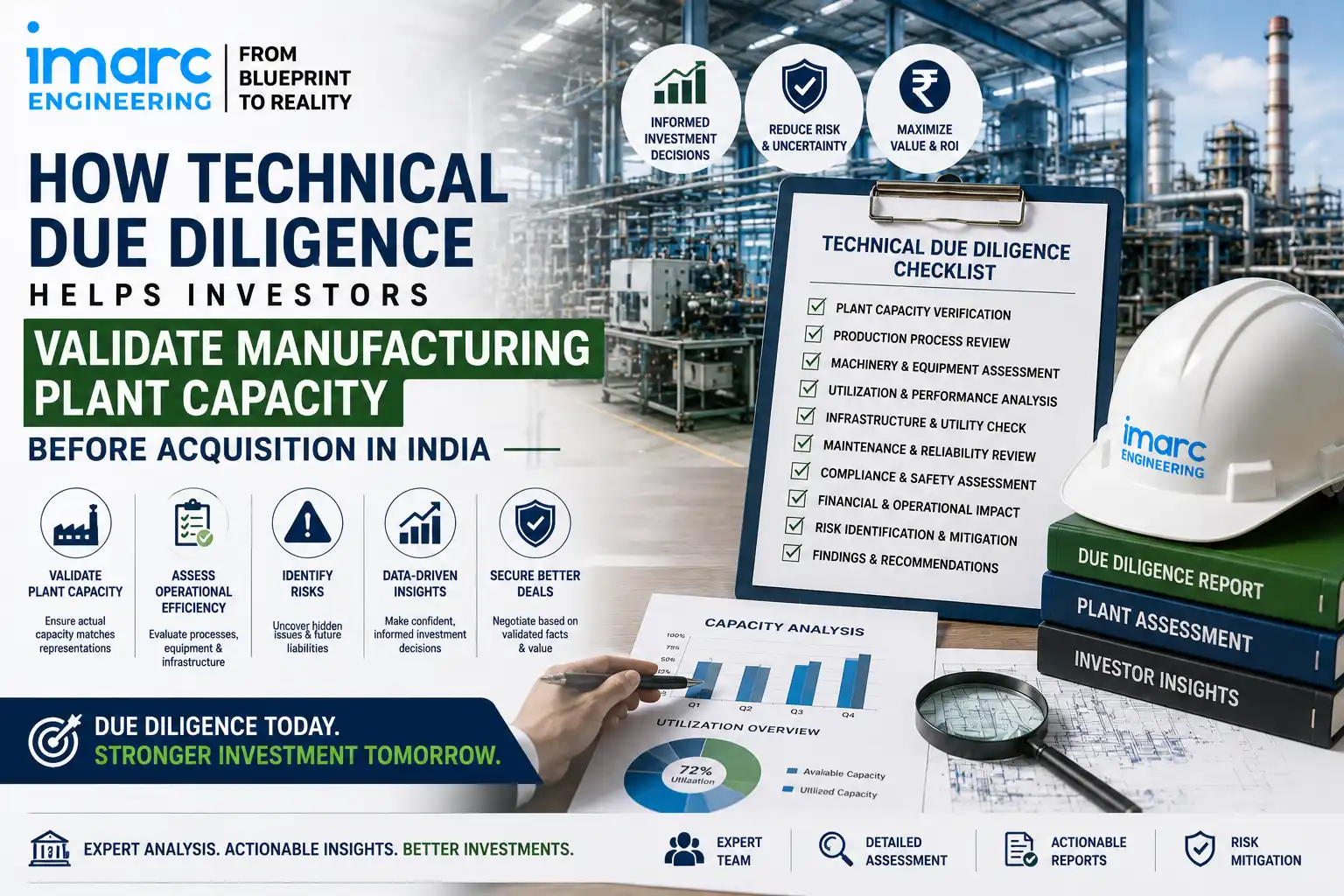
When investors, private equity firms, strategic acquirers or lenders evaluate an existing manufacturing plant in India, financial due diligence can confirm historical revenue and margins. It cannot confirm whether the physical plant can actually deliver the production volumes assumed in the investment model. Seller claims of installed or nameplate capacity often become the foundation for utilisation rates, revenue projections, debt-service coverage and exit assumptions. Those claims remain investment assumptions—not verified operating facts—until tested against production records, equipment condition, bottlenecks, utilities, maintenance, quality, workforce, raw-material availability and shop-floor performance.
Overstated capacity, deferred maintenance, utility constraints, high downtime, poor yields or regulatory limits can leave an acquirer with a plant that cannot sustain the modelled output. The result is frequently unexpected capital expenditure, lower utilisation, delayed returns or a renegotiated deal. Technical due diligence for investors in India closes this gap by converting capacity claims into evidence-based understanding before capital is committed.
India’s manufacturing push, supported by Production Linked Incentive schemes that have attracted actual investments exceeding ₹2.40 lakh crore and generated over 14.15 lakh jobs as of 31 March 2026 (as reported by the Ministry of Commerce & Industry via PIB), continues to drive plant acquisitions and expansions. Capacity validation remains critical because a running plant is not automatically a plant capable of sustaining the output the seller presents.
Why Manufacturing Plant Capacity Validation Matters Before Acquisition
Capacity directly shapes revenue forecasts, utilisation assumptions, valuation multiples, debt-service capacity, expansion potential and post-acquisition capital needs. If sustainable capacity is lower than claimed, the investment model overstates cash flows and understates the capital required to close the gap. Investors therefore need Technical Due Diligence for Investors to independently verify that the plant can consistently produce saleable output under real operating conditions rather than ideal design ratings.
Nameplate Capacity vs Actual vs Sustainable Capacity
Nameplate (or installed) capacity is the rated or design capacity of the installed equipment or production system, typically derived from OEM specifications. Actual production is the historical output the plant has achieved. Sustainable capacity is the realistic output the plant can consistently maintain under actual operating conditions, after accounting for equipment condition, utilities, maintenance, quality and yield, staffing, raw-material availability, product mix, changeovers, bottlenecks and other constraints.
Manufacturing Plant Capacity: What Investors Need to Validate
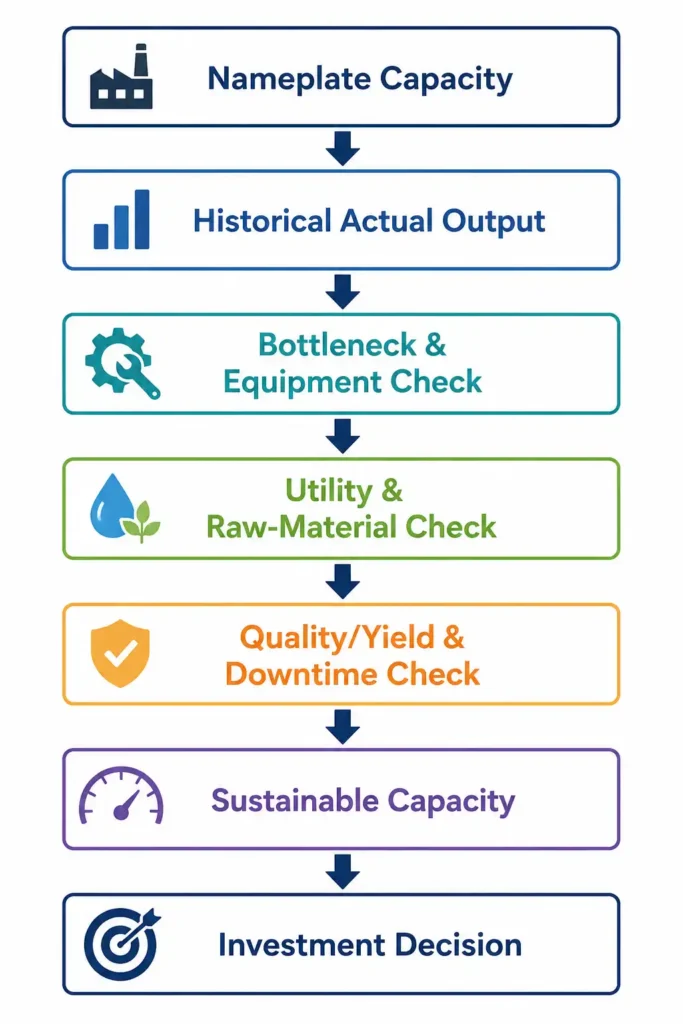
A plant’s practical capacity is frequently set by its bottleneck rather than its largest machine. Technical due diligence systematically tests each layer.
What Technical Due Diligence Checks to Validate Plant Capacity
A. Historical Production Data
Review recent production records, monthly trends, product-wise and line-wise output, peak versus average performance, seasonal variations, planned and unplanned shutdowns, and downtime. Evidence typically includes ERP or MIS extracts, production reports, batch records, dispatch data and production reconciliations. Not every plant maintains identical records; the assessment adapts to available data quality.
B. Nameplate Capacity Verification
Confirm equipment rated capacities, number of installed lines, OEM specifications, configuration, operating parameters and any parallel or backup equipment.
C. Equipment Condition
Assess age, physical condition, maintenance history, breakdown frequency, obsolescence risk, critical equipment status, spare-parts availability and overhaul or replacement needs.
D. Bottleneck Analysis
Map the full process—raw-material handling, processing, mixing or reaction, drying, packaging, inspection, storage, internal movement and dispatch—to identify the true constraint. Practical capacity is governed by the bottleneck.
E. Utility Capacity
Evaluate electrical load and transformer capacity, backup power, water, steam, compressed air, cooling, HVAC (where relevant), fuel, effluent-treatment and waste-handling systems. Compare available capacity against current and proposed production levels.
F. Maintenance and Downtime
Examine planned maintenance schedules, unplanned downtime, recurring failures, preventive-maintenance effectiveness, critical-spares inventory and maintenance backlog. Use the plant’s own historical data rather than generic benchmarks.
G. Product Mix and Changeovers
Review product mix, batch sizes, changeover frequency, cleaning requirements, packaging formats and testing protocols because these factors can affect practical throughput.
H. Raw-Material Availability
Review supplier base, quality consistency, seasonality, storage, lead times, alternative sources and any history of shortages.
I. Quality and Yield Constraints
Analyse yield, scrap, rework, rejections, quality holds, testing time and customer complaints. Gross volume is not the same as saleable output.
J. Labour and Skill Availability
Assess operator numbers, shift patterns, technical skills, supervisory strength, maintenance manpower, training, key-person dependence and contract-labour reliance.
K. Plant Layout and Material Flow
Review production flow, work-in-progress and finished-goods storage, internal logistics, space constraints and layout inefficiencies that limit throughput or expansion.
L. Regulatory or Approved Capacity
Applicable consents and permissions may constrain operations or expansion. Applicability depends on sector, location, capacity, process and environmental impact; no universal checklist applies.
How to Verify Seller Capacity Claims
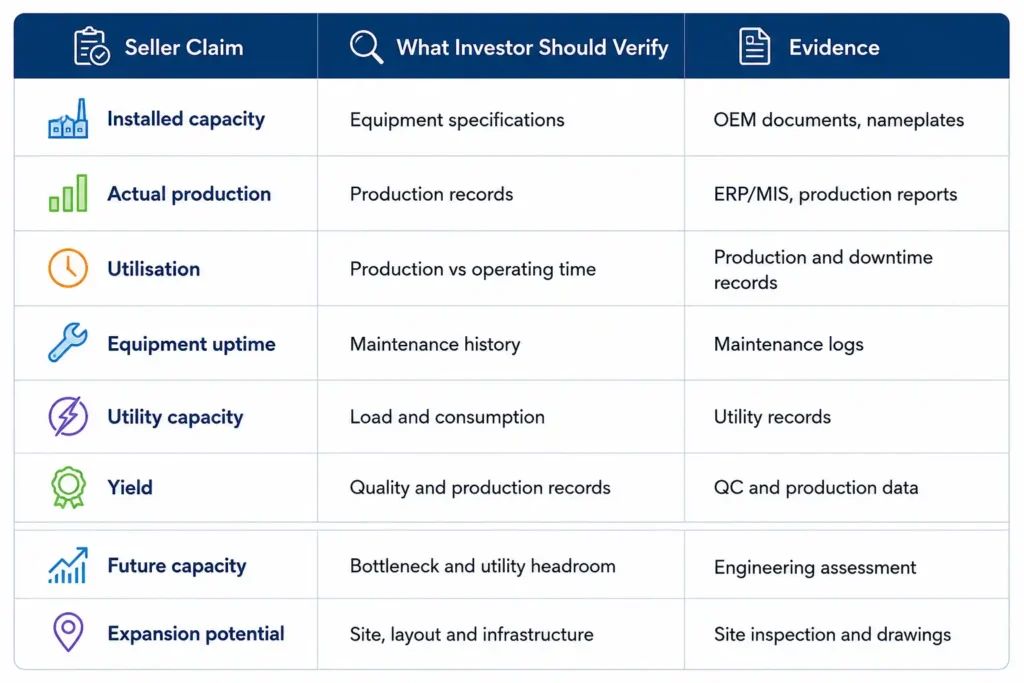
Data Room vs Shop-Floor Reality
Data-room documents provide the starting point. Technical due diligence then cross-checks them through site inspection, equipment condition assessment, operator interviews, utility performance observation and actual process behaviour. Common discrepancies include capacity claims that exceed historical output, reported utilisation that does not match production evidence, maintenance records that understate equipment condition, approved capacity that differs from actual operations, and expansion claims that ignore utility or layout constraints. Independent verification is essential because these gaps may not be visible in seller presentations alone.
How Equipment Condition Affects Sustainable Capacity
Ageing assets, rising breakdown frequency, obsolete technology, maintenance backlog and limited spare availability reduce reliability and effective output. Technical findings often translate into quantified post-acquisition CapEx for overhauls, replacements or reliability improvements that must be factored into the investment model.
How Utilities and Infrastructure Can Limit Capacity
Production equipment may have theoretical headroom while power, water, steam, compressed air, cooling, effluent treatment or storage systems operate near limits. Internal logistics and space constraints can further restrict throughput. Sustainable capacity cannot exceed the weakest supporting system.
How Product Mix, Yield and Changeovers Affect Capacity
A single capacity figure ignores variation caused by product mix, frequent changeovers, cleaning cycles, testing requirements, batch sizes, rejections and rework. Saleable output is what matters for revenue modelling.
How Technical Due Diligence Identifies Hidden CapEx
Findings commonly surface requirements for equipment replacement or debottlenecking, utility upgrades, environmental-system improvements, automation, clearance of maintenance backlog, storage expansion, quality-system upgrades or safety enhancements. These costs should be incorporated into the acquisition model and post-close plan.
Capacity Validation Red Flags for Investors
- Capacity based only on nameplate rating
- Absence of recent production evidence
- Large gap between installed and actual output
- High breakdown frequency
- Utilities near operating limits
- Capacity dependent on one key person
- Significant maintenance backlog
- High rejection or rework rates
- Packaging or storage bottlenecks
- Expansion claims without infrastructure assessment
- Data-room information inconsistent with site findings
How Capacity Findings Can Affect the Investment Decision
Technical findings may influence valuation, purchase price, deal structure, conditions precedent, holdbacks, representations and warranties, financing assumptions, immediate and medium-term CapEx, expansion plans and the ultimate go/no-go decision. Investors typically consider these implications with their financial and legal advisers.
Practical Technical Due Diligence Process
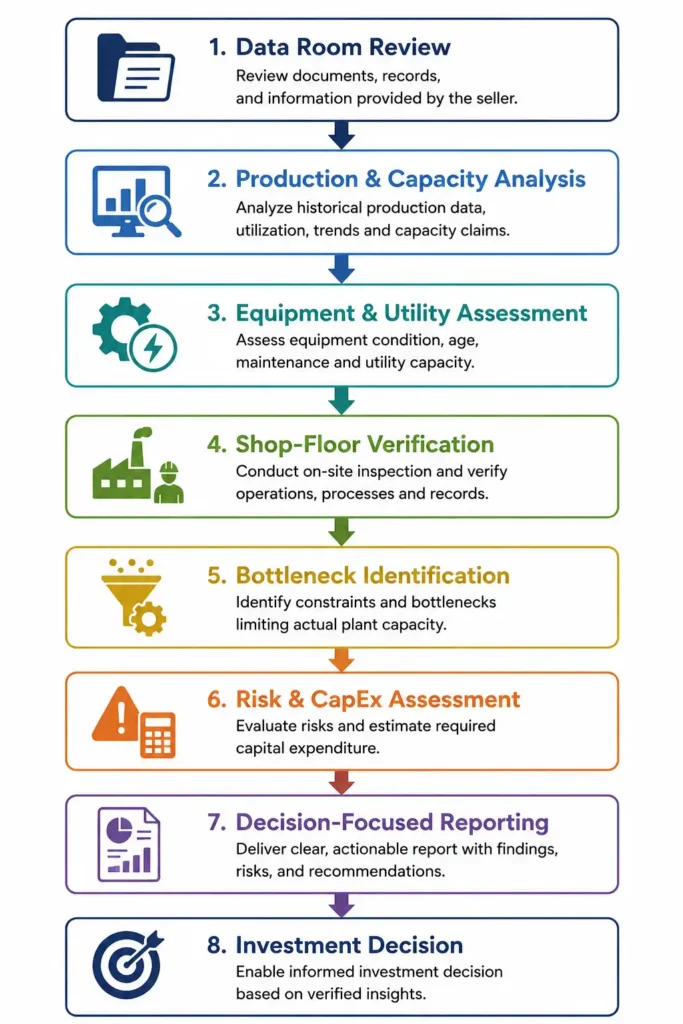
Each stage builds evidence that converts seller claims into a realistic view of sustainable capacity and associated risks.
Key Capacity Validation Areas in Technical Due Diligence
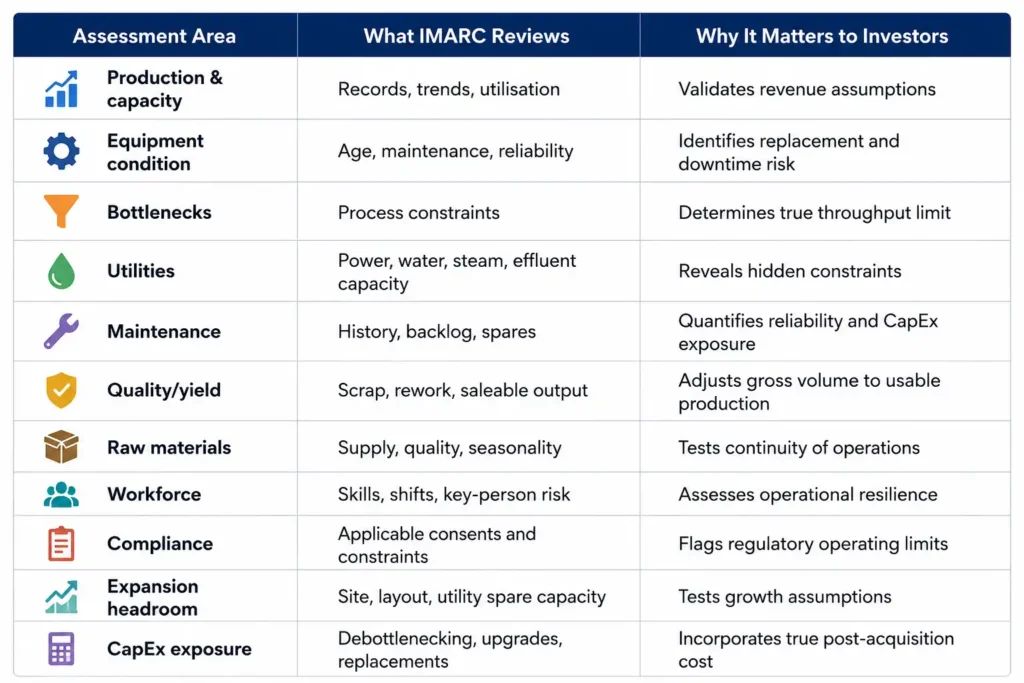
How IMARC Engineering Supports Investors
IMARC Engineering provides independent, engineering-led technical due diligence for investors evaluating manufacturing plants in India. The work focuses on pre-acquisition technical assessment, production and capacity validation, equipment-condition review, utility assessment, bottleneck identification, technical risk evaluation, hidden CapEx quantification and expansion-feasibility inputs. Reporting is decision-focused, enabling investors to test capacity claims against operating reality before finalising valuation, terms or the investment decision. IMARC Engineering is not a statutory authority, certification body, lender, valuation firm or legal adviser.
Evaluating a manufacturing acquisition? Learn more about Technical Due Diligence for Investors: https://www.imarcengineering.com/contact?service=technical-due-diligence-for-investors
Common Investor Mistakes
Relying solely on seller presentations, accepting nameplate capacity at face value, ignoring downtime and utility limits, overlooking product-mix effects, underestimating maintenance backlog, assuming expansion is straightforward, failing to verify production records, or completing technical diligence too late to influence deal terms all increase risk.
Conclusion
Technical due diligence for investors in India converts seller capacity claims into evidence-based investment understanding. A plant’s sustainable capacity depends on the interaction of equipment, utilities, raw materials, process, maintenance, quality and yield, workforce, bottlenecks, infrastructure and compliance. Capacity validation should occur before capital is committed and while investors still retain the ability to adjust valuation, terms, CapEx assumptions or the investment decision itself.
Contact Us:
IMARC Engineering
Phone: +91-120-433-0800
Email: sales@imarcengineering.com
India: C-130, Sector 2, Noida, Uttar Pradesh 201301
LinkedIn: https://www.linkedin.com/showcase/imarc-engineering/
About the Author