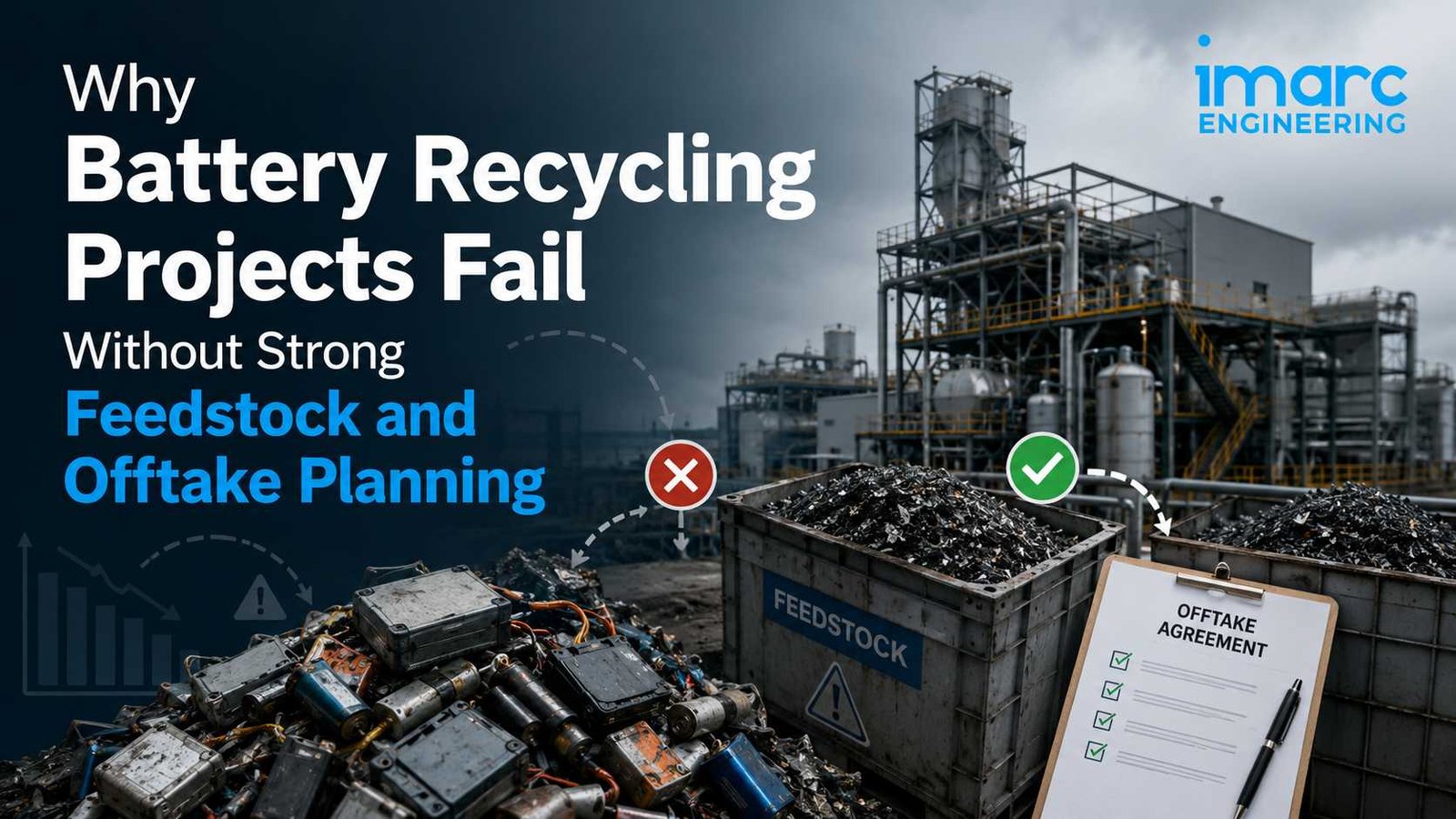
Battery recycling has emerged as a critical pillar of the clean-energy transition, yet a growing number of projects worldwide are struggling or failing. The core reason is rarely technology alone. Most setbacks stem from weak feedstock security and uncertain offtake arrangements. Without reliable volumes of end-of-life batteries or manufacturing scrap coming in, and without secure buyers for recovered materials going out, even well-engineered plants face low utilisation, cash-flow stress, and eventual distress.
In India, the mismatch is already visible. End-of-life lithium-ion battery (LIB) volumes were estimated at around 36–50 thousand tonnes in 2025, of which only a fraction, roughly 15 thousand tonnes in some assessments, reached formal recycling channels. Against this, announced recycling capacity already exceeded 80 thousand tonnes. Formal systems currently process less than 5% of available EOL batteries in several analyses. The India lithium-ion battery recycling market itself stood between USD 159 million and USD 298 million in 2024–2025, depending on the source, and is projected to expand rapidly toward the early 2030s. Yet capacity without feedstock remains idle capacity.
Globally the same pattern has played out. Recyclers in Europe and North America have reported severe feedstock shortages, forcing some operators to reintroduce gate fees, cut utilisation rates, pause construction, or enter insolvency proceedings. Projects that scaled plant size ahead of secured supply chains found fixed costs unsustainable once scrap volumes lagged EV adoption and manufacturing scrap streams.
The Feedstock Trap
Battery recycling plants are capital-intensive. Hydrometallurgical or combined mechanical-hydrometallurgical facilities require steady throughput—often thousands of tonnes per year—to cover energy, reagents, labour, and debt service. When feedstock is irregular or chemically inconsistent (mixed LFP and NMC chemistries, varying residual electrolytes), recovery rates drop and product quality suffers.
In India the bulk of near-term feedstock still comes from consumer electronics and early EV two- and three-wheelers rather than large passenger-car packs. Collection networks remain fragmented, with the informal sector still handling a large share. Without long-term offtake contracts from OEMs, fleet operators, or EPR-compliant producers, formal recyclers compete for limited volumes and pay higher acquisition costs. The result is thin margins even before the plant reaches design capacity.
Key India Battery Recycling Metrics (2025 estimates)
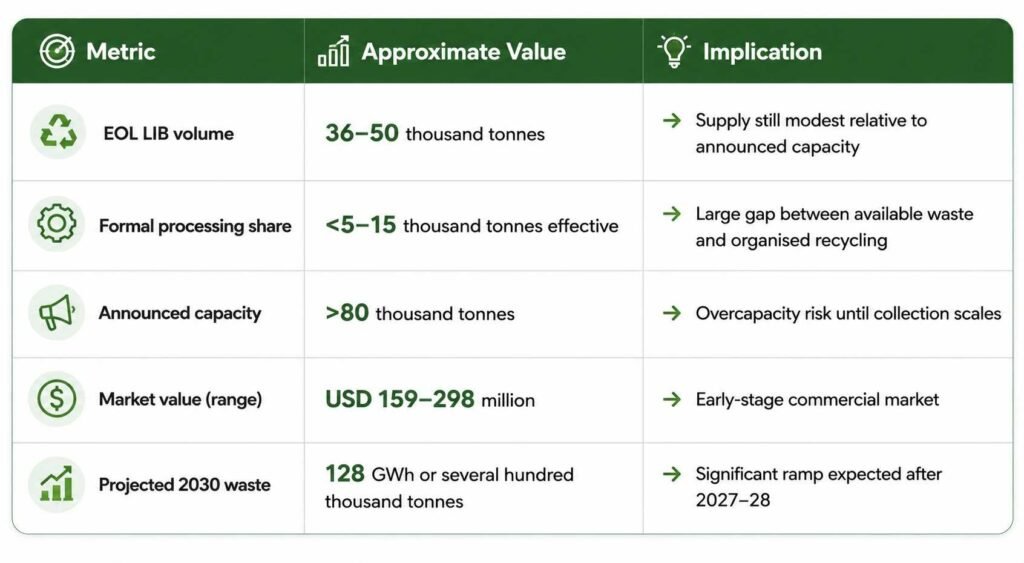
These figures underline why feedstock planning must precede final investment decisions. Successful projects secure multi-year supply agreements, invest in reverse logistics and collection partnerships, and design flexible process trains that can handle mixed chemistries.
The Offtake Challenge
Even when feedstock arrives, recovered materials must still clear two critical hurdles:
- Battery-grade quality requirements – Lithium carbonate or hydroxide, nickel and cobalt sulphates, black mass, or cathode active materials need to meet strict impurity limits, consistent particle morphology, and reliable delivery schedules. Material that falls short is discounted or rejected by cell and cathode producers.
- Price and margin pressure – Low metal prices in recent years have compressed payables for black mass and intermediate products, squeezing recycler margins further.
- Absence of firm offtake contracts – Without pre-negotiated agreements with cell makers, cathode producers, or traders, recyclers face inventory risk and price volatility. Several international projects that produced intermediates but lacked downstream refining or locked-in buyers saw margins evaporate.
- Policy support is coming, but not yet fully effective – India’s Battery Waste Management Rules 2022 and the Critical Mineral Recycling Scheme (INR 1,500 crore allocation) set recovery targets rising to 90% and mandate recycled content in new batteries from 2027–28. These measures will eventually strengthen both collection and demand. Until then, project sponsors who treat offtake as an afterthought remain exposed.
Practical Steps for Viable Projects
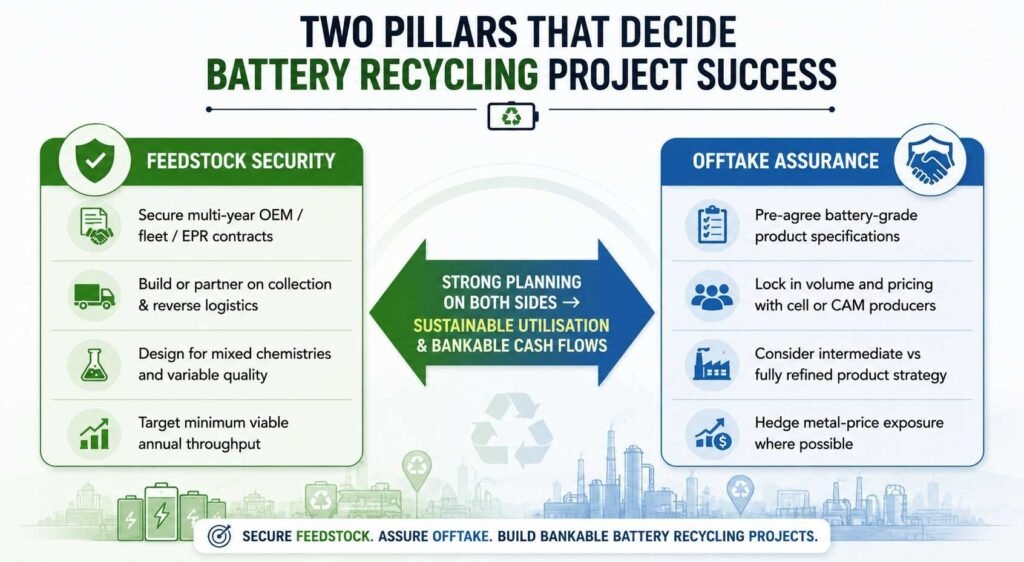
Projects that survive the current transition phase share common traits. They size the plant to realistic near-term feedstock rather than optimistic 2030 forecasts. They invest early in digital traceability and formal collection partnerships to divert material from informal channels. They negotiate offtake letters of intent or take-or-pay style contracts before major construction begins. They choose process technology that can flex between different battery chemistries and produce multiple product grades.
For developers evaluating or advancing battery recycling plant projects, integrating feedstock mapping, logistics modelling, and offtake strategy into the earliest feasibility and detailed project report stages is non-negotiable. Technology selection, site choice, and financing all depend on these two commercial foundations.
The market opportunity remains substantial. India’s EOL battery volumes are expected to rise sharply after 2027–28 as the first large wave of EV batteries retires, potentially reaching levels that can support several hundred thousand tonnes of annual processing by 2030. Global lithium-ion recycling capacity and market value are also forecast to expand multi-fold over the coming decade. The projects that capture this growth will be those that treated feedstock and offtake planning with the same seriousness as process engineering and environmental clearances.
In short, battery recycling is not only a technological challenge—it is a supply-chain and commercial challenge. Strong feedstock and offtake planning convert an attractive policy narrative into a bankable, long-running industrial asset. Without them, even the most advanced plant risks becoming an under-utilised liability.
Explore our trending battery recycling plant projects guide:
Lithium-Ion Battery Recycling Plant in India: https://www.imarcengineering.com/blog/how-to-set-up-a-lithium-ion-battery-recycling-plant-in-india
Sodium-Ion Battery Manufacturing in India: https://www.imarcengineering.com/blog/sodium-ion-battery-manufacturing-in-india
Consult With Our Team: https://www.imarcengineering.com/contact-us
Conclusion
Battery recycling projects succeed only when feedstock security and firm offtake agreements are locked in early. India’s 2025 reality—36–50 thousand tonnes of end-of-life lithium-ion batteries against announced capacity exceeding 80 thousand tonnes—shows the clear risk of overbuilding ahead of supply. Without reliable collection networks and pre-secured buyers for recovered materials, plants face low utilisation, margin pressure and potential failure. Strong commercial planning on both sides remains the decisive factor that turns policy support and technology into viable, long-term Battery Recycling Plant Projects.
Contact Us:
IMARC Engineering
Phone: +91-120-433-0800
Email: sales@imarcengineering.com
India: C-130, Sector 2, Noida, Uttar Pradesh 201301
LinkedIn: https://www.linkedin.com/showcase/imarc-engineering/
About the Author