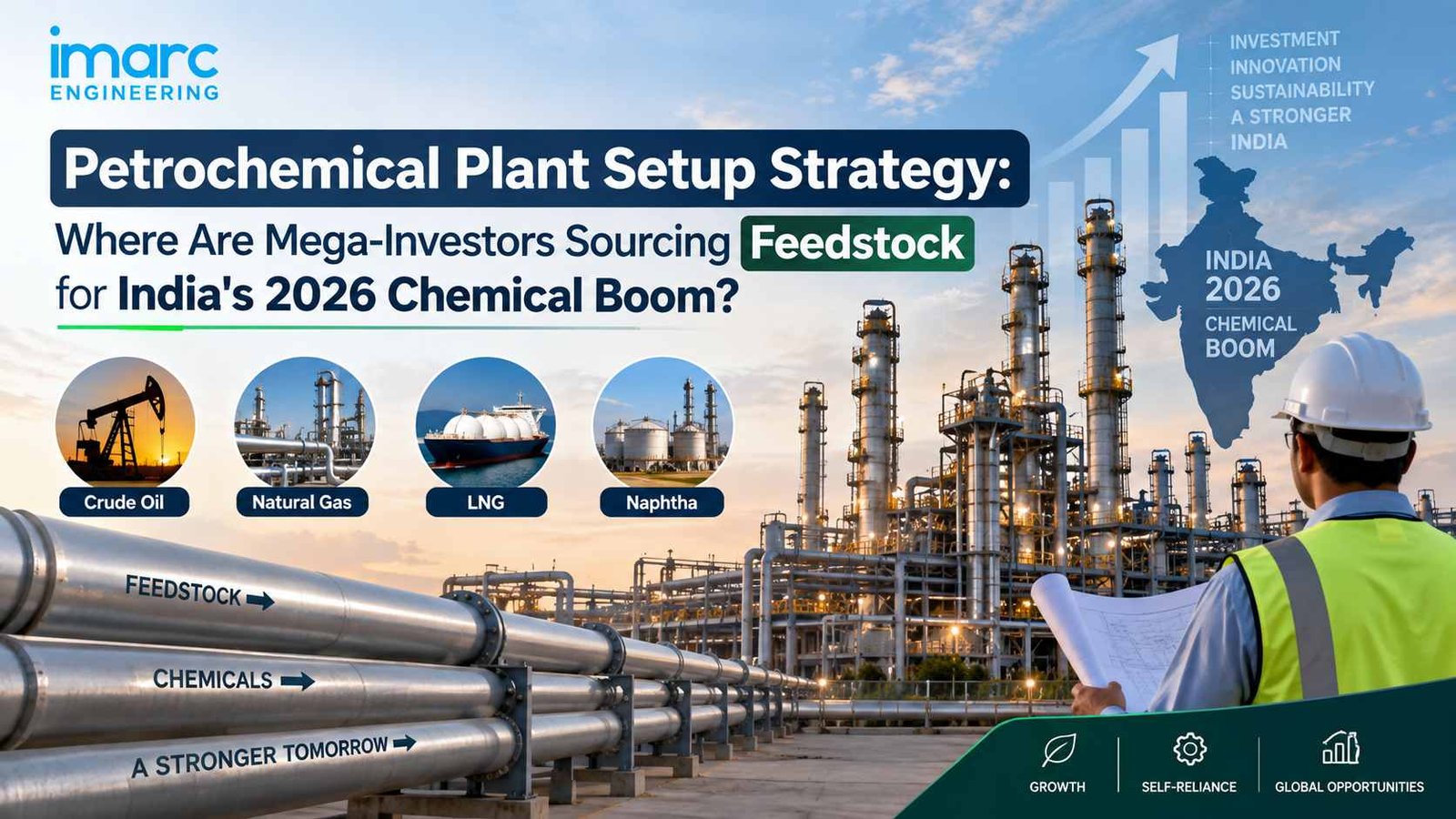
India’s petrochemical sector is entering 2026 with more capital chasing it than at any point in the past decade. Three operational Petroleum, Chemicals and Petrochemicals Investment Regions (PCPIRs) at Dahej (Gujarat), Vishakhapatnam-Kakinada (Andhra Pradesh), and Paradeep (Odisha) have together attracted a cumulative INR 3,49,192 crore in investment. Union Budget 2026-27 added fresh fuel with the Bhavya Rasayan Scheme, an INR 3,030 crore outlay for three new plug-and-play Chemical Parks.
But for every mega-investor evaluating a new plant, the single decision that shapes everything else, from plant location to capital structure to product mix, is feedstock. A steam cracker built around naphtha behaves nothing like a propane dehydrogenation unit or a methanol-to-olefins facility, and getting the feedstock call wrong is the most expensive mistake a sponsor can make before a single reactor is ordered.
Why feedstock sourcing decides the entire project
Petrochemical feedstock selection depends on target product, availability, and cost stability, and India’s investors are currently weighing five distinct sourcing routes.
- Naphtha: the most widely used feedstock in India, typically sourced from co-located refineries, and the backbone of mixed olefin/aromatic production through steam cracking
- Gas-based and light hydrocarbons: ethane, propane, and LPG, which support dedicated olefin production depending on availability and the process route chosen
- Crude oil derivatives: heavier hydrocarbons feeding large integrated complexes
- Coal-to-chemicals (methanol-to-olefins): an established route in select geographies, converting coal-derived methanol into ethylene and propylene
- Bio-based feedstocks: bio-ethanol and bio-naphtha, still emerging but gaining traction in specialty applications
Feedstock availability within an economical logistics radius remains the single strongest determinant of where a plant gets built. This is why India’s petrochemical industry has steadily shifted from standalone product units to integrated complexes anchored next to refineries and gas terminals, mirroring the global norm.
Consult With Our Team: https://www.imarcengineering.com/contact-us
Matching process route to product and feedstock
Each process technology locks a plant into a specific feedstock and a specific product slate. The table below maps the five dominant routes used in India’s current investment cycle.
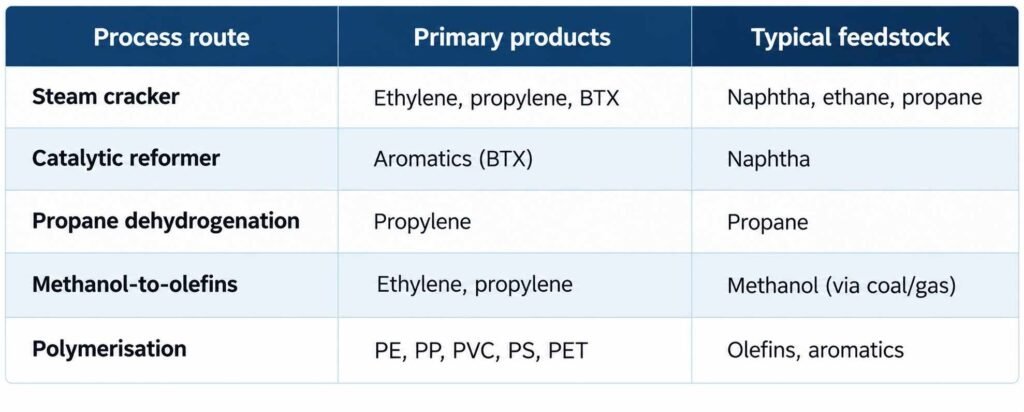
Ethylene and propylene remain the largest-volume olefins and effectively the backbone of most petrochemical complexes. Steam cracking of naphtha produces both in variable ratios depending on operating severity, while propane dehydrogenation has gained ground specifically for merchant propylene supply, a sign that investors are increasingly building single-product plants rather than only mega-crackers.
Where mega-investors are actually placing capital
Three signals point to where the smart money is concentrating feedstock and plant investment in 2026.
- PCPIR anchoring: All three operational PCPIRs are coastal, giving import access for naphtha and export access for finished products, a combination that has pulled the bulk of the INR 3,49,192 crore cumulative investment toward these zones rather than inland sites.
- Refinery-petrochemical integration: Steam crackers using naphtha feedstock, integrated aromatic complexes, and downstream polymer units are increasingly co-located with refining capacity, converting standalone economics into integrated economics.
- Gas terminal proximity: Expanding natural gas infrastructure is opening a second investment corridor for gas-based plants using ethane, propane, or LPG, independent of refinery-linked sites.
Site selection itself runs on a fixed checklist that mega-investors apply before committing capital:
- Feedstock proximity to a refinery, gas terminal, or pipeline
- Port access for feedstock import and product export
- PCPIR designation, which comes with pre-approved integrated infrastructure
- Utility availability for water, power, and gas
- Buffer distance requirements under safety norms
- Environmental sensitivity of the proposed location
- Workforce availability and state government support
Policy tailwinds shaping the 2026 investment case
Government policy has moved from passive enablement to active pump-priming this year.
- The New Scheme of Petrochemicals (NSP), run as a Central Sector Scheme with the Chemical Promotion and Development Scheme (CPDS) as its sub-scheme, remains the umbrella framework administered by the Department of Chemicals & Petrochemicals.
- The Bhavya Rasayan Scheme, approved in Union Budget 2026-27 at INR 3,030 crore, funds three new Chemical Parks on a plug-and-play model, directly reducing the site-readiness burden that used to fall entirely on individual investors.
- Most chemical sectors carry 100% FDI under the automatic route, removing a layer of approval friction for foreign-backed feedstock and technology partnerships.
Where the capital actually goes
Capital allocation inside a petrochemical project follows a fairly consistent pattern regardless of feedstock choice, though the weighting shifts with process complexity.
- Process equipment accounts for 30-40% of total CAPEX, the single largest line item, covering reactors, furnaces, and columns
- Piping and instrumentation adds another 15-20%
- Utilities (steam, cooling water, nitrogen) run 10-15%
- Civil and structural work takes 10-15%
- Electrical and controls, and storage and offsites, each account for 8-12%
- Technology licence fees, paid upfront plus ongoing production royalty, run 3-6% of CAPEX
Investment scales sharply with plant category. A small specialty petrochemical unit at 10,000-50,000 TPA typically requires INR 200-1,000 crore. A medium single-product plant at 50,000-300,000 TPA needs INR 1,000-5,000 crore. A large integrated cracker complex at 500,000+ TPA can run INR 10,000-40,000 crore, excluding land and pipeline connectivity.
Timelines scale accordingly. Long-lead equipment such as compressors, reactors, and large columns takes 18-30 months to procure. Construction runs 24-36 months for medium plants and 36-48 months for large complexes. Taken together with feasibility, engineering, and commissioning, the overall greenfield timeline from investment decision to commercial operation typically spans 4-6 years.
Technology licensor selection is a feedstock decision too
Choosing a feedstock route is inseparable from choosing a technology licensor, since licensors like Lummus, LyondellBasell, INEOS, UOP (Honeywell), Axens, ExxonMobil, Sinopec, and TechnipEnergies each specialise in different feedstock-to-product conversions. Selection criteria typically include:
- Process yield, product quality, and catalyst life
- Capital and operating cost, including energy and catalyst consumption
- Track record at comparable plant scale
- Licensor support commitments during execution and early operations
- Royalty terms and the scope of technology transfer
Most sponsors shortlist 3-6 licensors during the feasibility stage and run a combined technical and commercial evaluation before final selection, a process that should happen in parallel with, not after, the feedstock decision.
How IMARC Engineering’s Expertise Can Help in Petrochemical Feedstock and Plant Setup Strategy
- Evaluating feedstock options against site-specific logistics, refinery or gas terminal proximity, and long-term cost stability
- Running technology licensor shortlisting and technical-commercial comparison across established global licensors
- Structuring CAPEX estimates and capital-scale planning aligned to PCPIR or non-PCPIR site economics
- Supporting site selection against the full feedstock-to-port-to-utility checklist that mega-investors use before committing capital
For sponsors evaluating a new petrochemical manufacturing plant in India, aligning feedstock strategy with site selection and technology licensing from day one is what separates a project that reaches commercial operation on schedule from one that spends its first two years re-engineering around a feedstock decision made too early or too casually.
Read our detailed analysis here: https://www.imarcengineering.com/blog/how-to-set-up-petrochemical-manufacturing-plant-india
Conclusion
Feedstock sourcing is no longer a downstream engineering detail, it is the first strategic decision every petrochemical investor makes in 2026, and it determines site, technology, capital structure, and timeline together. With PCPIR investment past INR 3.49 lakh crore and fresh Budget 2026-27 support behind new Chemical Parks, disciplined feedstock and site strategy is what will separate India’s next generation of world-scale petrochemical complexes from stalled greenfield ambitions.
FAQs
What feedstocks do Indian petrochemical investors use in 2026?
The five dominant routes are naphtha (refinery-sourced, the most widely used), gas-based feedstocks (ethane, propane, LPG), crude oil derivatives, coal-to-chemicals via methanol-to-olefins, and emerging bio-based feedstocks such as bio-ethanol and bio-naphtha.
Where are India’s major petrochemical investment zones?
India has three operational PCPIRs at Dahej (Gujarat), Vishakhapatnam-Kakinada (Andhra Pradesh), and Paradeep (Odisha), which have together drawn a cumulative INR 3,49,192 crore in investment, largely due to coastal access for feedstock import and product export.
How much does it cost to set up a petrochemical plant in India?
Costs scale with capacity: small specialty units (10,000-50,000 TPA) typically cost INR 200-1,000 crore, medium single-product plants (50,000-300,000 TPA) cost INR 1,000-5,000 crore, and large integrated cracker complexes (500,000+ TPA) can run INR 10,000-40,000 crore.
What government support exists for petrochemical investment in 2026?
Union Budget 2026-27 introduced the Bhavya Rasayan Scheme (INR 3,030 crore) funding three new plug-and-play Chemical Parks, alongside the existing New Scheme of Petrochemicals and 100% FDI under the automatic route for most chemical sectors.
How long does it take to build a petrochemical plant in India?
Greenfield petrochemical projects typically take 4-6 years from investment decision to commercial operation, factoring in 18-30 months for long-lead equipment procurement and 24-48 months of construction depending on plant scale.
Contact Us:
IMARC Engineering
Phone: +91-120-433-0800
Email: sales@imarcengineering.com
India: C-130, Sector 2, Noida, Uttar Pradesh 201301
LinkedIn: https://www.linkedin.com/showcase/imarc-engineering/
About the Author