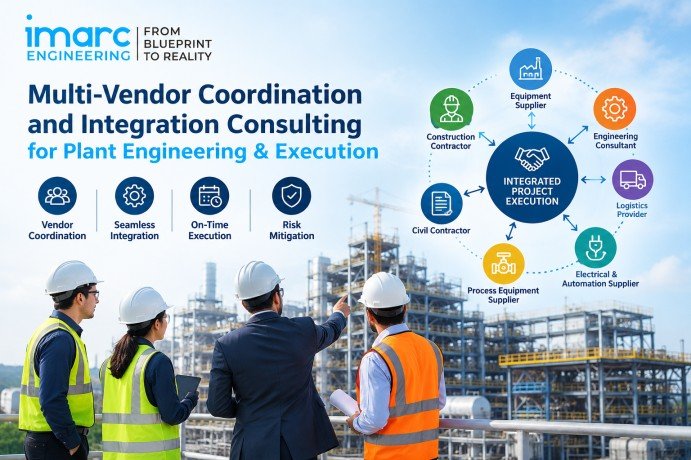
Multi-Vendor Coordination and Integration Consulting for Plant Engineering
Most industrial plants are not built by one company. They are assembled from the independent work of a dozen or more parties: an equipment OEM, a civil contractor, an electrical vendor, an automation integrator, and a commissioning team, each accountable only for their own package. The plant does not care about contract boundaries. It only works if every package connects correctly to every other one, and that connecting work is often where significant schedule, cost, and commissioning risk emerges.
This is why plant owners increasingly treat Multi-Vendor Coordination and Integration Consulting as an interface-management discipline rather than a scheduling exercise. The distinction matters commercially: coordinating vendors individually keeps each package on track, but does nothing to reconcile the dependencies between them. Left unmanaged, these dependencies tend to surface late, usually during installation or commissioning, when correcting them costs far more in rework, idle labour, and delayed production start-up than resolving them at the design stage would have.
What Is Multi-Vendor Coordination?
Multi-vendor coordination is often reduced to scheduling review calls and chasing drawings. That is vendor administration, not coordination. Genuine multi-vendor coordination is an engineering discipline that manages the interfaces between packages: the specific points where one vendor’s design, deliverable, or activity depends on another’s.
An interface exists wherever two parties must agree on something neither fully controls alone, such as a motor’s electrical load matching a switchgear another vendor is designing, a machine’s foundation loads matching what the civil contractor designed the slab for, a PLC’s communication protocol matching what the SCADA integrator is building, or a construction milestone matching what the commissioning team needs to start loop checks.
Why Multi-Vendor Projects Become Difficult to Execute
As of April 2026, India’s Ministry of Statistics and Programme Implementation (MoSPI) was monitoring 1,981 central-sector projects costing ₹150 crore or more. Their original approved cost of approximately ₹37.13 lakh crore had risen to about ₹42.78 lakh crore, a cumulative increase of roughly ₹5.66 lakh crore. The figures illustrate the scale of cost and schedule risk on complex projects; they do not by themselves identify a single cause.
What the Project Management Institute’s research establishes is the specific mechanism: effective engineering and construction interface management is a key project-success factor, and ineffective interface management is linked to cost overruns, schedule slippage, commissioning delays, and rework. Read together, execution-stage risk is real and substantial, and interface management is one of the disciplines most directly connected to controlling it.
Why Individual Vendor Schedules Can Still Produce a Late Plant
A recurring pattern shows up on multi-vendor projects: every vendor reports being on track, yet the plant is delayed. Individual schedules are internally consistent but collectively incompatible. A civil contractor’s foundation date, an equipment vendor’s dispatch date, and an automation vendor’s software-readiness date can each look reasonable in isolation while making the combined sequence physically impossible.
The Interface Failure Chain
A single unmanaged interface rarely stays isolated. A change in one package tends to cascade: an equipment vendor revises a specification, the connected load changes, the electrical panel design changes, the panel’s footprint changes the civil layout, the automation vendor’s I/O count changes to match, software testing shifts, FAT is delayed, and site commissioning starts late. This is why interface management should track dependencies, not just deliverables.
Why a RACI Chart Is Not Enough
A RACI answers who is responsible for a task. It does not answer what is being exchanged between two vendors, in what format, by what date, against what acceptance criterion, or what happens downstream if it changes. RACI should therefore be complemented by an interface register.
Multi-Vendor Coordination vs Vendor Management vs EPCM
These terms are frequently used interchangeably, but they describe different scopes of work:
| Function | Primary Focus |
| Project Management | Overall cost, schedule, and scope |
| Vendor Management | Supplier performance and contractual deliverables |
| EPCM | Engineering, procurement, and construction management |
| Multi-Vendor Integration | Interfaces between independently delivered packages |
It fills the gap where two vendors’ work must connect and neither is contractually responsible for the join.
The Five-Layer Interface Ownership Model
Coordination works better as five distinct ownership layers, each with its own owner and failure mode.
1. Scope and Contractual Interfaces — Battery limits, ownership of shared items, and responsibility for testing and warranty overlap, defined before design starts.
2. Information and Document Interfaces — Drawing revisions, datasheets, equipment tags, and I/O lists across vendors. Most late-stage rework traces to a mismatched revision or outdated document, which is the structured information-management principle behind ISO 19650’s framework for construction data.
3. Technical and Engineering Interfaces — Load lists, utility requirements, foundation loads, and communication protocols reconciled between mechanical, electrical, instrumentation, and civil vendors before procurement locks in.
4. Schedule and Deliverable Interfaces — Individual vendor schedules merged into one master sequence with explicit dependency logic, backed by a vendor deliverables tracker.
5. Commissioning and Start-up Interfaces — Interlock and alarm logic tested across vendor boundaries, pre-commissioning sequenced against another vendor’s utility readiness, and punch-list items owned jointly where they sit between two contractors.
Building the Interface Register
Meetings and email threads cannot reliably hold this much cross-vendor detail. An interface register can:
| ID | Package A | Package B | Interface | Requirement | Owner | Due Date | Risk | Status |
| IF-01 | Process | Equipment Vendor | Capacity | 5 T/hr rated throughput | Process Engineer | 15 Oct | High | Open |
| IF-02 | Equipment | Electrical Contractor | Connected Load | 250 kW confirmed | Electrical Lead | 20 Oct | Medium | Open |
| IF-03 | Automation | MES | Data Exchange | OPC UA | Automation Lead | 30 Oct | High | Closed |
| IF-04 | HVAC | Process | Temperature/RH | Defined range | HVAC Vendor | 10 Nov | Low | Closed |
The discipline is not the spreadsheet format. It is that every row has a single accountable owner, a hard due date, and a defined closure condition, so an interface cannot quietly stay open past the point where it blocks another vendor.
Multi-Vendor Automation and System Integration
Automation is where interface failures are hardest to see coming, because two systems can each work correctly and still fail to work together. Coordination here typically covers PLC-to-PLC and PLC-to-DCS communication, SCADA and MES data exchange (tag mapping, alarm consistency), OPC UA as the common interoperability layer across multi-vendor architectures, and shared responsibility for cybersecurity at the points where different vendors’ OT systems connect. ISA-95, whose Part 1 standard was updated in 2025, provides the underlying models and information-exchange concepts for integrating manufacturing control functions with enterprise systems.
FAT, SAT, and Integrated Commissioning
FAT generally verifies equipment or system functionality against agreed specifications before shipment, with the exact scope defined by the purchase specification and test protocol. SAT verifies that functionality holds after installation at site. Integrated commissioning asks a separate question: whether connected systems from different vendors operate together as intended. Equipment can pass both FAT and SAT and still fail in integrated trials because upstream and downstream cycle times are mismatched, interlocks are incomplete, or utility conditions differ from what one vendor assumed.
Greenfield vs Brownfield Multi-Vendor Coordination
A greenfield plant’s challenge is building the interface map from a blank sheet, with every vendor and control-system boundary defined for the first time under time pressure. A brownfield project inherits a working plant, so the objective is integration without unacceptable disruption to production: interfacing new equipment with legacy PLCs, sequencing installation around limited shutdown windows, and confirming new equipment does not disturb existing safety interlocks.
Key KPIs
- Open and overdue interfaces, and critical interface aging
- Interface-related change orders and vendor drawing approval cycle time
- Mechanical completion percentage by system, not by contractor
- Integrated test completion rate versus individual SAT completion rate
- Commissioning punch-list closure rate
What Does a Multi-Vendor Coordination Consultant Do, and When Do You Need One?
A consultant handles vendor mapping, interface identification and register maintenance, technical document review, scope-gap identification, integrated master schedule coordination, vendor expediting, FAT/SAT and site interface management, and commissioning integration through joint punch-list closure.
Bringing one in earns its cost when a project involves more than one major equipment OEM, separate automation and equipment suppliers, an EPC contractor alongside specialist packages, a brownfield expansion with legacy systems, multiple PLC, DCS, or MES vendors, a tight commissioning deadline, or a pattern of recurring scope disputes and vendor drawing delays.
How IMARC Engineering Can Help
IMARC Engineering approaches multi-vendor coordination as an interface-engineering discipline, integrating vendor scopes, engineering deliverables, schedules, and commissioning activities into one execution framework across greenfield and brownfield plants. If your project involves several independently contracted vendors, IMARC can assess your interfaces, identify scope gaps, and build a coordination framework before these issues reach construction. Request a Multi-Vendor Interface Assessment to find out where your project stands.
Consult With An Expert: https://www.imarcengineering.com/contact?service=multi-vendor-coordination-and-integration
Conclusion
Vendor coordination fails quietly, one unmanaged interface at a time, long before it becomes a visible schedule slip. Treating multi-vendor execution as an interface-management discipline, with clear ownership across scope, information, engineering, schedule, and commissioning layers, closes that gap before it reaches the site. A structured coordination framework shows up directly in fewer change orders, fewer commissioning surprises, and a production start-up date that holds.
Frequently Asked Questions
1. How is this different from project management?
Project management owns overall cost, schedule, and scope. Coordination specifically manages the interfaces between packages that no single vendor is responsible for.
2. Do we still need this with an EPCM contractor in place?
Interface coordination is a focused discipline within EPCM’s broader scope, and is most valuable when specialist vendors sit outside the EPCM’s direct contracts.
3. When should coordination start?
Ideally during vendor technical evaluation and design freeze, before procurement locks in specifications that later prove incompatible.
Contact Us:
IMARC Engineering
Phone: +91-120-433-0800
Email: sales@imarcengineering.com
India: C-130, Sector 2, Noida, Uttar Pradesh 201301
LinkedIn: https://www.linkedin.com/showcase/imarc-engineering/
About the Author