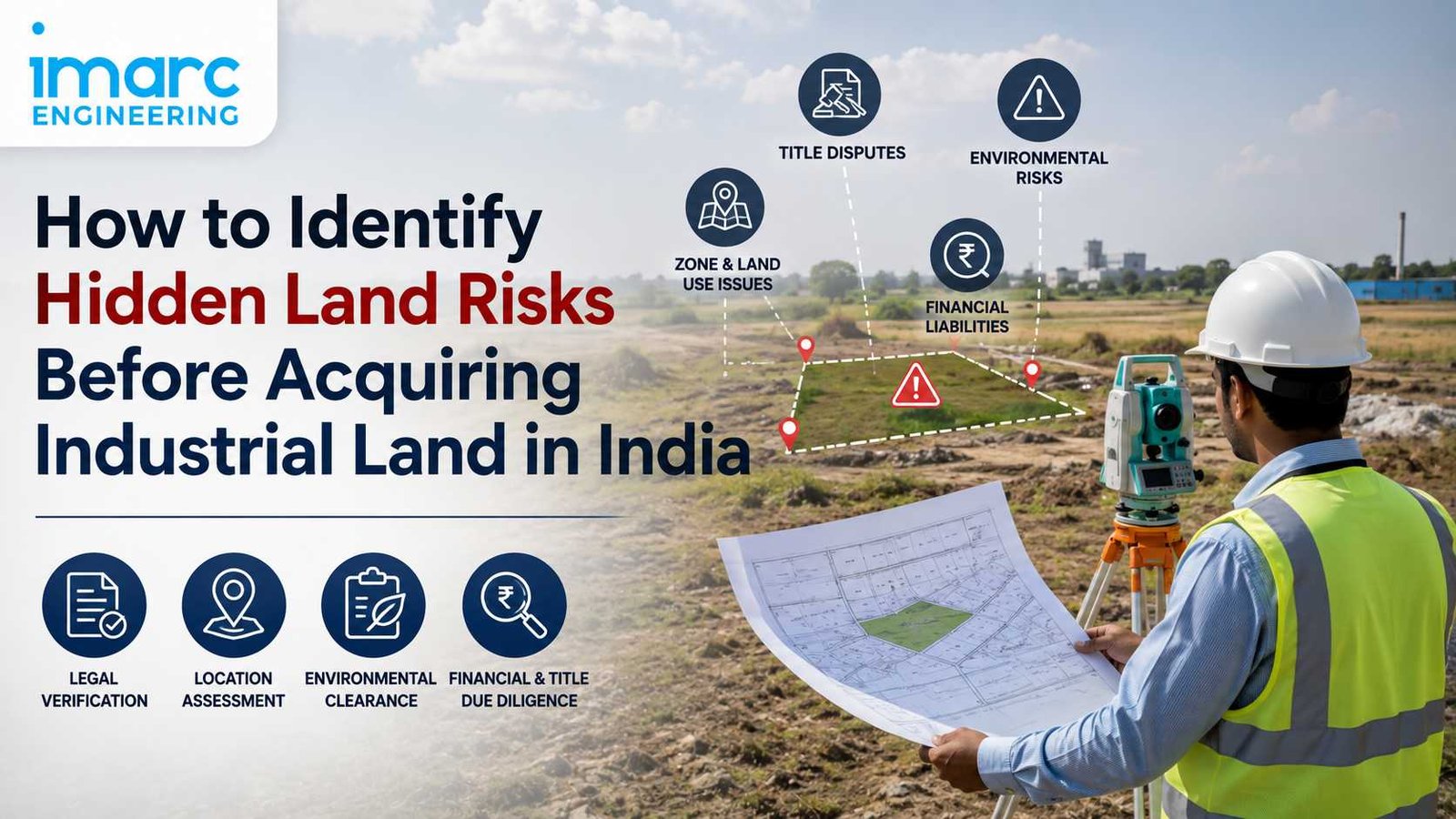
Industrial land deals in India rarely fail because the price was wrong. They fail because a risk sitting quietly in the title chain, the zoning register, or an old inspection file surfaces only after the sale deed is signed. For a manufacturer scouting a plot for a new plant, warehouse, or process unit, the gap between a clean-looking parcel and one that is legally and operationally suitable for the intended industrial use is exactly what experienced land acquisition consultants in India are trained to identify.
Catching these problems early gives the buyer room to renegotiate, seek remediation, or walk away before significant capital is committed. This article walks through the risks that can remain hidden during a routine site visit, the records and checks that help uncover them, and the due diligence sequence that should be completed before the acquisition becomes unconditional.
Why Hidden Risk Is the Default, Not the Exception
Industrial land in India is transacted across a patchwork of revenue records, state zoning frameworks, environmental registers and local body approvals that rarely sit in one place. A parcel can carry a perfectly clean sale deed and still fail at the factory-license stage because the master plan classifies it as agricultural, or because a 20-year-old tannery once operated on the site and left contamination that only a soil test will reveal. Hidden risk is less about fraud and more about fragmented records, so a due diligence process built only around the sale deed and the seller’s paperwork misses most of what matters.
Risks That Standard Site Visits Miss
Title and ownership gaps
- Unregistered family partitions or oral settlements that break the recorded ownership chain.
- Power-of-attorney sales where the original owner or a co-heir was never party to the transaction.
- Potential beneficial-ownership or title inconsistencies that may emerge during independent legal, lender or transaction due diligence .
Zoning and land-use conflicts
- Master plan classification that does not match the industrial use the buyer intends.
- Required land-use or non-agricultural conversion applied for but not finally approved by the competent authority.
- FAR, setback or buffer-zone restrictions that reduce buildable area well below what the deal assumed.
Environmental and regulatory exposure
- Legacy soil or groundwater contamination from previous industrial, mining, fuel storage, or waste-handling activities.
- Overlap with CRZ, forest, wetland, or eco-sensitive zone restrictions that may not be apparent during a physical site inspection.
- Pending show-cause notices, environmental non-compliance issues, or regulatory directions associated with previous operations at the site.
Physical and access constraints
- Encroachments or boundary overlaps that only a joint survey against the revenue map will expose.
- Right-of-way disputes on the approach road, or an access road narrower than what heavy-vehicle movement needs.
- Utility easements, transmission line corridors or pipeline right-of-way running through the parcel.
Discuss Your Land Acquisition Requirements with IMARC Engineering: https://www.imarcengineering.com/contact?service=land-acquisition-legal-due-diligence
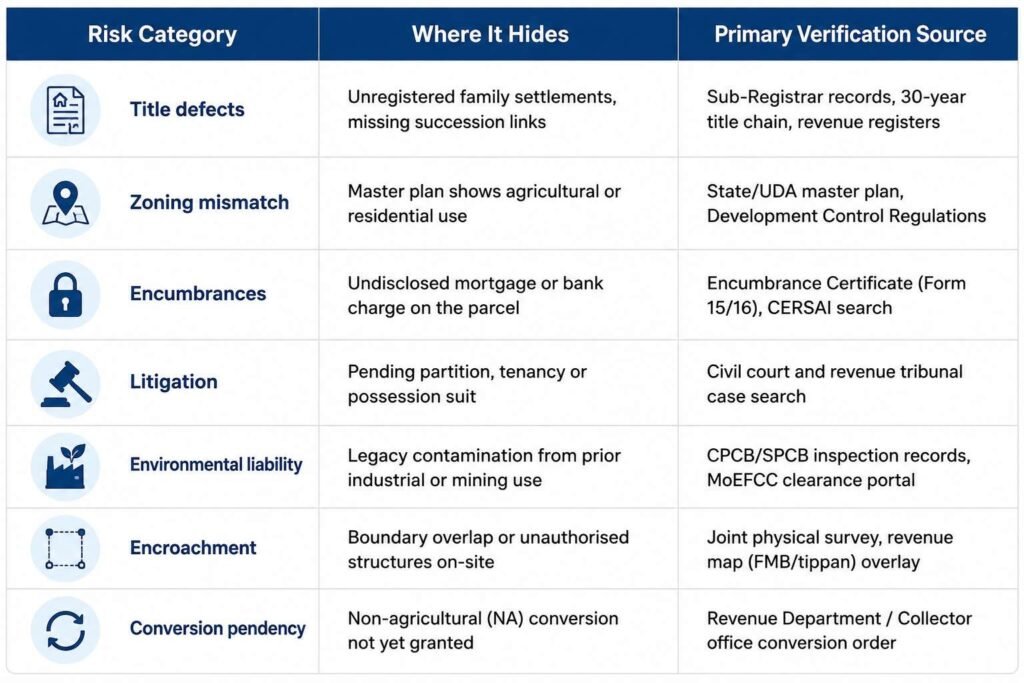
Risk Category, Where It Hides and How to Verify It
The table below maps the most common hidden risks to the specific record or search that exposes them. Each of these checks should be closed out, not merely requested, before earnest money changes hands.
Sequencing the Due Diligence Process
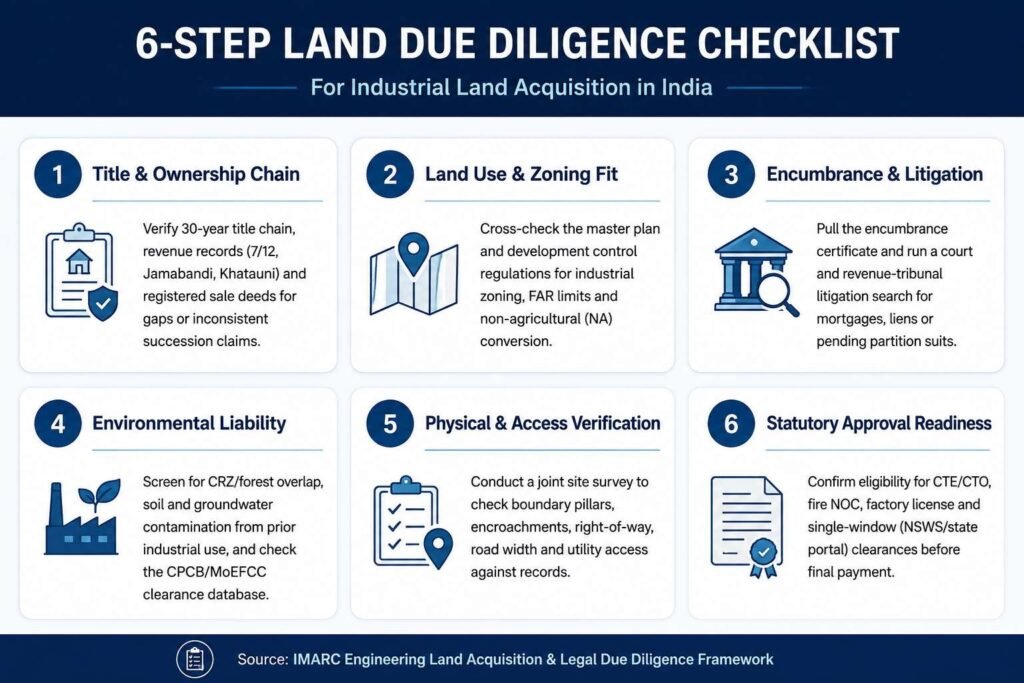
Most disputes trace back to sequencing rather than missing checks altogether: a survey done after the token amount is paid, or an environmental screen ordered only when the factory license is rejected. A defensible sequence starts with the paper record (title, encumbrance, zoning), moves to the physical record (survey, boundary, access), and closes with the regulatory record (environmental screening, conversion status, approval eligibility) before any binding commitment is made.
The infographic below summarises this as a six-step checklist that can be run in parallel with commercial negotiation, so due diligence findings inform the price and the contract terms rather than surfacing after they are already fixed.
Documents to Demand Before You Negotiate Price
- Certified copies of the last 30 years of title documents, including mutation entries.
- Latest Encumbrance Certificate for the relevant search period, supplemented by independent checks for mortgages, charges, litigation and other interests that may not be fully reflected in the EC.
- Land-use certificate or master plan extract confirming industrial or NA classification.
- No-litigation affidavit backed by an independent civil and revenue court search.
- Environmental site assessment report where prior industrial, mining or waste-handling use is suspected.
- Survey settlement map (FMB/tippan) to cross-check boundary and area against the sale deed.
How IMARC Engineering Helps You De-Risk Land Acquisition
IMARC Engineering runs land due diligence as a structured, multi-disciplinary exercise rather than a single legal opinion. The team combines title and revenue-record verification, zoning and master-plan cross-checks, environmental screening and physical survey validation into one consolidated risk report, so the decision to proceed, renegotiate or walk away is backed by evidence rather than assurance from the seller.
- End-to-end title and encumbrance verification across Sub-Registrar and revenue department records.
- Zoning, FAR and land-use compliance checks against the applicable master plan and DCR.
- Environmental risk screening for CRZ, forest, contamination and pollution board compliance history.
- Physical survey and boundary validation to flag encroachment or access issues before purchase.
- Regulatory pathway planning for applicable land-use conversion, environmental consents, building approvals and other statutory requirements associated with project development.
For a practical guide covering the key steps and requirements, explore IMARC Engineering’s guide on Industrial Site Selection in India: https://www.imarcengineering.com/blog/industrial-site-selection-in-india
Conclusion
Hidden land risk is rarely a single red flag. It is usually a combination of title, zoning, access, environmental and regulatory issues that only become visible when each layer is independently verified. Identifying those risks before an acquisition becomes unconditional gives manufacturers the opportunity to renegotiate terms, require remediation, redesign the project strategy or walk away before significantly more capital is exposed.
Contact Us:
IMARC Engineering
Phone: +91-120-433-0800
Email: sales@imarcengineering.com
India: C-130, Sector 2, Noida, Uttar Pradesh 201301
LinkedIn: https://www.linkedin.com/showcase/imarc-engineering/
About the Author