Setting up a tyre pyrolysis plant in India presents a compelling investment case backed by the country’s rapidly growing industrial recycling sector, rising energy demand, and the urgent need for sustainable waste management solutions. India generates millions of end-of-life tyres annually, creating a continuous and cost-effective feedstock base for pyrolysis operations. The demand for pyrolysis oil as an alternative fuel, carbon black for rubber compounding, and recovered steel for construction and manufacturing makes this one of the most versatile circular-economy investments available in the Indian market today. Key demand-driving industries include power generation, rubber and polymer manufacturing, construction and building materials, and industrial fuel applications all sectors experiencing strong structural growth in India.
India’s strategic advantages as a production hub for tyre pyrolysis are significant. The country’s rapid urbanisation is driving tyre consumption at scale, while large-scale infrastructure projects under the Make in India initiative are generating industrial demand for recovered materials such as steel and carbon black. States such as Gujarat and Maharashtra offer well-established industrial estates with reliable utility infrastructure, proximity to automotive and rubber manufacturing clusters, and competitive land and labour costs. India’s dense network of tyre dealers, auto workshops, and transport fleet operators ensures a geographically distributed supply of waste tyre feedstock, reducing collection costs and supporting consistent production throughput. For investors evaluating circular economy opportunities in Asia, India represents a strategically sound and commercially viable location.
Tyre pyrolysis in India combines government policy support with cost-competitive manufacturing, robust feedstock availability, and diversified end-market demand across energy, construction, and rubber sectors making it one of the few processing investments where gross margins of 35-45% are achievable alongside measurable environmental impact and a clear break-even trajectory.
What is Tyre Pyrolysis?
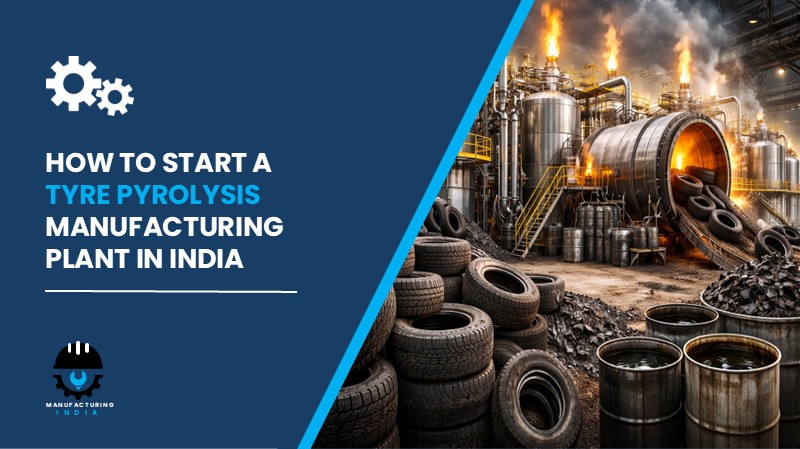
Tyre pyrolysis is a thermochemical heating process that decomposes waste tyres under controlled temperatures and in the complete absence of oxygen, converting end-of-life rubber into four high-value output streams: pyrolysis oil, carbon black, steel, and combustible gas. Each of these outputs carries direct commercial value. The pyrolysis oil can be used directly as industrial fuel or further refined to produce specialty chemicals. The recovered carbon black is reused as a functional additive in rubber products and construction materials. The steel wire extracted from the tyre carcass is dispatched to metal recyclers, and the non-condensable gas generated during the thermal process can be combusted on-site to generate power or process heat.
The production method used is the pyrolysis process either in continuous or batch reactor configurations making it adaptable to varying scales of investment and feedstock availability. The process is classified as eco-friendly because it diverts waste tyres from landfills, eliminates open burning, and transforms non-biodegradable rubber into industrially useful materials. The end-use industries served by tyre pyrolysis outputs include power generation, building and construction materials, rubber and plastics manufacturing, and the broader industrial fuel and environmental management sectors.
Cost of Setting Up a Tyre Pyrolysis Plant in India
The cost of establishing a tyre pyrolysis plant depends on several interdependent variables: annual production capacity, technology configuration (batch versus continuous), geographic location, level of automation, and the regulatory compliance requirements of the chosen state.
1. Capital Expenditure (CapEx)
Land and Site Development form a foundational component of the total capital investment, covering land registration charges, boundary development, drainage, and road access. Investors in India can reduce land acquisition costs by targeting designated Special Economic Zones (SEZs) or MIDC/GIDC industrial estates in Maharashtra and Gujarat, which offer pre-developed plots with utility connections and regulatory clearances already in place.
Civil Works and Construction costs cover the construction of the main production shed, reactor housing, condensate collection area, carbon black storage, steel wire baling area, laboratory and quality control block, administrative office, security infrastructure, and effluent treatment plant. Reinforced construction with fire-resistant materials is standard given the thermal nature of the process.
Machinery and Equipment represent the largest single component of capital expenditure. Key machinery required includes:
- Tyre shredders
- Pyrolysis reactors (batch or continuous configuration)
- Condensers (for converting pyrolysis gas into liquid oil)
- Carbon black collection systems
- Steel separators
- Compressors
- Packaging machines
Other Capital Costs include costs related to the effluent treatment plant (ETP), pre-operative expenses such as feasibility studies and regulatory filing fees, commissioning and trial run costs, import duties on specialised reactor components where applicable, and working capital margin for the initial months of operation.
Request a Sample Report for In-Depth Market Insights: https://www.imarcgroup.com/tyre-pyrolysis-manufacturing-plant-project-report/requestsample
2. Operational Expenditure (OpEx)
Raw Material Cost is the dominant variable cost driver for this facility. Waste tyres are the primary and sole feedstock for tyre pyrolysis production, accounting for approximately 30–40% of total operating expenditure. Given the distributed nature of end-of-life tyre generation across India’s transport, logistics, and automotive sectors, operators are advised to establish long-term collection agreements with tyre dealers, fleet operators, retreading businesses, and municipal collection agencies to stabilise feedstock supply and control input costs.
Utility Cost covering electricity for shredding, reactor heating, conveyor systems, and auxiliary plant equipment, along with water for cooling condensers and steam for process requirements — accounts for 20–25% of total OpEx, making energy efficiency a key variable in margin management.
Other Operating Costs include transportation of feedstock to the plant and dispatch of finished products (pyrolysis oil, carbon black, and steel), packaging materials for oil and carbon black, salaries and wages for plant operators and technical staff, scheduled and breakdown maintenance, depreciation on capital assets, and applicable state and central taxes. By the fifth year of operations, the total operational cost is expected to increase substantially due to inflation, market fluctuations, and potential rises in the cost of key materials. Supply chain disruptions and shifts in the global economy are additional factors expected to contribute to this increase.
3. Plant Capacity
The proposed facility is designed with an annual production capacity ranging between 20,000 and 50,000 MT, enabling economies of scale while maintaining operational flexibility. Capacity can be customised per investor requirements, and profitability improves meaningfully with higher capacity utilisation rates due to the relatively fixed nature of civil and infrastructure overheads.
4. Profit Margins and Financial Projections
The tyre pyrolysis plant demonstrates healthy profitability potential under normal operating conditions. Gross profit margins typically range between 35-45%, supported by stable demand and value-added applications for all four output streams. Net profit margins average 15-20% over the project lifecycle. Comprehensive financial projections covering NPV, IRR, payback period, gross margin, net margin, sensitivity analysis, and uncertainty analysis are included in the detailed project report, enabling investors to model multiple scenarios before committing capital.
Why Set Up a Tyre Pyrolysis Plant in India?
Growing Demand for Sustainable Recycling. The increased requirement for green waste disposal and recycling solutions is a primary driver propelling the adoption of tyre pyrolysis technology globally and within India. Stricter municipal and industrial waste management standards are pushing industries and governments to invest in processing infrastructure rather than landfill-based disposal.
Value Recovery from Waste Feedstock. The fundamental commercial logic of tyre pyrolysis is the conversion of a zero- or negative-cost input waste tyres into four revenue-generating products: pyrolysis oil, carbon black, steel wire, and combustible gas. This multi-product output model significantly de-risks the revenue stream compared to single-product recycling processes.
Favorable Regulatory Environment. The stricter environmental standards and waste management rules being enforced across Indian states are prompting companies and municipal bodies to invest in certified tyre recycling technologies. This regulatory pressure creates a sustained and growing demand pipeline for licensed pyrolysis operators.
Energy Generation Potential. Pyrolysis oil and the process gas generated during thermal decomposition serve as viable alternative fuels for industrial boilers and power generation units, reducing dependency on conventional fossil fuels. In an energy-cost-sensitive manufacturing environment like India, this dual-use property of pyrolysis outputs is a compelling commercial advantage.
Active Industry Investment and Technology Advancement. In October 2025, Lummus Technology and InnoVent Renewable signed a master cooperation agreement to jointly license and deploy InnoVent’s continuous tyre pyrolysis technology globally, with Lummus acting as the exclusive licensor to convert end-of-life tyres into pyrolysis oil, gas, carbon black, and steel. In February 2025, Orion S.A. signed a long-term supply agreement with Contec S.A. to secure tyre pyrolysis oil for producing circular carbon black for tyre and rubber manufacturers a clear signal of deepening downstream supply chain integration across the global industry.
Scalable Operations Aligned with India’s Tyre Demand Growth. According to the Japan Automobile Tyre Manufacturers Association (JATMA), Asia and Oceania accounted for over 70% of global rubber used in tyres in 2024, with China alone consuming around 43%. India’s own tyre sector is growing in parallel with vehicle ownership and fleet expansion, ensuring a long-term and expanding supply of end-of-life tyre feedstock for pyrolysis plants situated in key automotive states.
Manufacturing Process – Step by Step
The tyre pyrolysis process uses the pyrolysis process as the primary production method, involving thermal decomposition of rubber in an oxygen-free reactor environment. The process can be configured as a batch or continuous operation depending on plant scale and investment preference.
- Tyre Shredding: Whole waste tyres are fed into industrial shredders, which break them down into smaller chips and granules to increase surface area and improve reactor throughput efficiency.
- Reactor Feeding: The shredded tyre material is loaded into sealed pyrolysis reactors, which are then closed and prepared for the thermal processing cycle.
- Pyrolysis at Controlled Temperatures: The reactor is heated to the required pyrolysis temperature under an oxygen-free atmosphere. Thermal decomposition breaks down the rubber polymer chains, generating gas, liquid vapour, carbon black residue, and releasing the embedded steel wire.
- Condensation of Gas into Pyrolysis Oil: The hydrocarbon vapours generated in the reactor are channelled through condenser units, where they are cooled and converted into liquid pyrolysis oil, which is collected in storage tanks.
- Carbon Black Recovery: The solid residue remaining in the reactor after pyrolysis is processed through carbon black collection systems to recover recovered carbon black, which is sieved, graded, and prepared for dispatch to rubber compounders and construction material producers.
- Steel Separation: The steel wire remaining from the tyre reinforcement layer is separated using magnetic or mechanical steel separators, baled, and dispatched to metal recycling facilities.
- Packaging and Dispatch: Finished outputs pyrolysis oil, carbon black, and steel are packaged, labelled, and dispatched to end-use industries in power generation, rubber and polymer manufacturing, construction, and industrial fuel applications.
Key Applications
Tyre pyrolysis outputs serve a broad range of industries spanning energy, manufacturing, construction, and environmental management.
- Renewable Energy Production: Pyrolysis oil and combustible gas provide alternative energy solutions for industrial boilers and power plants, replacing conventional fossil fuel inputs.
- Rubber and Polymer Industry: Recovered carbon black is reused as a functional additive in rubber product compounding and tyre manufacturing.
- Construction and Manufacturing: Steel recovered from tyres is recycled into construction components and industrial tooling, supporting demand in infrastructure and manufacturing sectors.
- Waste Management and Environmental Sector: Pyrolysis provides a certified, non-polluting disposal route for waste tyres, reducing landfill burden and environmental contamination.
Leading Manufacturers
The global tyre pyrolysis industry is served by a select group of manufacturers with extensive production capacities and diverse application portfolios across industrial recycling, energy production, and environmental management sectors. Key players include:
- Henan Doing Environmental Protection Technology Co., Ltd. (China)
- Beston Group (China)
- Huayin Group (China)
- Klean Industries Inc. (Canada)
- Monolith Inc. (U.S.)
Timeline to Start the Plant
- Feasibility study and project report preparation
- Land acquisition and site development
- Regulatory approvals and environmental clearances
- Factory licence and fire safety compliance
- Machinery procurement and installation
- Raw material supplier agreements and supply chain setup
- Trial production and quality testing
- Commercial production launch
Licences and Regulatory Requirements
Starting a tyre pyrolysis unit in India requires several approvals:
- Business registration (Proprietorship, LLP, or Pvt Ltd)
- Factory Licence under the Factories Act
- Environmental Clearance from State Pollution Control Board
- GST Registration
- Fire Safety NOC
- Hazardous waste handling authorisation under the Hazardous and Other Wastes (Management and Transboundary Movement) Rules
- Effluent Treatment Plant (ETP) operational clearance
- Occupational Health and Safety compliance
Key Challenges to Consider
High Capital Requirements. Establishing a tyre pyrolysis plant at a commercially viable capacity of 20,000-50,000 MT per annum involves substantial capital outlay for reactors, shredding equipment, condensers, and civil infrastructure, which may require structured debt financing or phased investment approaches.
Raw Material Price Volatility. While waste tyres are the primary feedstock and are broadly available, collection logistics, transport costs, and competition from other recycling operators can create variability in feedstock pricing and availability, impacting raw material costs which constitute 30-40% of OpEx.
Regulatory Compliance. Tyre pyrolysis units in India are subject to environmental clearance, hazardous waste management rules, and emission norms, requiring dedicated compliance teams and investment in effluent treatment and emission monitoring systems.
Technology and Innovation Pressure. The recent deployment of continuous pyrolysis technology as evidenced by the Lummus Technology and InnoVent agreement in October 2025 signals that batch operators may face productivity and efficiency pressure as continuous systems become more widely licensed and commercially available.
Competition from Global Players. The presence of established global manufacturers such as Beston Group, Henan Doing Environmental Protection Technology Co., Ltd., and Klean Industries Inc. means that Indian operators must compete on feedstock cost, process efficiency, and output quality to maintain market position.
Skilled Manpower. Operating pyrolysis reactors, managing condensation systems, and ensuring consistent carbon black quality requires trained chemical process engineers and plant operators, which may be in short supply in Tier 2 and Tier 3 industrial locations.
Frequently Asked Questions
1. How much does it cost to set up a tyre pyrolysis plant in India? The total setup cost depends on plant capacity, technology type, location, and automation level. A detailed breakdown covering land, civil works, machinery, and other capital costs is available in the project feasibility report.
2. Is tyre pyrolysis profitable in India in 2026? Yes. Gross profit margins of 35-45% and net margins of 15-20% demonstrate strong profitability under normal operating conditions, supported by stable multi-product demand across energy, rubber, and construction sectors.
3. What machinery is required for a tyre pyrolysis plant in India? Key equipment includes tyre shredders, pyrolysis reactors, condensers, carbon black collection systems, steel separators, compressors, and packaging machines.
4. What licences and approvals are required to start a tyre pyrolysis plant in India? Required approvals include business registration, Factory Licence, Environmental Clearance, GST registration, Fire Safety NOC, hazardous waste authorisation, ETP operational clearance, and occupational health and safety compliance.
5. What raw materials are needed for tyre pyrolysis? Waste tyres are the sole primary raw material, accounting for 30-40% of total operational expenditure. Long-term supply agreements with tyre dealers and fleet operators are recommended to stabilise costs.
6. What are the environmental compliance requirements for a tyre pyrolysis plant in India? Plants must obtain environmental clearance from the State Pollution Control Board, comply with hazardous waste handling regulations, operate a certified Effluent Treatment Plant, and install advanced monitoring systems to detect process deviations and control emissions.
7. What is the best location to set up a tyre pyrolysis plant in India? Ideal locations offer proximity to waste tyre generation sources such as automotive clusters and transport hubs, access to reliable utilities, and established industrial infrastructure. Gujarat and Maharashtra industrial estates offer strong foundational advantages.
8. What is the break-even period for this type of plant in India? Break-even analysis is detailed in the financial projections section of the full project report, covering payback period, NPV, and IRR under realistic capacity utilisation and pricing assumptions.
9. What government incentives are available for manufacturers in India? Manufacturers in India can access incentives under the Make in India initiative, state-level industrial promotion schemes, capital subsidy programs through MSME development schemes, and environmental compliance grants applicable to green recycling investments.
Key Takeaways for Investors
The tyre pyrolysis plant in India represents a structurally sound investment opportunity at the intersection of industrial recycling, energy generation, and circular materials recovery serving high-growth sectors including rubber and polymer manufacturing, construction and infrastructure, power generation, and environmental management. Financial viability is demonstrated across the 20,000–50,000 MT capacity range, with gross margins of 35-45% and net margins of 15-20% achievable under standard operating conditions. The global tyre pyrolysis oil market was valued at USD 383.32 million in 2025 and is projected to reach USD 622.75 million by 2034 at a CAGR of 5.5% from 2026 to 2034, pointing to sustained long-term market expansion. With increasing regulatory pressure on tyre disposal, accelerating circular economy adoption in Indian industry, and a growing domestic tyre market aligned with vehicle fleet expansion, demand sustainability for tyre pyrolysis outputs in India is well-supported for the decade ahead.
About the Author