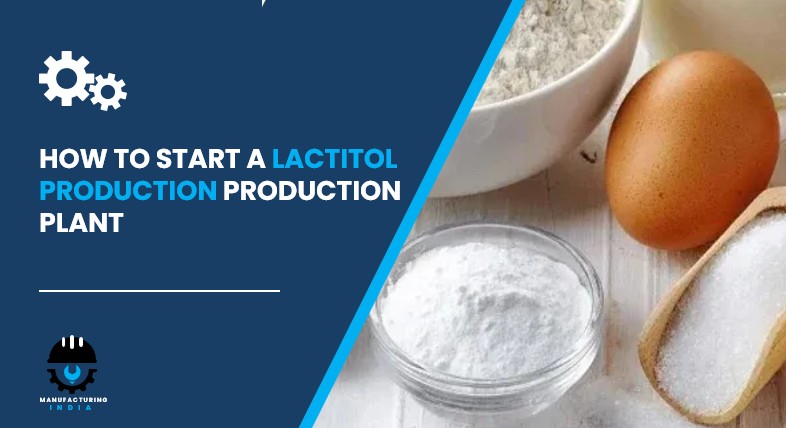
Setting up a lactitol production plant in India represents a highly attractive investment proposition underpinned by robust and structurally growing demand from the pharmaceutical, nutraceutical, food and beverage, and personal care sectors. As consumer preferences shift decisively toward low-calorie, sugar-free, and diabetic-friendly products, and awareness of digestive health continues to rise, lactitol a polyol sweetener derived from lactose occupies an increasingly important position across bulking agent, humectant, and functional excipient applications. This growth trajectory, combined with the versatility of lactitol across food, pharmaceutical, and oral care formulations, creates a highly favourable manufacturing environment for new entrants with efficient hydrogenation, purification, and crystallisation capabilities.
What is Lactitol?
Lactitol is a low-calorie sugar alcohol (polyol) with the chemical formula C₁₂H₂₄O₁₁, produced by catalytically hydrogenating lactose using hydrogen gas and a nickel-based catalyst, followed by purification, filtration, concentration, crystallisation or spray drying, and packing. Lactitol offers approximately 30–40% of sucrose’s sweetness, fewer calories, and a modest glycemic response. Its exceptional stability, mild sweetness, and humectant properties make it widely used in sugar-free confections, baked goods, dairy products, pharmaceutical formulations, nutraceuticals, and oral care products. Commercial production places strong emphasis on high product purity, controlled moisture content, and adherence to food safety, pharmaceutical, and quality requirements to ensure consistent product performance.
Key Investment Highlights
- Process Used: Catalytic hydrogenation of lactose using hydrogen gas and a nickel catalyst, followed by purification, filtration, concentration, crystallisation or spray drying, milling, quality testing, and packaging.
- End-Use Industries: Food and beverage, pharmaceuticals, nutraceuticals, dental care, personal hygiene, and specialised ingredient manufacturing.
- Applications: Bulking agent, humectant, low-calorie sweetener, sugar alternative, prebiotic ingredient, pharmaceutical excipient, and functional food ingredient.
Cost of Setting Up a Lactitol Production Plant
The total capital investment required to establish a lactitol production plant is shaped by several key parameters: annual production capacity, the level of automation across hydrogenation, purification, and crystallisation sections, facility specification, raw material sourcing strategy, and applicable food safety and pharmaceutical regulatory compliance requirements. Below is a structured breakdown of the major cost components.
1. Capital Expenditure (CapEx)
Total capital investment in a lactitol production plant covers the following major heads:
Land and Site Development
This encompasses land acquisition or lease, site preparation, boundary development, and utilities connectivity. Site selection should prioritise proximity to reliable lactose supply sources and hydrogen gas infrastructure, robust transportation networks for inbound raw materials and outbound finished product, availability of process water and steam generation capacity, and a trained workforce for plant operations and quality control. Compliance with industrial zoning regulations, food safety and pharmaceutical manufacturing standards, and hazardous gas storage and handling norms applicable to hydrogen must be assessed from project initiation.
Civil Works and Construction
Building costs cover the main processing facility including the lactose storage and preparation section, catalytic hydrogenation reactor house, purification and ion-exchange section, evaporation and crystallisation or spray drying area, centrifugation and milling section, automated packaging and dispatch infrastructure, quality control laboratory, administrative block, and utility infrastructure including boiler house, hydrogen storage and supply systems, power backup, cooling water systems, and effluent treatment plant. Construction must comply with applicable factory act requirements, food and pharmaceutical safety manufacturing standards, and hazardous gas handling and storage norms.
Machinery and Equipment
Machinery represents the single largest CapEx component. Key equipment required for a lactitol production plant includes:
- Lactose Storage Tanks: Bulk storage tanks and material handling systems for incoming liquid or powdered lactose feedstock, maintained under controlled temperature and hygienic conditions prior to processing
- Hydrogen Storage and Supply Systems: Pressurised storage vessels, piping, and flameproof supply infrastructure to deliver hydrogen gas safely to the catalytic hydrogenation reactors
- Catalytic Hydrogenation Reactors: Pressure reactors where lactose is hydrogenated in the presence of a nickel-based catalyst and hydrogen gas to convert it into lactitol
- Nickel Catalyst Handling Systems: Equipment for safe catalyst loading, recovery, regeneration, and disposal to maintain reaction efficiency and manage catalyst life-cycle costs
- Filtration Units: Systems to remove spent catalyst and particulate matter from the hydrogenated reaction mixture prior to purification
- Ion-Exchange Purification Systems: Resin-based systems to remove residual salts, ions, and impurities from the lactitol solution, improving product purity
- Evaporators: Multiple-effect or vacuum evaporation systems to concentrate the purified lactitol solution ahead of crystallisation or drying
- Crystallisers or Spray Dryers: Controlled cooling crystallisation systems or spray-drying units to convert concentrated lactitol solution into crystalline or powdered finished product
- Centrifuges: Equipment to separate lactitol crystals from residual mother liquor following crystallisation
- Milling and Sieving Equipment: Milling machines and sieving units to achieve consistent particle size and grade specifications for food and pharmaceutical customers
- Storage Silos: Bulk storage silos for finished lactitol powder or granules pending packaging and dispatch
- Weighing and Packaging Units: Automated weighing, filling, and packaging lines for retail, bulk, and pharmaceutical-grade product formats
- Clean-in-Place (CIP) Systems: Automated cleaning systems to maintain hygienic processing conditions across product-contact equipment
- Automated Process Control Systems: Instrumentation and control systems to monitor and regulate hydrogenation, purification, and crystallisation parameters for consistent product quality
Other Capital Costs
These include pre-operative expenses, commissioning charges, import duties on specialised hydrogenation and purification equipment, staff training and competency development, initial raw material and consumable inventory for production commissioning, regulatory compliance setup including FSSAI licensing, pharmacopeia-grade certification where applicable, hazardous chemicals and gas storage compliance for hydrogen handling, and ISO 22000 / HACCP food safety management system establishment costs.
Request a Sample Report for In-Depth Market Insights: https://www.imarcgroup.com/lactitol-manufacturing-plant-project-report/requestsample
2. Operational Expenditure (OpEx)
Raw materials principally lactose and hydrogen gas along with the nickel catalyst and other processing consumables constitute the dominant operating cost, typically representing 55–65% of total OpEx. Utility costs, driven primarily by steam generation, electricity consumption of hydrogenation, evaporation, and drying equipment, and hydrogen supply, account for 9–13% of OpEx. Labour, maintenance, quality control, packaging, transportation, depreciation, taxes, and overhead costs constitute the remainder of the operating cost base.
3. Plant Capacity
The proposed lactitol production facility is designed with an annual production capacity of 3,000 MT, enabling economies of scale while maintaining operational flexibility. This capacity supports a product portfolio spanning food-grade and pharmaceutical-grade lactitol in crystalline and powdered forms, serving food and beverage manufacturers, pharmaceutical formulators, nutraceutical companies, and oral care product manufacturers across domestic and export markets.
4. Profit Margins and Financial Projections
The project demonstrates healthy profitability potential under normal operating conditions. Financial projections encompass capital investment, operating costs, capacity utilisation ramp-up schedule, product mix between food-grade and pharmaceutical-grade lactitol, and forward demand outlook underpinned by rising sugar-free and functional ingredient consumption. A comprehensive feasibility analysis includes sensitivity analysis, Net Present Value (NPV), Internal Rate of Return (IRR), and Payback Period calculations. Gross profit margins for lactitol production typically range from 26–34%, supported by stable demand and value-added applications. Net profit margins of 15–21% are achievable with disciplined cost management, optimal capacity utilisation, and effective process yield optimisation.
Why Set Up a Lactitol Production Plant?
Growing Demand for Sugar-Free Foods
Lactitol is being used increasingly as a sugar substitute due to consumers’ growing desire for low-calorie and reduced-sugar products across confectionery, baked goods, dairy, and beverage categories. Its favourable taste profile and stability under processing conditions position it well against alternative polyol sweeteners in sugar-reduction formulations.
Growth of Functional Foods and Nutraceuticals
Consumption of lactitol continues to be encouraged by rising awareness of prebiotic ingredients and digestive health benefits. Its inclusion in dietary supplements and functional food formulations supports sustained demand growth beyond traditional confectionery applications.
Growing Pharmaceutical Manufacturing
Commercial production is being driven by demand for high-quality pharmaceutical excipients and laxative formulations, where lactitol is used as a filler, sweetener, and active therapeutic ingredient in tablets, syrups, and powder formulations.
Growing Diabetes and Health-Conscious Consumer Base
Rising global prevalence of diabetes and increasing health consciousness is generating long-term demand for low-glycemic and diabetic-friendly food and confectionery items, supporting sustained category growth for lactitol as a functional sweetener.
High-Value Functional Ingredient Positioning
Lactitol is a specialty ingredient that commands a value-added positioning relative to commodity sweeteners, requiring high purity, controlled crystallisation, and compliance with food and pharmaceutical quality standards. This creates a differentiated, less commoditised market position for capable processors.
Expanding Food Processing Industry
According to the India Brand Equity Foundation (IBEF), the Indian food processing market is projected to grow to approximately US$700 billion by 2030, driven by rising investment in value-added food products, growing manufacturing capacity, favourable government initiatives, and rising processed food consumption, supporting sustained demand for functional sweeteners such as lactitol as a specialty food ingredient.
Advancing Purification Technology Supporting Broader Applications
Technological advancements in lactitol purification and crystallisation processes have enabled purity levels above 99.5% in leading production facilities, broadening the range of food and pharmaceutical applications accessible to processors and supporting premium product positioning for new entrants investing in modern purification infrastructure.
Manufacturing Process Overview
The lactitol production operation transforms lactose feedstock into purified, crystalline or powdered lactitol through a sequence of hydrogenation, purification, concentration, crystallisation, and packaging operations. The key process stages are:
- Lactose Reception and Storage: Lactose received from suppliers is screened, tested for quality parameters, and stored under controlled conditions prior to processing to preserve feedstock quality.
- Catalytic Hydrogenation: Lactose is dissolved and reacted with hydrogen gas in the presence of a nickel-based catalyst under controlled temperature and pressure conditions, converting lactose into lactitol.
- Catalyst Filtration and Recovery: The hydrogenated reaction mixture is filtered to remove the spent nickel catalyst, which is recovered and regenerated where possible to manage input costs.
- Ion-Exchange Purification: The filtered lactitol solution is passed through ion-exchange resin systems to remove residual salts, ions, and colour-forming impurities.
- Concentration: The purified lactitol solution is concentrated through multiple-effect or vacuum evaporation to reach the concentration required for crystallisation or spray drying.
- Crystallisation or Spray Drying: The concentrated solution undergoes controlled cooling crystallisation to form lactitol crystals, or is spray-dried to produce a fine powder, depending on the target product grade.
- Centrifugation: Crystallised lactitol is separated from residual mother liquor using centrifuges, which is recycled back into the process to improve yield.
- Drying, Milling, and Sieving: Separated crystals are dried, milled, and sieved to achieve the target particle size and grade specification for food or pharmaceutical customers.
- Quality Control: Finished lactitol is tested for purity, moisture content, particle size distribution, and other parameters to verify compliance with food safety and pharmacopeia quality standards before release for packaging.
- Packaging and Dispatch: Quality-approved lactitol is packed in bags, drums, or bulk containers for food, pharmaceutical, and nutraceutical customers, and dispatched via road or bulk logistics to domestic and export markets.
Key Applications of Lactitol
- Food and Beverage Industry: Used extensively in baked goods, dairy products, chocolates, chewing gum, sugar-free candies, frozen desserts, and functional drinks as a bulking sweetener with reduced-calorie characteristics.
- Pharmaceutical Industry: Used in tablets, syrups, powders, and pharmaceutical formulations as an excipient, filler, sweetener, and laxative active ingredient.
- Nutraceuticals: Included in dietary supplements and functional foods owing to prebiotic qualities and digestive health benefits.
- Oral Care Products: Used in mouthwash, toothpaste, and sugar-free oral care formulations due to its tooth-friendly, non-cariogenic properties.
- Specialty Food Ingredients: Used in low-calorie and diabetic-friendly food items as a bulking agent, moisture stabiliser, and texture enhancer.
Global Lactitol Market Outlook
The global lactitol market was valued at approximately USD 600.0 Million in 2025. According to IMARC Group estimates, the market is expected to reach USD 868.88 Million by 2034, exhibiting a CAGR of 4.2% from 2026 to 2034. The lactitol market benefits from multiple structural demand drivers:
- Rising consumer demand for low-calorie, sugar-free, and diabetic-friendly food and beverage products across global markets
- Growing awareness of digestive health and prebiotic ingredient benefits, supporting adoption in dietary supplements and functional foods
- Expanding pharmaceutical manufacturing demand for high-quality excipients, fillers, and laxative formulations
- Increasing global prevalence of diabetes and obesity, driving long-term demand for low-glycemic sweetening alternatives
- Growing use of lactitol in tooth-friendly, non-cariogenic oral care formulations
- Continued expansion of the Indian and broader Asian food processing sector, supporting demand for functional specialty ingredients
- Technological advancements in purification and crystallisation improving product purity and broadening accessible applications
- Sustained capital investment by major global producers in production capacity expansion to meet rising demand
Leading producers in the global lactitol industry include Roquette Frères, Cargill Incorporated, and Archer Daniels Midland Company, among others, serving end-use sectors including food and beverage, pharmaceuticals, nutraceuticals, dental care, and personal hygiene.
Latest Industry Developments
- Capacity Investment: Major global lactitol producers have invested more than USD 120 million in production capacity expansion since 2024 to meet rising demand from the food, pharmaceutical, and nutraceutical sectors.
- Purity Improvements: Technological advancements in lactitol production have improved purity levels above 99.5% at leading facilities, enabling broader food and pharmaceutical applications and supporting premium product positioning.
Licenses and Regulatory Requirements
Establishing a lactitol production unit requires a range of approvals and certifications, which may vary by country and jurisdiction, including:
- Business registration and company incorporation under applicable company law
- Factory License under applicable state Factories Act provisions for manufacturing operations
- FSSAI (Food Safety and Standards Authority of India) License for manufacturing and sale of food-grade lactitol
- Pharmacopeia-grade certification (e.g., USP/EP/IP compliance) for pharmaceutical-grade lactitol production
- Compliance under the Manufacture, Storage and Import of Hazardous Chemicals Rules for facilities storing and handling hydrogen gas
- Explosive and gas storage licenses for hydrogen storage from the Petroleum and Explosives Safety Organisation (PESO)
- Pollution Control Board Clearances Consent to Establish (CTE) and Consent to Operate (CTO) for manufacturing operations and effluent generation
- ISO 22000 / HACCP Food Safety Management System Certification for food safety infrastructure compliance
- ISO 9001:2015 Quality Management System Certification for quality management infrastructure compliance
- Weights and Measures (Legal Metrology) registration for packaged commodity labelling and net quantity declaration
- Export-Import Code (IEC) for international market access
- Trademark and Brand Registration for proprietary branded product launch
- Occupational Health and Safety management compliance (ISO 45001 / Factories Act provisions) for manufacturing worker safety, particularly in hydrogen handling areas
Key Challenges to Consider
Raw Material Supply Consistency
Lactose, which accounts for 55–65% of total operating costs, is sourced from dairy processing by-product streams, and its availability and pricing can vary depending on dairy industry output and seasonal milk supply cycles. Securing long-term supply arrangements with reliable lactose suppliers is a critical operational priority for maintaining consistent production economics.
Hydrogen Handling and Process Safety
Catalytic hydrogenation operations using hydrogen gas introduce fire, explosion, and occupational health hazards that must be managed through flameproof equipment, gas detection systems, and rigorous safety protocols compliant with hazardous gas handling regulations. Continuous investment in storage system maintenance and safety audit compliance is a non-negotiable operational requirement.
Production Cost and Substitution Competition
Lactitol’s production cost is materially higher than conventional polyol sweeteners, with pricing typically 2–3 times that of maltitol and sorbitol, owing to the complex hydrogenation and purification process required. This cost differential requires processors to emphasise lactitol’s functional and prebiotic advantages to justify premium positioning against lower-cost substitute sweeteners such as maltitol, sorbitol, erythritol, and xylitol.
Quality Certification and Food Safety Compliance Maintenance
Maintaining FSSAI licensing, pharmacopeia-grade certification where applicable, and food safety management system certifications requires ongoing investment in quality laboratory infrastructure, process monitoring, and surveillance audit preparedness. Producing lactitol that consistently meets purity and moisture specifications across all production batches requires disciplined process control, as any compliance lapse can disrupt market access and damage brand reputation.
Capital Intensity of Purification and Crystallisation Infrastructure
Achieving pharmaceutical-grade and high-purity food-grade lactitol requires substantial capital investment in ion-exchange purification, evaporation, and controlled crystallisation or spray-drying infrastructure. New entrants must carefully evaluate the phasing of investment between standard food-grade production and higher-value pharmaceutical-grade capabilities based on available capital and target markets.
Frequently Asked Questions (FAQs)
1. How much does it cost to set up a lactitol production plant?
The total investment depends on plant capacity, automation level, facility specification, location, and target market certifications. Costs cover land, civil construction (hydrogenation section, purification and crystallisation area, storage tank farm, quality laboratory, utilities), machinery (hydrogenation reactors, ion-exchange systems, evaporators, crystallisers or spray dryers, packaging lines), quality certifications, working capital, and regulatory compliance. A comprehensive feasibility study from IMARC Group provides detailed, capacity-specific cost estimates covering all CapEx and OpEx components.
2. Is lactitol production a profitable business in 2026?
Yes. Sustained demand from health-conscious consumers, the expanding pharmaceutical and nutraceutical sectors, and growing sugar-free food consumption combined with gross margins of 26–34% and net profit margins of 15–21% make lactitol production financially attractive.
3. What machinery and equipment are required for a lactitol production plant?
Key equipment includes lactose storage tanks, hydrogen storage and supply systems, catalytic hydrogenation reactors, nickel catalyst handling systems, filtration units, ion-exchange purification systems, evaporators, crystallisers or spray dryers, centrifuges, milling and sieving equipment, storage silos, weighing and packaging units, clean-in-place (CIP) systems, and automated process control systems.
4. What licenses and approvals are required?
Required approvals include company registration, Factory License, FSSAI License for food-grade manufacturing, pharmacopeia-grade certification where applicable, compliance under the Manufacture, Storage and Import of Hazardous Chemicals Rules and PESO licensing for hydrogen storage, Pollution Control Board clearances, and ISO 22000/HACCP food safety management system certification.
5. How long does it take to commission a lactitol production plant?
Typically, 12–24 months from project initiation to commercial production launch, depending on project scale, facility construction timeline, equipment procurement lead times for hydrogenation and purification systems, regulatory approvals, and food safety certification timelines, which should be initiated early in the project to avoid delays to commercial launch.
6. What are the key raw materials for lactitol production?
The primary raw materials are lactose and hydrogen gas, along with a nickel-based catalyst used in the hydrogenation reaction. Other key inputs include ion-exchange resins for purification and packaging materials for finished product dispatch.
7. What is the break-even period for a lactitol production plant?
The break-even period generally depends on capacity utilisation ramp-up trajectory, the product mix between food-grade and pharmaceutical-grade lactitol, raw material supply consistency, and offtake arrangements. Securing long-term lactose supply agreements and stable offtake arrangements with food, pharmaceutical, and nutraceutical customers significantly improves revenue predictability and supports faster break-even achievement.
8. What are the main product grades of lactitol and their applications?
Lactitol is primarily produced in food-grade and pharmaceutical-grade forms, each available in crystalline or powdered formats. Food-grade lactitol serves confectionery, bakery, dairy, and beverage applications, while pharmaceutical-grade lactitol, meeting pharmacopeia purity standards, serves tablet, syrup, and laxative formulation applications.
9. What government incentives are available for lactitol processors?
Processors may benefit from food processing sector incentive schemes, state-level industrial investment incentives and capital subsidies for specialty ingredient manufacturing units, infrastructure support under food parks and mega food park schemes, and export promotion benefits for specialty food and pharmaceutical ingredient exports.
10. How does lactitol production compare to other polyol sweetener processing in terms of setup?
Compared to other polyol sweeteners such as maltitol and sorbitol, lactitol production is tied to a dairy-derived feedstock (lactose) rather than starch-derived glucose, requiring processors to build reliable relationships with dairy processing supply chains. The catalytic hydrogenation technology employed is broadly similar to other polyol processing, allowing processors with experience in sugar alcohol manufacturing to adapt existing technical capabilities to lactitol with targeted investment in purification and crystallisation infrastructure to meet higher purity requirements.
Key Takeaways for Investors
The lactitol production industry represents a structurally resilient and financially attractive investment opportunity positioned at the intersection of rising global demand for sugar-free and low-calorie products, expanding pharmaceutical and nutraceutical manufacturing, and growing consumer awareness of digestive health. Stable demand from food and beverage, pharmaceutical, nutraceutical, and oral care channels provides resilience against single-segment demand volatility, while lactitol’s premium positioning relative to commodity sweeteners supports healthy gross margins of 26–34% and net margins of 15–21%. Continued technological advancement in purification and crystallisation processes is broadening the range of accessible high-value applications, while sustained capital investment by established global producers reflects strong confidence in the long-term growth and profitability of the category. The scalable nature of the value chain allows investors to phase capital deployment between standard food-grade production and higher-value pharmaceutical-grade capabilities according to risk appetite and target market positioning.
About the Author