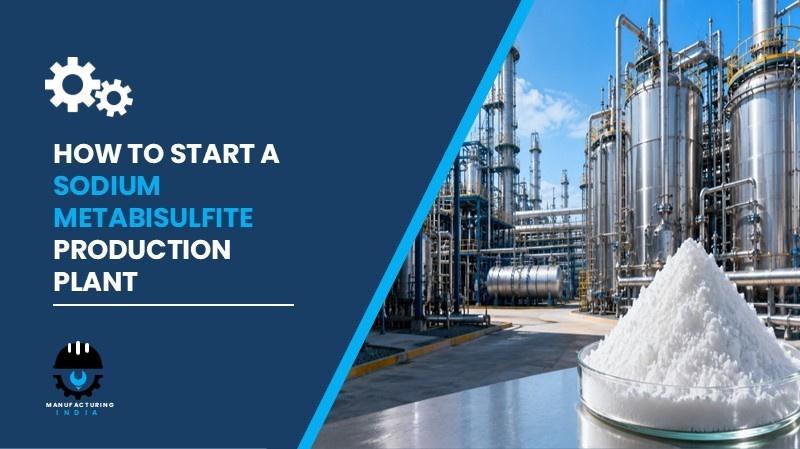
A sodium metabisulfite production plant setup in India presents a compelling investment case for entrepreneurs eyeing the country’s expanding chemicals sector. Demand for this compound is driven by the food and beverage, water treatment, pharmaceuticals, textiles, pulp and paper, mining, and chemicals industries, which rely on its antioxidant, disinfectant, and reducing properties. As processed food consumption rises and water quality regulations tighten, sodium metabisulfite has become a critical input for preservation, dechlorination, and industrial bleaching applications across the country.
India’s growing urbanisation, expanding industrial infrastructure, and the Make in India initiative make the timing favourable for new capacity. States with established chemical manufacturing clusters, particularly Gujarat and Maharashtra, offer access to raw material suppliers, port connectivity, and skilled labour, all of which support cost-competitive operations. Combined with a fast-growing domestic pharmaceutical sector that increasingly consumes preservatives and stabilisers, this investment is well positioned to serve both domestic and export markets.
This is a chemical investment opportunity backed by policy support under Make in India, cost-competitive raw material access in Gujarat and Maharashtra, steady demand from food processing, water treatment, and pharmaceutical sectors, gross margins of 20-30%, and a viable path to break-even under normal operating conditions.
What is Sodium Metabisulfite?
Sodium metabisulfite is a white to slightly yellow crystalline powder characterized by a pungent smell of sulfur dioxide. It is highly soluble in water and functions as a robust reducing agent, antioxidant, and antimicrobial substance. In aqueous solutions, it yields sulfur dioxide, which provides its preservation and bleaching properties. The compound is moisture-attracting and must be stored under controlled conditions, and it reacts strongly with oxidizing agents and acids, giving it the ability to remove oxygen, inhibit microbial growth, and stabilize color across industrial applications.
A sodium metabisulfite production plant uses sulfur dioxide absorption, neutralization, crystallization, filtration, drying, and packaging as its core production process. The compound serves as a preservative, antioxidant, bleaching agent, dechlorination agent, and reducing agent, and it is consumed by the food and beverage, water treatment, pharmaceutical, textile, pulp and paper, and mining industries.
Cost of Setting Up a Sodium Metabisulfite Production Plant in India
The cost of setting up this facility depends on capacity, technology, location, automation level, and regulatory compliance requirements, all of which shape the total investment needed for the unit.
1. Capital Expenditure (CapEx)
Land and site development form a substantial part of the overall investment, covering land acquisition, registration, and boundary development, with options to locate the unit within an industrial estate or SEZ to benefit from ready infrastructure. Civil works and construction costs cover the production shed, laboratory, raw material and finished goods storage, and the administrative block. Machinery costs account for the largest portion of total capital expenditure for the unit. Key machinery required includes:
- Sulfur burner or SO2 generator
- Absorption reactors
- Crystallizers
- Centrifuges or filtration units
- Dryers
- Packaging and material handling systems
Other capital costs include effluent treatment plant (ETP) installation, pre-operative expenses, and commissioning costs, all of which must be factored into the overall project budget for the facility.
Request a Sample Report for In-Depth Market Insights: https://www.imarcgroup.com/sodium-metabisulfite-manufacturing-plant-project-report/requestsample
2. Operational Expenditure (OpEx)
Raw material cost is the single largest component of operating expenditure for a sodium metabisulfite production plant, accounting for approximately 60-75% of total OpEx. The primary raw materials are soda ash (sodium carbonate) or caustic soda, and sulfur, and investors are advised to secure long-term supplier contracts to stabilize pricing and ensure a consistent supply. Utility cost, covering electricity, water, and steam, represents 15-25% of OpEx. Other operating costs include transportation, packaging, salaries and wages, maintenance, depreciation, and taxes. By the fifth year of operations, total operating cost is expected to increase substantially due to inflation, market fluctuations, and potential rises in the cost of key raw materials, alongside supply chain disruptions and rising consumer demand.
3. Plant Capacity
The proposed sodium metabisulfite production facility is designed with an annual capacity ranging between 20,000 and 30,000 tons per year, which enables economies of scale while maintaining operational flexibility. Capacity can be customized based on investor requirements, and profitability generally improves as capacity utilisation increases across the sodium metabisulfite production process.
4. Profit Margins and Financial Projections
Financial projections for a sodium metabisulfite production plant are developed based on capital investment, operating costs, capacity utilisation, pricing trends, and demand outlook, and cover ROI, net present value (NPV), and payback period alongside profitability. Gross profit margins typically range between 20-30%, while net profit margins range between 8-15%, reflecting healthy profitability potential for the unit under normal operating conditions.
Why Set Up a Sodium Metabisulfite Plant in India?
Essential Industrial Chemical Demand: Sodium metabisulfite is a necessary input for food processing, water treatment, textiles, mining, and pharmaceuticals, keeping demand consistently strong. As these downstream industries expand, the case for a new sodium metabisulfite production plant to serve domestic supply grows in parallel.
Wide Application Spectrum: Its multifunctional properties as a preservative, antioxidant, and reducing agent support use across several unrelated sectors, which reduces reliance on any single end market and provides revenue stability for the plant.
Favorable Market Dynamics: Rising packaged food consumption, stricter water quality regulations, and growing industrial processing activity continue to support sustained growth in the sodium metabisulfite market, which was valued at USD 200.78 Million globally in 2025 and is projected to reach USD 303.56 Million by 2034, at a CAGR of 4.7% from 2026 to 2034.
Pharmaceutical Sector Tailwinds: According to the India Brand Equity Foundation (IBEF), India’s pharmaceutical sector is expected to grow at a CAGR exceeding 10%, reaching an estimated market value of around USD 130 billion by 2030. As pharmaceutical production volumes rise, demand for sodium metabisulfite as a stabiliser and antioxidant in injectable formulations, tablets, and API processing is expected to strengthen further.
Active Industry Investment: In September 2025, Southern Ionics announced plans to invest in its sulfur chemicals facility in Tuscaloosa, Alabama, to expand capacity and add sodium metabisulfite production for water treatment, food, chemical, and pharmaceutical applications. In August 2025, China’s National Health Commission accepted applications confirming sodium metabisulfite as a new food additive, signalling continued global regulatory momentum for the compound.
Scope for Regional Production: Local production allows manufacturers to reduce dependency on imports, strengthen supply chain reliability, and deliver more quickly to end users, a factor that favours setting up capacity within India rather than relying on imported material.
Production Process – Step by Step
The sodium metabisulfite production process uses sulfur dioxide absorption, neutralization, crystallization, filtration, drying, and packaging as the primary production method.
- Sulfur Dioxide Generation: Sulfur is burned in a sulfur burner or SO2 generator to produce sulfur dioxide gas.
- Absorption: The sulfur dioxide gas is passed through absorption reactors where it reacts with soda ash (sodium carbonate) or caustic soda.
- Neutralization: The resulting solution is neutralized to form sodium bisulfite/metabisulfite liquor.
- Crystallization: The liquor is processed in crystallizers to precipitate sodium metabisulfite crystals.
- Filtration: Centrifuges or filtration units separate the crystals from the mother liquor.
- Drying: The separated crystals are passed through dryers to remove residual moisture.
- Packaging and Dispatch: The finished sodium metabisulfite is packed using packaging and material handling systems before dispatch to end-use industries such as food and beverage, water treatment, and pharmaceuticals.
Key Applications
Sodium metabisulfite serves a wide range of industries due to its preservative, antioxidant, and reducing properties.
- Food and Beverage Industry: Used against oxidation, microbial spoilage, and enzymatic browning in processed foods, beverages, dried fruits, and starch-based products.
- Water Treatment Industry: Used for dechlorination, removal of excess chlorine, and oxygen scavenging in municipal and industrial water treatment systems.
- Pharmaceutical Industry: Functions as an antioxidant and stabilizer in injectable formulations, tablets, and active pharmaceutical ingredient processing.
- Pulp and Paper Industry: Used as a bleaching agent and reducing chemical to improve pulp brightness and control lignin oxidation.
- Textile and Mining Industries: Acts as a reducing agent in textile dyeing processes and as a flotation reagent in mineral beneficiation.
Leading Manufacturers
The global sodium metabisulfite industry includes several established players with extensive production capacities and diverse application portfolios. Key players include:
- Akkim
- BASF SE
- Solvay
- Grillo-Werke
- Esseco USA
- Hydrite Chemical
- Surpass Chemical
- Aditya Birla Chemicals
- Seidler Chemical
- Tangshan Sanjiang Chemical
- Weifang Taida United Chemical
- Ineos Calabrian Corporation
- Santa Cruz Biotechnology
Timeline to Start the Plant
- Feasibility study and project report preparation
- Land acquisition and site development
- Regulatory approvals and environmental clearances
- Factory licence and fire safety compliance
- Machinery procurement and installation
- Raw material supplier agreements and supply chain setup
- Trial production and quality testing
- Commercial production launch
Licences and Regulatory Requirements
Starting a sodium metabisulfite production unit in India requires several approvals:
- Business registration (Proprietorship, LLP, or Pvt Ltd)
- Factory Licence under the Factories Act
- Environmental Clearance from State Pollution Control Board
- GST Registration
- Fire Safety NOC
- Hazardous/Chemical compliance for sulfur dioxide handling
- Effluent Treatment Plant (ETP) operational clearance
- Occupational Health and Safety compliance
Key Challenges to Consider
High Capital Requirements: Machinery costs, including absorption reactors, crystallizers, and drying systems, account for a large share of the total capital expenditure needed to commission a sodium metabisulfite production plant, making upfront funding a key consideration for a new sodium metabisulfite facility.
Raw Material Price Volatility: Soda ash (sodium carbonate) or caustic soda, and sulfur together represent the majority of operating costs, and price fluctuations in these inputs can directly affect margins.
Regulatory Compliance: Environmental clearances, effluent treatment obligations, and hazardous chemical handling rules require ongoing attention and documentation.
Competition from Established Players: Global producers such as BASF SE, Solvay, and Aditya Birla Chemicals have strong production capacities and diverse application portfolios, requiring new entrants to compete on cost and reliability.
Skilled Manpower: Operating a sodium metabisulfite production plant safely requires trained technical staff for absorption, crystallization, and drying systems, particularly for handling sulfur dioxide gas.
Supply Chain Dependence: Consistent access to soda ash, caustic soda, and sulfur from nearby suppliers is essential to avoid production disruptions at the facility.
Frequently Asked Questions
1. How much does it cost to set up a sodium metabisulfite production plant in India?
Cost depends on plant capacity, machinery selection, automation level, and location, covering land, civil works, machinery, and other capital costs.
2. Is sodium metabisulfite production profitable in India in 2026?
Yes, the project shows healthy profitability potential, with gross margins of 20-30% and net margins of 8-15% under normal operating conditions.
3. What machinery is required for a sodium metabisulfite plant in India?
Core machinery includes a sulfur burner or SO2 generator, absorption reactors, crystallizers, centrifuges or filtration units, dryers, and packaging systems.
4. What licences and approvals are required to start a sodium metabisulfite plant in India?
Requirements include business registration, a Factory Licence, Environmental Clearance, GST Registration, Fire Safety NOC, hazardous chemical compliance, and ETP clearance.
5. What raw materials are needed for sodium metabisulfite production?
The primary raw materials are soda ash (sodium carbonate) or caustic soda, and sulfur.
6. What are the environmental compliance requirements for a sodium metabisulfite plant in India?
Plants require Environmental Clearance from the State Pollution Control Board and an operational Effluent Treatment Plant (ETP) to manage emissions and discharge.
7. What is the best location to set up a sodium metabisulfite plant in India?
Sites near soda ash, caustic soda, and sulfur suppliers, with robust transport, utility, and waste management infrastructure, are best suited, with Gujarat and Maharashtra offering established chemical clusters.
8. What is the break-even period for this type of plant in India?
Break-even depends on capacity utilisation, pricing, and cost structure, and is assessed as part of the project’s financial and payback period analysis.
9. What government incentives are available for manufacturers in India?
The Make in India initiative supports domestic chemical production, alongside state-level industrial estate and SEZ benefits that reduce infrastructure costs.
Key Takeaways for Investors
This investment opportunity is backed by consistent demand from the food and beverage, water treatment, pharmaceutical, textile, pulp and paper, and mining industries. Financial projections indicate healthy profitability across plant capacities of 20,000-30,000 tons per year, with gross margins of 20-30% and net margins of 8-15%. The global sodium metabisulfite market, valued at USD 200.78 Million in 2025, is projected to grow to USD 303.56 Million by 2034 at a CAGR of 4.7%, supported further by India’s pharmaceutical sector expanding toward an estimated USD 130 billion by 2030. With sustained demand across essential industrial applications, this unit is positioned for long-term viability.
About the Author