Introduction
Most manufacturing businesses in India run machinery well past its original design life, and that is not automatically a problem. What is a problem is not knowing, with evidence, how many productive years of reliable output remain in that machine, and what it would cost to keep it running safely. This is the exact gap that machinery residual life assessment consultants are engaged to close.
Decisions on capital expenditure, insurance renewal, plant expansion, investor due diligence, and even bank financing increasingly depend on a Machinery Residual Life Assessment that answers a simple question: is this equipment still fit for the job, and for how long? Without that answer, businesses either over-invest in premature replacement or under-invest and absorb the risk of unplanned failure. Experienced Machinery Residual Life Assessment Consultants close this gap with verified, site-level evidence rather than assumption.
IMARC Engineering provides Machinery Residual Life Assessment Services, equipment health evaluation, and engineering due diligence for manufacturers, exporters, and industrial investors across India. This article explains how a structured Machinery Residual Life Assessment supports capital planning, insurance decisions, asset management, and long-term operational reliability.
Why Machinery Residual Life Assessment Is Becoming Critical for India’s Manufacturing Sector
Several economic and policy trends are pushing machinery condition and equipment life from a maintenance-department concern to a boardroom one.
Capacity Utilisation Is Rising, and So Is Wear on Existing Assets
- Manufacturing capacity utilisation reached multi-quarter highs, rising to 74.3% in the July–September 2025 quarter, per the RBI’s Order Books, Inventories and Capacity Utilisation Survey (OBICUS), among its strongest readings in recent rounds
- Higher operating hours per asset: Higher utilisation means machines run more hours per year, compressing the assumptions manufacturers made about equipment life when they first purchased it
- Less margin for surprises: Businesses running assets closer to full capacity have the least room for an unplanned breakdown, and the least visibility into how much life is actually left
Capital Goods Output and Machinery Investment Are Both Expanding
- Sector output nearly doubled: India’s capital goods sector output has nearly doubled over the past decade, reaching ₹4,29,001 crore in FY2023-24, per data cited by Invest India and the Ministry of Heavy Industries
- Production accelerating: The Index of Industrial Production for capital goods grew 8.1% in late 2025, signalling faster machinery purchase and deployment across industry
- A growing installed base: As new machinery enters service faster, the installed base that will eventually need residual life evaluation grows in parallel
PLI-Linked Capacity Build-out Is Adding to the Installed Machinery Base
- Investment at scale: Cumulative investment under the Production Linked Incentive (PLI) scheme crossed ₹2.16 lakh crore, with 836 applications approved and cumulative sales exceeding ₹20.41 lakh crore as of December 2025, per the Ministry of Commerce and Industry (PIB)
- Mostly plant and machinery: A large share of this investment is in plant and machinery, much of it new capacity that will need documented condition tracking well before its warranty period ends
- Investor expectations are shifting: Investors and lenders backing PLI-linked capacity increasingly expect equipment condition reporting as part of ongoing asset monitoring, not only at commissioning
MSMEs Carry a Large Share of India’s Ageing Machinery Base
- A large share of manufacturing output: MSMEs contribute 35.4% of India’s manufacturing Gross Value Added, per the Ministry of MSME and Economic Survey data
- Government-acknowledged modernisation gap: The Ministry of MSME’s Credit Linked Capital Subsidy Scheme (CLCSS) offers a 15% upfront subsidy, capped at ₹15 lakh, for technology upgradation on machinery investment of up to ₹1 crore, a direct acknowledgment that ageing machinery constrains productivity across the MSME base
- The scheme supports only new machinery by design : Second-hand or already-upgraded machinery does not qualify for CLCSS support, which makes an independent residual life assessment the only reliable way for an MSME to justify, or defer, a replacement decision
Figure 1: India’s Machinery Investment and Ageing Asset Landscape — capacity utilisation, capital goods momentum, PLI investment, and the MSME modernisation gap.
The opportunity to extend equipment life is real, but so is the risk of running assets on assumption instead of assessment.
Why Ageing Machinery Without Residual Life Assessment Creates Risk That Is Difficult to Reverse
Most machinery-related losses follow a familiar pattern: replacement or continuation decisions made on OEM design-life assumptions or maintenance logs, without independent verification of actual remaining life.
The following risks typically surface after the wrong investment decision:
- Unplanned failure and downtime: Equipment that looks serviceable on paper can fail without warning once fatigue, corrosion, or wear cross a threshold that routine maintenance does not measure
- Capital misallocation: Businesses without residual life data either replace machinery years before it is necessary or delay replacement until failure forces an unplanned, unbudgeted purchase
- Safety and statutory exposure: Continuing to operate pressure vessels, boilers, cranes, or other regulated equipment beyond a safe operating threshold creates exposure under the Factories Act, Boiler Act, and equivalent state regulations
- Insurance and asset valuation gaps: Insurers and auditors increasingly expect documented equipment condition data; without it, machinery may be under-insured, over-insured, or carried on the books at a value the asset cannot support
- Investor and lender confidence risk: Investors, private equity due diligence teams, and banks financing expansion or acquisition treat undocumented machinery condition as an unquantified liability, which can affect valuation and loan terms
- Resale and exit value erosion: A manufacturer selling a plant, divesting a business unit, or exiting a joint venture loses negotiating leverage without third-party evidence of the residual value embedded in its machinery
Structured residual life assessment prevents these outcomes by replacing assumption with evidence before a capital decision is made.
Key Parameters Evaluated During a Machinery Residual Life Assessment
A credible machinery residual life assessment examines six interconnected technical and financial dimensions. A gap in any one of them can distort the final conclusion.
1. Mechanical Condition and Wear Analysis
- Visual and dimensional inspection of critical wear components against OEM tolerance limits
- Vibration analysis, thermography, and lubricant or oil analysis to detect early-stage degradation
- Non-destructive testing (NDT), including ultrasonic thickness gauging, dye penetrant, and radiography, for pressure parts and load-bearing structures
- Comparison against baseline specifications from the original equipment manufacturer
Wear that is invisible to routine inspection is often the first sign of a shortened remaining life.
2. Structural and Safety Integrity
- Fatigue and corrosion assessment on structural members, pressure vessels, and load-bearing frames
- Weld integrity and material degradation checks on critical joints
- Verification against applicable design codes and statutory inspection certificates
- Assessment of any modifications or repairs made outside OEM specifications
3. Performance and Output Efficiency Benchmarking
- Actual output, cycle time, and energy consumption measured against original commissioning benchmarks
- Efficiency drift that signals accelerating wear even when the machine is still technically running
- Downtime frequency and mean-time-between-failure trends over recent operating history
A machine that still runs is not the same as a machine still performing at commercially useful efficiency.
4. Maintenance and Failure History Review
- Completeness and consistency of maintenance logs, spare-parts replacement records, and breakdown history
- Root-cause patterns behind repeat failures rather than isolated incidents
- Verification of whether maintenance practices match OEM-recommended intervals or have been deferred
5. Regulatory and Statutory Compliance
- Validity of statutory certifications: boiler certificates, pressure vessel approvals, crane and lifting equipment certifications, and PESO approvals where applicable
- Alignment with Factories Act and state-specific safety inspection requirements
- Documentation readiness for insurance renewal, environmental audits, or regulatory inspection
6. Financial and Replacement Economics — How Machinery Residual Life Assessment Consultants Support Better Investment Decisions
- Remaining useful life expressed in operating years, not just a pass or fail condition rating
- Cost of continued operation, including maintenance, downtime risk, and energy inefficiency, weighed against the cost of replacement or refurbishment
- Depreciated replacement value and fair market value for insurance, financing, and transaction purposes
- Capital planning inputs that align equipment life with production and investment roadmaps
This is the stage where a technical inspection becomes a practical business decision.
Machinery Residual Life Assessment: Evaluation Snapshot
The table below summarises how each evaluation area translates into a business outcome.
| Evaluation Area | What Is Verified | Business Impact |
|---|---|---|
| Mechanical Condition | Wear, vibration, thermography, and NDT results against OEM tolerances | Early detection of failure risk before breakdown |
| Structural Integrity | Fatigue, corrosion, weld, and material condition | Safety assurance and reduced statutory liability |
| Performance Efficiency | Output, cycle time, and energy consumption trends | Identifies hidden productivity and cost losses |
| Maintenance History | Logs, repair patterns, and root-cause data | Distinguishes genuine wear from poor upkeep |
| Regulatory Compliance | Statutory certificates and safety approvals | Reduces compliance and insurance risk |
| Financial & Replacement Economics | Remaining useful life, replacement cost, and fair value | Supports capex, insurance, and investment decisions |
How Machinery Residual Life Assessment Consultants at IMARC Engineering Evaluate Equipment Health
IMARC Engineering’s assessment process is structured to produce a defensible, evidence-based conclusion rather than a subjective condition rating.
- Asset inventory and documentation review: Compiling equipment specifications, commissioning records, maintenance logs, and prior inspection or insurance reports before any site visit
- On-site condition assessment: Physical inspection combined with vibration analysis, thermography, lubricant testing, and non-destructive testing appropriate to the equipment category
- Performance benchmarking: Comparing actual output, efficiency, and downtime data against OEM design specifications and historical performance baselines
- Maintenance and failure history analysis: Reviewing repair patterns and root causes to separate manageable wear from structural degradation
- Regulatory and statutory verification: Cross-checking all applicable certifications, licences, and safety approvals against source documents, not self-declaration
- Residual life assessment and valuation reporting: Structured reporting that expresses remaining useful life, fair value, and replacement economics to support internal sign-off, insurance renewal, or investor due diligence
IMARC Engineering conducts this assessment across process industries, FMCG production lines, auto components, pharmaceuticals, chemicals, and general industrial machinery, where duty cycles, statutory requirements, and failure consequences differ significantly and a generic maintenance checklist is not sufficient.
Need to determine whether your existing machinery should be refurbished, upgraded, or replaced? Speak with IMARC Engineering’s technical experts for an independent Machinery Residual Life Assessment: https://www.imarcengineering.com/contact?service=technical-due-diligence-for-investors
Figure 2: The Machinery Residual Life Assessment Process — from asset documentation to a decision-ready residual life and valuation report.
Common Mistakes in Machinery Investment and Asset Life Planning
- Relying on OEM design life alone: A stated design life is a manufacturer’s general estimate, not a measurement of how a specific machine has actually aged under real operating conditions
- Delaying assessment until a failure occurs: Reactive assessment after breakdown finds the cause, not the runway a business had to plan a replacement in advance
- Treating maintenance logs as sufficient evidence: Logs show what work was done, not what condition the equipment is actually in today
- Skipping structural and NDT testing to save cost: The equipment types most likely to fail catastrophically, such as pressure vessels, boilers, and structural frames, are exactly the ones where skipping testing carries the highest downside
- Under-valuing or over-valuing assets for insurance and transactions: Without independent assessment, insurance cover, loan collateral value, and M&A valuations are built on assumption rather than verified condition
- Assuming residual life is a one-time exercise: Operating conditions, load, and maintenance quality change year to year, which makes residual life a periodic assessment rather than a single certificate
Conclusion
India’s manufacturing base is expanding on every measure that matters, including capacity utilisation, capital goods output, PLI-linked investment, and MSME production, and every one of these trends adds machinery to an installed base that will eventually need an honest answer about how much useful life remains.
Mechanical condition, structural integrity, performance efficiency, maintenance history, regulatory compliance, and replacement economics together determine whether continuing to operate a machine is a sound investment or a growing liability. A Machinery Residual Life Assessment replaces assumption with verified evidence, enabling manufacturers to optimize capital investments, improve asset utilization, reduce operational risk, and provide manufacturers, investors, and lenders with a defensible basis for informed capital decisions.
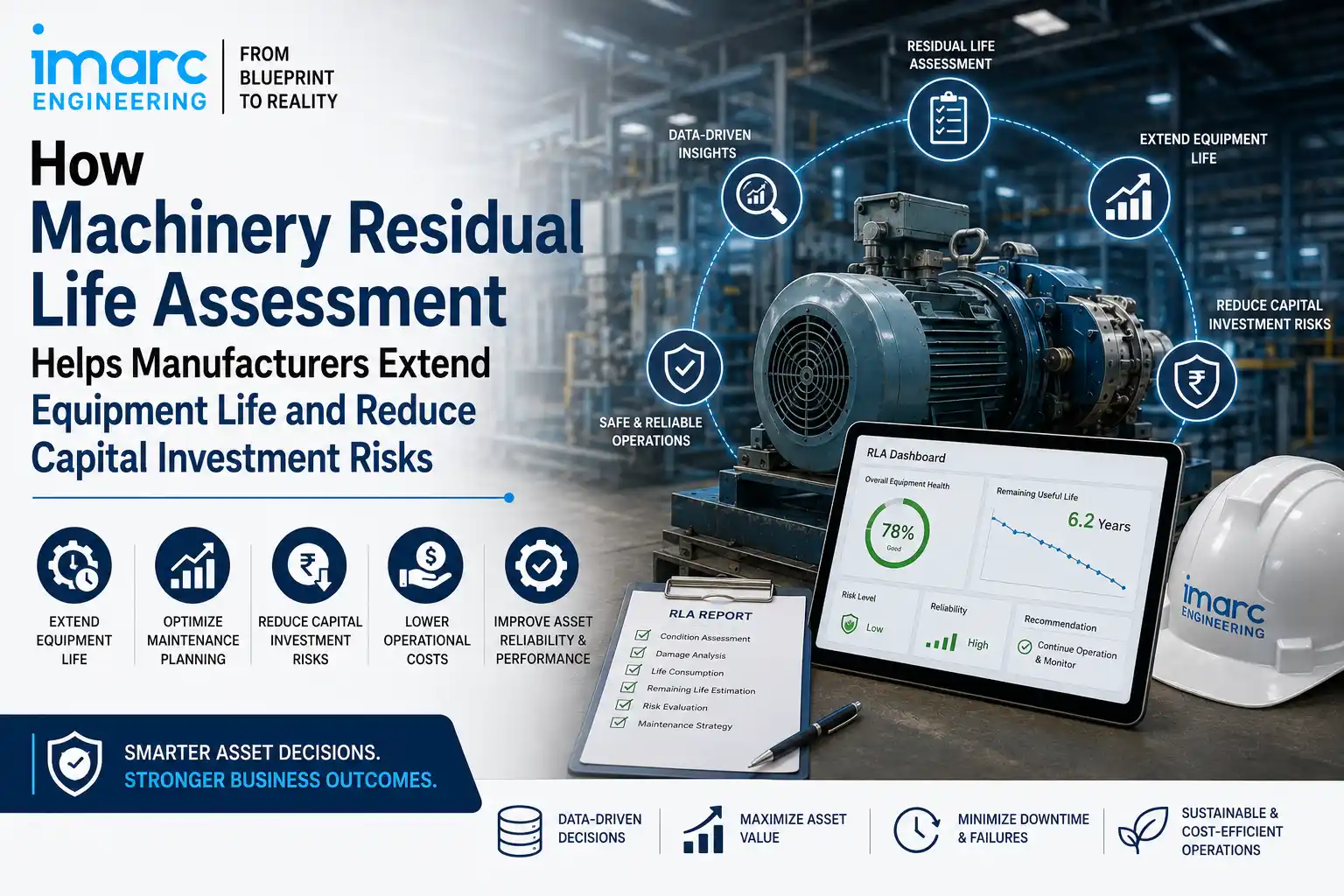
Through structured condition assessment, statutory compliance verification, performance benchmarking, and residual life reporting, Machinery Residual Life Assessment Consultants at IMARC Engineering help manufacturers extend equipment life, optimize maintenance planning, reduce capital investment risks, and make evidence-based asset management decisions.
Contact Us:
IMARC Engineering
Phone: +91-120-433-0800
|Email: sales@imarcengineering.com
India: C-130, Sector 2, Noida, Uttar Pradesh 201301
LinkedIn: https://www.linkedin.com/showcase/imarc-engineering/
About the Author