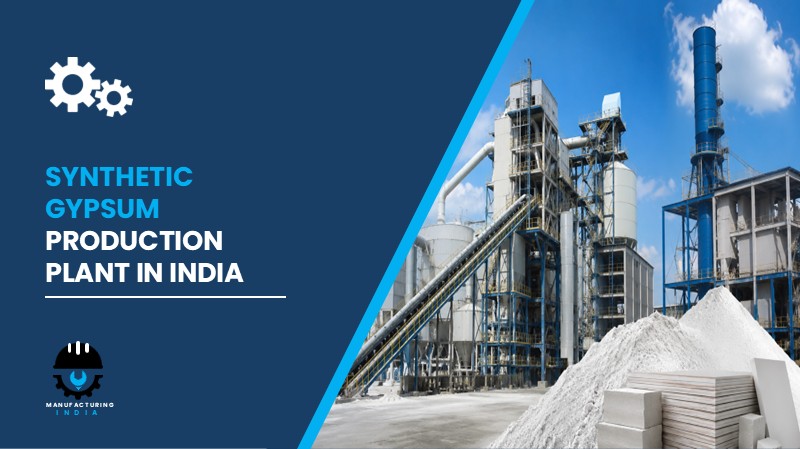
Setting up a synthetic gypsum production plant in India presents a compelling investment case at a time when the country’s construction sector is in one of its most sustained growth phases in history, its coal-fired power generation fleet continues to operate at significant scale while facing tightening environmental compliance obligations, its cement industry is among the world’s largest and fastest-growing, and the circular economy imperative of converting industrial by-products into valuable commercial materials is gaining policy and commercial momentum simultaneously. Synthetic gypsum — the chemically identical form of calcium sulfate dihydrate produced through industrial processes instead of mining, most commonly through flue-gas desulfurisation (FGD) where coal-fired power plants use limestone slurry to capture sulfur dioxide emissions — is used extensively in cement manufacturing and drywall construction as a cost-effective, sustainability-advantaged alternative to mined natural gypsum. As India’s residential construction sector expands at 6.8% annually toward USD 350 Billion by 2030, and as its power utilities seek productive, revenue-generating outlets for FGD by-products that would otherwise represent a costly waste disposal burden, the domestic case for synthetic gypsum production capacity is becoming increasingly commercially compelling.
India’s domestic investment momentum in gypsum-based building materials confirms the commercial confidence underlying this opportunity. In April 2026, Balrampur Chini Mills disclosed that it would set up a Lactogypsum Processing Plant at Kumbhi, Uttar Pradesh, with an investment of ₹160 crore — a facility that will manufacture gypsum boards using lactogypsum, a by-product of the company’s upcoming Polylactic Acid project. This investment is a direct, India-specific signal that domestic manufacturers are actively building industrial by-product-to-gypsum-board value chains, validating the broader commercial logic that underpins synthetic gypsum production from any qualifying industrial by-product stream, including FGD gypsum from India’s coal power fleet. India’s residential construction sector, which expanded at 6.8% during FY2024–25 and is projected to reach USD 350 Billion by 2030, provides a deep and structurally growing domestic demand base for both gypsum boards and cement-grade synthetic gypsum that a new producer can access.
Investing in a synthetic gypsum production plant in India today aligns the country’s coal power fleet’s FGD by-product generation, its booming residential construction sector, and growing circular economy and sustainability mandates with a global synthetic gypsum market growing from USD 1.50 Billion in 2025 to USD 2.17 Billion by 2034 at a CAGR of 4.2%. With gross profit margins of 22–30% and net profit margins of 12–18% at an annual production capacity of 100,000 MT, the unit economics are commercially sound, and the investment’s dual cost-and-sustainability advantage over mined gypsum supports durable, long-term competitive positioning.
What is Synthetic Gypsum?
Synthetic gypsum is a chemically identical form of calcium sulfate dihydrate produced through industrial processes instead of mining. The most common source is flue-gas desulfurisation (FGD), where coal-fired power plants use limestone slurry to capture sulfur dioxide emissions. It is used in cement manufacturing and drywall construction.
Because synthetic gypsum is chemically identical to mined natural gypsum, it can be used as a direct substitute across all conventional gypsum applications — without requiring any compromise in product performance — while offering the dual advantage of lower feedstock cost (since it is sourced as an industrial by-product rather than mined from virgin deposits) and a positive sustainability and circular economy narrative that mined gypsum cannot match. As synthetic gypsum is mainly produced as a by-product of flue-gas desulfurisation in coal-fired power plants, it offers cost and sustainability advantages over mined gypsum while helping utilities reduce waste disposal burdens — a mutually beneficial economic relationship between power generation utilities seeking to monetise an environmental compliance by-product and gypsum product manufacturers seeking a reliable, cost-advantaged feedstock supply.
The primary production process covers precipitation, dewatering, washing, and thermal drying. End-use industries served include wallboard manufacturing, cement production, agricultural soil conditioning, specialty plasters, and glassmaking. Applications span drywall core formulations, cement retarder additives, soil nutrient supplements, industrial filler compounds, and high-purity plaster of Paris blends.
Cost of Setting Up a Synthetic Gypsum Production Plant in India
The cost of establishing a synthetic gypsum production plant in India depends on production capacity, FGD by-product or alternative industrial by-product feedstock sourcing arrangements, product mix across wallboard-grade and cement-grade synthetic gypsum, geographic location — particularly proximity to coal-fired power plants or other gypsum-generating industrial facilities — degree of automation, and the quality compliance requirements applicable to synthetic gypsum supplied to cement manufacturers and gypsum board producers.
1. Capital Expenditure (CapEx)
Land and Site Development forms a foundational component of total capital investment, covering land acquisition charges, site registration, boundary development, drainage infrastructure, and site utilities. The location must offer easy access to key raw materials such as calcium hydroxide/lime, sulfuric acid/sulfur dioxide, and water. Proximity to target markets will help minimise distribution costs. The site must have robust infrastructure, including reliable transportation, utilities, and waste management systems. Compliance with local zoning laws and environmental regulations must also be ensured. Locating the plant adjacent to or within close proximity of coal-fired thermal power plants — particularly NTPC and state electricity board facilities across India — provides direct access to FGD gypsum by-product streams and the most commercially advantaged feedstock supply arrangement available to a synthetic gypsum producer.
Plant Layout Optimisation is critical for a synthetic gypsum production facility integrating precipitation, dewatering, washing, and thermal drying operations. The layout should be optimised to enhance workflow efficiency, safety, and minimise material handling. Separate areas for raw material storage, production, quality control, and finished goods storage must be designated. Space for future expansion should be incorporated to accommodate business growth as cement industry and gypsum board manufacturer customer relationships develop.
Machinery and Equipment represent the largest single component of total CapEx for a synthetic gypsum production plant. Essential equipment includes:
- Dryers
- Calciners
- Grinders
- Classifying systems
- Hydration mixers
- Stucco cooling units
- Additive dosing stations
- Bagging lines
- Board-forming machinery
Other Capital Costs include effluent treatment systems to minimise environmental impact and ensure compliance with emission standards, advanced monitoring systems to detect leaks or deviations in the process, pre-operative expenses, quality certification costs for cement-grade and wallboard-grade product lines, commissioning charges, and any import duties on specialised board-forming machinery or calcination equipment not available domestically.
Request a Sample Report for In-Depth Market Insights: https://www.imarcgroup.com/synthetic-gypsum-manufacturing-plant-project-report/requestsample
2. Operational Expenditure (OpEx)
Raw Material Cost is the dominant operational expense, accounting for approximately 42–52% of total OpEx. The primary raw materials are calcium hydroxide/lime, sulfuric acid/sulfur dioxide, and water. Where the synthetic gypsum production facility is integrated with or co-located near an FGD process at a coal-fired power plant, the gypsum by-product itself is sourced at minimal cost from the utility’s flue-gas desulfurisation operation — a structural cost advantage over mined gypsum that defines the core economic proposition of synthetic gypsum manufacturing. Reliable suppliers must be secured for raw materials like calcium hydroxide/lime, sulfuric acid/sulfur dioxide, and water to ensure consistent production quality. Minimising transportation costs by selecting nearby suppliers is essential, and sustainability and supply chain risks must be assessed, with long-term contracts negotiated to stabilise pricing and ensure a steady supply.
Utility Cost is the second-largest OpEx component, representing approximately 12–16% of total operating expenses, covering electricity, water, and steam for dryer, calciner, grinder, and hydration mixer operations across the precipitation, dewatering, washing, and thermal drying production sequence.
Other Operating Costs include transportation and distribution to wallboard manufacturers, cement producers, agricultural soil conditioning companies, specialty plaster producers, and glassmaking facilities, packaging materials for bagged stucco and gypsum products, salaries and wages for plant operators and quality control staff, routine machinery maintenance, depreciation on production equipment, and applicable taxes. By the fifth year, the total operational cost is expected to increase substantially due to factors such as inflation, market fluctuations, and potential rises in the cost of key materials. Additional factors, including supply chain disruptions, rising consumer demand, and shifts in the global economy, are expected to contribute to this increase.
3. Plant Capacity
The proposed production facility for synthetic gypsum is designed with an annual production capacity of 100,000 MT, enabling economies of scale while maintaining operational flexibility across wallboard-grade synthetic gypsum for drywall and gypsum board manufacturing and cement-grade synthetic gypsum for use as a set-retarding additive in Portland cement production. Plant capacity can be customised per investor requirements and phased in line with secured FGD by-product supply agreements with thermal power utilities and offtake agreements with cement manufacturers and gypsum board producers.
4. Profit Margins and Financial Projections
The financial projections for a synthetic gypsum production plant demonstrate healthy profitability potential under normal operating conditions. Gross profit margins typically range between 22–30%, supported by stable demand and value-added applications across construction, cement, and agricultural sectors. Net profit margins are projected at 12–18%. A comprehensive financial analysis covering NPV, IRR, payback period, and five-year projections is essential before committing capital, with projections developed based on realistic assumptions related to capital investment, operating costs, production capacity utilisation, pricing trends, and demand outlook.
Why Set Up a Synthetic Gypsum Plant in India?
Essential Construction and Agricultural Material with Multi-Sector Demand. Synthetic gypsum serves as a key raw material for gypsum boards, cement production, plaster products, soil conditioning, and agricultural applications, making it a vital component for the construction, infrastructure, and farming sectors. This broad-based multi-sector demand profile provides revenue diversification and resilience that single-application industrial materials cannot match.
Moderate but Justifiable Entry Barriers Favouring Efficient Operators. While less capital-intensive than many specialty chemical industries, synthetic gypsum production requires reliable feedstock sourcing, process control, quality consistency, environmental compliance, and established customer relationships, creating barriers that favour efficient and experienced manufacturers. These barriers — particularly around securing reliable FGD by-product supply agreements with power utilities — create a defensible competitive position for early movers who establish strategic feedstock relationships before competitors enter the market.
Megatrend Alignment with India’s Residential Construction Boom. Rapid urbanisation, affordable housing programmes, commercial construction growth, infrastructure development, and increasing adoption of sustainable building materials are driving long-term demand for gypsum-based products. The residential construction sector, which expanded at 6.8% during FY2024–25, is projected to reach USD 350 Billion by 2030 — providing one of the largest and most sustained domestic demand environments for gypsum board and cement-grade synthetic gypsum products available anywhere in the world.
Policy and Sustainability Push Supporting Circular Economy Materials. Government investments in infrastructure, smart cities, housing development, and environmentally responsible industrial practices support demand for synthetic gypsum. Its utilisation also aligns with circular economy objectives by converting industrial by-products into valuable commercial materials — a positioning that resonates strongly with India’s growing environmental, social, and governance (ESG) focus across both public infrastructure procurement and organised private real estate development.
Active Domestic Investment Confirming Market Confidence. In April 2026, Balrampur Chini Mills disclosed that it would set up a Lactogypsum Processing Plant at Kumbhi, Uttar Pradesh, with an investment of ₹160 crore. The proposed facility will manufacture gypsum boards using lactogypsum — a by-product of the company’s upcoming Polylactic Acid project. This recent, India-specific investment in industrial by-product gypsum board manufacturing directly validates the commercial logic of synthetic gypsum production from non-mined feedstock sources in the Indian market.
Localisation and Supply Chain Reliability Creating Commercial Opportunity. Construction material manufacturers increasingly prefer dependable regional suppliers to minimise transportation costs, ensure uninterrupted availability, and maintain consistent product quality. This creates opportunities for domestic producers with efficient operations, strong logistics networks, and secure feedstock arrangements — particularly Indian producers positioned near major coal power generation clusters in states including Chhattisgarh, Odisha, Jharkhand, and Madhya Pradesh, where reliable, large-volume FGD gypsum feedstock supply is increasingly available as environmental compliance investment expands across India’s thermal power fleet.
Manufacturing Process — Step by Step
The synthetic gypsum production process uses precipitation, dewatering, washing, and thermal drying as the primary production method. Each stage requires controlled process parameters to produce synthetic gypsum meeting the purity, particle characteristics, and moisture specifications required by cement manufacturers and gypsum board producers.
- Precipitation: Calcium hydroxide/lime reacts with sulfuric acid/sulfur dioxide and water in a controlled precipitation process — replicating or capturing the flue-gas desulfurisation reaction at a coal-fired power plant — to produce calcium sulfate dihydrate (synthetic gypsum) as the primary reaction product.
- Dewatering: The precipitated synthetic gypsum slurry is processed to separate the solid gypsum fraction from the aqueous process liquor, reducing moisture content to the level required for efficient downstream washing and drying operations.
- Washing: Dewatered synthetic gypsum is washed with water to remove residual reaction by-products, soluble salts, and impurities that would compromise product purity and performance in cement and wallboard applications.
- Thermal Drying: Washed synthetic gypsum is processed through dryers and calciners at controlled temperature to reduce moisture content to specification levels and, where stucco (calcium sulfate hemihydrate) is the target product, to drive off partial crystal water through calcination.
- Grinding and Classification: Dried or calcined synthetic gypsum is processed through grinders and classifying systems to achieve the target particle size distribution required for the specific application — finer particle sizes for cement additive use, and the specific stucco particle profile required for wallboard core formulation.
- Hydration and Mixing (Wallboard Production): For gypsum board manufacturing, calcined stucco is rehydrated in hydration mixers with controlled water addition and additive dosing stations introducing setting accelerators, foaming agents, and reinforcing fibres to produce the wallboard core slurry.
- Stucco Cooling and Board Forming: Where wallboard is the target product, stucco cooling units manage the exothermic hydration reaction temperature, and board-forming machinery produces the continuous gypsum board with paper facing applied in the standard production line configuration.
- Quality Control and Testing: Finished synthetic gypsum products — whether bulk cement-grade gypsum or finished wallboard — undergo comprehensive quality testing covering purity, particle size, moisture content, setting time (for cement additive grades), and board strength and dimensional accuracy (for wallboard products), verifying compliance with customer specification requirements.
- Packaging and Dispatch: Specification-compliant bulk synthetic gypsum is packaged using bagging lines, and finished wallboard is palletised and wrapped, before dispatch to cement manufacturers, gypsum board producers, agricultural soil conditioning companies, specialty plaster producers, and glassmaking facilities.
Key Applications
Synthetic gypsum produced in India serves a commercially diverse range of construction, industrial, and agricultural applications:
- Construction Materials: Used in gypsum boards, drywall panels, plaster products, and ceiling tiles for residential and commercial buildings — the dominant application across India’s expanding construction sector.
- Cement Industry: Acts as a set-retarding agent in Portland cement manufacturing and enhances cement performance — a function essential to every tonne of cement produced in India’s cement industry, one of the world’s largest.
- Agriculture: Applied as a soil amendment and conditioner to improve soil structure, water infiltration, and nutrient availability across India’s vast agricultural sector, particularly in sodic and saline soil remediation applications.
- Infrastructure Development: Utilised in road construction, embankment stabilisation, and land reclamation projects across India’s expanding infrastructure investment programmes.
Leading Manufacturers
The global synthetic gypsum industry is served by a group of large multinational companies with extensive production capacities and diverse application portfolios across wallboard manufacturing, cement production, agricultural soil conditioning, specialty plasters, and glassmaking. Key players in the global market include:
- American Electric Power Company, Inc.
- Duke Energy Corporation
- Eagle Materials Inc.
- Etex Group SA
- Knauf Group
Timeline to Start the Plant
Establishing a synthetic gypsum production plant in India involves a structured multi-phase development sequence. Investors should plan for the following phases:
- Feasibility study and project report preparation
- Land acquisition and site development
- Regulatory approvals and environmental clearances
- Factory licence and fire safety compliance
- Machinery procurement and installation
- Raw material supplier agreements and supply chain setup
- Trial production and quality testing
- Commercial production launch
Licences and Regulatory Requirements
Starting a synthetic gypsum production unit in India requires several approvals spanning business registration, environmental, chemical safety, and industrial compliance domains:
- Business registration (Proprietorship, LLP, or Pvt Ltd)
- Factory Licence under the Factories Act
- Environmental Clearance from the State Pollution Control Board
- GST Registration
- Fire Safety NOC
- Hazardous/Chemical compliance applicable to sulfuric acid/sulfur dioxide handling in the precipitation reaction process
- By-product utilisation agreements with thermal power utilities where FGD gypsum is sourced as the primary feedstock
- Effluent Treatment Plant (ETP) operational clearance to minimise environmental impact and ensure compliance with emission standards
- Occupational Health and Safety compliance
Key Challenges to Consider
FGD By-Product Supply Chain Security. Where synthetic gypsum production depends on FGD by-product feedstock from coal-fired power plants, securing reliable, long-term by-product supply agreements with thermal power utilities is the most critical commercial priority. India’s transition toward renewable energy and progressive coal power plant retirements over the long term create a feedstock supply consideration that must be evaluated against the multi-decade investment horizon of a synthetic gypsum production facility.
Quality Consistency Across Variable By-Product Streams. FGD gypsum quality can vary based on the coal source, limestone quality, and FGD process parameters at the originating power plant, requiring robust incoming material quality testing and process flexibility to maintain consistent finished product specifications for cement and wallboard customers.
Competition from Mined Gypsum and Established Synthetic Gypsum Producers. The Indian gypsum market is served by both mined natural gypsum suppliers — particularly from Rajasthan’s gypsum deposits — and established synthetic gypsum sources from existing FGD installations. New producers must demonstrate consistent quality and reliable supply to compete effectively against established natural gypsum supply chains that cement and wallboard manufacturers have long-standing relationships with.
Environmental Compliance for Acid and Chemical Handling. The precipitation process involving sulfuric acid/sulfur dioxide requires comprehensive chemical safety management, effluent treatment for process water containing residual reaction chemicals, and ongoing regulatory compliance monitoring under state pollution control board requirements.
Customer Qualification for Cement and Wallboard Applications. Supplying synthetic gypsum to cement manufacturers and gypsum board producers requires consistent product specification compliance and may require initial product qualification trials before large-volume commercial supply agreements are confirmed, requiring sustained quality demonstration and technical relationship development with potential customers.
Capital Intensity of Board-Forming Equipment for Wallboard Production. Where the investment includes downstream wallboard manufacturing capability rather than bulk gypsum supply alone, board-forming machinery represents a significant additional capital investment requiring careful evaluation of the value-added economics of vertical integration into finished wallboard products versus supplying bulk gypsum to existing board manufacturers.
Frequently Asked Questions
1. How much does it cost to set up a synthetic gypsum production plant in India?
The total capital investment depends on plant capacity, technology, and location, covering land acquisition, site preparation, and necessary infrastructure. Equipment costs — for dryers, calciners, grinders, classifying systems, hydration mixers, stucco cooling units, additive dosing stations, bagging lines, and board-forming machinery — represent a significant portion of capital expenditure. The April 2026 Balrampur Chini Mills ₹160 crore lactogypsum processing investment provides a recent domestic Indian benchmark. A detailed project report with full CapEx and OpEx breakdowns is available on request.
2. Is synthetic gypsum production profitable in India in 2026?
Yes. The project demonstrates gross profit margins of 22–30% and net profit margins of 12–18% under normal operating conditions, supported by India’s residential construction sector expanding at 6.8% in FY2024–25 toward USD 350 Billion by 2030, and the cement industry’s consistent demand for set-retarding gypsum additives. The global synthetic gypsum market growing from USD 1.50 Billion in 2025 to USD 2.17 Billion by 2034 at a 4.2% CAGR confirms sustained commercial opportunity.
3. What machinery is required for a synthetic gypsum production plant in India?
Key machinery includes dryers, calciners, grinders, classifying systems, hydration mixers, stucco cooling units, additive dosing stations, bagging lines, and board-forming machinery. Dryers and calciners are the most production-critical equipment, determining moisture content reduction and, for stucco production, the calcination quality that affects subsequent wallboard hydration performance.
4. What licences and approvals are required to start a synthetic gypsum plant in India?
Required approvals include business registration, a Factory Licence under the Factories Act, Environmental Clearance from the State Pollution Control Board, GST registration, a Fire Safety NOC, hazardous chemical compliance for sulfuric acid/sulfur dioxide handling, by-product utilisation agreements with thermal power utilities where applicable, ETP operational clearance, and Occupational Health and Safety compliance.
5. What raw materials are needed for synthetic gypsum production?
The primary raw materials are calcium hydroxide/lime, sulfuric acid/sulfur dioxide, and water. These inputs account for approximately 42–52% of total operating expenses, with the structural cost advantage of synthetic gypsum production deriving from sourcing the core gypsum feedstock as a by-product from FGD power plant operations or other qualifying industrial processes rather than from virgin mining.
6. What are the environmental compliance requirements for a synthetic gypsum plant in India?
The unit must obtain Environmental Clearance from the State Pollution Control Board, operate effluent treatment systems to minimise environmental impact and ensure compliance with emission standards, install advanced monitoring systems to detect leaks or deviations in the process, and maintain continuous compliance monitoring for chemical handling and process effluent management.
7. What is the best location to set up a synthetic gypsum plant in India?
Optimal locations offer proximity to coal-fired thermal power plants with FGD installations or other industrial by-product gypsum sources, reliable utilities, and access to cement manufacturing and gypsum board producer customer clusters. Major coal power generation states including Chhattisgarh, Odisha, Jharkhand, and Madhya Pradesh, alongside cement industry clusters across India, are among the most strategically relevant options.
8. What is the break-even period for this type of plant in India?
The break-even period depends on plant capacity, FGD by-product supply chain reliability, capacity utilisation rate, and demand conditions across cement, wallboard, and agricultural customer segments. A detailed financial analysis including payback period, NPV, and IRR projections is included in the full project report, available via the sample request link.
9. What government incentives are available for manufacturers in India?
Governments may offer incentives such as capital subsidies, tax exemptions, reduced utility tariffs, export benefits, or interest subsidies to promote manufacturing under various national or regional industrial policies. Government circular economy initiatives, environmental compliance support programmes for FGD by-product utilisation, and state-level industrial promotion policies provide financial and regulatory support for synthetic gypsum production investments.
Key Takeaways for Investors
A synthetic gypsum production plant in India represents a commercially sound investment that combines circular economy positioning with India’s exceptional construction sector growth trajectory — anchored by the residential construction sector’s expansion at 6.8% in FY2024–25 toward USD 350 Billion by 2030, the cement industry’s consistent and structural demand for set-retarding gypsum additives, and the cost and sustainability advantages that synthetic gypsum offers over mined natural gypsum. The project demonstrates financial viability at an annual production capacity of 100,000 MT, with gross profit margins of 22–30% and net profit margins of 12–18% confirming commercially sound unit economics supported by the structural feedstock cost advantage available to producers who secure reliable FGD by-product supply agreements with thermal power utilities. The global synthetic gypsum market, valued at USD 1.50 Billion in 2025, is projected to reach USD 2.17 Billion by 2034, growing at a CAGR of 4.2%, with India’s construction boom, cement industry scale, and circular economy policy momentum all sustaining a multi-vector domestic demand environment. With Balrampur Chini Mills’ April 2026 ₹160 crore lactogypsum processing investment confirming domestic commercial confidence in industrial by-product gypsum board manufacturing, demand sustainability for India-based synthetic gypsum production is structurally robust, sustainability-aligned, and commercially compelling across the full investment horizon.
About the Author