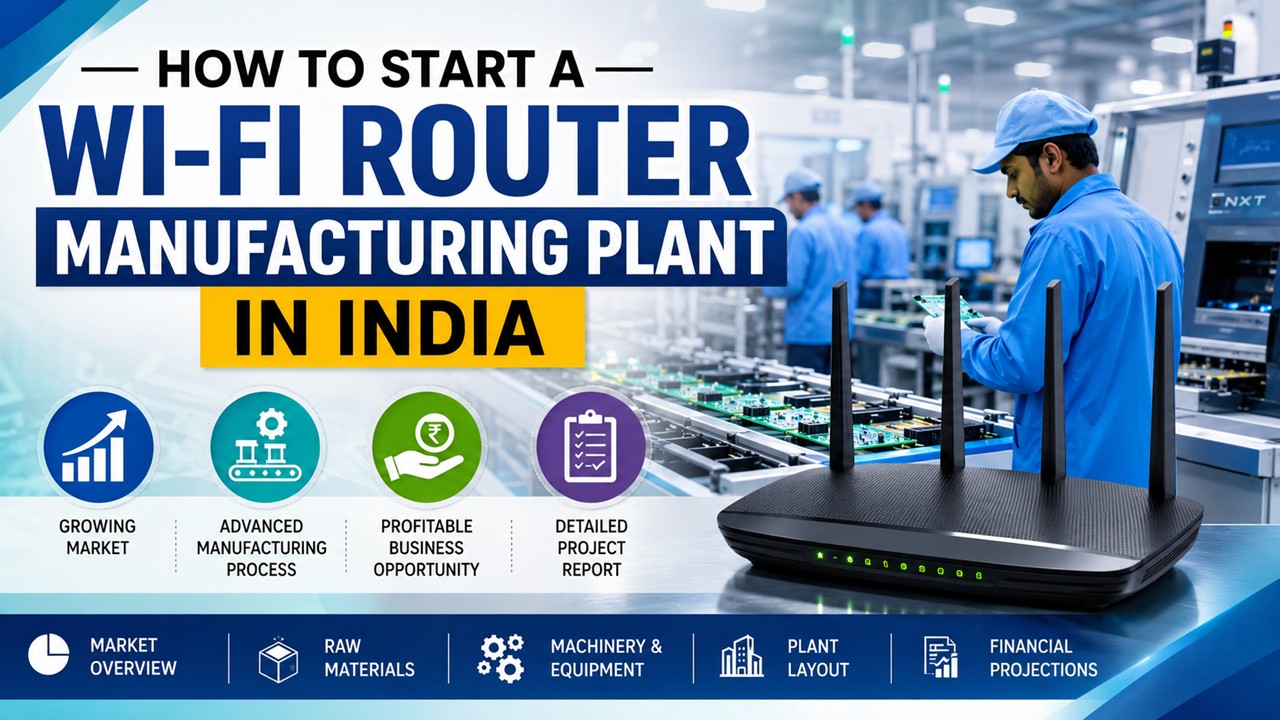
Wi-Fi Router Manufacturing Plant Setup in India
Setting up a Wi-Fi router manufacturing plant in India presents a compelling investment case, driven by rising broadband penetration, rapid digitalization of enterprises, increasing smart home adoption, expansion of IoT ecosystems, and continuous upgrades to higher wireless standards such as Wi‑Fi 6 and Wi‑Fi 7. Wi‑Fi routers are critical to India’s economy as they form the backbone of the country’s digital infrastructure, enabling high‑speed internet connectivity across homes, businesses, and industrial environments. With the global online population growing by more than 240 million people in 2025 and the transition toward fiber‑to‑the‑home (FTTH) networks accelerating, the demand for advanced routers capable of gigabit transmission speeds is surging.
India’s accelerated digital transformation, the proliferation of connected devices per household, and the government’s “Make in India” initiative provide strong tailwinds for domestic manufacturing. Key manufacturing states such as Gujarat, Maharashtra, Tamil Nadu, and Karnataka offer established electronics manufacturing clusters and access to skilled labour. Government initiatives promoting domestic electronics manufacturing and supply chain diversification are actively encouraging local production of networking equipment. With enterprise digital transformation initiatives, smart city infrastructure projects, and the rise in bandwidth‑intensive applications like 4K streaming, cloud gaming, and video conferencing, India offers a strategically sound environment for establishing a Wi‑Fi router manufacturing facility.
India’s Wi‑Fi router market presents strong investment potential, bolstered by policy support like Make in India, rapid digitalization, and a booming consumer electronics sector. With gross margins typically ranging between 30‑40% and net margins of 15‑25%, investors can achieve healthy profitability and a viable break‑even timeline.
What is a Wi‑Fi Router?
A Wi‑Fi router is a networking device that forwards data packets between computer networks and provides wireless internet connectivity to multiple devices within a defined area. It integrates routing, switching, and wireless access point functions into a single unit. Modern Wi‑Fi routers operate on IEEE 802.11 standards (including 802.11ac, 802.11ax, and emerging 802.11be), supporting dual‑band or tri‑band frequency transmission (2.4 GHz, 5 GHz, and 6 GHz). Key technical characteristics include data throughput capacity, antenna configuration (MIMO technology), security protocols (WPA3), Quality of Service (QoS) management, beamforming, and network management software. The Wi‑Fi router manufacturing process uses fine wire drawing, precision annealing, and high‑density braiding as the primary production method. Key end‑use industries served include telecommunications, consumer electronics, IoT (Internet of Things), data centers, and networking hardware.
Cost of Setting Up a Wi‑Fi Router Manufacturing Plant in India
The total cost of setting up a Wi‑Fi router manufacturing plant in India depends on several critical factors, including plant capacity, technology, location, automation levels, and regulatory compliance requirements.
1. Capital Expenditure (CapEx)
The total capital investment required for establishing a Wi‑Fi router manufacturing plant covers land acquisition, site preparation, and necessary infrastructure. The location must offer easy access to key raw materials such as PCB, chipset (SoC), antenna, housing, and power adapter, with proximity to target markets helping to minimize distribution costs. The site must have robust infrastructure, including reliable transportation, utilities, and waste management systems. Machinery costs account for the largest portion of total capital expenditure. The cost of land and site development, including charges for land registration, boundary development, and other related expenses, forms a substantial part of the overall investment.
Key machinery required includes:
- Surface‑mount technology (SMT) lines
- Reflow ovens
- Wave soldering machines
- Automated pick‑and‑place systems
- Firmware flashing stations
- Radio frequency shielding rooms
- Signal testing chambers
- Assembly conveyor belts
Other capital costs include civil works (production shed, quality control lab, raw material and finished goods storage, administrative block), effluent treatment systems, and pre‑operative and commissioning expenses.
Request a Sample Report for In‑Depth Market Insights: https://www.imarcgroup.com/wi-fi-router-manufacturing-plant-project-report/requestsample
2. Operational Expenditure (OpEx)
The operating cost structure of a Wi‑Fi router manufacturing plant is primarily driven by raw material consumption, particularly PCB, which accounts for approximately 70‑80% of total operating expenses (OpEx). Raw materials required include PCB, chipset (SoC), antenna, housing, and power adapter. Utilities (electricity, water, steam) account for 5‑10% of OpEx. Other OpEx components include transportation costs, packaging costs, salaries and wages, repairs and maintenance, depreciation, and taxes. By the fifth year, the total operational cost is expected to increase substantially due to factors such as inflation, market fluctuations, and potential rises in the cost of key materials.
3. Plant Capacity
The proposed manufacturing facility is designed with an annual production capacity ranging between 1 ‑ 5 Million Units, enabling economies of scale while maintaining operational flexibility. Plant capacity can be customized per investor requirements. Profitability improves significantly with higher capacity utilization.
4. Profit Margins and Financial Projections
The project demonstrates healthy profitability potential under normal operating conditions. Gross profit margins typically range between 30‑40%, supported by stable demand and value‑added applications. Net profit margins are projected at 15‑25%. Financial analysis includes comprehensive projections of net present value (NPV), internal rate of return (IRR), payback period, income projections, expenditure projections, and profit and loss accounts.
Why Set Up a Wi‑Fi Router Plant in India?
Expanding Digital Infrastructure: Global broadband expansion and fiber deployment initiatives are increasing demand for advanced wireless routers capable of supporting gigabit‑speed internet and high device density. India’s FTTH network expansion and the growing number of internet users create a sustained market for networking equipment.
Smart Home and IoT Integration: Growing adoption of smart appliances, voice assistants, and IoT devices is accelerating the need for routers with higher throughput, lower latency, and improved network stability. The proliferation of connected devices per household directly drives router replacement cycles.
Enterprise Digital Transformation: Cloud migration, hybrid work models, and cybersecurity upgrades are driving enterprises to invest in secure and high‑performance networking hardware. Indian businesses across sectors are upgrading their IT infrastructure, creating consistent demand for enterprise‑grade routers.
Rapid Technological Upgradation: Continuous innovation in wireless standards (Wi‑Fi 6/6E/7) shortens product replacement cycles, ensuring consistent demand for upgraded routers. As new standards emerge, consumers and businesses alike seek the latest technology, sustaining market growth.
Localization of Electronics Manufacturing: Government initiatives promoting domestic electronics manufacturing and supply chain diversification are encouraging local production of networking equipment. The “Make in India” initiative and production‑linked incentive (PLI) schemes for electronics manufacturing create a favourable policy environment.
Active Industry Investment: In October 2025, TP‑Link, the network equipment maker best known for its Wi‑Fi routers and mesh devices, announced a major expansion plan to establish its largest global manufacturing facility in India. The project, part of a five‑year, ₹100 crore‑plus investment, aims to boost local production and strengthen its presence in Asia. In the same month, ASUS Republic of Gamers announced the ROG Rapture GT‑BE19000AI, the world’s first AI router, combining breakthrough intelligence with next‑generation performance.
Manufacturing Process – Step by Step
The Wi‑Fi router manufacturing process uses fine wire drawing, precision annealing, and high‑density braiding as the primary production method.
- Raw Material Sourcing: Reliable suppliers must be secured for raw materials like PCB, chipset (SoC), antenna, housing, and power adapter to ensure consistent production quality. Minimizing transportation costs by selecting nearby suppliers is essential. Long‑term contracts should be negotiated to stabilize pricing and ensure a steady supply.
- Surface‑Mount Technology (SMT) Assembly: Electronic components are mounted onto PCBs using automated pick‑and‑place systems and reflow ovens. This is the core step where the router’s electronic circuitry is assembled.
- Wave Soldering: Through‑hole components are soldered onto the PCB using wave soldering machines, ensuring secure electrical connections.
- Firmware Flashing: The router’s operating software is loaded onto the chipset using firmware flashing stations.
- Antenna and Housing Assembly: The antenna and external housing are assembled onto the board. Internal wiring, including RF antenna leads, internal signal cables, and grounding connections, is completed at this stage.
- Radio Frequency (RF) Shielding: RF shielding rooms are used to test and shield the router from electromagnetic interference.
- Signal Testing: Completed routers undergo rigorous testing in signal testing chambers to verify performance, throughput, and compliance with wireless standards.
- Quality Assurance: A comprehensive quality control system is established throughout production. Analytical instruments are used to monitor product concentration, purity, and stability. Documentation for traceability and regulatory compliance is maintained.
- Packaging and Dispatch: Finished routers are packaged and dispatched to end‑use industries including telecommunications, consumer electronics, IoT, data centers, and networking hardware.
Key Applications
Wi‑Fi routers serve a diverse range of industries and applications:
- Telecommunications: Used in broadband networks, fiber‑to‑the‑home (FTTH) deployments, and service provider infrastructure.
- Consumer Electronics: Deployed in homes for wireless internet connectivity, smart home integration, and streaming devices.
- IoT (Internet of Things): Enable connectivity for smart appliances, sensors, and industrial IoT devices.
- Data Centers: Used for network management, internal wiring harnesses, and high‑frequency data transmission.
- Networking Hardware: Integrated into enterprise networks, office environments, and educational institutions.
Leading Manufacturers
Leading manufacturers in the global Wi‑Fi router industry include several multinational companies with extensive production capacities and diverse application portfolios. Key players include:
- Cisco Systems, Inc.
- TP‑Link Technologies Co., Ltd.
- Netgear Inc.
- Huawei Technologies Co., Ltd.
- Xiaomi Corporation
- D‑Link Corporation
These key players serve end‑use sectors such as telecommunications, consumer electronics, IoT (Internet of Things), data centers, and networking hardware.
Timeline to Start the Plant
- Feasibility study and project report preparation
- Land acquisition and site development
- Regulatory approvals and environmental clearances
- Factory licence and fire safety compliance
- Machinery procurement and installation
- Raw material supplier agreements and supply chain setup
- Trial production and quality testing
- Commercial production launch
Licences and Regulatory Requirements
Starting a Wi‑Fi router manufacturing unit in India requires several approvals:
- Business registration (Proprietorship, LLP, or Pvt Ltd)
- Factory Licence under the Factories Act
- Environmental Clearance from State Pollution Control Board
- GST Registration
- Fire Safety NOC
- Effluent Treatment Plant (ETP) operational clearance
- Occupational Health and Safety compliance
Key Challenges to Consider
- High Capital Requirements: Machinery costs for SMT lines, reflow ovens, wave soldering machines, pick‑and‑place systems, firmware flashing stations, RF shielding rooms, signal testing chambers, and assembly conveyor belts represent a significant portion of capital expenditure.
- Raw Material Price Volatility: Fluctuations in prices of PCB, chipset (SoC), antenna, housing, and power adapter directly impact margins. Raw materials account for 70‑80% of operating expenses.
- Regulatory Compliance: Navigating environmental clearances, factory licences, and pollution control board regulations requires careful planning. Effluent treatment systems are necessary to minimize environmental impact and ensure compliance with emission standards.
- Technology and Innovation Pressure: Rapid technological upgradation and continuous innovation in wireless standards (Wi‑Fi 6/6E/7) shorten product lifecycles and require ongoing R&D investment to remain competitive.
- Competition: The market includes established global players such as Cisco Systems, TP‑Link, Netgear, Huawei, Xiaomi, and D‑Link.
- Skilled Manpower: Access to skilled electronics engineers, SMT machine operators, firmware developers, and quality control technicians is essential for maintaining production quality.
Frequently Asked Questions
- How much does it cost to set up a Wi‑Fi router manufacturing plant in India?
The total capital investment depends on plant capacity, technology, and location, covering land acquisition, site preparation, infrastructure, and machinery costs. - Is Wi‑Fi router manufacturing profitable in India in 2026?
Yes, gross profit margins typically range between 30‑40%, with net profit margins of 15‑25%, indicating healthy profitability potential. - What machinery is required for a Wi‑Fi router plant in India?
Essential equipment includes surface‑mount technology lines, reflow ovens, wave soldering machines, automated pick‑and‑place systems, firmware flashing stations, radio frequency shielding rooms, signal testing chambers, and assembly conveyor belts. - What licences and approvals are required to start a Wi‑Fi router plant in India?
Required approvals include business registration, Factory Licence under the Factories Act, Environmental Clearance from State Pollution Control Board, GST Registration, Fire Safety NOC, and ETP operational clearance. - What raw materials are needed for Wi‑Fi router manufacturing?
Raw materials required include PCB, chipset (SoC), antenna, housing, and power adapter. - What are the environmental compliance requirements for a Wi‑Fi router plant in India?
Facilities must implement effluent treatment systems, obtain environmental clearance from the State Pollution Control Board, and comply with emission standards. - What is the best location to set up a Wi‑Fi router plant in India?
The location must offer easy access to key raw materials such as PCB, chipset, antenna, housing, and power adapter, with proximity to target markets. Key electronics manufacturing states include Gujarat, Maharashtra, Tamil Nadu, and Karnataka. - What is the break‑even period for this type of plant in India?
Financial projections including break‑even analysis are provided in detailed feasibility reports, with timelines varying based on capacity, utilization rates, and operating efficiencies. - What government incentives are available for manufacturers in India?
Investors benefit from the “Make in India” initiative, government initiatives promoting domestic electronics manufacturing, supply chain diversification, and potential benefits under production‑linked incentive (PLI) schemes for electronics manufacturing.
Key Takeaways for Investors
Setting up a Wi‑Fi router manufacturing plant in India offers a compelling investment opportunity, driven by strong demand from telecommunications, consumer electronics, IoT, data centers, and networking hardware end‑use sectors. The project demonstrates healthy financial viability across various plant capacities (1 ‑ 5 Million Units annually), with gross profit margins ranging between 30‑40% and net margins of 15‑25%. The global Wi‑Fi router market was valued at USD 15.40 Billion in 2025 and is expected to reach USD 35.14 Billion by 2034, exhibiting a CAGR of 9.6% from 2026 to 2034. With India’s digital infrastructure expanding, smart home adoption rising, and major investments like TP‑Link’s ₹100 crore‑plus manufacturing facility in India, the Wi‑Fi router industry is poised for continued expansion, making now an opportune time for investors to enter this dynamic market.
About the Author