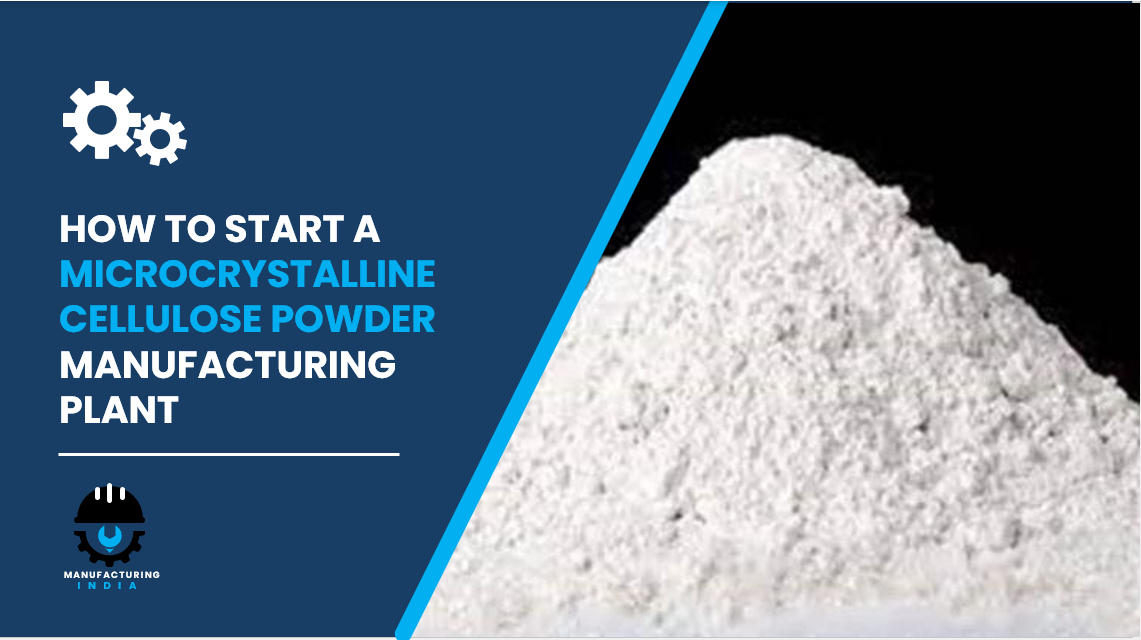
Setting up a microcrystalline cellulose powder manufacturing plant in India in 2026 is a high-potential investment opportunity driven by robust and growing demand across the pharmaceutical, food processing, and personal care sectors. Microcrystalline cellulose (MCC) powder is a critical pharmaceutical excipient used as a binder, disintegrant, and filler in oral solid dosage forms — primarily tablets and capsules. The increasing production of solid oral dosage forms continues to support consistent demand for MCC as a key excipient, making domestic manufacturing capacity a strategic priority for India’s rapidly expanding pharmaceutical sector.
Beyond pharmaceuticals, the processed food industry’s expanding reliance on MCC as a stabilizer, anti-caking agent, and fat replacer, coupled with the personal care sector’s growing demand for cosmetic-grade excipients, further widens the commercial opportunity for domestic MCC producers. India’s manufacturing-friendly policy ecosystem — including the Production Linked Incentive (PLI) scheme for pharmaceuticals — combined with a cost-competitive raw material supply chain positions the country as an ideal destination for high-value specialty chemical production.
“With over 1.5 billion consumers, a rapidly expanding pharmaceutical and FMCG sector, Make in India policy support, and growing demand for high-value excipients, India offers a financially compelling environment for Microcrystalline Cellulose Powder manufacturing — with gross profit margins of 35–45% and net profit margins of 18–28%.”
What is Microcrystalline Cellulose Powder?
Microcrystalline cellulose (MCC) powder exists as a refined cellulose product that contains partially broken-down cellulose derived from plant-based materials, especially wood pulp. The production process begins with controlled acid hydrolysis, which produces a white powdered product after purification, drying, and milling steps. The material offers exceptional compressibility, binding capabilities, and stable chemical properties, making it a popular choice across multiple industries.
MCC functions as a binder, disintegrant, and stabilizer in various product formulations. It is widely used in tablet manufacturing, food processing, and cosmetic applications. Its origin from renewable plant materials also gives it a sustainability advantage, aligning with the growing market demand for biodegradable and plant-based components.
Cost of Setting Up a Microcrystalline Cellulose Powder Manufacturing Plant in India
The cost of establishing a Microcrystalline Cellulose Powder Manufacturing Plant in India depends on several key parameters including plant capacity, technology selection, location, automation level, and regulatory compliance. Below is a structured breakdown of all major cost components:
1. Capital Expenditure (CapEx)
The total capital investment in a microcrystalline cellulose powder manufacturing plant covers the following major components:
Request a Sample Report for In-Depth Market Insights: https://www.imarcgroup.com/microcrystalline-cellulose-powder-manufacturing-plant-project-report/requestsample
Land and Site Development
This includes land acquisition, boundary development, land registration charges, and basic site preparation. Costs vary depending on whether the land is located in an industrial estate, Special Economic Zone (SEZ), or a privately purchased plot. Proximity to raw material suppliers such as wood pulp, hydrochloric acid, and sodium hydroxide is a critical location criterion.
Civil Works and Construction
Building costs include the main manufacturing shed, utility area, raw material storage zones, quality control laboratory, administrative block, and worker amenities. Construction specifications depend on plant scale and local environmental and safety compliance norms.
Machinery and Equipment
Machinery costs account for the largest portion of total capital expenditure. Key equipment required for a microcrystalline cellulose powder manufacturing plant includes:
- Reactors
- Filtration Units
- Dryers
- Pulverizers
- Sieving Machines
- Automated Packaging Systems
All machinery must be corrosion-resistant and comply with industry standards for safety, efficiency, and reliability given the chemical nature of the MCC manufacturing process.
Other Capital Costs
These include pre-operative expenses, commissioning charges, import duties (if machinery is sourced internationally), utilities installation, fire safety systems, and Effluent Treatment Plant (ETP) setup.
2. Operational Expenditure (OpEx)
Once the plant is commissioned, the ongoing cost structure is dominated by the following key components:
Raw Material Cost (Wood Pulp, Hydrochloric Acid, Sodium Hydroxide): 55–65% of Total OpEx
Wood pulp is the primary raw material and accounts for the largest share of operating expenses. Additional raw materials include hydrochloric acid for acid hydrolysis and sodium hydroxide for the washing and neutralization stages.
Utility Cost: 20–25% of Total OpEx
Utilities form a significant share of operating costs and include electricity (used for reactors, dryers, and pulverizers), steam, water (for washing and cooling systems), and compressed air supply.
Other Operating Costs
The remaining budget covers transportation, secondary packaging, salaries and wages, maintenance, depreciation, taxes, and miscellaneous overhead.
3. Plant Capacity
The proposed manufacturing facility is designed with an annual production capacity ranging between 5,000 – 20,000 MT, enabling economies of scale while maintaining operational flexibility. This range allows the plant to serve multiple end-use segments including pharmaceuticals, food processing, and personal care products.
4. Profit Margins and Financial Projections
- Gross Profit Margin: 35–45%
- Net Profit Margin: 18–28%
The project demonstrates healthy profitability under normal operating conditions, supported by stable demand and value-added applications. Financial projections must account for capital investment, operating costs, capacity utilization rates, pricing trends, and demand outlook. A thorough analysis should also include sensitivity analysis, Net Present Value (NPV), Internal Rate of Return (IRR), and Payback Period.
Why Set Up a Microcrystalline Cellulose Powder Plant in India?
India presents a uniquely favorable environment for establishing a microcrystalline cellulose powder manufacturing plant:
- Essential Pharmaceutical Excipient Demand: India is one of the world’s largest producers and exporters of generic pharmaceuticals. Microcrystalline cellulose functions as an essential material in tablet and capsule production, creating consistent, high-volume domestic demand for MCC.
- Stable and Expanding Market: The pharmaceutical market will experience constant growth as pharmaceutical production increases, generic drug manufacturing expands, and processed food consumption rises. India’s growing middle class and healthcare investments reinforce this trend.
- High Value-Added Product: The specialized functions and strict quality requirements of MCC allow it to command higher profit margins than raw cellulose, making it an attractive manufacturing segment.
- Policy and Regulatory Support: The Government of India’s PLI (Production Linked Incentive) scheme for pharmaceuticals, Make in India initiative, and circular economy policies create a supportive regulatory and financial environment for MCC manufacturers. Notably, Sigachi Industries received benefits from the Government of India’s PLI program for its MCC expansion.
- Regulatory-Driven Market Barriers: The market operates under strict quality standards and entry restrictions, which benefit manufacturers who possess technical skills and official certifications — creating a competitive moat for established players.
- Sustainability Advantage: MCC is produced from renewable plant materials, aligning with the rising demand for biodegradable and plant-based components across pharmaceuticals, food processing, and personal care industries.
- Export Opportunities: India-based manufacturers can tap into growing international demand. As an example, Juku Orchem Private Limited and other Indian manufacturers export MCC to multiple international markets, reflecting strong global appetite for Indian-manufactured pharmaceutical excipients.
- Asia-Pacific Growth Leadership: APAC holds approximately 37.8% of the overall MCC market share, with India and China leading expansion as pharmaceutical manufacturing centers and healthcare infrastructure investments increase.
Manufacturing Process — Step by Step
The microcrystalline cellulose powder manufacturing process is a multi-step operation involving several unit operations, material handling, and quality checks. Below are the main stages:
Step 1 – Raw Material Sourcing and Preparation: High-quality wood pulp is sourced from reliable suppliers. Additional chemicals including hydrochloric acid and sodium hydroxide are procured and stored in compliance with safety standards.
Step 2 – Pulp Treatment: The wood pulp undergoes initial processing to prepare it for acid hydrolysis, including cleaning and size reduction.
Step 3 – Acid Hydrolysis: The treated pulp is subjected to controlled acid hydrolysis using hydrochloric acid in a reactor. This process breaks down the amorphous cellulose regions while retaining the crystalline structure, forming the microcrystalline cellulose.
Step 4 – Washing and Neutralization: The hydrolyzed cellulose is thoroughly washed with water and neutralized using sodium hydroxide to remove residual acid and impurities.
Step 5 – Filtration: The washed cellulose slurry passes through filtration units to remove excess water and achieve the desired moisture content.
Step 6 – Drying: The filtered cellulose cake is dried using industrial dryers to reduce moisture to specification levels required for pharmaceutical and food-grade applications.
Step 7 – Milling and Sieving: The dried cellulose is milled using pulverizers and then sieved to achieve the required particle size distribution for specific grades of MCC powder.
Step 8 – Quality Inspection: Comprehensive quality checks are performed including tests for particle size, moisture content, bulk density, compressibility index, and purity to ensure compliance with pharmacopeial and food-grade standards.
Step 9 – Packaging and Dispatch: Finished MCC powder is packed using automated packaging systems into appropriate containers and dispatched to end-use industries.
Key Applications of Microcrystalline Cellulose Powder
Microcrystalline cellulose powder manufactured in India serves a wide variety of end-use industries:
- Pharmaceuticals: Utilized as a tablet binder, disintegrant, and filler in oral solid dosage forms including tablets and capsules. It is among the most widely used excipients in the global pharmaceutical industry.
- Food Industry: Used as an anti-caking agent, fat replacer, stabilizer, and texturizer in processed foods. The rising consumer preference for clean-label and low-calorie food products drives consistent demand for food-grade MCC.
- Personal Care: Employed as a thickening and stabilizing agent in creams, lotions, and cosmetic powders. The personal care industry increasingly incorporates MCC for its functional and plant-based properties.
Timeline to Start the Plant
Setting up a microcrystalline cellulose powder manufacturing plant from ideation to commissioning typically requires 12 to 18 months. This covers:
- Feasibility study and project report preparation
- Land acquisition and site development
- Regulatory approvals and environmental clearances
- Factory license and fire safety compliance
- Machinery procurement and installation
- Trial production and quality testing
- Commercial production launch
Licenses and Regulatory Requirements
Starting a microcrystalline cellulose powder manufacturing unit in India requires several approvals, including:
- Business registration (Proprietorship, LLP, or Private Limited Company)
- Factory License under the Factories Act
- Environmental Clearance from the State Pollution Control Board
- GST Registration
- Fire Safety NOC
- WHO-GMP Certification (mandatory for pharmaceutical-grade MCC supply)
- FSSAI Approval (for MCC used in food and beverage applications)
- BIS Certification (for applicable product standards)
- Drug Manufacturing License under the Drugs and Cosmetics Act (for pharma-grade supply)
Key Challenges to Consider
Before investing, entrepreneurs should be aware of the common challenges in this business:
- High Capital Requirements: Initial CapEx for precision chemical processing equipment including reactors, dryers, pulverizers, and filtration systems is substantial, especially for mid to large-scale plants targeting 5,000–20,000 MT annual capacity.
- Raw Material Price Volatility: Wood pulp prices are subject to global supply chain fluctuations and can directly impact operating margins. Long-term supplier contracts are critical to cost stability.
- Stringent Regulatory Compliance: Meeting pharmacopeial standards such as USP, EP, and IP for pharmaceutical-grade MCC requires continuous investment in quality systems, testing infrastructure, and qualified technical personnel.
- Skilled Manpower Requirements: Operating chemical reactors, precision milling equipment, and automated quality control systems requires trained technical and scientific staff, which can be challenging to recruit and retain.
- Competition from Established Players: The MCC market includes both large multinational manufacturers and established Indian players. New entrants must define a clear differentiation strategy around grade, quality certification, or customer segment.
Frequently Asked Questions
The following questions are answered in the report:
- How much does it cost to set up a Microcrystalline Cellulose Powder Manufacturing Plant in India?
- What is the annual production capacity for a microcrystalline cellulose powder plant in India?
- What raw materials are required for microcrystalline cellulose powder manufacturing?
- What machinery is needed to set up a microcrystalline cellulose powder plant in India?
- What are the profit margins for a microcrystalline cellulose powder manufacturing plant in India?
- What licenses and regulatory approvals are required for an MCC manufacturing plant in India?
- How long does it take to commission a microcrystalline cellulose powder plant in India?
- What government incentives are available for MCC manufacturers in India?
- What are the pharmaceutical-grade quality standards required for MCC production in India?
Leading Microcrystalline Cellulose Powder Manufacturers
Leading manufacturers in the global microcrystalline cellulose powder industry include:
- FMC Corporation
- J. RETTENMAIER & SOHNE Group
- Asahi Kasei
- Accent Microcell
- Wei Ming Pharmaceutical
- Mingtai Chemical
- Juku Orchem Private Limited
- BLANVER
- Anhui Sunhere Pharmaceutical
These companies serve end-use sectors such as pharmaceuticals, food processing, and personal care.
Key Takeaways for Investors
A Microcrystalline Cellulose Powder Manufacturing Plant in India offers strong financial viability with gross margins of 35–45% and net margins of 18–28%, backed by growing pharmaceutical, food, and personal care sector demand. With an annual capacity range of 5,000–20,000 MT and a supportive policy environment including PLI benefits, the investment presents a compelling and scalable opportunity in India’s specialty chemicals landscape.
About the Author