Industrial Licenses for Manufacturing Units in India
India’s manufacturing sector is witnessing strong expansion in 2026, supported by Production Linked Incentive (PLI) schemes, industrial corridor development, rising foreign direct investment (FDI), and the government’s Make in India initiative. According to DPIIT and Economic Survey 2025–26 estimates, India aims to increase manufacturing’s contribution to GDP from nearly 17% to 25% while generating over 100 million manufacturing-related jobs over the long term.
India’s manufacturing Gross Value Added (GVA) recorded growth of over 7% during FY2025–26, while cumulative manufacturing FDI inflows crossed USD 165 billion over the past decade. Simultaneously, the government’s INR 1.97 lakh crore PLI program across 14 sectors has already generated investments exceeding INR 2.16 lakh crore and production output worth more than INR 20 lakh crore by early 2026.
However, despite the manufacturing momentum, industrial licensing remains one of the biggest challenges for manufacturers planning greenfield and brownfield projects in India. Delays in environmental clearances, factory approvals, land conversion permissions, and utility compliance can increase project costs by 10–15% due to delayed commissioning, idle capital deployment, and contractor escalation costs.
Understanding the framework for , Industrial Licenses for Manufacturing Units in India ,has become essential for reducing compliance risks and accelerating project execution.
Why Industrial Licensing Matters for Manufacturing Units
Industrial licenses are mandatory approvals required from central, state, and local authorities before establishing or operating manufacturing facilities. These approvals ensure compliance with:
- Environmental regulations
- Factory safety standards
- Labour and occupational safety norms
- Land zoning regulations
- Hazardous material handling requirements
- Fire and industrial safety standards
Failure to obtain the required industrial permits can result in:
- Project delays of 6–18 months
- Cost overruns of 10–20%
- Financial penalties and shutdown notices
- Delayed commercial production
- Investor and lender concerns
According to Invest India, more than 85% of industrial approvals are now processed through digital or semi-digital systems. However, approval timelines still vary depending on project category, pollution classification, and state regulations.
For example:
- Standard factory approvals may take 30–90 days
- Red-category environmental approvals can take 8–14 months
- Hazardous industry approvals involving PESO often require multiple technical audits
Industries such as chemicals, pharmaceuticals, petrochemicals, food processing, renewable energy equipment, and heavy engineering typically face stricter regulatory scrutiny because of higher environmental and operational risks.
Key Industrial Licenses Required for Manufacturing Units in India
Nearly 90% of medium and large manufacturing projects in India require approvals related to factory operations, pollution control, fire safety, environmental management, and hazardous material handling.
1. Factory License Approval
Under DGFASLI and state factory rules, manufacturing facilities operating with power-driven machinery must obtain factory licenses.
This approval generally includes:
- Factory building plan approval
- Machinery layout validation
- Worker safety compliance
- Occupational health assessments
- Fire preparedness compliance
India currently has more than 2.5 lakh registered factories, with Maharashtra, Gujarat, Tamil Nadu, and Uttar Pradesh accounting for nearly 45% of total industrial establishments.
Industry estimates suggest that incomplete factory documentation and improper layout planning contribute to nearly 20–30% of approval resubmissions in manufacturing projects.
2. Consent to Establish (CTE) and Consent to Operate (CTO)
Manufacturing facilities must secure approvals from State Pollution Control Boards (SPCBs).
Consent to Establish (CTE)
CTE is required before construction begins and evaluates:
- Pollution load projections
- Water consumption
- Air emission systems
- Wastewater treatment infrastructure
- Hazardous waste management plans
Red-category industries account for nearly 60–65% of pollution monitoring cases handled by SPCBs annually.
Consent to Operate (CTO)
CTO is mandatory before commercial production starts. Authorities inspect:
- Effluent treatment systems
- Air pollution control equipment
- Hazardous waste disposal systems
- Environmental monitoring mechanisms
According to CPCB assessments, environmental non-compliance contributes to nearly 35–40% of industrial regulatory notices across major industrial states.
Industries such as specialty chemicals, petrochemicals, pharmaceuticals, and bulk drugs often experience longer approval timelines because of higher environmental risk profiles.
Manufacturers implementing zero-liquid discharge systems and integrated pollution management infrastructure can reduce environmental approval delays by nearly 25–30%.
3. Environmental Clearance for Manufacturing Plants
Large manufacturing projects may require Environmental Clearance (EC) from MoEFCC or State Environmental Impact Assessment Authorities (SEIAA).
Industries requiring environmental clearance typically include:
- Chemicals and petrochemicals
- Cement manufacturing
- Bulk pharmaceutical manufacturing
- Mining-linked processing facilities
- Large engineering plants
The process generally includes:
- Environmental Impact Assessment (EIA) studies
- Public hearing procedures
- Air and water mitigation planning
- Ecological risk analysis
- Waste management planning
Environmental approvals for high-impact industries can account for nearly 20–30% of total pre-construction project timelines.
Incomplete EIA studies and public hearing objections contribute to nearly 25% of environmental clearance delays in large industrial projects.
Additionally, ESG-linked manufacturing regulations are becoming increasingly important in 2026. Companies implementing green infrastructure and energy-efficient manufacturing systems can reduce long-term compliance costs by nearly 15–20%.
4. Fire NOC and Industrial Safety Approvals
State fire departments evaluate manufacturing facilities for fire prevention and emergency response readiness.
Authorities review:
- Fire hydrant systems
- Emergency evacuation plans
- Fire suppression infrastructure
- Hazardous storage compliance
- Emergency response systems
According to NDMA estimates, industrial fire incidents contribute to losses exceeding INR 20,000 crore annually in India. Nearly 70% of industrial fire incidents are associated with inadequate safety systems or improper hazardous storage practices.
Industries handling flammable chemicals, gases, fuels, solvents, and combustible materials undergo stricter safety inspections.
5. PESO Approvals for Hazardous Industries
Industries handling:
- Petroleum products
- Industrial gases
- Hazardous chemicals
- Explosives
- Pressure vessels
must obtain approvals from the Petroleum and Explosives Safety Organisation (PESO).
Industry estimates suggest that nearly 25–35% of hazardous industry approval delays are linked to incomplete technical documentation, equipment certification gaps, and safety audit issues.
Step-by-Step Industrial Licensing Process in India
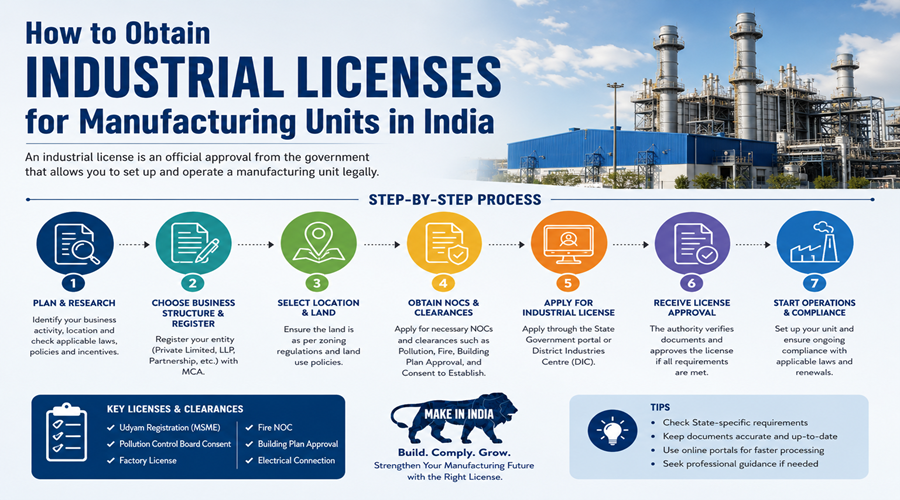
Step 1: Conduct Regulatory and Feasibility Assessment
Before land acquisition or plant construction, manufacturers should conduct:
- Regulatory applicability analysis
- Environmental assessments
- Utility planning
- Land zoning verification
- State policy evaluation
Early-stage compliance planning can reduce redesign and approval correction costs by 15–20%.
Step 2: Select the Right State for Manufacturing Investment
States such as Gujarat, Tamil Nadu, Maharashtra, Telangana, Karnataka, and Uttar Pradesh have developed advanced industrial approval systems.
For example:
- Gujarat attracts nearly 30% of India’s chemical manufacturing investments
- Tamil Nadu contributes over 35% of India’s automobile manufacturing ecosystem
- Telangana’s TS-iPASS framework has significantly reduced industrial approval timelines
India currently has 11 industrial corridor projects under development aimed at reducing logistics costs by nearly 20–25%.
Step 3: Prepare Technical Documentation
Manufacturing applications generally require:
- Land ownership documents
- Factory layouts
- Pollution control plans
- Fire safety drawings
- Hazardous material handling procedures
- Utility requirement details
Industry experts estimate that incomplete documentation contributes to nearly 35–40% of industrial approval delays in India.
Step 4: Apply Through Digital Approval Portals
Most industrial approvals are now processed through:
- State single-window portals
- Pollution control board systems
- Labour department platforms
- Industrial development authority portals
Digitalization has reduced manual dependency by nearly 40–50% in several industrial states. However, approval sequencing and inter-department coordination continue to remain challenges for large industrial projects.
Step 5: Compliance Inspection and Approval Validation
Authorities conduct:
- Site inspections
- Machinery verification
- Safety audits
- Environmental compliance checks
Inspection-related non-compliance contributes to nearly 20–25% of operational approval delays in hazardous manufacturing sectors.
Common Challenges During Industrial Licensing
Manufacturers frequently face challenges related to:
- Multi-department approvals
- Environmental clearance delays
- State-wise policy variations
- Incentive eligibility risks
- Technical documentation gaps
Large industrial projects may require approvals from 15–30 different authorities depending on project category and utility requirements.
Environmental infrastructure and pollution control systems can account for nearly 3–7% of total manufacturing project capex, especially in chemicals, pharmaceuticals, and heavy process industries.
Additionally, incentive structures vary significantly across states:
- SGST reimbursement benefits may range from 75–100%
- Capital subsidies may range between 10–35%
- Stamp duty exemptions may reach 50–100% depending on location and sector
Emerging Trends in Industrial Licensing in India
India’s industrial approval ecosystem is evolving rapidly with:
- Digital approval platforms
- GIS-based industrial land systems
- ESG-linked manufacturing compliance
- Integrated compliance management systems
- Green manufacturing incentives
- Faster PLI-linked approvals
According to NITI Aayog, reducing logistics and regulatory compliance costs by 10–12% is essential for improving India’s global manufacturing competitiveness.
Sectors receiving accelerated policy support in 2026 include:
- EV manufacturing
- Semiconductor manufacturing
- Renewable energy equipment
- Medical devices
- Electronics manufacturing
- Specialty chemicals
India’s electronics manufacturing sector is projected to exceed USD 300 billion by 2030, while the EV sector is expected to grow at over 40% CAGR during the decade.
Final Thoughts
Industrial licensing for manufacturing units in India requires strategic planning, technical compliance, and proactive regulatory management. While India offers major opportunities through PLI incentives, industrial corridors, export growth, and rising domestic demand, approval delays can still impact project viability if compliance processes are not managed efficiently.
Manufacturers investing early in industrial licensing strategy, environmental compliance planning, and incentive structuring are better positioned to reduce project risks, accelerate commercial operations, and improve long-term scalability in India’s rapidly expanding manufacturing ecosystem.operational scalability.
Contact Us:
IMARC Engineering
Phone: +91-120-433-0800
Email: sales@imarcengineering.com
India: C-130, Sector 2, Noida, Uttar Pradesh 201301
LinkedIn: https://www.linkedin.com/showcase/imarc-engineering/
About the Author