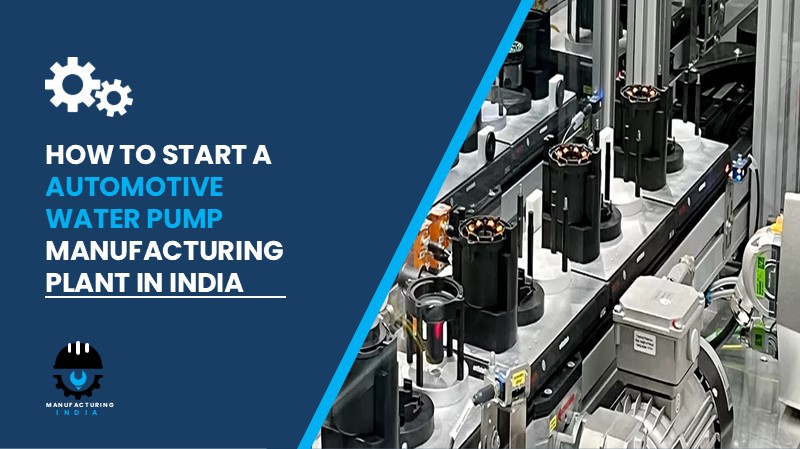
Setting up an automotive water pump manufacturing plant in India presents a compelling investment case at a time when the country’s automotive industry is expanding at an accelerating pace, electric vehicle adoption is rising, and OEM supply chain localisation is creating significant commercial opportunities for domestic component manufacturers. Automotive water pumps — essential parts of an automobile’s cooling system that circulate coolant through the engine to maintain optimal temperatures — are critical to engine efficiency, durability, and emissions compliance across internal combustion engine, hybrid, and electric vehicle thermal management systems alike. As India’s vehicle production volumes grow, emission norms tighten, and the transition toward electrified powertrains intensifies demand for specialised thermal management components, the domestic requirement for high-performance mechanical and electric water pumps is building into a durable, multi-decade investment opportunity.
India’s structural positioning makes it one of the most strategically sound locations in Asia for establishing automotive water pump production. The country’s automotive industry dominates industrial robot adoption, accounting for 42% of the total market share, with installations increasing by 139% to 3,551 units in 2023, signalling rapid manufacturing modernisation that benefits precision component suppliers. The Make in India initiative and the Production-Linked Incentive (PLI) scheme for auto components are actively incentivising domestic manufacturing of automotive parts, reducing dependence on imports and creating a policy-supported demand pull for locally produced cooling system components. Automotive manufacturing clusters in Pune, Chennai, Manesar, Sanand, and Aurangabad provide immediate proximity to OEM customers, established aluminium and bearing supply chains, and logistics infrastructure essential for a precision engineering facility.
Investing in an automotive water pump manufacturing plant in India today aligns the country’s surging vehicle production, EV adoption momentum, and OEM localisation drive with strong policy support under Make in India and PLI schemes for auto components. With gross profit margins of 30–40% and net profit margins of 12–18%, the unit economics are among the most attractive in the automotive components segment, and the facility’s scalable precision manufacturing model — designed for 2 to 5 million units annually — supports commercially viable returns across a well-defined investment horizon.
What is an Automotive Water Pump?
An automotive water pump is an essential part of an automobile’s cooling system, functioning to circulate coolant through the engine in a manner that ensures optimal engine temperatures are consistently maintained. It is engine crankshaft-powered in conventional applications and constructed using metal materials as well as plastic components in a manner that makes the engine lighter and more efficient in fuel consumption and thermal management performance.
There are two primary types of automotive water pumps: mechanical water pumps and electric water pumps. Mechanical water pumps are employed in vehicles with internal combustion engines, where they are belt-driven from the crankshaft to circulate coolant through the radiator circuit. Electric water pumps are employed in electric automobiles and hybrid vehicles, where electronically controlled coolant circulation is required for battery thermal management and power electronics cooling. An efficient water pump ensures that an engine or battery system does not overheat, directly impacting vehicle longevity, fuel efficiency, and emissions compliance.
The production process covers pump assembly covering housing, impeller, shaft, and bearing integration; cooling system integration for engine cooling circulation and thermal management; sealing and leakage prevention using mechanical seals, gaskets, and O-ring applications; and testing and quality control spanning performance testing, durability validation, and leak inspection. End-use industries served are automotive and electric vehicle (EV) manufacturing. Applications include automotive water pump hoses, radiator cooling lines, heater core connectors, HVACR circuits, engine coolant circulation systems, and reinforced flexible fluid transfer systems.
Cost of Setting Up an Automotive Water Pump Manufacturing Plant in India
The cost of establishing an automotive water pump manufacturing plant in India depends on plant capacity, technology selection, product mix between mechanical and electric variants, geographic location, degree of automation, and the OEM qualification and quality compliance requirements applicable to automotive-grade component production.
1. Capital Expenditure (CapEx)
Land and Site Development forms a foundational component of total capital investment, covering land registration charges, boundary development, drainage infrastructure, and site utilities. Investors may explore automotive component clusters, Special Economic Zones (SEZs), or dedicated auto parts manufacturing estates in Pune, Chennai, Manesar, or Sanand — locations that offer immediate proximity to OEM customers including two-wheeler, passenger vehicle, and commercial vehicle manufacturers, significantly reducing logistics costs and enabling just-in-time delivery capability that automotive customers require.
Civil Works and Construction cover the main precision machining and assembly production hall requiring vibration-controlled flooring for CNC operations, die-casting and core moulding areas with appropriate ventilation and fume extraction, raw material storage for aluminium billets, bearings, and seals, a quality control and testing laboratory, finished goods warehousing, an administrative block, and utilities infrastructure including compressed air systems and coolant distribution for machining operations.
Machinery and Equipment represent the largest single component of total CapEx for an automotive water pump manufacturing plant. Key machinery required includes:
- Core moulding machines
- Die-casting systems
- CNC machining centres
- Lathes
- Milling machines
- Assembly line conveyors
- Pressure testing stations
- Leak testers
- Packaging systems
Other Capital Costs include an effluent treatment plant (ETP) for managing coolant and machining fluid waste streams, dust collection and fume extraction systems for casting and machining operations, pre-operative expenses, commissioning charges, OEM qualification testing costs, and import duties on high-precision CNC machining centres or die-casting systems not available through domestic machinery suppliers.
Request a Sample Report for In-Depth Market Insights: https://www.imarcgroup.com/automotive-water-pump-manufacturing-plant-project-report/requestsample
2. Operational Expenditure (OpEx)
Raw Material Cost is the dominant operational expense, accounting for approximately 65–75% of total OpEx. The primary raw materials are aluminium, bearings, and seals. Aluminium — as the primary structural material for pump housings and impellers — is consumed in the largest volumes and drives the majority of raw material cost, with its pricing tied to global LME aluminium markets and domestic secondary aluminium availability. Bearings and mechanical seals are precision-engineered components whose quality directly determines pump service life and OEM acceptance. Long-term procurement contracts with reliable suppliers for all three input categories are essential to stabilise production costs and maintain the supply consistency that automotive OEM customers mandate.
Utility Cost is the second-largest OpEx component, representing 10–15% of total operating expenses, covering electricity for die-casting systems, CNC machining centres, lathes, milling machines, and assembly line conveyors, as well as compressed air for pneumatic assembly tools, water for machining coolant circuits, and general plant operations.
Other Operating Costs include transportation and distribution to OEM customers and the automotive aftermarket, packaging materials for component protection during transit, salaries and wages for precision machining operators and quality engineers, routine machinery maintenance including CNC calibration and die-casting tooling upkeep, depreciation on high-value precision manufacturing equipment, and applicable taxes. By the fifth year of operations, total operational costs are projected to increase substantially due to inflation, market fluctuations, potential rises in aluminium and bearing prices, supply chain disruptions, rising consumer demand, and shifts in the global economy — all variables requiring careful incorporation into the five-year financial model.
3. Plant Capacity
The proposed manufacturing facility for an automotive water pump plant is designed with an annual production capacity ranging between 2 million and 5 million units, enabling economies of scale while maintaining the operational flexibility to serve both OEM supply agreements and the expanding automotive aftermarket for replacement parts. Plant capacity can be customised per investor requirements and phased in line with OEM qualification milestones and volume ramp-up schedules. Profitability improves meaningfully with higher capacity utilisation, making secured OEM supply contracts or established aftermarket distribution relationships a strategic commercial foundation that should be developed in parallel with plant commissioning activities.
4. Profit Margins and Financial Projections
The financial projections for an automotive water pump manufacturing plant demonstrate strong profitability potential under normal operating conditions. Gross profit margins typically range between 30–40%, supported by stable demand across automotive OEM and aftermarket replacement segments and the value-added precision engineering properties that high-performance pump assemblies command relative to their raw material cost. Net profit margins are projected at 12–18% — among the highest in the automotive components category. A comprehensive financial analysis covering NPV (net present value), IRR (internal rate of return), payback period, gross margin progression, and net margin development across a five-year horizon is essential before committing capital. The project’s ROI profile and long-term sustainability are assessed against realistic assumptions on capital investment, production capacity utilisation, aluminium and bearing pricing trends, and demand outlook from OEM and aftermarket automotive segments.
Why Set Up an Automotive Water Pump Plant in India?
Rising Automotive Production and Growing Vehicle Fleet. The demand for automotive water pumps is driven directly by the growing automotive industry, which is fuelled by rising vehicle production and an increasing global and domestic automotive fleet. India’s position as one of the world’s largest vehicle-producing nations creates a large and growing addressable domestic market for automotive cooling system components, with every new passenger car, commercial vehicle, and two-wheeler with a liquid-cooled engine requiring at least one water pump unit.
EV and Hybrid Vehicle Adoption Driving Electric Water Pump Demand. The market benefits significantly from the shift towards electric vehicles (EVs), which require specialised cooling systems for batteries and electronic components that demand electric water pumps rather than conventional belt-driven mechanical units. As India’s EV penetration accelerates under government FAME and PLI incentive frameworks, demand for electric water pumps is emerging as an incremental growth layer on top of the established ICE vehicle replacement market.
Stringent Emission Norms and Engine Efficiency Focus. Stricter environmental regulations and an increasing focus on engine efficiency are driving demand for high-performance and energy-efficient pumps that meet tighter thermal management specifications. Engine downsizing and turbocharging trends — which increase thermal loads and demand more precise coolant flow control — further reinforce the requirement for advanced water pump technology across India’s expanding passenger and commercial vehicle fleets.
Policy and Automotive Ecosystem Support. Government initiatives supporting domestic automotive manufacturing, fuel efficiency regulations, and EV adoption under Make in India and PLI for auto components indirectly boost demand for locally manufactured automotive water pumps and related cooling system components. The automotive industry’s dominance in industrial robot adoption in India — accounting for 42% of total market share with installations increasing 139% to 3,551 units in 2023 — signals the sector’s increasing manufacturing sophistication and readiness for precision component suppliers.
Active Domestic and Global Industry Investment. In June 2025, Setco Automotive Limited announced the successful launch of its automotive water pump product, marking a strategic expansion into the critical engine cooling segment and reinforcing commitment to innovation, reliability, and efficient engineering. In February 2024, the Schaeffler Automotive Aftermarket division expanded its product portfolio under its INA brand to offer electric auxiliary water pumps to leading OEM standards — signalling global aftermarket investment in electric water pump technology that mirrors the direction of India’s own market evolution.
Supply Chain Localisation and OEM Preference for Domestic Suppliers. OEMs increasingly prioritise localised, dependable suppliers to reduce logistics risk, improve responsiveness, ensure consistent quality, and manage cost volatility. This preference for regional water pump manufacturers with robust engineering, testing, and scalable production capabilities creates strong commercial opportunities for new entrants who can achieve OEM qualification and demonstrate supply chain reliability across both mechanical and electric water pump variants.
Manufacturing Process — Step by Step
The automotive water pump manufacturing process uses precision machining, die-casting, assembly, sealing, and quality testing as the primary production method. Each stage requires controlled dimensional tolerances, material integrity, and functional performance verification to meet OEM qualification standards for engine cooling system components.
- Core Moulding: Sand cores and expendable cores for pump housing internal geometries are produced using core moulding machines, establishing the internal flow passages of the pump housing with precise dimensional control.
- Die-Casting: Aluminium is processed through die-casting systems to produce the pump housing and impeller castings, with controlled pour temperature, injection speed, and cooling cycle parameters to achieve the required density, dimensional accuracy, and surface quality.
- CNC Machining: Cast pump housings and impellers are precision-machined using CNC machining centres to achieve the tight dimensional tolerances required for bearing fits, seal seats, and mating face flatness, using lathes and milling machines for specific feature machining operations.
- Bearing and Shaft Assembly: Precision bearings are pressed onto the shaft to specified interference fits using controlled assembly fixtures, with shaft runout and bearing preload verified against OEM specification requirements before further assembly.
- Impeller and Seal Fitting: The machined impeller is fitted to the shaft assembly, and mechanical seals and O-ring components are installed into the housing to provide leak-free coolant containment between the pump internal cavity and the bearing housing environment.
- Pump Assembly: Completed sub-assemblies are brought together on assembly line conveyors, with housing, impeller, shaft, bearing, and sealing components integrated and fastened to specified torque values in a controlled assembly sequence.
- Pressure Testing and Leak Detection: Assembled pumps are subjected to pressure testing at pressure testing stations and leak testers to verify hydraulic integrity, sealing performance, and flow capacity against OEM performance specifications.
- Testing and Quality Control: Pumps undergo performance testing for flow rate, head pressure, and rotational efficiency, along with durability validation and final dimensional inspection before being cleared for packaging and dispatch to automotive and electric vehicle manufacturing customers.
- Packaging: Inspected and approved units are packed using packaging systems into OEM-compliant packaging formats for dispatch to vehicle manufacturers and automotive aftermarket distribution channels.
Key Applications
Automotive water pumps manufactured in India serve a range of critical thermal management and fluid circulation applications across the automotive value chain:
- Pump Assembly: Housing, impeller, shaft, and bearing integration for complete cooling system modules supplied to vehicle assembly lines.
- Cooling System Integration: Engine cooling circulation and thermal management systems for internal combustion, hybrid, and electric vehicle powertrains.
- Sealing and Leakage Prevention: Mechanical seals, gaskets, and O-ring applications ensuring leak-free coolant containment across the full operating temperature and pressure range.
- Testing and Quality Control: Performance testing, durability validation, and leak inspection supporting both OEM first-fit supply and aftermarket replacement channel requirements.
Leading Manufacturers
The global automotive water pump industry is served by a group of large multinational corporations with extensive production capacities and diversified product portfolios across mechanical and electric water pump variants for passenger, commercial, and electric vehicle applications. Key players in the global market include:
- Bosch
- Aisin Seiki Co. Ltd.
- Gates Corporation
- Continental AG
- Johnson Electric
Timeline to Start the Plant
Establishing an automotive water pump manufacturing plant in India involves a structured multi-phase development sequence. Investors should plan for the following phases:
- Feasibility study and project report preparation
- Land acquisition and site development
- Regulatory approvals and environmental clearances
- Factory licence and fire safety compliance
- Machinery procurement and installation
- Raw material supplier agreements and supply chain setup
- Trial production and quality testing
- Commercial production launch
Licences and Regulatory Requirements
Starting an automotive water pump manufacturing unit in India requires several approvals spanning business registration, environmental, industrial safety, and automotive quality compliance domains:
- Business registration (Proprietorship, LLP, or Pvt Ltd)
- Factory Licence under the Factories Act
- Environmental Clearance from the State Pollution Control Board
- GST Registration
- Fire Safety NOC
- Hazardous/Chemical compliance applicable to machining coolants, cutting fluids, and die-casting release agents used in the production process
- Effluent Treatment Plant (ETP) operational clearance for managing metalworking fluid and coolant waste streams
- Occupational Health and Safety compliance
Key Challenges to Consider
OEM Qualification Cycles and Entry Barriers. Automotive water pump manufacturing demands precision machining, material expertise, sealing technology, endurance testing, and long OEM qualification cycles. New suppliers must pass rigorous technical audits, deliver validated prototype samples, and complete extended durability testing before receiving production orders from OEM customers. These qualification timelines — which can extend to 12–24 months — must be planned as part of the pre-revenue investment period.
Raw Material Price Volatility. Aluminium, bearings, and seals together account for 65–75% of total OpEx. Aluminium pricing is directly exposed to global LME commodity cycles, energy cost movements in primary aluminium smelting, and domestic secondary aluminium market conditions. Precision bearings and mechanical seals require consistent metallurgical and dimensional quality from approved supplier sources. Long-term procurement contracts and dual-source strategies across all three input categories are essential for cost stability and supply resilience.
Precision Manufacturing Quality Standards. Supplying automotive OEM customers requires compliance with IATF 16949 automotive quality management standards, dimensional tolerances measured in micrometres, and zero-defect delivery performance expectations that demand substantial ongoing investment in quality systems, statistical process control, calibrated measurement equipment, and trained quality engineering personnel.
Competition from Established Global Players. The competitive landscape is led by multinationals including Bosch, Aisin Seiki Co. Ltd., Gates Corporation, Continental AG, and Johnson Electric, all of which hold long-standing OEM relationships, global manufacturing scale, and significant technology development capabilities. New Indian entrants must focus on cost competitiveness, responsiveness, and quality consistency to establish positions in domestic OEM and aftermarket supply chains.
Electric Water Pump Technology Transition. The growing shift toward electric vehicles and hybrid powertrains is creating demand for electric water pumps alongside conventional mechanical units. As Schaeffler’s February 2024 INA brand expansion into electric auxiliary water pumps demonstrates, the industry is actively investing in this transition. Indian manufacturers entering the market must plan for eventual product portfolio evolution to include electric water pump variants to remain relevant as the domestic EV market scales.
Skilled Manpower for Precision Engineering Operations. Maintaining the dimensional accuracy, sealing integrity, and functional performance required to supply automotive OEM customers demands experienced CNC machinists, die-casting process engineers, assembly technicians, and quality engineers — a specialised technical workforce requiring ongoing investment in recruitment, technical training, and competitive retention programmes.
Frequently Asked Questions
1. How much does it cost to set up an automotive water pump manufacturing plant in India?
The total setup cost depends on plant capacity, technology selection, product mix between mechanical and electric variants, location, and automation level. CapEx covers land and site development, precision engineering civil construction, core machinery including die-casting systems, CNC machining centres, lathes, milling machines, assembly line conveyors, pressure testing stations, and leak testers, along with ETP and other capital costs. A detailed project report with full CapEx and OpEx breakdowns is available on request.
2. Is automotive water pump manufacturing profitable in India in 2026?
Yes. The project demonstrates gross profit margins of 30–40% and net profit margins of 12–18% under normal operating conditions, supported by rising vehicle production, expanding EV adoption, and growing aftermarket replacement demand across India’s large and rapidly growing automotive fleet.
3. What machinery is required for an automotive water pump plant in India?
Key machinery includes core moulding machines, die-casting systems, CNC machining centres, lathes, milling machines, assembly line conveyors, pressure testing stations, leak testers, and packaging systems.
4. What licences and approvals are required to start an automotive water pump plant in India?
Required approvals include business registration, a Factory Licence under the Factories Act, Environmental Clearance from the State Pollution Control Board, GST registration, a Fire Safety NOC, hazardous/chemical compliance approvals for machining fluids and die-casting agents, ETP operational clearance, and Occupational Health and Safety compliance.
5. What raw materials are needed for automotive water pump manufacturing?
The primary raw materials are aluminium, bearings, and seals. Aluminium accounts for approximately 65–75% of total operating expenses as the dominant structural input, making aluminium procurement strategy and pricing contracts the most critical cost management lever for the investment.
6. What are the environmental compliance requirements for an automotive water pump plant in India?
The unit must obtain Environmental Clearance from the State Pollution Control Board, operate a certified ETP for managing machining coolant and metalworking fluid waste streams, comply with chemical handling regulations for die-casting release agents, and install monitoring systems for wastewater discharge and air emissions in line with applicable state pollution control standards.
7. What is the best location to set up an automotive water pump plant in India?
Optimal locations offer proximity to OEM vehicle manufacturing clusters, reliable utilities including stable electricity and compressed air infrastructure, access to aluminium, bearing, and seal supply chains, and logistics connectivity for just-in-time delivery. Automotive component manufacturing hubs in Pune, Chennai, Manesar, Sanand, and Aurangabad are among the most strategically relevant options for this investment.
8. What is the break-even period for this type of plant in India?
The break-even period depends on plant capacity, OEM qualification timelines, capacity utilisation rate, aluminium pricing trends, and demand conditions. A detailed financial analysis including payback period, NPV, and IRR projections is included in the full project report, available via the sample request link.
9. What government incentives are available for manufacturers in India?
The Make in India initiative and PLI scheme for auto components provide financial and regulatory support for domestic automotive component manufacturing investments. State-level automotive zone incentives, capital subsidy schemes under state investment promotion boards, and export promotion benefits may offer additional fiscal advantages depending on the chosen plant location and production profile.
Key Takeaways for Investors
An automotive water pump manufacturing plant in India represents a commercially well-grounded investment opportunity anchored by rising vehicle production, growing EV thermal management demand, tightening emission norms, and an expanding aftermarket replacement sector that together constitute one of the most consistent and structurally supported demand environments in the Indian automotive components industry. The project demonstrates strong financial viability across annual production capacities of 2 to 5 million units, with gross profit margins of 30–40% and net profit margins of 12–18% confirming attractive unit economics relative to the capital investment required. The global automotive water pump market, valued at USD 3.47 Billion in 2025, is projected to reach USD 5.81 Billion by 2034, growing at a CAGR of 5.9% from 2026 to 2034, with India’s growing automotive fleet, EV adoption trajectory, and OEM localisation drive placing domestic producers at the centre of this expansion. With the automotive industry modernising rapidly, electric water pump demand emerging alongside established mechanical pump volumes, and OEMs increasingly prioritising dependable local suppliers, demand sustainability for India-based automotive water pump production is structurally robust across the full investment horizon.
About the Author