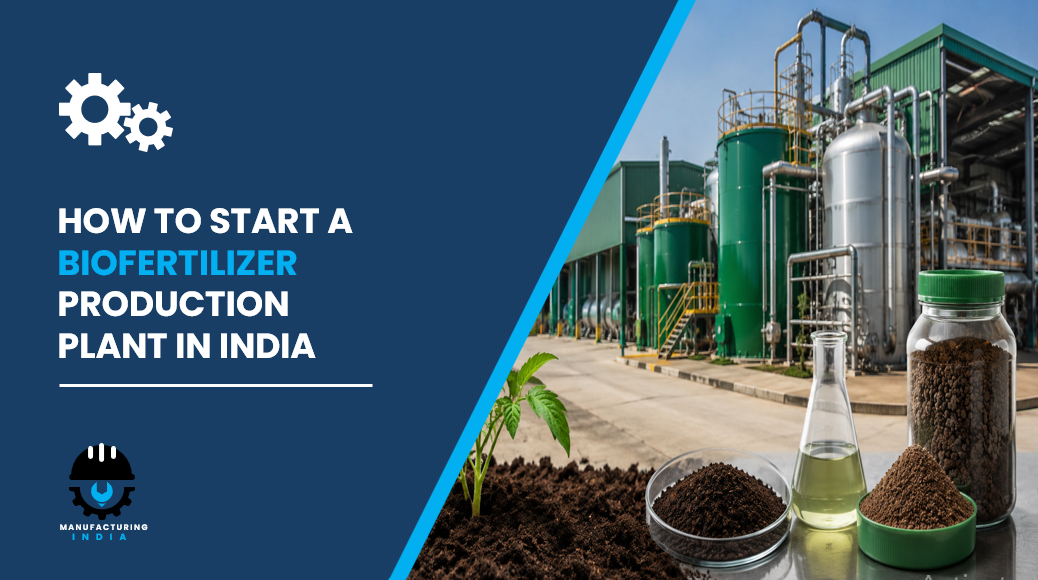
Biofertilizer Production Plant in India
Setting up a biofertilizer production plant in India presents a compelling investment case anchored in the country’s vast agricultural economy, accelerating national shift toward sustainable and organic farming, growing government support for chemical fertilizer substitution, and deepening farmer awareness of soil health and long-term crop productivity. Biofertilizers — natural products containing living microorganisms that enhance plants’ nutrient uptake while sustainably maintaining soil fertility — are at the forefront of India’s transition from synthetic fertilizer dependency toward integrated, eco-friendly nutrient management. As government initiatives expand, organic certification requirements tighten, and farmers increasingly seek solutions that improve soil health and crop yields without the environmental burden of chemical inputs, the domestic demand for quality biofertilizer products is growing at a structural and policy-reinforced pace.
India’s strategic position for this investment is clearly established. The country’s enormous agricultural base — serving hundreds of millions of smallholder and commercial farmers across cereals, pulses, oilseeds, horticulture, and plantation crops — provides a vast and diverse institutional and retail buyer base for biofertilizer producers. In 2024, World Bank-supported agriculture and food projects enabled nearly 4.7 million farmers to adopt improved, climate-smart practices, including water-efficient methods and resilient cropping systems — directly demonstrating the scale of institutional investment in sustainable agriculture adoption. States such as Gujarat, Maharashtra, Uttar Pradesh, Karnataka, and Tamil Nadu offer established agricultural input distribution networks, chemical processing infrastructure, and state government support for biological input manufacturing. The Make in India initiative and national organic farming promotion schemes further reinforce the investment environment for establishing a biofertilizer manufacturing plant in India.
A biofertilizer manufacturing plant in India combines India’s massive agricultural base, accelerating organic farming adoption, and strong government policy support to deliver gross margins of 40–50% and net margins of 15–25% — among the most attractive profitability profiles in the agricultural input manufacturing sector. With the global biofertilizer market projected to reach USD 9.33 billion by 2034 at a CAGR of 10.6%, this investment offers premium financial returns and essential positioning within India’s sustainable agriculture supply chain.
What is Biofertilizer?
Biofertilizers are natural products containing living microorganisms that are beneficial to plants’ nutrient uptake while serving as a sustainable source of soil fertility. Several types of biofertilizers are commercially available — including those comprising nitrogen-fixing bacteria that work symbiotically with plants, phosphate-dissolving bacteria, potassium-dissolving microbes, and mycorrhizal fungi. These products reduce chemical fertilizer dependence, yield healthier crops, maintain soil in good condition, and promote the eco-friendliness of agricultural practices.
Biofertilizers come in various forms — powder, liquid, and granules — making them suitable for application by both smallholder and large-scale farmers. Continuous application ensures consistent nutrient delivery, faster plant growth, and reduced environmental pollution. They are increasingly adopted in horticulture, cereals, pulses, and plantation crops for their commercial and ecological advantages. The primary production method spans microbial cultures preparation, fermentation, blending, carrier material incorporation, quality testing, drying, packaging, and labelling. The product serves end-use industries including agriculture and horticulture, organic farming, commercial plantations, and government-supported sustainable farming projects.
Cost of Setting Up a Biofertilizer Production Plant in India
The total cost of establishing a biofertilizer manufacturing plant in India depends on production capacity, fermentation technology, plant location, degree of automation, and regulatory compliance requirements.
1. Capital Expenditure (CapEx)
The capital investment required to set up this facility covers several major cost heads. Land and site development — including land registration, boundary development, sterile production environment preparation, and related site infrastructure — forms a substantial portion of total CapEx. Investors should consider locating the unit within agro-chemical or agri-input industrial estates in Gujarat (for proximity to national agricultural input distribution hubs), Maharashtra, Uttar Pradesh, or Karnataka, where access to microbial culture suppliers, carrier material sources, and established agricultural input dealer networks creates a commercially favourable operating environment. A controlled, low-contamination environment throughout the production facility is a critical design requirement for maintaining microbial viability from fermentation through to packaged product shelf life.
Civil works and construction costs cover the microbial culture preparation laboratory, sterilisation and fermentation hall, carrier material storage and preparation area, blending and inoculation section, drying and quality testing zone, packaging and labelling area, finished goods warehouse, effluent treatment zone, and administrative block. Sterile production areas and contamination-controlled zones throughout the facility add specification complexity and cost to the civil works scope relative to conventional chemical or agro-processing facilities.
Machinery and equipment represent the largest component of total capital expenditure for this biofertilizer manufacturing plant. Key machinery required includes:
- Fermenters or bioreactors
- Autoclaves (sterilisation units)
- Blending units
- Filtration systems
- Drying units
- Screening equipment
- Packaging machines
- Quality inspection systems
Other capital costs include effluent treatment plant (ETP) installation, contamination monitoring and clean-environment control systems, pre-operative and commissioning expenses, and any applicable import duties on specialised bioreactor and fermentation equipment not manufactured domestically.
Request a Sample Report for In-Depth Market Insights: https://www.imarcgroup.com/biofertilizer-manufacturing-plant-project-report/requestsample
2. Operational Expenditure (OpEx)
The operating cost structure of a biofertilizer manufacturing plant is primarily driven by raw material procurement. Raw material cost — covering microbial cultures (including strains such as Rhizobium, Azotobacter, phosphate-dissolving bacteria, and mycorrhizal fungi) as the primary and most technically critical input, along with carrier materials such as peat or lignite, growth media, and additives — accounts for approximately 50–60% of total OpEx. Microbial culture quality is the single most important determinant of product efficacy and shelf life, making culture source selection, in-house culture maintenance, and supplier qualification the most strategically significant procurement decisions for the plant.
Utility costs, covering electricity, water, and steam required for fermentation, sterilisation, and drying operations, account for 20–25% of OpEx — a moderately high share reflecting the energy demands of autoclave sterilisation cycles and fermentation temperature control. Other operating costs include transportation and logistics for raw material procurement and finished biofertilizer dispatch to agricultural dealers, organic farming cooperatives, and commercial plantation operators, packaging materials, salaries and wages, maintenance and calibration of fermentation and quality testing equipment, depreciation of fixed assets, and applicable taxes. By the fifth year of operations, total operational costs are projected to increase substantially due to inflation, microbial culture and carrier material price escalation, market fluctuations, supply chain disruptions, and rising agricultural demand dynamics.
3. Plant Capacity
The proposed production facility is designed with an annual production capacity ranging between 5,000–10,000 MT, enabling economies of scale while maintaining operational flexibility. Capacity can be customised based on specific investor requirements, target crop and regional market mix, product form strategy across powder, liquid, and granular variants, and available capital. Capital investment in fermentation and blending processes allows production volumes to be flexible, and scalable production design enables incremental capacity additions as market demand and distribution network penetration grow.
4. Profit Margins and Financial Projections
The biofertilizer manufacturing plant demonstrates exceptionally strong profitability potential — among the highest in the agricultural input manufacturing sector. Gross profit margins typically range between 40–50%, supported by the premium positioning of biological input products over commodity chemical fertilizers, government policy-backed organic farming demand, and the relatively moderate cost structure of microbial fermentation and carrier-based formulation relative to chemical synthesis processes. Net profit margins are projected in the range of 15–25%. Break-even for this type of plant typically ranges from 3 to 5 years, depending on production scale, raw material costs, market demand, and regulatory support. Key financial indicators including NPV, IRR, payback period, liquidity analysis, and sensitivity analysis are covered comprehensively in the full project report.
Why Set Up a Biofertilizer Production Plant in India?
Growing Demand for Sustainable and Organic Agriculture. The global and domestic movement toward eco-friendly farming is the primary driver of accelerating demand for inputs that are chemical-fertilizer-free. India’s national organic farming expansion — supported by government subsidies, certification support, and soil health programmes — is creating a structurally growing institutional and retail buyer base for high-quality biofertilizer products. Efficient, consistent, and certified biofertilizer supply is increasingly positioned as a core agricultural input rather than an optional supplement.
Improved Soil Health and Long-Term Productivity Benefits. Biofertilizers enhance nutrient availability and microbial activity, ensuring long-term soil fertility across repeated cropping cycles. India’s Soil Health Card programme has documented widespread nutrient depletion across the country’s agricultural land, creating a strong agronomic case for biological nutrient management programmes that biofertilizer producers can position their products within through farmer education and dealer channel marketing.
Expanding Organic Farming Sector Driving Certified Input Demand. The area cultivated with organic crops is growing rapidly in India, driven by premium market prices for organic produce, export demand from European and North American markets, and government promotion schemes. Organic certification requirements mandate the exclusive use of permitted biological inputs — including certified biofertilizers — creating a directly addressable and captive buyer base for compliant domestic producers.
Customisation Opportunities Enabling Premium Product Lines. Manufacturers can develop crop-specific, region-specific, or multi-nutrient formulations for targeted applications — including Rhizobium formulations for legumes, mycorrhizal products for horticulture, and multi-strain consortium products for cereals and plantation crops. This product customisation capability enables premium pricing and differentiated market positioning that is difficult for commodity chemical fertilizer producers to replicate.
Active Global Industry Investment and Innovation Confirming Market Momentum. In May 2025, Syngenta completed the acquisition of Intrinsyx Bio, strengthening its global leadership in the biologicals sector and expanding its biofertilizer portfolio. The deal combines Intrinsyx Bio’s nutrient use efficiency products — including NUELLO iN — with Syngenta’s R&D and commercial reach, supporting higher crop yields, sustainable farming, and growth in the fastest-growing Nutrient Use Efficiency (NUE) market. In June 2025, MVAC and DPH Biologicals introduced TerraTrove AmplAphex, a liquid biofertilizer that received the Organic Materials Review Institute (OMRI) Listed seal for certified organic use, demonstrating improvements in soil structure, nutrient uptake, and crop stress resilience across the Western and Southern U.S. — confirming the commercial and institutional acceptance of certified biofertilizer products in major agricultural markets.
Government-Supported Soil Management Programmes Creating Institutional Channels. Government initiatives at both central and state levels — including subsidies for biofertilizer procurement by farmers, integration of biofertilizers into soil health restoration programmes, and promotion of Integrated Nutrient Management (INM) frameworks — create direct institutional demand channels that biofertilizer producers can access through government tender and programme supply contracts alongside retail dealer distribution.
Manufacturing Process — Step by Step
The biofertilizer manufacturing process uses microbial cultures preparation, fermentation, blending, carrier material incorporation, quality testing, drying, packaging, and labelling as the primary production method. The process involves multiple unit operations, material handling stages, sterility management protocols, and quality verification checkpoints throughout.
- Microbial Strain Selection and Culture Maintenance: Target microbial strains — including Rhizobium, Azotobacter, phosphate-dissolving bacteria, potassium-dissolving microbes, and mycorrhizal fungi — are selected for efficacy, shelf stability, and crop compatibility. Master and working culture stocks are maintained under controlled conditions in the microbial culture preparation laboratory.
- Growth Media Preparation and Sterilisation: Liquid or solid growth media are prepared and sterilised in autoclaves to eliminate contaminants before inoculation with target microbial strains. Sterilisation completeness is verified before proceeding to fermentation.
- Fermentation (Microbial Cultivation): Sterilised growth media are inoculated with selected microbial strains and incubated in fermenters or bioreactors under controlled temperature, aeration, and agitation conditions to achieve the required cell density and microbial viability for the finished product.
- Carrier Material Preparation and Sterilisation: Carrier materials — peat, lignite, or other approved substrates — are ground, moisture-adjusted, and sterilised in autoclaves to prepare a contamination-free matrix for microbial inoculation. Carrier material selection directly impacts microbial survival during storage and shelf life of the finished product.
- Blending and Inoculation: Fermented microbial broth is blended with sterilised carrier material in blending units under aseptic conditions. Inoculation parameters — microbial load per gram of carrier, moisture content, and mixing uniformity — are controlled to achieve the required colony-forming unit (CFU) count in the finished product.
- Curing and Incubation: Inoculated carrier material is incubated for a defined curing period to allow microbial establishment and stabilisation within the carrier matrix, improving shelf life and product performance under field conditions.
- Drying: Biofertilizer material is dried using drying units to reduce moisture content to the specification required for long-term storage stability while preserving microbial viability.
- Screening: Dried product is passed through screening equipment to achieve uniform particle size distribution and remove oversized or undersized fractions, ensuring product consistency in the packaged unit.
- Quality Testing: Finished biofertilizer is tested for CFU count per gram, moisture content, pH, microbial purity, contamination, and shelf life using quality inspection systems against applicable FCO (Fertiliser Control Order) specifications and organic certification standards.
- Packaging and Labelling: Approved biofertilizer — in powder, granule, or liquid form — is packaged in sealed bags or containers using packaging machines and labelled with product composition, target crop, application rate, microbial content, and shelf life data before dispatch to agricultural dealers, organic farming cooperatives, commercial plantation operators, and government programme buyers.
Key Applications
The biofertilizer manufacturing plant serves multiple agricultural segments with consistent and growing demand for certified, high-efficacy biological nutrient management inputs:
- Agriculture and Horticulture: Using microbial formulations, soil is enriched and harvests are increased across cereals, pulses, oilseeds, vegetables, fruits, and ornamental crops — the largest volume application segment for biofertilizer products.
- Organic Farming Sector: Enables farmers to comply with organic certification standards while reducing chemical fertilizer dependency — a mandatory input category for certified organic crop producers.
- Plantation and Commercial Farming: Increases productivity in large tea, coffee, rubber, sugarcane, and oil palm plantations along with nutrient uptake efficiency, making biofertilizers commercially viable as a cost-saving and productivity-enhancing input for large-scale operators.
- Government-Supported Soil Management Programmes: Supports central and state government initiatives for sustainable soil health restoration and integrated nutrient management across priority agricultural zones.
Leading Manufacturers
The global biofertilizer industry is served by several producers with extensive production capacities and diverse application portfolios. Key players include:
- Gujarat State Fertilizers & Chemicals Limited (GSFC)
- IPL Biologicals Limited
- Kiwa Bio-Tech Products Group Corporation
- Madras Fertilizers Limited (MFL)
- National Fertilizers Limited (NFL)
- Rashtriya Chemicals and Fertilizers Limited (RCF)
- Rizobacter Argentina SA (Bioceres S.A.)
- Symborg SL (Corteva, Inc.)
- T. Stanes and Company Limited
Timeline to Start the Plant
- Feasibility study and project report preparation
- Land acquisition and site development
- Regulatory approvals and environmental clearances
- Factory licence and fire safety compliance
- Machinery procurement and installation
- Raw material supplier agreements and supply chain setup
- Trial production and quality testing
- Commercial production launch
The overall timeline from project initiation to commercial production typically ranges from 12 to 24 months, depending on plant scale, equipment setup, regulatory approvals, and availability of microbial strains and sterile production infrastructure.
Licences and Regulatory Requirements
Starting a biofertilizer manufacturing unit in India requires several approvals:
- Business registration (Proprietorship, LLP, or Pvt Ltd)
- Factory Licence under the Factories Act
- Environmental Clearance from State Pollution Control Board
- GST Registration
- Fire Safety NOC
- Registration and product certification under the Fertiliser Control Order (FCO) — mandatory for biofertilizer manufacture and sale in India, specifying minimum CFU counts and quality standards for registered microbial types
- Organic input certification from accredited certification bodies — required for supply to certified organic farmers and compliance with organic programme specifications
- Effluent Treatment Plant (ETP) operational clearance
- Occupational Health and Safety compliance
Key Challenges to Consider
Maintaining Microbial Viability Across Production and Distribution. The defining operational challenge of biofertilizer manufacturing is ensuring consistently high colony-forming unit (CFU) counts from production through to the point of farm application — across packaging, storage, and supply chain conditions. Temperature excursions, contamination, and improper storage at dealer level can degrade product efficacy, damaging farmer trust and brand reputation. Cold chain management and robust dealer training are essential operational investments.
Raw Material Quality and Microbial Culture Consistency. Microbial cultures — accounting for the most critical fraction of the 50–60% OpEx raw material share — must be consistently high quality in terms of strain efficacy, purity, and fermentation performance. Maintaining in-house master culture stocks and qualifying backup culture suppliers protects against the production disruption risk of a single-source microbial supply failure.
Regulatory Compliance Under the Fertiliser Control Order. FCO registration requires product-specific minimum CFU counts, approved microbial strains, and ongoing batch testing compliance — adding mandatory quality management system investment and regulatory documentation obligations to the operational cost base. OMRI or equivalent organic certification requirements for export and organic segment supply add further compliance layers.
Technology and Innovation Pressure. Rapidly advancing biofertilizer science — including multi-strain consortium products, nano-encapsulated microbial formulations, and nutrient use efficiency biologicals as demonstrated by Syngenta’s May 2025 acquisition of Intrinsyx Bio — requires producers to monitor the R&D landscape and invest in next-generation product development to maintain competitive efficacy positioning with agronomically sophisticated farmer and distributor buyers.
Competition. Established Indian producers including Gujarat State Fertilizers & Chemicals Limited (GSFC), IPL Biologicals Limited, Madras Fertilizers Limited, and National Fertilizers Limited, along with global players like Symborg SL (Corteva) and Rizobacter Argentina SA (Bioceres), maintain strong market positions. New entrants must differentiate on product efficacy, crop-specific formulation depth, FCO compliance, and distribution channel development.
Skilled Manpower for Sterile Bioprocessing. Operating fermenters and bioreactors, maintaining microbial culture stocks, and managing contamination-controlled production environments to FCO and organic certification standards requires microbiologists and bioprocess engineers — a specialised workforce category presenting sourcing and retention challenges outside established biotechnology and agri-input manufacturing clusters.
Frequently Asked Questions
1. How much does it cost to set up a biofertilizer manufacturing plant in India?
Total investment depends on production capacity (5,000–10,000 MT annually), fermentation technology, sterile facility requirements, location, and automation level. Key cost components include land and contamination-controlled facility construction, machinery (fermenters or bioreactors, autoclaves, blending units, filtration systems, drying units, screening equipment, packaging machines, quality inspection systems), ETP, and working capital for microbial culture and carrier material procurement. A detailed project report provides capacity-specific CapEx and OpEx estimates.
2. Is biofertilizer manufacturing profitable in India in 2026?
Yes — it is among the most financially attractive agricultural input manufacturing opportunities. The facility demonstrates gross profit margins of 40–50% and net profit margins of 15–25% under normal operating conditions, supported by premium organic farming demand, government policy backing, and India’s vast agricultural base. Break-even typically ranges from 3 to 5 years.
3. What machinery is required for a biofertilizer manufacturing plant in India?
Key equipment includes fermenters or bioreactors, autoclaves (sterilisation units), blending units, filtration systems, drying units, screening equipment, packaging machines, and quality inspection systems.
4. What licences and approvals are required to start a biofertilizer manufacturing plant in India?
Required approvals include business registration, Factory Licence under the Factories Act, Environmental Clearance from the State Pollution Control Board, GST registration, FCO registration for biofertilizer manufacture and sale, organic input certification for organic market supply, ETP operational clearance, Fire Safety NOC, and Occupational Health and Safety certification.
5. What raw materials are needed for biofertilizer manufacturing?
Key raw materials include microbial strains such as Rhizobium, Azotobacter, phosphate-dissolving bacteria, and mycorrhizal fungi as the primary biological inputs, along with carrier materials such as peat or lignite, growth media, and additives used in culture, stabilisation, and product formulation.
6. What are the environmental compliance requirements for a biofertilizer manufacturing plant in India?
Operators must obtain Environmental Clearance, maintain an operational ETP for process wastewater from fermentation and washing operations, comply with State Pollution Control Board guidelines on effluent quality, and implement responsible management of sterilisation and fermentation process waste streams in accordance with applicable biosafety and waste disposal norms.
7. What is the best location to set up a biofertilizer manufacturing plant in India?
Ideal locations offer proximity to agricultural markets and dealer distribution networks, access to microbial culture and carrier material suppliers, reliable power and water infrastructure, and access to agro-chemical or agri-input industrial estates. Gujarat, Maharashtra, Uttar Pradesh, Karnataka, and Tamil Nadu are strong options given their established agricultural input industry ecosystems, large farming communities, and state government support for biological input manufacturing.
8. What is the break-even period for this type of plant in India?
Break-even typically ranges from 3 to 5 years, depending on production scale, raw material costs, capacity utilisation, distribution network reach, and market demand. Efficient operations, government programme supply contracts, and growing organic farming certification rates can help accelerate returns.
9. What government incentives are available for manufacturers in India?
Biofertilizer manufacturers in India can benefit from capital subsidies under national and state-level organic farming promotion schemes, tax exemptions under state industrial promotion policies, subsidised supply arrangements under government Integrated Nutrient Management programmes, reduced utility tariffs in agro-industrial estates, and export-linked benefits for FCO-compliant and OMRI-certified biofertilizer products.
Key Takeaways for Investors
The biofertilizer manufacturing plant opportunity in India is underpinned by structural, policy-reinforced demand from India’s vast agricultural sector transitioning toward sustainable and organic farming — with World Bank-supported programmes enabling nearly 4.7 million farmers to adopt climate-smart practices in 2024 alone — alongside growing institutional demand from government soil health programmes, organic certification-compliant farming, and commercial plantation operations requiring crop-specific biological nutrient management solutions. The financial profile is exceptionally attractive across the 5,000–10,000 MT annual capacity range, with gross margins of 40–50% and net margins of 15–25%, supported by premium organic input pricing, government subsidised procurement, and the comparatively moderate capital intensity of fermentation and carrier-based production versus chemical manufacturing. The global biofertilizer market, valued at USD 3.76 billion in 2025, is projected to reach USD 9.33 billion by 2034 at a CAGR of 10.6%, confirming a powerful and sustained demand growth trajectory. As global majors including Syngenta complete strategic acquisitions in the biologicals space in May 2025 and OMRI-certified products like TerraTrove AmplAphex demonstrate institutional market acceptance in June 2025, India-based biofertilizer producers positioned with FCO compliance, crop-specific formulation depth, and robust distribution channel development are set for durable, multi-decade growth across every tier of India’s rapidly evolving sustainable agriculture input market.
About the Author