Setting up a PVC resin manufacturing plant in India presents a compelling investment case grounded in the country’s expanding construction and infrastructure activity, accelerating urbanisation, growing demand for water and sewage piping systems, rising electrification requirements, and the broad-based shift across multiple industries toward lightweight, durable, and cost-effective polymer materials. PVC resin – polyvinyl chloride resin – is among the most widely consumed synthetic polymers globally, underpinning the production of pipes and fittings, cable insulation, window profiles, films, sheets, flooring, medical devices, and packaging products across construction, electrical, automotive, packaging, and healthcare sectors. As India’s infrastructure investment pipeline deepens and global plastics production continues expanding – reaching an estimated 430 million tonnes in 2024 according to Plastics Europe – the structural demand environment for domestically produced PVC resin grows progressively more favourable for new manufacturing investment.
India’s strategic advantages strengthen the investment case substantially. The country’s rapid urbanisation is driving heightened investments in water supply, sewage infrastructure, and power electrification projects – all of which are the primary end-use drivers for PVC pipes, fittings, and cable insulation. The government’s active manufacturing push under Make in India, combined with a highly significant regulatory tailwind – India’s Directorate General of Trade Remedies (DGTR) recommended five-year anti-dumping duties on PVC resin imports in August 2025, with proposed levies ranging from USD 22 to USD 284 per metric ton by country of origin – directly improves the competitive positioning of domestic PVC resin producers against low-cost imports. This policy signal, targeting price stability, fair competition for domestic producers, and long-term market share growth for the Indian plastic pipe industry, represents one of the most important near-term investment enablers for this manufacturing category. Industrial locations in Gujarat, Maharashtra, Andhra Pradesh, and Odisha – with access to chemical feedstock supply chains, port infrastructure, and major downstream buyers – offer investors cost-competitive and well-connected sites for establishing large-scale PVC resin production capacity.
A PVC resin manufacturing plant in India is positioned at the intersection of a global market valued at USD 74.93 billion in 2025 growing at 4.5% CAGR toward USD 111.35 billion by 2034, India’s accelerating infrastructure and construction demand, and a landmark anti-dumping duty recommendation that directly improves domestic producer competitiveness. With gross margins of 20–30%, net margins of 8–12%, and a scalable production model at 100,000–200,000 MT annual capacity, this investment delivers commercially sound returns in one of India’s most strategically supported polymer manufacturing categories.
What is PVC Resin?
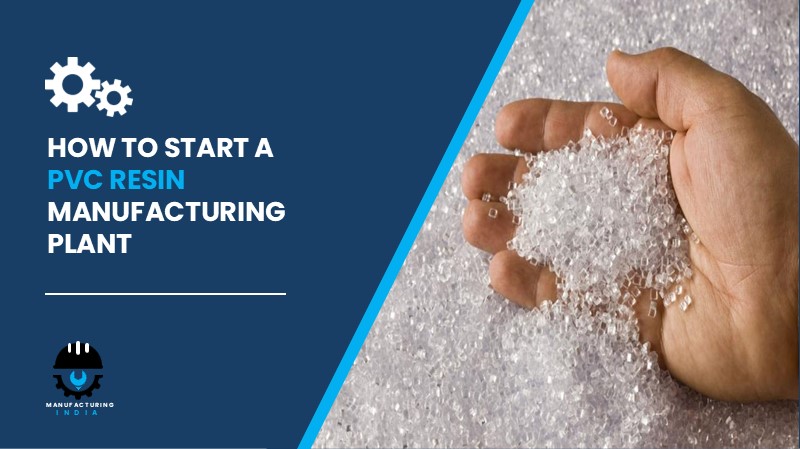
Polyvinyl chloride resin, also referred to as PVC resin, is a synthetic thermoplastic polymer that results from the polymerisation of vinyl chloride monomer (VCM). The resin is a white powder, widely recognised as a base material for producing a vast range of rigid and flexible plastic products. PVC resin, depending on its formulation and processing, can be converted into pipes, fittings, cables, profiles, films, sheets, medical devices, flooring, and packaging materials.
The material’s key characteristics include chemical resistance, mechanical strength, flame retardancy, and cost efficiency – properties that have made it one of the most versatile and widely applied polymers in global manufacturing. The grades of PVC resin are primarily divided into suspension, emulsion, and bulk polymerised forms, each serving particular industrial applications and end-use specifications. The advantages of its versatility, long service life, and recyclability have positioned PVC resin as one of the most popular polymers across global manufacturing industries. The primary production method involves vinyl chloride polymerisation, stripping and degassing, drying, blending, quality inspection, and packaging. End-use industries served include construction and infrastructure, electrical and electronics, automotive, packaging, healthcare, and consumer goods.
Cost of Setting Up a PVC Resin Manufacturing Plant in India
The total investment required to establish a PVC resin manufacturing plant in India depends on plant capacity, polymerisation technology selection, geographic location, level of automation, and compliance with chemical safety and environmental regulatory frameworks. Investors must account comprehensively for both one-time capital expenditure and recurring operational costs when preparing a feasibility study or detailed project report (DPR).
1. Capital Expenditure (CapEx)
Land and Site Development constitutes a foundational and substantial investment. Costs for land registration, boundary development, internal road construction, drainage infrastructure, and site levelling vary based on whether the facility is within a government-notified chemical industrial zone, a petrochemical Special Economic Zone (SEZ), or on privately acquired industrial land. Coastal chemical processing zones in Gujarat and Andhra Pradesh provide infrastructure-ready sites with established VCM feedstock supply chains, port logistics for export, and compliance with chemical industrial zoning requirements – reducing site development timelines and costs for new entrants.
Civil Works and Construction encompasses the main polymerisation reactor building – which requires pressure-rated, VCM-resistant construction specifications – along with the VCM storage and handling facility with containment and vapour recovery systems, stripping and degassing plant, centrifuge and drying hall, blending and quality control area, finished resin storage and bagging facility, effluent treatment plant, and administrative block. The hazardous chemical handling requirements for VCM – a listed carcinogen requiring strict containment, leak detection, and emergency response infrastructure – add significantly to civil construction costs and specification standards relative to non-hazardous manufacturing facilities.
Machinery and Equipment represent the single largest component of capital expenditure. Key machinery required includes:
- Polymerisation reactors
- Centrifuges
- Dryers
- Blending systems
- Material handling equipment
- Packaging units
Other Capital Costs include the effluent treatment plant (ETP) for managing VCM-contaminated process water and wastewater streams, VCM vapour recovery and scrubbing systems, pre-operative expenses covering regulatory filings and environmental impact assessment preparation, plant commissioning charges, utility connection fees, and import duties applicable to large-scale polymerisation reactors or specialised centrifuge equipment sourced from international suppliers.
Request a Sample Report for In-Depth Market Insights: https://www.imarcgroup.com/pvc-resin-manufacturing-plant-project-report/requestsample
2. Operational Expenditure (OpEx)
Raw Material Cost is the dominant driver of operating expenditure, accounting for approximately 70–80% of total OpEx. The primary and overwhelmingly largest input is vinyl chloride monomer (VCM), which is directly polymerised to produce PVC resin. VCM pricing is linked to ethylene and chlorine commodity markets, which are subject to global petrochemical cycle dynamics, feedstock price volatility, and supply chain disruptions. Investors are advised to secure long-term VCM supply contracts with domestic or regional petrochemical producers to stabilise the dominant input cost and ensure production continuity. Additional raw material inputs include initiators and additives that are incorporated during polymerisation to control molecular weight, particle size distribution, and performance properties. Selecting VCM suppliers in geographic proximity to the plant site materially reduces inbound logistics costs and supply chain disruption risk.
Utility Costs – covering electricity for polymerisation reactors, centrifuges, dryers, and facility operations – account for approximately 10–15% of total OpEx. VCM polymerisation is an exothermic reaction requiring controlled cooling infrastructure, adding to utility expenditure relative to processes that require external heating. Investors in regions with reliable industrial power supply and access to competitive electricity tariffs, or those able to develop captive power generation, are better positioned to manage this cost component over the plant’s operational life.
Other Operating Costs include outbound transportation to pipe and fitting manufacturers, cable producers, profile extruders, film converters, healthcare product manufacturers, and packaging companies; packaging materials for resin bags and bulk containers; employee salaries and wages for chemical process engineers, plant operators, quality assurance chemists, and safety personnel; equipment maintenance; quality assurance testing for resin grade specifications including K-value, particle size distribution, and bulk density; depreciation on civil and machinery assets; and applicable taxes. By the fifth year of operations, total operational costs are expected to increase substantially due to inflation, market fluctuations, and potential rises in VCM and petrochemical feedstock prices, compounded by supply chain disruptions and shifts in the global chemical economy.
3. Plant Capacity
The proposed PVC resin manufacturing facility is designed with an annual production capacity ranging between 100,000 and 200,000 MT, enabling significant economies of scale while maintaining operational flexibility across different resin grades and product specifications. This capacity range is well-aligned with the requirements of large-scale pipe and fitting manufacturers, cable producers, and profile extruders in India’s growing construction and electrical infrastructure sectors. Capacity can be customised based on investor requirements, VCM supply availability, and downstream market offtake commitments. Profitability improves consistently with higher capacity utilisation, and PVC resin plants support capacity expansion through additional reactor trains with contained incremental investment – allowing phased scale-up as market demand grows and VCM supply contracts are expanded.
4. Profit Margins and Financial Projections
The PVC resin manufacturing plant demonstrates solid profitability potential under normal operating conditions, with margins supported by the anti-dumping duty protection recommended by India’s DGTR in August 2025. Gross profit margins typically range between 20–30%, supported by stable multi-sector demand and the value-added, specification-consistent nature of polymerised resin relative to VCM feedstock. Net profit margins range between 8–12%, reflecting the capital intensity and VCM cost dominance of the production model. A comprehensive financial analysis should include income projections, expenditure forecasts, gross and net margin tracking across Years 1 through 5, net present value (NPV), internal rate of return (IRR), payback period, and a full profit and loss account. Sensitivity analysis covering VCM price movements and domestic resin price dynamics under the anti-dumping duty framework is particularly important for investment-grade financial planning.
Why Set Up a PVC Resin Manufacturing Plant in India?
Anti-Dumping Duty Recommendation Directly Improving Domestic Producer Competitiveness. In August 2025, India’s Directorate General of Trade Remedies (DGTR) recommended five-year anti-dumping duties on PVC resin imports, with proposed levies ranging from USD 22 to USD 284 per metric ton by country of origin. The stated objectives of this policy intervention include targeting price stability, inventory normalisation, distributor restocking, fair competition for domestic producers, and long-term market share growth for the Indian plastic pipe industry. This direct regulatory support for domestic PVC resin production substantially improves the commercial viability of new manufacturing investment by reducing the pricing pressure from low-cost imported resin that has historically compressed domestic producer margins.
India’s Infrastructure Boom Driving Structural Pipe and Fitting Demand. Rapid urbanisation, higher investments in water supply and sewage infrastructure, power electrification projects, and smart city development programs are driving strong and sustained demand for PVC pipes, fittings, and cable insulation in India. These infrastructure applications – which are the primary end-use categories for PVC resin – are supported by central and state government infrastructure spending commitments that provide a multi-year demand runway for domestic resin producers.
Global Plastics Production Growth Validating Market Expansion. According to Plastics Europe, global plastics production continued expanding year on year, reaching an estimated 430 million tonnes in 2024. This sustained growth in overall plastics output directly supports higher demand for PVC resin as one of the world’s most consumed polymer types, reinforcing the long-term commercial fundamentals of the investment category.
Expanding Electrical and Electronics Applications. The growing demand for cable insulation and wire coverings – driven by India’s power sector expansion, renewable energy installations, and consumer electronics manufacturing growth – is creating additional demand for PVC resin with specific electrical grade specifications. The material’s non-combustibility and high electrical insulation properties make it the preferred choice for cable jacketing applications across residential, commercial, and industrial wiring systems.
Healthcare and Packaging Demand Diversifying Revenue Streams. The healthcare sector’s demand for PVC-based medical tubing, blood bags, and disposable devices – requiring controlled formulation and sterilisation compatibility – and the packaging industry’s use of PVC films for rigid and flexible barrier packaging are creating high-value, specification-specific demand streams beyond the core construction applications. These diversified end-use channels reduce revenue concentration risk and improve the product mix profitability of the manufacturing facility.
Scalable Production Model with Strong Export Potential. PVC resin plants support capacity expansion through additional reactor trains with contained incremental investment, enabling phased scale-up aligned to domestic and export market growth. Consistent global demand from downstream processors across Asia-Pacific, the Middle East, and Africa enables manufacturers with competitive production costs to build international export revenue streams alongside domestic sales, reducing dependence on any single market or buyer category.
Manufacturing Process – Step by Step
The PVC resin manufacturing process uses vinyl chloride polymerisation, stripping and degassing, drying, blending, quality inspection, and packaging as the primary production method. Below are the main stages involved in the PVC resin manufacturing process flow:
- VCM Receipt and Storage: Vinyl chloride monomer (VCM) is received at the facility via pipeline, rail tanker, or road tanker, stored in pressure-rated VCM storage vessels with containment and vapour recovery systems, and quality-tested for purity before being cleared for polymerisation.
- Reactor Charging – Aqueous Suspension Polymerisation: Polymerisation reactors are charged with demineralised water, VCM, initiators, and suspension agents in defined proportions for the target resin grade. The suspension polymerisation process disperses VCM droplets in water using the suspension agent, and the initiators trigger the polymerisation reaction within each VCM droplet.
- Polymerisation Reaction: The VCM polymerisation reaction proceeds under controlled temperature and pressure conditions within the reactors. The exothermic nature of the reaction requires precise cooling system management to maintain temperature within the target range, which determines the molecular weight (K-value) and particle morphology of the resulting PVC resin.
- Stripping and Degassing: Following polymerisation completion, residual unreacted VCM is stripped from the PVC slurry using stripping equipment that applies heat and vacuum to drive off VCM vapours, which are recovered and recycled back to the polymerisation process or the VCM storage system, minimising emissions and improving raw material yield.
- Centrifugation: Centrifuges separate the PVC resin particles from the aqueous suspension medium, reducing the moisture content of the resin cake to levels suitable for the subsequent drying stage. The separated water phase is treated before discharge or recycled within the process.
- Drying: Dryers apply controlled heat and airflow to the wet PVC cake to reduce its moisture content to the specified final level for the target resin grade – typically below 0.3% – while preserving particle integrity and avoiding thermal degradation of the polymer.
- Blending: Blending systems combine dried PVC resin from multiple production batches to achieve homogeneous bulk grade specifications, including consistent K-value, particle size distribution, porosity, and bulk density across the production lot.
- Quality Inspection: Analytical instruments and quality inspection systems test the blended resin against grade specifications including K-value (molecular weight indicator), apparent bulk density, particle size distribution, volatiles content, thermal stability, and colour. Batch release is conditional on all parameters meeting the specification acceptance criteria for the designated resin grade.
- Packaging: Packaging units fill finished PVC resin into 25 kg multi-wall paper or polyethylene bags, jumbo bags, or bulk tanker vehicles depending on customer requirements, applying batch coding and grade labelling for full supply chain traceability.
- Dispatch: Finished PVC resin is dispatched to pipe and fitting manufacturers, cable and wire producers, profile extruders, film and sheet converters, healthcare product manufacturers, and packaging companies across domestic and export markets.
Key Applications
PVC resin produced at this type of facility serves a wide range of end-use industries and product manufacturing categories, each requiring specific resin grades, K-values, and formulation characteristics:
- Construction and Infrastructure Industry: Manufacture of pipes, fittings, and profiles in large volumes for water supply, sewage, drainage, irrigation, and conduit applications requiring long-lasting, corrosion-resistant, and cost-economical solutions.
- Electrical and Electronics Sector: Manufacturing of cables and wire coverings using the resin’s non-combustibility and high electrical insulation properties for residential, commercial, and industrial power distribution and communication wiring systems.
- Packaging Industry: Production of rigid and flexible barrier films for packaging applications with excellent clarity, strength, and extended shelf life for food, pharmaceutical, and consumer goods packaging.
- Healthcare and Medical Products: Manufacture of medical tubing, blood bags, intravenous bags, and disposable medical devices through controlled formulation and sterilisation compatibility – requiring dedicated medical-grade PVC resin specifications.
- Automotive: Production of lightweight, durable interior trim components, seals, and protective coverings for automotive applications requiring chemical resistance and dimensional stability.
Leading PVC Resin Manufacturers
The global PVC resin industry is served by several large-scale manufacturers with extensive production capacities and diversified end-use sector portfolios. Key players include:
- Xinjiang Zhongtai Chemical Co. Ltd.
- Ineos
- Westlake Chemical Corporation
- Shin-etsu Chemicals Limited
- Formosa Plastics Corporation
Timeline to Start the Plant
Investors planning to establish a PVC resin manufacturing plant in India should anticipate the following project development phases:
- Feasibility study and project report preparation
- Land acquisition and site development
- Regulatory approvals and environmental clearances
- Factory licence and fire safety compliance
- Machinery procurement and installation
- Raw material supplier agreements and supply chain setup
- Trial production and quality testing
- Commercial production launch
Licences and Regulatory Requirements
Starting a PVC resin manufacturing unit in India requires several approvals:
- Business registration (Proprietorship, LLP, or Private Limited Company)
- Factory Licence under the Factories Act
- Environmental Clearance from the Ministry of Environment, Forest and Climate Change (MoEFCC) and State Pollution Control Board – including Environmental Impact Assessment for a Schedule A hazardous chemical facility involving VCM
- Hazardous chemical safety compliance under the Manufacture, Storage and Import of Hazardous Chemical (MSIHC) Rules for VCM handling and storage
- GST Registration
- Fire Safety NOC – including VCM flammable gas hazard compliance
- Effluent Treatment Plant (ETP) operational clearance for VCM-contaminated wastewater management
- Occupational Health and Safety compliance covering VCM exposure monitoring, respiratory protection, and emergency response planning
- Bureau of Indian Standards (BIS) certification for applicable PVC resin grades where required under IS specifications
- Petroleum and Explosives Safety Organisation (PESO) approval where applicable for VCM pressure vessel registration
Key Challenges to Consider
High Capital Intensity and VCM Hazard Management Requirements. PVC resin manufacturing involves handling VCM – a classified carcinogen – at scale under pressure, requiring significant investment in containment infrastructure, leak detection systems, VCM vapour recovery equipment, and emergency response facilities that substantially increase CapEx relative to non-hazardous polymer manufacturing.
VCM Price Volatility as the Dominant Cost Variable. VCM – accounting for 70–80% of total OpEx – is priced against ethylene and chlorine commodity markets subject to global petrochemical cycle volatility. Any significant increase in VCM prices directly and materially compresses PVC resin gross margins. Long-term VCM supply contracts at fixed or formula-based pricing are the primary risk mitigation tool but require careful supplier qualification and contract structure assessment.
Regulatory and Environmental Compliance Complexity. PVC resin manufacturing in India is subject to overlapping hazardous chemical regulations – including MSIHC Rules for VCM, Environmental Clearance requirements under EIA Notification 2006, CPCB emission standards for VCM and vinyl chloride residuals, and wastewater discharge standards – creating a multi-authority compliance framework that demands dedicated environmental and safety management system investment.
Competition from Established Domestic and Global Producers. The market is served by globally scaled producers including Shin-etsu Chemicals, Westlake Chemical, Formosa Plastics, and INEOS with large-scale, low-cost production infrastructure. In October 2025, Westlake Corp. reported a USD 727 million goodwill impairment tied to its North American PVC unit – reflecting the margin pressures even large producers face in this competitive environment. Indian new entrants must leverage domestic market access advantages and anti-dumping duty protection to build competitive positioning.
Technology Selection for Polymerisation Process. The choice between suspension polymerisation (the dominant commercial process for pipe and profile grade resins), emulsion polymerisation (for paste grade resins used in flooring and coatings), and bulk polymerisation affects the product grade portfolio, reactor design, capital cost, and downstream application capabilities of the plant. Investors must carefully evaluate this technology choice against their target market segment.
Skilled Chemical Engineering Workforce. Operating polymerisation reactors, stripping systems, centrifuges, and VCM handling infrastructure requires chemical process engineers and operators with specialised training in PVC polymerisation chemistry, hazardous chemical safety management, and polymer quality control. Sourcing and retaining this talent pool – particularly in locations outside established petrochemical processing clusters – presents a meaningful operational challenge.
Frequently Asked Questions
1. How much does it cost to set up a PVC resin manufacturing plant in India?
The total cost depends on plant capacity (100,000–200,000 MT per annum), polymerisation technology, location, and automation level. CapEx covers land, hazardous chemical-grade civil construction, and machinery including polymerisation reactors, centrifuges, dryers, blending systems, material handling equipment, and packaging units, along with VCM containment infrastructure and pre-operative regulatory costs.
2. Is PVC resin manufacturing profitable in India in 2026?
Yes. With gross margins of 20–30% and net margins of 8–12%, supported by India’s infrastructure-led pipe and fitting demand, the DGTR’s anti-dumping duty recommendation protecting domestic producers from underpriced imports, and a global market growing at 4.5% CAGR toward USD 111.35 billion by 2034, the investment presents a commercially sound and improving profitability case.
3. What machinery is required for a PVC resin manufacturing plant in India?
Key equipment includes polymerisation reactors, centrifuges, dryers, blending systems, material handling equipment, and packaging units. Supporting systems include VCM storage and handling equipment, stripping units, VCM vapour recovery systems, cooling systems, and analytical quality control instruments.
4. What licences and approvals are required to start a PVC resin manufacturing plant in India?
Required approvals include business registration, Factory Licence, Environmental Clearance including EIA, MSIHC hazardous chemical compliance for VCM, GST Registration, Fire Safety NOC, ETP operational clearance, BIS certification where applicable, Occupational Health and Safety compliance, and PESO approval for VCM pressure vessel registration.
5. What raw materials are needed for PVC resin manufacturing?
The primary raw material is vinyl chloride monomer (VCM), which accounts for 70–80% of total OpEx. Additional inputs include demineralised water, suspension agents, initiators, and processing additives that control resin grade specifications including K-value, particle size, and porosity.
6. What are the environmental compliance requirements for a PVC resin manufacturing plant in India?
Environmental Clearance including EIA is mandatory, along with MSIHC compliance for VCM handling, State Pollution Control Board clearance, VCM vapour recovery and emission control systems, ETP operational clearance for VCM-contaminated wastewater treatment, and ongoing ambient air VCM monitoring compliance under CPCB standards.
7. What is the best location to set up a PVC resin manufacturing plant in India?
Coastal chemical processing zones in Gujarat and Andhra Pradesh – with established VCM supply chain access, petrochemical industrial infrastructure, port logistics for export, and proximity to large downstream pipe, cable, and profile manufacturing clusters – offer the best combination of feedstock access, logistics connectivity, and regulatory infrastructure for PVC resin manufacturing investment.
8. What is the break-even period for this type of plant in India?
The break-even period depends on plant scale, VCM procurement pricing, capacity utilisation, and domestic resin pricing dynamics under the anti-dumping duty framework. A full NPV and IRR analysis incorporating sensitivity testing for VCM price movements and domestic selling price scenarios is recommended for investment-grade financial planning.
9. What government incentives are available for PVC resin manufacturers in India?
The DGTR’s recommended anti-dumping duties on PVC resin imports provide direct market protection. Make in India incentives, petrochemical sector PLI scheme benefits, state-level chemical industrial zone incentives in Gujarat and Andhra Pradesh, and export promotion support through chemical export councils provide additional financial and regulatory support for qualifying PVC resin manufacturing investments.
Key Takeaways for Investors
A PVC resin manufacturing plant in India represents a strategically well-timed investment opportunity supported by a global market growing at 4.5% CAGR from USD 74.93 billion in 2025 toward USD 111.35 billion by 2034, India’s construction and infrastructure demand boom driving structural consumption of pipes, fittings, and cable insulation, and the landmark DGTR anti-dumping duty recommendation of August 2025 that directly strengthens the commercial case for domestic PVC resin production. Financial viability is demonstrated across a plant capacity range of 100,000 to 200,000 MT per annum, with gross margins of 20–30% and net margins of 8–12% achievable under competitive VCM procurement and efficient production operations. Global plastics production reaching 430 million tonnes in 2024 and India’s rapidly expanding electrification, water infrastructure, and construction pipelines collectively ensure that long-term demand sustainability for domestically produced PVC resin is structurally sound and well-supported for the decade ahead.
About the Author