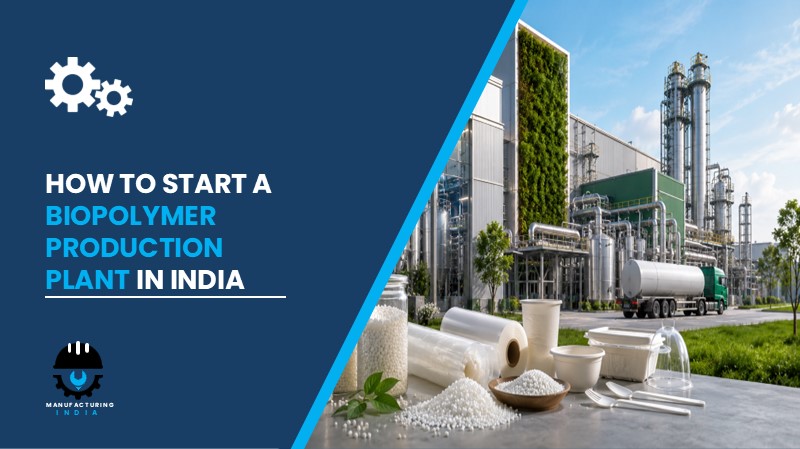
Setting up a biopolymer production plant in India presents a compelling investment case driven by surging demand across the packaging, automotive, medical devices, textiles, agriculture, and consumer goods sectors. As governments and corporations across Asia accelerate plastic bans and commit to circular economy mandates, biodegradable and compostable alternatives are rapidly replacing conventional petroleum-based plastics. India, as one of Asia-Pacific’s fastest-growing consumer markets, sits at the heart of this shift — positioned to absorb enormous volumes of bio-based packaging materials, agricultural films, medical implants, and industrial fibers as industrial and urban consumption scales upward.
India’s structural advantages — a cost-competitive labour pool, access to agricultural by-products and renewable feedstocks, improving logistics infrastructure, and the government’s Make in India initiative — create a uniquely favourable environment for establishing bio-based polymer production. States such as Gujarat and Maharashtra, with established chemical and industrial clusters, offer proximity to raw material suppliers, port access for exports, and availability of Special Economic Zones (SEZs) that reduce land and duty costs. As major food and beverage brands such as Nestlé and Coca-Cola commit to 100% recyclable or biodegradable packaging, India-based manufacturers stand to capture growing domestic procurement volumes while also serving export markets across Southeast Asia and the Middle East.
India’s biopolymer production sector benefits from simultaneous policy tailwinds, cost-competitive production economics, and rising demand from packaging, agriculture, automotive, and medical sectors. With a well-structured feasibility study, a plant of appropriate capacity can achieve viable break-even timelines, healthy gross and net margins, and a strong net present value — making this one of the more commercially sound green-production investments available to Indian entrepreneurs and industrial groups today.
What is Biopolymer?
A biopolymer is a naturally derived polymer produced by living organisms or synthesized from renewable biological sources such as plants, microorganisms, or agricultural by-products. Unlike conventional petroleum-based plastics, biopolymers are valued for being biodegradable, compostable, and environmentally friendly. They exhibit versatile mechanical properties, ranging from flexible films to rigid thermoplastics, allowing them to substitute traditional plastics across a wide range of industrial and consumer applications.
Common types include polysaccharides such as cellulose, starch, and chitosan; proteins such as collagen and silk; and polyesters such as polylactic acid (PLA) and polyhydroxyalkanoates (PHA). These variants differ in their mechanical performance, thermal stability, and end-use suitability. The primary production method is microbial fermentation, enzymatic conversion, or polymerization using renewable feedstocks — all of which are implemented within a purpose-built biopolymer production facility.
End-use industries served by biopolymers include packaging, automotive, medical devices, textiles, agriculture, and consumer goods. Applications range from biodegradable packaging and coatings to medical implants, films, fibers, and agricultural films — making this one of the most versatile material categories in modern green production.
Cost of Setting Up a Biopolymer Production Plant in India
The total cost of establishing a biopolymer production plant in India depends on plant capacity, technology selection, location, level of automation, and the degree of regulatory compliance required. Investors must account for both one-time capital expenditure and recurring operational expenditure to build an accurate financial model.
1. Capital Expenditure (CapEx)
Capital investment covers all fixed assets required to bring the facility to commercial readiness. The largest single component is machinery, but land, civil works, and ancillary costs are also substantial.
Land and Site Development: Land acquisition costs vary significantly across India. Industrial estates in Gujarat, Maharashtra, and Uttar Pradesh offer relatively structured pricing, while SEZ locations may provide duty exemptions on imported equipment and raw materials. Site preparation costs include land registration, boundary development, drainage, and road connectivity.
Civil Works and Construction: Civil works encompass the main production shed, quality control laboratory, raw material and finished goods storage warehouses, effluent treatment plant (ETP) infrastructure, and administrative block. The design must incorporate separate zones for feedstock preparation, fermentation, purification, compounding, and packaging to meet layout efficiency and safety standards.
Machinery and Equipment: Equipment costs represent the most significant portion of total capital expenditure. Key machinery required includes:
- Fermentation reactors
- Bioreactors
- Centrifuges
- Filtration systems
- Dryers
- Extruders
- Blending units
- Separation systems
- Purification units
- Polymerization lines
- Pelletizing and packaging machines
All machinery must comply with industry standards for safety, efficiency, and reliability. High-quality, corrosion-resistant equipment suited to biopolymer production environments is essential. For imported machinery, applicable customs duties and import compliance costs must be factored into the CapEx budget.
Other Capital Costs: These include pre-operative expenses such as consultant fees, project report preparation, trial production costs, commissioning charges, and the establishment of quality control systems capable of monitoring polymer purity, molecular weight distribution, and biodegradability standards.
Request a Sample Report for In-Depth Market Insights: https://www.imarcgroup.com/biopolymer-manufacturing-plant-project-report/requestsample
2. Operational Expenditure (OpEx)
Operating costs in the first year of production are projected to be significant, covering the full spectrum of inputs and overheads required to sustain commercial-scale output.
Raw Material Cost: The primary raw materials for biopolymer production include plant-based feedstocks, fermentation sugars, and bio-based monomers. These inputs constitute a major share of recurring operating costs. Establishing long-term supplier contracts with reliable domestic agricultural processors is a recommended strategy to mitigate price volatility and ensure supply continuity.
Utility Cost: The biopolymer production process is energy-intensive. Electricity for bioreactors, dryers, and extruders, along with water and steam for fermentation and purification, form a material component of monthly utility expenditure. Proximity to reliable power infrastructure in established industrial zones is therefore a key site-selection criterion.
Other Operating Costs: Ongoing expenditure includes transportation and logistics for raw material inbound and finished goods outbound, packaging materials, salaries and wages for skilled production and quality control personnel, preventive maintenance, depreciation on machinery, taxes, and general administrative overheads. By the fifth year of operations, total operational costs are expected to increase substantially due to inflation, market fluctuations, and potential rises in the cost of key materials, as well as supply chain disruptions and rising consumer demand.
3. Plant Capacity
Biopolymer production plants are scalable, and capacity can be customised based on investor requirements — from pilot-scale units to large industrial facilities targeting 1 million tons or more of annual output. Profitability improves meaningfully with higher capacity utilisation, as fixed costs are spread across a larger production volume, improving per-unit economics. Investors should assess domestic demand projections alongside export potential when determining the optimal initial capacity.
4. Profit Margins and Financial Projections
A comprehensive financial analysis for a biopolymer production plant includes projections for net present value (NPV), internal rate of return (IRR), gross profit margin, net profit margin, and payback period. Income and expenditure projections across a five-year horizon, sensitivity analysis for raw material price changes, and liquidity assessments are all essential components of a robust project report. Specific margin ranges depend on plant capacity, product mix, and prevailing market prices, and are best assessed through a detailed techno-economic feasibility study tailored to the investor’s target location and scale.
Why Set Up a Biopolymer Plant in India?
Rising Demand for Sustainable Packaging. The growing awareness of environmental pollution caused by traditional plastics is a primary demand driver for biopolymers across India and the wider Asia-Pacific region. According to the Press Information Bureau (PIB), 400 million tons of plastic are produced globally each year, of which one-third is produced for single-use products and around 10 million tons are dumped into the ocean. Biopolymers such as PLA and PHA offer biodegradability without compromising functionality, making them highly suitable for consumer goods packaging, food trays, and agricultural films — all of which are high-growth segments in India’s rapidly urbanising economy.
Government Regulations and Policy Support. Governmental frameworks across Asia-Pacific are enforcing extended producer responsibility (EPR) and circular economy policies that directly incentivise bio-based products. Increasing public funding for bioeconomy projects in developing countries such as India is strengthening domestic capabilities in biopolymer production, reducing market risk, and attracting long-term investment in green production infrastructure.
Make in India and Industrial Policy Tailwinds. India’s Make in India initiative, combined with state-level industrial promotion schemes in Gujarat and Maharashtra, provides prospective plant operators with incentives including subsidised land in industrial estates, power tariff concessions, and facilitated access to environmental clearances. These policy measures materially reduce the effective cost of establishing and operating a biopolymer production unit.
Cost-Competitive Production. India offers globally competitive land costs, a skilled-yet-affordable labour pool, and proximity to abundant agricultural raw material sources — plant-based feedstocks, fermentation sugars, and bio-based monomers — that are critical inputs for biopolymer production. Together these structural advantages yield a lower cost of production compared to facilities in developed markets.
Active Industry Investment. The global biopolymer sector is attracting significant capital. In June 2025, Braskem announced a new USD 20 million facility in Massachusetts focused on expanding bioplastic production, with a stated target of reaching 1 million tons of annual production capacity for bioproducts and bio-attributed products by 2030. In June 2024, BASF announced an expansion of its Ecoflex biodegradable polymer portfolio to increase the use of renewable feedstocks for the packaging sector. These investments signal strong global confidence in the category and create a supportive commercial environment for Indian manufacturers.
Local Supply Chain Preference. Packaging companies, agricultural input suppliers, automotive interior manufacturers, and medical device producers across India are actively seeking domestically sourced biodegradable materials to meet sustainability commitments and reduce supply chain risk. A locally established production facility is well-positioned to service this demand with shorter lead times and lower logistics costs compared to imported alternatives.
Production Process – Step by Step
The biopolymer production process uses microbial fermentation, enzymatic conversion, or polymerization using renewable feedstocks as the primary production method. The process is a multi-step operation involving several unit operations, material handling stages, and quality verification checkpoints.
- Feedstock Preparation: Plant-based feedstocks, fermentation sugars, and bio-based monomers are received, inspected, and pre-processed to the specifications required for the downstream fermentation or polymerization stage.
- Fermentation or Polymerization: Prepared feedstocks are introduced into fermenters or bioreactors, where microbial fermentation or enzymatic conversion transforms biological inputs into the target polymer precursors under controlled temperature, pressure, and pH conditions.
- Monomer Recovery: Post-fermentation or reaction broth undergoes centrifugation and filtration to separate the monomer or polymer intermediate from biomass and process water.
- Polymer Purification: Filtration systems and purification units remove residual impurities to achieve the target polymer purity, molecular weight distribution, and biodegradability profile.
- Compounding and Blending: Purified polymer is combined with additives or reinforcing agents in blending units to achieve the required mechanical properties for the target application.
- Pelletizing: Extruders convert compounded polymer into uniform pellets, the standard commercial form for downstream processing by packaging, textile, automotive, or medical manufacturers.
- Quality Control: The quality control laboratory conducts technical tests to verify polymer purity, molecular weight distribution, and compliance with biodegradability standards before batch release.
- Packaging and Dispatch: Finished pellets are packaged and dispatched to end-use industries, including packaging converters, automotive component manufacturers, medical device producers, textile mills, and agricultural film producers.
Key Applications
Biopolymers serve a diverse range of industries, making the product category highly resilient to single-sector demand fluctuations. End-use applications sourced from the production facility include:
- Packaging: Biodegradable food trays, flexible films, and compostable packaging for consumer goods and food and beverage brands.
- Automotive: Interior components and lightweight structural parts where bio-based thermoplastics substitute conventional petroleum-based plastics.
- Medical Devices: Medical implants, surgical sutures, and drug-delivery coatings that leverage biopolymers’ biocompatibility and controlled degradability.
- Textiles: Bio-based fibers used in apparel and technical textiles requiring sustainability certification.
- Agriculture: Agricultural films for mulching and crop protection that biodegrade in-field, eliminating plastic residue from farmland.
- Consumer Goods: A broad category encompassing coatings, 3D printing materials, and durable goods packaging where compostability is a specified requirement.
Leading Producers
The global biopolymer market is served by major industrial biotechnology firms operating large-scale, vertically integrated facilities spanning dedicated crop cultivation, biomass preprocessing, and advanced fermentation and polymerization plants. Key players in the global market include:
- NatureWorks LLC
- BASF SE
- TotalEnergies Corbion
- Danimer Scientific
- Mitsubishi Chemical Holdings Corporation
- Novamont S.p.A.
- Braskem S.A.
Timeline to Start the Plant
Establishing a biopolymer production plant in India typically proceeds through the following phases:
- Feasibility study and project report preparation
- Land acquisition and site development
- Regulatory approvals and environmental clearances
- Factory licence and fire safety compliance
- Machinery procurement and installation
- Raw material supplier agreements and supply chain setup
- Trial production and quality testing
- Commercial production launch
Licences and Regulatory Requirements
Starting a biopolymer production unit in India requires several approvals:
- Business registration (Proprietorship, LLP, or Pvt Ltd)
- Factory Licence under the Factories Act
- Environmental Clearance from State Pollution Control Board
- GST Registration
- Fire Safety NOC
- Hazardous/Chemical compliance (applicable given use of fermentation chemicals and process solvents)
- Effluent Treatment Plant (ETP) operational clearance
- Occupational Health and Safety compliance
Key Challenges to Consider
High Capital Requirements. Establishing a biopolymer production facility demands significant upfront investment in specialised fermentation reactors, bioreactors, purification units, extruders, and quality control infrastructure, making access to structured project finance essential.
Raw Material Price Volatility. Plant-based feedstocks, fermentation sugars, and bio-based monomers are subject to agricultural commodity cycles and global supply chain pressures. Long-term procurement contracts and diversified sourcing strategies are critical risk mitigation measures.
Regulatory Compliance. Meeting environmental clearance requirements, ETP standards, and chemical handling regulations across Indian state jurisdictions adds complexity to the project timeline and operating overhead.
Technology and Innovation Pressure. Advancements in bioengineering are continuously improving polymer performance and enabling new applications in automotive interiors, 3D printing, and medical sutures, requiring producers to invest in process upgrades to remain competitive.
Competition from Global Players. The presence of established multinational producers — including BASF SE, NatureWorks LLC, TotalEnergies Corbion, and Braskem S.A. — means domestic Indian manufacturers must compete on cost, product quality, and service responsiveness to secure and retain customers.
Skilled Manpower. Operating fermenters, bioreactors, and advanced purification systems requires trained biochemical engineers and process technicians — a talent segment that remains relatively scarce and commands premium compensation in India’s production labour market.
Frequently Asked Questions
1. How much does it cost to set up a biopolymer production plant in India?
The total cost depends on plant capacity, technology, location, and automation level. It covers land acquisition, civil construction, machinery such as fermenters, bioreactors, extruders, and purification units, as well as pre-operative and commissioning expenses. A detailed feasibility study is the most reliable way to arrive at a project-specific cost estimate.
2. Is biopolymer production profitable in India in 2026?
Yes. With rising demand from packaging, agriculture, automotive, and medical sectors, combined with growing policy support for bio-based materials, biopolymer production presents a commercially sound investment case. Profitability improves with higher capacity utilisation and effective raw material cost management.
3. What machinery is required for a biopolymer plant in India?
Key machinery includes fermentation reactors, bioreactors, centrifuges, filtration systems, dryers, extruders, blending units, separation systems, purification units, polymerization lines, and pelletizing and packaging machines.
4. What licences and approvals are required to start a biopolymer plant in India?
Required approvals include business registration, a Factory Licence under the Factories Act, Environmental Clearance from the State Pollution Control Board, GST registration, Fire Safety NOC, ETP operational clearance, chemical compliance certification, and Occupational Health and Safety compliance.
5. What raw materials are needed for biopolymer production?
The primary raw materials are plant-based feedstocks, fermentation sugars, and bio-based monomers. Securing long-term supplier contracts is recommended to stabilise pricing and ensure supply continuity.
6. What are the environmental compliance requirements for a biopolymer plant in India?
An operational Effluent Treatment Plant (ETP) is mandatory, along with Environmental Clearance from the State Pollution Control Board. Advanced monitoring systems must be installed to detect process deviations, and waste valorization systems are recommended for recycling by-products into energy or secondary materials.
7. What is the best location to set up a biopolymer plant in India?
Gujarat and Maharashtra are preferred locations given their established chemical industry clusters, port access, SEZ availability, and proximity to agricultural raw material suppliers. Site selection should also consider access to reliable utilities, transportation networks, and a skilled workforce.
8. What is the break-even period for this type of plant in India?
The break-even period depends on plant capacity, product pricing, and operational efficiency. A detailed financial analysis including income projections, expenditure forecasts, payback period calculations, NPV, and IRR should be conducted as part of the project feasibility study.
9. What government incentives are available for manufacturers in India?
The Make in India initiative, state-level industrial promotion schemes, SEZ duty exemptions, extended producer responsibility frameworks, and public funding for bioeconomy projects collectively provide a supportive incentive environment for biopolymer manufacturers establishing new facilities in India.
Key Takeaways for Investors
The biopolymer production plant opportunity in India is underpinned by strong and diversifying end-use demand across packaging, automotive, medical devices, textiles, agriculture, and consumer goods — sectors that collectively span millions of tonnes of annual material consumption. The investment is financially viable across a range of plant capacities, with profitability scaling favourably as utilisation rates improve and raw material procurement is optimised through long-term supplier agreements. Global industry activity — including Braskem’s June 2025 announcement of a USD 20 million bioplastics facility targeting 1 million tons of annual production capacity by 2030, and BASF’s June 2024 expansion of its Ecoflex biodegradable polymer portfolio – signals robust confidence in long-term sector growth. For Indian investors, the convergence of regulatory tailwinds, cost-competitive production conditions, and sustained demand from both domestic consumers and export markets makes a well-structured biopolymer production plant a strategically sound and commercially attractive long-term asset.
About the Author