Feasibility Studies for Manufacturing Projects in India
A manufacturing project feasibility study is a comprehensive evaluation that determines whether a proposed industrial facility is technically achievable and financially viable. This assessment integrates market research, technical engineering analysis, financial projections, and risk evaluation to inform investment decisions. For entrepreneurs planning greenfield plants, capacity expansions, or product line diversifications, feasibility studies serve as critical gateways before committing substantial capital.
Research indicates that companies conducting detailed feasibility assessments experience 35 to 40 percent lower project failure rates compared to those proceeding without structured analysis. The study addresses multiple dimensions of project viability, from raw material sourcing and technology selection to workforce requirements and market demand validation, ensuring decision-makers have comprehensive data before proceeding.
Why Manufacturing Project Feasibility Studies Matter
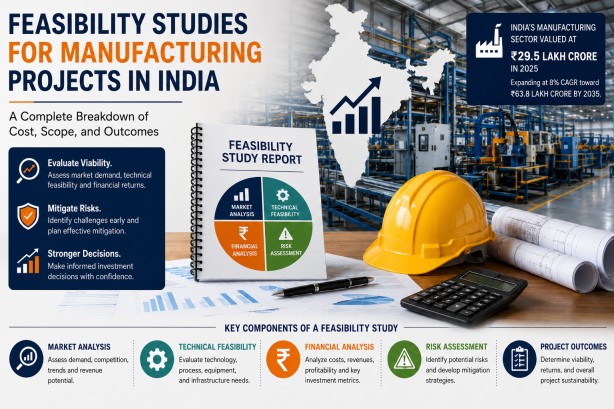
With India’s manufacturing sector valued at ₹29.5 lakh crore in 2025 and expanding at 8% CAGR toward ₹63.8 lakh crore by 2035. the landscape presents substantial opportunities alongside heightened competition. Manufacturing ventures require capital-intensive investments ranging from ₹30 crore for mid-scale operations to over ₹100 crore for specialized facilities, making informed pre-investment analysis non-negotiable. Feasibility studies for manufacturing projects, mitigate financial risk by answering critical questions before money is deployed:
- Is there sufficient market demand for projected production volumes?
- Can raw materials be sourced reliably and competitively in the target region?
- Will infrastructure and regulatory frameworks support operation profitably?
- What is the payback period and debt service coverage ratio for lenders?
According to SIDBI’s 2025 MSME sector analysis, access to finance remains the primary obstacle for 47 percent of manufacturing entrepreneurs. Detailed feasibility reports strengthen loan applications by demonstrating thorough due diligence and realistic financial projections, increasing approval rates from financial institutions.
Key Components of a Comprehensive Feasibility Study
Market Demand and Viability Assessment
Market analysis examines current demand, competitive positioning, and growth potential for the target product category. This section identifies addressable market size, projected consumption trends, and customer segmentation. For manufacturing ventures, market validation determines production volume targets and pricing assumptions underlying financial projections.
India’s manufacturing PMI registered 59.1 in July 2025, the highest level since March 2024 signalling strong industrial activity and new order growth across multiple sectors. This positive momentum validates demand assumptions for facility expansions and new product launches across automotive, electronics, pharmaceuticals, and consumer goods segments.
Technical and Engineering Feasibility
Technical assessment evaluates process technology selection, equipment specifications, facility layout, and production capacity alignment. Engineering teams validate that chosen manufacturing processes deliver required quality standards while optimizing cost per unit. This analysis includes supply chain requirements, utilities infrastructure, environmental compliance, and automation levels:
- Machinery and equipment procurement timeline and cost estimates
- Raw material sourcing strategy and quality assurance protocols
- Energy and water consumption requirements and availability assessment
- Skilled workforce availability and training program design
Financial and Investment Analysis
Financial modelling calculates total project investment, operating costs, revenue projections, and returns using standard investment appraisal metrics. Manufacturing plants in India typically experience upfront capital expenditure ranging from ₹30 crore to ₹60 crore for mid-scale operations, depending on production capacity and technology sophistication. Financial analysis incorporates machinery costs, civil construction, land acquisition, working capital, and contingency reserves.
Investment professionals emphasize critical metrics including Internal Rate of Return (IRR), Net Present Value (NPV), Payback Period, Debt Service Coverage Ratio (DSCR), and Profitability Index. A DSCR exceeding 1.25 is typically required for bank financing approval, ensuring sufficient cash generation to service debt obligations reliably. Monte Carlo simulation and scenario modelling assess financial resilience under varying assumptions for raw material prices, capacity utilization, and market demand.
Critical Investment Appraisal Metrics for Manufacturing Projects
| Metric | Definition | Benchmark Standard |
| IRR | Annual percentage return on invested capital | Above 15% for manufacturing; 20%+ for competitive returns |
| NPV | Present value of future cash flows minus initial investment | Positive NPV at 10% discount rate |
| DSCR | Ratio of annual operating cash flow to debt service | Minimum 1.25x for bank lending approval |
| Payback Period | Years required to recover initial investment | 4-6 years acceptable; shorter preferred |
Risk Assessment and Mitigation Strategies
Manufacturing ventures face structural challenges in India requiring proactive mitigation. The National Manufacturing Mission 2025-26 identifies critical obstacles including inadequate infrastructure, regulatory complexity, and reliance on imported components. Feasibility studies incorporate risk assessment frameworks evaluating technical, financial, market, operational, and regulatory risks.
Infrastructure and Compliance Risks
Infrastructure deficiencies including unreliable power supply, inadequate transportation connectivity, and water scarcity remain significant operational constraints. According to OECD analysis, 31 percent of Indian manufacturing firms report power outages as primary operational obstacles. Feasibility studies evaluate infrastructure adequacy in candidate locations, calculate contingency costs for backup power systems, and validate utility availability for manufacturing operations:
- Power backup systems: Generators and solar installations require ₹50 lakh to ₹2 crore investment depending on facility size
- Water management: Treatment plants and storage facilities to ensure 24/7 supply reliability
- Environmental and regulatory compliance: Mandatory for industrial facility operations
Sensitivity and Scenario Analysis
Sensitivity analysis tests financial model resilience to key assumption variations. Feasibility studies typically stress-test performance across multiple scenarios addressing raw material price fluctuations, market demand variations, and capacity utilization changes. Monte Carlo simulations quantify downside risks and probability distributions for critical financial outcomes.
Standard scenarios in manufacturing feasibility analysis include best-case (95% capacity utilization), base-case (75% utilization), and worst-case (55% utilization) scenarios. A 10 percent variation in raw material costs typically impacts project IRR by 200 to 300 basis points, making procurement strategy critical. Feasibility studies identify key assumptions requiring close monitoring post-commissioning.
Typical Capital Investment Ranges for Manufacturing Plants in India (2025)
| Cost Category | Mid-Scale Plant (30-50k Units/year) | Large-Scale Plant (100k+ Units/year) |
| Land & Civil Works | ₹5-10 crore | ₹12-20 crore |
| Machinery & Equipment | ₹10-15 crore | ₹25-35 crore |
| Working Capital & Contingency | ₹5-7 crore | ₹8-15 crore |
| Total Project Cost | ₹30-60 crore | ₹60-100+ crore |
Government Support and Financing Options
Multiple government schemes reduce financing barriers for manufacturing entrepreneurs. The Production-Linked Incentive (PLI) scheme, active since March 2020, provides capital subsidies and tax benefits encouraging domestic manufacturing across electronics, automobiles, pharmaceuticals, and renewable energy components. The scheme has contributed to exports in mobile phones reaching ₹16,932 crore in 2024, representing 44 percent growth year-over-year.
- Credit-linked Subsidy Scheme (CLSS): 15-35% subsidy on project costs up to ₹50 lakh for manufacturing
- Stand Up India: Bank credit facilitation for women and SC/ST entrepreneurs; total outstanding loans ₹57,466 crore
- National Infrastructure Pipeline: Identified investment of approximately ₹111 lakh crore across infrastructure sectors through FY 2024-25
- SIDBI analysis confirms that MSME financing increased 4.6% in FY 2025-26 through dedicated government funding and enhanced guarantee coverage. Detailed feasibility studies strengthen loan applications by demonstrating realistic financial projections and comprehensive risk mitigation strategies.
Steps to Develop an Effective Feasibility Study
Phase 1: Concept and Scoping
Define project scope, production capacity, target products, and investment parameters. Conduct preliminary market research validating demand assumptions. Identify candidate locations evaluating land availability, infrastructure adequacy, and regulatory environment. This phase typically requires 4-6 weeks and clarifies project viability at a preliminary level.
Phase 2: Detailed Research and Analysis
Conduct comprehensive market studies, competitive analysis, technology evaluation, and process engineering. Collect site-specific data on utilities, land conditions, and regulatory requirements. Prepare detailed engineering designs and equipment specifications. Engage suppliers for cost quotations and delivery timelines. This phase requires 8-12 weeks for thorough completion.
Phase 3: Financial Modelling and Investment Analysis
Develop comprehensive financial models incorporating capital expenditure estimates, operating cost projections, revenue assumptions, and financing structures. Calculate IRR, NPV, DSCR, and payback period across base-case and scenario analyses. Test sensitivity to critical assumptions including capacity utilization, raw material costs, and market prices. Phase duration: 4-6 weeks.
Phase 4: Risk Assessment and Recommendation
Identify technical, financial, operational, and market risks. Develop mitigation strategies for significant risks. Prepare an executive summary and investment recommendation. The final feasibility report includes detailed appendices, financial statements, and supporting analysis. Presentation and stakeholder review typically requires 2-3 weeks.
How IMARC Engineering Can Help with DPR Reports and Feasibility Studies in India
IMARC Engineering provides comprehensive DPR (Detailed Project Report) and feasibility study services for manufacturing, industrial, and infrastructure projects across India. Our experts combine market analysis, technical evaluation, financial modeling, and regulatory assessment to determine project viability and investment potential.
We support greenfield projects, brownfield expansions, capacity enhancement, and diversification initiatives by delivering bankable reports that help secure financing, reduce risks, optimize investments, and support informed decision-making for successful project execution.
Need a DPR or Feasibility Study?
Assess project viability, costs, risks, and returns with IMARC Engineering’s expert advisory services.https://www.imarcengineering.com/contact?service=feasibility-study-business-planning
Key Takeaways
Manufacturing project feasibility studies represent essential investments protecting against substantially larger capital losses. With India’s manufacturing sector expanding and capital requirements reaching ₹30 to ₹100 crore for facility development, comprehensive pre-investment analysis is non-negotiable. Detailed feasibility studies integrating market validation, technical engineering assessment, financial modeling, and risk evaluation provide entrepreneurs and lenders with defensible decision frameworks.
Structured feasibility analysis addresses critical pain points facing manufacturing entrepreneurs: securing bank financing requires a minimum DSCR of 1.25x; validating market demand reduces demand-side risks; identifying infrastructure gaps enables contingency planning; and quantifying financial returns aligns stakeholder expectations. Government support through PLI, CLSS, and other schemes reduces financing barriers when supported by rigorous feasibility documentation.
Manufacturing ventures succeeding over 10-year horizons typically commence with detailed feasibility assessments addressing all project dimensions systematically. The investment in comprehensive pre-project analysis, averaging 0.5 to 1 percent of total project cost yields substantial returns through risk mitigation, improved financing terms, and confident stakeholder execution.
Conclusion: Turning Manufacturing Vision into Bankable Reality
Manufacturing project feasibility studies in India are not just preliminary assessments ,they are strategic tools that convert ideas into viable, investment-ready opportunities. By evaluating technical, financial, and market dynamics, businesses can minimize risks, optimize resource allocation, and ensure regulatory alignment. In a rapidly evolving industrial landscape, a well-executed feasibility study provides the clarity and confidence needed to move forward. Whether you are an entrepreneur or an established manufacturer, investing in feasibility analysis is the first step toward building profitable, scalable, and future-ready manufacturing plants in India.
Contact Us
IMARC Engineering
Phone: +91-120-433-0800
Email: sales@imarcengineering.com
India: C-130, Sector 2, Noida, Uttar Pradesh 201301
LinkedIn: https://www.linkedin.com/showcase/imarc-engineering/
About the Author