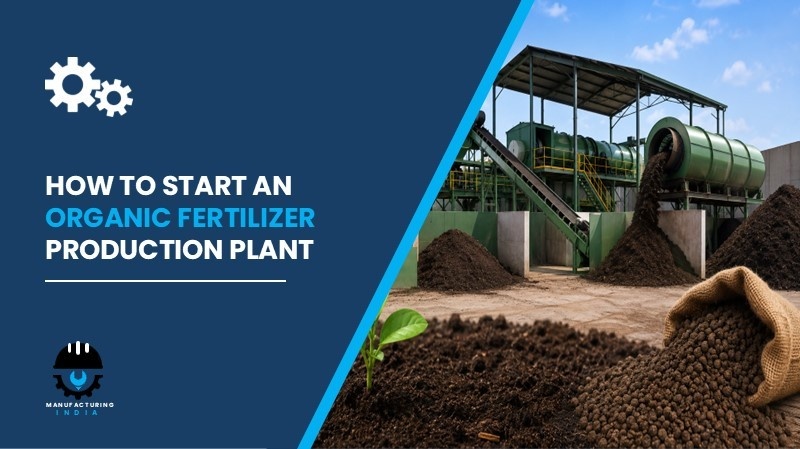
Setting up an organic fertilizer production plant in India presents a compelling investment case driven by the country’s vast agricultural base and the accelerating shift toward sustainable farming. Agriculture, horticulture, landscaping and turf management, and organic food production are all major demand drivers for organic fertilizer, as farmers and agri-businesses seek to move away from chemical-dependent inputs. With soil health degradation emerging as a structural concern across farming regions, and with consumer demand for residue-free food products growing steadily, the market for natural, soil-enriching fertilizers is expanding at a scale that rewards early movers in domestic production.
India’s cost-competitive production environment, large agricultural land base, and progressive policy framework make it a strategically sound location for this investment. States such as Gujarat, Maharashtra, and Uttar Pradesh offer access to agro-industrial corridors with proximity to raw material sources like crop residues and animal waste. The Government of India’s Make in India initiative, combined with national organic farming missions and soil health card programs, creates a clear regulatory and subsidy environment that reduces investor risk. Establishing production domestically also allows manufacturers to serve local agricultural supply chains at lower logistics cost compared to importing finished products.
India’s organic fertilizer sector sits at the intersection of policy support, rising organic food demand, and an urgent national conversation around soil health. With gross margins of 35-45% and a payback window of 3-5 years, this is a financially viable and strategically relevant production investment for 2026 and beyond.
What is Organic Fertilizer?
Organic fertilizers are natural substances derived from plant residues or animals – including manure, compost, bone meal, fish meal, and seaweed – that slowly release nutrients, feeding plants while simultaneously improving soil health. Unlike fast-acting synthetic fertilizers, organic fertilizers are minimally processed, sourced from living organisms, and contribute to long-term soil fertility through decomposition by soil microorganisms. Key properties include the enhancement of microbial activity, improvement of organic carbon content, support for beneficial microorganisms, and gradual nutrient release that reduces leaching and environmental contamination.
The primary production method for organic fertilizer involves composting, vermicomposting, anaerobic digestion, drying, screening, and granulation. End-use industries served include agriculture, horticulture, landscaping and turf management, and organic food production. Applications span soil conditioning, crop nutrient supplementation, support for certified organic farming systems, and home gardening – making this a product with both industrial-scale and consumer-facing demand channels.
Cost of Setting Up an Organic Fertilizer Production Plant in India
The cost of establishing an organic fertilizer production plant depends on plant capacity, technology selection, site location, level of automation, and regulatory compliance requirements. The following sections break down the major cost components.
1. Capital Expenditure (CapEx)
Capital investment for this facility covers several categories.
Land and site development costs include land registration, boundary development, and related site preparation – forming a substantial component of total CapEx. Investors may consider locating within SEZ zones or designated industrial estates to benefit from infrastructure support and potential fiscal advantages.
Civil works and construction cover the production shed, quality control laboratory, raw material storage areas, finished goods warehouse, and administrative block. These must be designed to accommodate future capacity expansion.
Machinery and equipment represent the largest single portion of total capital expenditure. Key machinery required includes:
- Compost turners
- Shredders and crushers
- Fermentation tanks
- Rotary dryers
- Screening machines
- Granulators
- Bagging and packaging units
Other capital costs include effluent treatment plant (ETP) installation, pre-operative expenses, commissioning charges, and quality testing equipment.
Request a Sample Report for In-Depth Market Insights: https://www.imarcgroup.com/organic-fertilizer-manufacturing-plant-project-report/requestsample
2. Operational Expenditure (OpEx)
Raw material cost is the dominant driver of operating expenditure, accounting for approximately 50-60% of total OpEx. Core inputs include agro waste and compost cultures. Securing long-term contracts with reliable, nearby suppliers is essential to managing price volatility and ensuring supply continuity. Sourcing raw materials locally – from agricultural residues and animal waste streams – also supports circular economy principles and reduces procurement logistics costs.
Utility costs, covering electricity, water, and steam, constitute 15-20% of OpEx, reflecting the energy requirements of drying, fermentation, and granulation processes. Other operating costs include transportation, packaging materials, salaries and wages, maintenance, depreciation, and taxes. By the fifth year of operations, total operational costs are projected to increase substantially, driven by inflation, potential rises in key material costs, supply chain shifts, and growth in production volumes.
3. Plant Capacity
The proposed production facility is designed with an annual production capacity ranging between 20,000-50,000 MT, enabling economies of scale while maintaining operational flexibility. This capacity range accommodates both mid-scale market entry and larger-scale production depending on investor requirements. Profitability improves meaningfully at higher capacity utilisation rates, and the plant layout is designed to allow future expansion.
4. Profit Margins and Financial Projections
The project demonstrates healthy profitability potential under normal operating conditions. Gross profit margins typically range between 35-45%, supported by stable demand and value-added applications across agriculture and horticulture. Net profit margins are projected at 15-20%. A full financial analysis – including NPV, IRR, payback period, income and expenditure projections, profit and loss account, and sensitivity analysis – is provided in the complete IMARC project report. Break-even is typically achieved within 3-5 years, depending on production volume, raw material sourcing efficiency, and prevailing market demand conditions.
Why Set Up an Organic Fertilizer Plant in India?
Rising demand for organic food products: Growing consumer preference for organic produce is directly driving demand for certified organic inputs, including fertilizers. As India’s food retail and export segments expand their organic offerings, the requirement for compliant, chemical-free soil inputs creates sustained volume demand for domestic producers.
Soil health restoration imperative: Soil health degradation is a recognised challenge across Indian farming regions. Organic fertilizers address this by enhancing microbial activity and organic carbon content – making them an agronomic necessity, not simply a premium product. This positions organic fertilizer as a structurally demanded input rather than a discretionary purchase.
Favorable government policies: Subsidies, certification programs, and organic farming missions are actively encouraging domestic production. Soil health card programs and restrictions on excessive synthetic fertilizer usage are creating regulatory tailwinds that benefit Indian manufacturers. Internationally, the European Union has set aside 30% of its Common Agricultural Policy budget for its rural growth program to support organic farming – a policy shift that also influences export-oriented Indian producers.
Cost-competitive production: India offers significant advantages in land cost, labour availability, and proximity to agricultural raw material streams. The ability to source agro waste and compost cultures locally reduces both input costs and logistics complexity, supporting competitive unit economics relative to import-dependent alternatives.
Active industry investment: In December 2025, a Russia-Myanmar joint venture broke ground on a new organic fertilizer factory in Naypyidaw, focused on organic and foliar fertilizer production to support agricultural productivity. In March 2025, Nitricity Inc. announced USD 10 million in project funding from Trellis Climate and Elemental Impact to build a first-of-a-kind organic fertilizer facility in California. These global investments reflect accelerating confidence in the sector’s commercial viability.
Utilisation of agricultural waste streams: Organic fertilizer production enables value-added conversion of crop residues and animal manure – feedstocks that are abundantly available across India’s farming states. This supports both circular economy models and cost-efficient raw material sourcing.
Production Process – Step by Step
The organic fertilizer production process uses composting, vermicomposting, anaerobic digestion, drying, screening, and granulation as the primary production methods. The key steps are:
- Collection and sorting of raw materials: Agro waste, compost cultures, and other organic inputs are collected, inspected, and sorted for quality and moisture content.
- Shredding and mixing: Raw materials pass through shredders and crushers to reduce particle size, followed by mixing to achieve a homogeneous feedstock blend.
- Composting or fermentation: Material undergoes controlled composting or anaerobic fermentation in fermentation tanks, enabling microbial breakdown and nutrient stabilisation.
- Curing and drying: Fermented material is cured and then processed through rotary dryers to achieve target moisture levels required for downstream processing.
- Screening: Screening machines remove oversized particles and contaminants, ensuring uniform particle size distribution.
- Granulation: Granulators form the processed material into pellet or granule form for ease of application and packaging.
- Packaging and dispatch: Bagging and packaging units prepare the finished product for storage and dispatch to agriculture, horticulture, landscaping, and organic food production end-users.
Key Applications
Organic fertilizer serves a broad set of industries, each with specific agronomic requirements:
- Agriculture: Enhances soil organic matter, improves nutrient availability, and supports sustainable crop yields across grain, pulse, and vegetable cultivation.
- Horticulture: Applied to fruits, vegetables, and ornamental plants to improve root development and plant vitality.
- Landscaping and Turf Management: Used in lawns, parks, and golf courses for sustained nutrient release and soil structure improvement.
- Organic Food Production: Supports certified organic farming by complying with chemical-free input requirements for domestic and export markets.
Leading Manufacturers
The global organic fertilizer market includes several established multinational and regional producers with significant production capacities. Key players operating in this space include:
- PT Pupuk Kalimantan Timur
- Lallemand Inc.
- T Stanes & Company Limited
- Madras Fertilizers Limited
- Cropmate Fertilizers Sdn Bhd
- Midwestern BioAg
- Biostar Renewables, LLC
- NatureSafe
- Biolchim Spa
Timeline to Start the Plant
- Feasibility study and project report preparation
- Land acquisition and site development
- Regulatory approvals and environmental clearances
- Factory licence and fire safety compliance
- Machinery procurement and installation
- Raw material supplier agreements and supply chain setup
- Trial production and quality testing
- Commercial production launch
Licences and Regulatory Requirements
Starting an organic fertilizer production unit in India requires several approvals:
- Business registration (Proprietorship, LLP, or Pvt Ltd)
- Factory Licence under the Factories Act
- Environmental Clearance from State Pollution Control Board
- GST Registration
- Fire Safety NOC
- Effluent Treatment Plant (ETP) operational clearance
- Occupational Health and Safety compliance
Key Challenges to Consider
High Capital Requirements: Establishing a plant in the 20,000-50,000 MT capacity range requires significant upfront investment across land, civil construction, and machinery – particularly compost turners, fermentation tanks, and granulation systems. Securing appropriate financing structures is essential from the outset.
Raw Material Price Volatility: The primary inputs – agro waste and compost cultures – are subject to seasonal availability and pricing shifts driven by agricultural cycles, weather patterns, and competing demand from other waste-processing sectors. Long-term supplier contracts help mitigate this risk.
Regulatory Compliance: Environmental clearances, ETP operational requirements, and certification for organic farming compliance add layers of procedural complexity. Delays in approvals can extend project timelines beyond the typical 12-18 months.
Competition: The presence of established global producers such as T Stanes & Company Limited, Madras Fertilizers Limited, and Lallemand Inc. means that new entrants must differentiate on quality, distribution reach, or cost efficiency to capture meaningful market share.
Skilled Manpower: Operating composting infrastructure, fermentation tanks, and quality control systems requires trained technical personnel. Recruiting and retaining skilled workers in processing and quality assurance roles is a recurring operational challenge.
Frequently Asked Questions
1. How much does it cost to set up an organic fertilizer production plant in India?
Total capital investment depends on plant capacity (20,000-50,000 MT per year), location, technology, and automation level. Costs cover land acquisition, civil construction, machinery, utilities, and pre-operative expenses. A detailed CapEx breakdown is available in the IMARC project report.
2. Is organic fertilizer production profitable in India in 2026?
Yes. The project demonstrates gross profit margins of 35-45% and net profit margins of 15-20% under normal operating conditions. Profitability improves with higher capacity utilisation and efficient raw material sourcing.
3. What machinery is required for an organic fertilizer plant in India?
Key machinery includes compost turners, shredders and crushers, fermentation tanks, rotary dryers, screening machines, granulators, and bagging and packaging units.
4. What licences and approvals are required to start an organic fertilizer plant in India?
Required approvals include business registration, Factory Licence under the Factories Act, Environmental Clearance from the State Pollution Control Board, GST Registration, Fire Safety NOC, and ETP operational clearance.
5. What raw materials are needed for organic fertilizer production?
Core raw materials include agro waste and compost cultures, along with plant residues, manure, bone meal, fish meal, seaweed, and mineral additives derived from natural organic sources.
6. What are the environmental compliance requirements for an organic fertilizer plant in India?
Compliance requirements include Environmental Clearance from the State Pollution Control Board, operation of an Effluent Treatment Plant, and adherence to emission standards. Advanced monitoring systems to detect process deviations are also required.
7. What is the best location to set up an organic fertilizer plant in India?
The site should offer easy access to agro waste and compost cultures, proximity to target agricultural markets, reliable transportation and utility infrastructure, and compliance with local zoning and environmental regulations.
8. What is the break-even period for this type of plant in India?
Break-even typically ranges from 3 to 5 years, depending on production volume, raw material costs, local demand, and available government incentives for sustainable agriculture.
9. What government incentives are available for manufacturers in India?
Governments may offer capital subsidies, tax exemptions, reduced utility tariffs, export benefits, and interest subsidies under national and regional industrial and organic farming policies.
Key Takeaways for Investors
The organic fertilizer production plant opportunity in India is underpinned by durable demand from agriculture, horticulture, landscaping, and organic food production – sectors that are growing in both scale and policy priority. Financial viability is strong across the 20,000-50,000 MT capacity range, with gross margins of 35-45% and a net margin of 15-20% making this a commercially attractive project at multiple investment scales. The global organic fertilizer market was valued at USD 7.78 Billion in 2025 and is projected to reach USD 16.75 Billion by 2034, representing a CAGR of 8.9% from 2026 to 2034 – a trajectory that reflects sustained demand growth well beyond the plant’s initial payback horizon. For investors seeking a defensible, policy-supported, and agronomically essential production opportunity in India, organic fertilizer production offers a compelling combination of margin, scale, and long-term demand sustainability.
About the Author