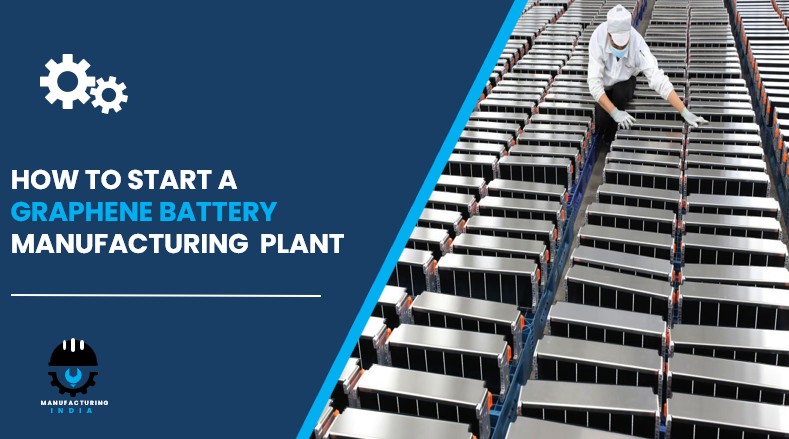
Setting up a graphene battery manufacturing plant in India represents a transformative investment opportunity driven by the accelerating global transition to clean energy, surging demand for next-generation energy storage solutions, and rapid technological advancement in graphene-enhanced battery technologies. As electric vehicles, renewable energy storage, and high-performance consumer electronics become mainstream, graphene batteries with their superior charge speeds, higher energy density, extended cycle life, and enhanced thermal safety have emerged as the defining technology for the next generation of energy storage. This growth trajectory, combined with expanding end-use sectors such as electric vehicles, grid-scale energy storage, consumer electronics, aerospace, and industrial applications, creates a highly favourable environment for new graphene battery manufacturing entrants.
What is a Graphene Battery?
A graphene battery is an advanced energy storage device that incorporates graphene a single-layer carbon lattice of extraordinary conductivity, strength, and surface area as a functional material within the electrode or electrolyte architecture. Graphene is applied as a conductive additive, a standalone anode material, or a structural coating on cathode particles to enhance electron transport, reduce internal resistance, and increase charge-discharge efficiency. Compared to conventional lithium-ion batteries, graphene batteries offer substantially faster charging rates, higher energy density, superior thermal management, and significantly longer cycle life making them the preferred technology for demanding applications in electric mobility, grid storage, and high-performance electronics. The technology is advancing rapidly from R&D to commercial-scale production, with leading manufacturers deploying graphene battery platforms in electric vehicles, energy storage systems, and consumer devices globally.
Cost of Setting Up a Graphene Battery Manufacturing Plant
The total cost of establishing a graphene battery manufacturing plant is shaped by several key parameters: production capacity (measured in GWh), technology platform (graphene-enhanced lithium-ion, graphene-based solid-state, or hybrid supercapacitor-battery), automation level, facility specification, raw material sourcing strategy, and applicable regulatory and environmental compliance requirements. Below is a structured breakdown of all major cost components.
1. Capital Expenditure (CapEx)
Total capital investment in a graphene battery manufacturing plant covers the following major heads:
Land and Site Development
This includes land acquisition or lease, site preparation, boundary development, land registration, and utilities connectivity. Site selection should prioritize proximity to graphene material suppliers and precursor chemical distributors, lithium and cathode active material sources, and specialized battery-grade packaging material vendors. Reliable high-capacity power infrastructure with backup systems, advanced thermal management and HVAC utilities, strong logistics corridors for both inbound raw materials and outbound finished goods, and access to a skilled electrochemical engineering and battery manufacturing workforce are critical selection criteria. Compliance with industrial zoning regulations, battery manufacturing standards, hazardous material handling requirements, and environmental regulations is essential from the outset.
Civil Works and Construction
Building costs encompass the main production facility including electrode fabrication zones, graphene processing and dispersion units, cell assembly cleanrooms (dry room conditions with dew point control), electrolyte filling stations, formation cycling areas, aging chambers, finished goods storage and dispatch facilities, quality control and electrochemical testing laboratories, administrative block, utility infrastructure (HVAC, dry room systems, water treatment, compressed air, nitrogen supply), and worker amenities. Construction must comply with applicable battery manufacturing facility standards, hazardous materials storage regulations, Good Manufacturing Practice (GMP) requirements, and environmental compliance frameworks.
Machinery and Equipment
Machinery represents the single largest component of CapEx. Key equipment required for a graphene battery manufacturing plant includes:
- Graphene Processing and Dispersion Equipment (for production of battery-grade graphene dispersions, graphene oxide reduction, and slurry preparation)
- Electrode Slurry Mixing Systems (high-shear planetary mixers and vacuum dispersers for anode and cathode slurry homogenization)
- Electrode Coating Lines (precision slot-die or comma-bar coating systems for electrode active material deposition on current collector foils)
- Calendering Machines (for electrode compression and porosity optimization to target energy density and rate capability specifications)
- Electrode Slitting and Notching Equipment (precision slitting lines and laser notching systems for electrode sheet dimensioning)
- Dry Room Cell Assembly Lines (winding or stacking machines, tab welding systems, and can or pouch sealing equipment under controlled dry room conditions)
- Electrolyte Filling and Vacuum Impregnation Systems (precision electrolyte dosing and vacuum impregnation units for cell filling under dry room conditions)
- Formation Cycling and Aging Systems (high-channel battery formation cyclers and temperature-controlled aging chambers for cell conditioning)
- Cell Testing and Grading Equipment (high-precision impedance analyzers, capacity testing systems, and automated sorting and grading lines)
- Module and Pack Assembly Lines (automated module stacking, busbar welding, BMS integration, and pack enclosure assembly systems)
- Quality Control and Characterization Equipment (SEM/TEM for graphene characterization, electrochemical workstations, X-ray inspection systems, and cycle life testing chambers)
- Material Handling Equipment (automated guided vehicles, cleanroom-compatible conveyors, and controlled atmosphere storage systems)
Other Capital Costs
These include pre-operative expenses, commissioning charges, import duties on specialized dry room and battery formation equipment, staff training costs, initial raw material and consumable inventory for commissioning, regulatory compliance setup including battery product certification, UN 38.3 transport testing, and quality system establishment costs.
Request a Sample Report for In-Depth Market Insights: https://www.imarcgroup.com/graphene-battery-manufacturing-plant-project-report/requestsample
2. Operational Expenditure (OpEx)
Raw materials principally graphene (produced or procured), lithium compounds (lithium carbonate or lithium hydroxide), cathode active materials (NMC, LFP, or NCA), anode materials, electrolyte solutions, separator films, current collector foils, and cell housing components constitute the dominant operating cost, typically representing 50–60% of total OpEx. Utility costs, driven primarily by dry room HVAC systems, formation cycling equipment, aging chambers, and environmental monitoring, account for 15–25% of OpEx. Labor, maintenance, quality control, packaging, transportation, and overhead costs constitute the remainder of the operating cost base.
3. Plant Capacity
The proposed graphene battery manufacturing facility is designed with an annual production capacity ranging between 10–20 GWh, enabling economies of scale while maintaining operational flexibility. This capacity supports a diversified product portfolio of graphene-enhanced lithium-ion cells, graphene-based battery modules, and battery pack assemblies across electric vehicle, stationary energy storage, and consumer electronics end-use segments.
4. Profit Margins and Financial Projections
The project demonstrates strong profitability under normal operating conditions. Financial projections should encompass capital investment, operating costs, capacity ramp-up schedule, pricing strategy by product tier (standard graphene-enhanced cells vs. premium high-performance modules), and forward demand outlook. A comprehensive analysis should include sensitivity analysis, Net Present Value (NPV), Internal Rate of Return (IRR), and Payback Period calculations. Gross margins for graphene battery manufacturing typically range from 40–55%, supported by the premium performance characteristics of the product and the rapidly expanding addressable market. Net profit margins of 15–30% are achievable with disciplined cost management and optimal capacity utilization.
Why Set Up a Graphene Battery Manufacturing Plant?
Next-Generation Energy Storage Leadership
Graphene batteries represent the most advanced commercially viable energy storage technology available today, offering faster charging, higher energy density, longer cycle life, and superior thermal safety compared to conventional lithium-ion cells. As electric vehicles, grid-scale renewable energy storage, and high-performance consumer devices demand increasingly capable battery solutions, graphene battery manufacturers are positioned at the technology frontier of a structurally growing global energy transition market worth hundreds of billions of dollars annually.
Electric Vehicle Market Supercycle
Global electric vehicle adoption is accelerating at an unprecedented pace, with major economies mandating the phase-out of internal combustion engine vehicles and automotive manufacturers committing to fully electric product lines within this decade. Graphene-enhanced battery technologies directly address the primary consumer concerns about EV adoption range anxiety, charging speed, and long-term battery degradation creating strong pull demand from automotive OEMs seeking differentiated battery technology platforms. The EV battery market represents the single largest growth opportunity for graphene battery manufacturers globally.
Renewable Energy Storage Imperative
The global transition to solar and wind power generation creates massive demand for grid-scale energy storage systems capable of storing intermittent renewable energy and delivering stable power on demand. Graphene batteries offer superior cycle life, faster response times, and improved thermal stability compared to conventional lithium-ion alternatives for stationary storage applications. Government renewable energy targets, grid modernization programs, and corporate sustainability commitments across all major economies are driving sustained demand for advanced battery storage solutions across utility, commercial, and industrial segments.
Superior Performance Driving Premium Pricing
Graphene batteries command significant price premiums over standard lithium-ion equivalents in performance-critical applications due to their superior charge-discharge rates, extended cycle life exceeding 3,000–5,000 cycles, and enhanced safety characteristics. These premium performance attributes support gross margins of 40–55% at commercial scale, substantially superior to conventional lithium-ion cell manufacturing margins and create strong financial justification for investment in graphene battery manufacturing capabilities.
Supply Chain Localization and Energy Security
Governments and industrial energy users are increasingly prioritizing domestic battery manufacturing capabilities to ensure energy storage supply chain security, reduce import dependency, and maintain strategic control over critical energy infrastructure. This localization trend is creating structural opportunities for domestic graphene battery producers with strong technology platforms, quality management systems, and reliable supply chain management, particularly in markets currently dependent on imported battery cells from a limited number of Asian manufacturers.
Consumer Electronics and Portable Device Demand
The global consumer electronics market is undergoing a rapid upgrade cycle driven by demand for smartphones, laptops, wearables, and portable power tools with longer battery life, faster charging, and lighter form factors. Graphene batteries directly address these performance requirements, enabling manufacturers to differentiate premium product tiers with measurably superior battery performance. The consumer electronics segment provides near-term revenue opportunities for graphene battery producers ahead of full-scale EV and grid storage commercial deployments.
Aerospace, Defence, and Industrial Applications
High-performance aerospace, defence, and industrial applications require battery solutions that operate reliably under extreme temperature conditions, deliver high power density on demand, and maintain performance across thousands of cycles. Graphene batteries meet these demanding specifications, creating opportunities in unmanned aerial vehicles (UAVs), military electronics, industrial robotics, and specialized power tool applications that command premium prices and strong margins independent of consumer market cycles.
Manufacturing Process Overview
The graphene battery manufacturing process is a precision electrochemical fabrication operation that transforms graphene materials, lithium compounds, and cell components into high-performance battery cells, modules, and packs through controlled electrode processing, cell assembly, formation cycling, and quality testing operations. The key process stages are:
- Graphene Material Processing: Battery-grade graphene is produced through chemical vapour deposition, liquid-phase exfoliation, or graphene oxide reduction processes, followed by dispersion in NMP or aqueous carrier solvents to produce homogeneous graphene slurries for electrode formulation.
- Electrode Slurry Preparation: Anode slurries (graphene-enhanced graphite, silicon-graphene composite, or pure graphene) and cathode slurries (graphene-coated NMC, LFP, or NCA) are prepared in planetary mixers with binders (PVDF or SBR/CMC) and conductive additives under controlled temperature and atmosphere conditions.
- Electrode Coating and Drying: Electrode slurries are precision-coated onto current collector foils (copper for anode, aluminium for cathode) using slot-die coating systems, followed by infrared and convection drying to produce uniform electrode sheets with controlled active material loading.
- Calendering and Slitting: Dried electrode sheets are calendered to target porosity and density specifications, then precision-slit to cell-specific dimensions. Laser notching systems create tab structures for current collection.
- Cell Assembly (Dry Room): Under controlled dry room conditions (dew point below -40°C), electrode sheets and separators are wound (cylindrical cells) or stacked (prismatic or pouch cells), tabs are ultrasonically welded to current collectors, and cells are inserted into housings (can or pouch) and sealed.
- Electrolyte Filling and Sealing: Cells receive precision-dosed electrolyte filling under dry room conditions, followed by vacuum impregnation for complete electrode wetting, final sealing, and pre-formation degassing.
- Formation Cycling: Each cell undergoes controlled initial charge-discharge formation cycling to develop the solid electrolyte interphase (SEI) layer and activate full electrochemical capacity. Formation protocols are optimized for graphene-enhanced electrode chemistries.
- Aging and Testing: Formed cells undergo temperature-controlled aging for internal short circuit screening, followed by comprehensive electrical testing including capacity, impedance, rate capability, and self-discharge measurements. Automated grading systems sort cells to performance tier specifications.
- Module and Pack Assembly: Grade-sorted cells are assembled into battery modules with structural frames, thermal management components, and busbar connections, then integrated into battery packs with Battery Management Systems (BMS), thermal management systems, and structural enclosures.
- Quality Control and Traceability: Comprehensive inline and end-of-line quality testing systems, including X-ray inspection for internal defect detection and full electrochemical characterization, ensure product quality. Serialization and traceability systems maintain complete production records from raw materials to finished packs.
Key Applications of Graphene Battery
The graphene battery market serves several major end-use segments across energy, mobility, and electronics sectors. Electric vehicles represent the largest and highest-growth application segment, with graphene batteries enabling faster charging, extended range, and longer operational life for passenger EVs, commercial electric trucks, electric buses, and two-wheelers. Grid-scale stationary energy storage systems for solar and wind power integration represent the second major application, utilizing graphene batteries for frequency regulation, peak shaving, and renewable energy dispatch services. Consumer electronics applications encompass smartphones, laptops, tablets, wearables, and wireless earbuds requiring compact, fast-charging, and long-lasting power solutions. Power tools and industrial portable equipment deploy graphene batteries for high-current applications requiring sustained performance under demanding duty cycles. Aerospace and defence applications include UAV propulsion systems, military communications equipment, and advanced avionics requiring high energy density and extreme-condition reliability. Emerging applications encompass medical devices, electric aircraft, marine electrification, and advanced robotics platforms requiring next-generation battery performance.
Global Graphene Battery Market Outlook
The global graphene battery market size was valued at USD 166.48 Billion in 2025. According to IMARC Group estimates, the market is expected to reach USD 912.59 Billion by 2034, exhibiting a CAGR of 20.8% from 2026 to 2034. Globally, the graphene battery market benefits from multiple structural demand drivers:
- Accelerating global electrification of transportation, with over 30 major economies committing to internal combustion engine phase-out timelines by 2035–2040
- Explosive growth in renewable energy installations driving demand for gigawatt-scale energy storage systems globally
- Rapid technology maturation of graphene battery platforms reducing manufacturing costs and enabling commercial-scale production across cell formats
- Rising consumer electronics performance expectations driving adoption of graphene batteries in premium device tiers
- Government industrial policy, battery manufacturing incentives, and domestic supply chain development programs across the US, EU, India, and Southeast Asia
- Asia-Pacific expected to remain the dominant production and consumption region, with India, China, South Korea, and Japan representing major market opportunities
Major global players in the graphene battery industry include Samsung SDI, CATL, Panasonic, LG Energy Solution, and emerging specialist graphene battery developers, serving EV, stationary storage, consumer electronics, and industrial end-use sectors across all major markets.
Licenses and Regulatory Requirements
Establishing a graphene battery manufacturing unit requires a range of approvals and certifications, which may vary by country and jurisdiction, including:
- Business registration and company incorporation
- Factory License under applicable labor and manufacturing laws
- Battery Manufacturing License and hazardous materials handling permits under applicable national chemical and battery regulations
- UN 38.3 Transportation Testing Certification for lithium battery transport compliance
- ISO 9001:2015 Quality Management System Certification
- IEC 62133 Safety Standard Certification for portable sealed lithium secondary cells
- IEC 62619 Safety Standard Certification for stationary lithium secondary battery applications
- Pollution Control Board Clearances Consent to Establish (CTE) and Consent to Operate (CTO) for battery manufacturing with chemical handling
- Fire Safety Certificate and NOC from local fire authority (mandatory for battery manufacturing facilities)
- ISO 14001 Environmental Management System Certification for hazardous waste and chemical management
- CE Marking (for European market access) and UL Certification (for North American market access)
- Export-Import Code (IEC) for international market access
- Electrical Inspector Approval for high-capacity formation cycling and testing equipment installations
- Occupational Health and Safety management compliance (ISO 45001) with specific provisions for dry room operations and lithium chemical handling
Key Challenges to Consider
Graphene Raw Material Sourcing and Quality Consistency
Battery-grade graphene production requires consistent quality in terms of layer count, lateral flake size, defect density, and surface chemistry to deliver reproducible electrochemical performance across production batches. The global graphene supply chain is still maturing, with limited numbers of producers capable of supplying battery-grade graphene at commercial scale with the consistency required for mass production. Managing graphene material specifications, supplier qualification, incoming quality control, and batch-to-batch performance consistency represents a critical operational challenge for graphene battery manufacturers at scale.
Dry Room Manufacturing Infrastructure
Graphene battery manufacturing requires dry room production environments with dew point control below -40°C to -50°C to prevent moisture contamination of lithium-reactive cell components and electrolytes. Dry room construction, HVAC systems, moisture monitoring, and personnel entry-exit protocols represent significant capital and operational cost drivers, and require specialized engineering expertise to design, construct, and maintain at production scale. Any compromise in dry room integrity during cell assembly or electrolyte filling operations creates latent quality and safety risks.
Technology Maturity and Scale-Up Risk
While graphene battery technology has demonstrated compelling performance at cell and prototype levels, scaling from laboratory to gigawatt-scale commercial production introduces significant process engineering challenges including electrode coating uniformity at high line speeds, graphene dispersion homogeneity in large-batch slurry preparation, formation cycling optimization for graphene-enhanced electrode chemistries, and yield management across the multi-stage manufacturing process. Managing technology scale-up risk requires substantial R&D investment, close collaboration with equipment suppliers, and disciplined process qualification protocols.
Intellectual Property and Technology Access
Key graphene battery technologies including graphene synthesis processes, electrode formulation compositions, electrolyte compatibility solutions, and BMS algorithms are protected by extensive and growing patent portfolios held by established manufacturers and research institutions. New entrants must carefully navigate freedom-to-operate analysis, develop proprietary technology platforms, or license core technologies to avoid infringement, which may require significant R&D investment, technology licensing costs, or both. Technology partnership agreements with research universities or established battery manufacturers can provide valuable IP access while sharing development risk.
Customer Qualification and Automotive OEM Certification
Automotive OEMs and tier-1 battery system integrators subject new battery cell suppliers to rigorous multi-year qualification programs encompassing electrochemical performance validation, abuse tolerance testing (nail penetration, overcharge, thermal runaway), aging and cycle life studies, and quality management system audits. Achieving approved supplier status with major automotive OEMs typically requires 24–36 months from initial sample submission to series production authorization. Government and utility customers for stationary storage applications impose similarly rigorous performance demonstration and bankability requirements.
Lithium Supply Chain and Battery Material Cost Volatility
Graphene battery manufacturing depends on lithium compounds, cathode active materials (NMC, LFP, NCA), and electrolyte solvents sourced from globally concentrated supply chains subject to price volatility and geopolitical disruption risk. Lithium carbonate and lithium hydroxide prices have demonstrated extreme volatility over recent years, directly impacting battery cell production economics. Long-term raw material supply agreements, strategic inventory management, and active supplier diversification strategies are essential for managing input cost volatility and ensuring production continuity.
Frequently Asked Questions (FAQs)
1. How much does it cost to set up a graphene battery manufacturing plant?
The investment depends on plant capacity (10–20 GWh per annum), technology platform (graphene-enhanced lithium-ion, solid-state hybrid, or supercapacitor integration), automation level, dry room specification, and location. Costs cover land, civil construction (dry room assembly, formation cycling, aging, testing facilities, storage, utilities), machinery (electrode coating lines, calendaring systems, dry room assembly equipment, formation cyclers, testing and grading systems), quality systems, working capital, and regulatory compliance. A comprehensive feasibility study from IMARC Group provides detailed, capacity-specific cost estimates covering all CapEx and OpEx components.
2. Is graphene battery manufacturing a profitable business in 2026?
Yes. Strong and structurally growing demand from electric vehicles, grid-scale energy storage, consumer electronics, and aerospace applications, combined with gross margins of 40–55% and net profit margins of 15–30%, makes graphene battery manufacturing financially attractive. The technology premium commanded by graphene-enhanced cells over conventional lithium-ion equivalents supports superior pricing power and margin sustainability. Break-even periods of 4–7 years are achievable with disciplined capacity ramp-up, strong technology and quality management, and targeted market development in high-value EV and storage applications.
3. What machinery and equipment are required for a graphene battery manufacturing plant?
Key equipment includes graphene processing and dispersion systems, electrode slurry planetary mixers, precision slot-die electrode coating lines, calendering machines, electrode slitting and laser notching systems, dry room cell assembly lines (winding or stacking machines, tab welding, sealing systems), electrolyte filling and vacuum impregnation units, formation cycling systems with high-channel battery cyclers, aging chambers, cell testing and grading equipment, module and pack assembly lines, and comprehensive quality control characterization instruments. Dry room HVAC systems and environmental monitoring equipment are essential infrastructure investments.
4. What licenses and approvals are required?
Required approvals generally include company registration, factory license, battery manufacturing and hazardous materials handling permits, UN 38.3 transportation certification, IEC 62133 and IEC 62619 safety certifications, ISO 9001 quality management certification, Pollution Control Board clearances, fire safety NOC (mandatory for battery manufacturing), and applicable export market certifications (CE marking for Europe, UL for North America). Battery product certification dossier preparation and electrochemical safety testing are mandatory for commercial launch authorization across all major markets.
5. How long does it take to commission a graphene battery manufacturing plant?
Typically, 24–36 months from project initiation to commercial production launch, depending on project scale, dry room and electrode coating equipment procurement lead times, civil construction timeline, formation cycling system commissioning, regulatory approvals, product certification timelines, and customer qualification requirements for key automotive or storage OEM accounts. Automotive OEM qualification timelines are a critical path item and should be initiated as early as possible, as they typically require 24–36 months from initial sample to series supply authorization.
6. What are the key raw materials for graphene battery manufacturing?
Primary raw materials and components include battery-grade graphene (produced or procured), lithium compounds (lithium carbonate or lithium hydroxide), cathode active materials (NMC, LFP, or NCA), anode materials (graphene-enhanced graphite, silicon-graphene composites, or graphene anodes), electrolyte solvents and lithium salts (LiPF6), separator films (ceramic-coated polyolefin), current collector foils (copper and aluminium), cell housing components (cylindrical cans, prismatic cases, or pouch films), and battery management system (BMS) electronics for module and pack integration.
7. What is the break-even period for a graphene battery manufacturing plant?
The break-even period generally ranges from 4–7 years for well-positioned plants, depending on capacity utilization ramp-up, product mix between EV, stationary storage, and consumer electronics applications, operating efficiency, raw material cost management, and market demand development trajectory. Securing long-term supply agreements with automotive OEMs or utility-scale storage developers significantly improves revenue predictability and accelerates break-even achievement.
8. What are the main types of graphene battery products and their applications?
The primary categories include graphene-enhanced cylindrical lithium-ion cells (for consumer electronics and EV applications), graphene-enhanced prismatic cells (for EV battery modules and stationary storage systems), graphene-based pouch cells (for premium consumer electronics and high-performance EV applications), and battery modules and packs incorporating graphene cells with integrated BMS, thermal management, and structural systems for EV and stationary storage deployment. Each product type serves distinct market segments with different energy density, power density, cycle life, and form factor specifications.
9. What government incentives are available for graphene battery manufacturers?
Manufacturers may benefit from Production Linked Incentive (PLI) schemes for advanced chemistry cell battery manufacturing in India, National Advanced Chemistry Cell (ACC) battery storage program incentives, state industrial investment incentives and capital subsidies for battery manufacturing facilities, infrastructure support in designated battery manufacturing zones, export promotion benefits for internationally certified products, technology upgrade fund schemes, and R&D tax credits for graphene battery technology development programs. Domestic production of graphene batteries aligns directly with energy security, clean energy transition, and advanced manufacturing objectives across all major economies.
10. How does graphene battery manufacturing compare to conventional lithium-ion cell manufacturing in terms of setup?
Compared to conventional lithium-ion cell manufacturing, graphene battery production requires additional graphene material processing capabilities, more sophisticated electrode slurry formulation expertise, and specialized dry room process controls optimized for graphene-enhanced electrode chemistries. Formation cycling protocols and quality characterization requirements for graphene cells are more demanding than for standard lithium-ion cells. However, graphene batteries command significant price premiums (20–40% over equivalent conventional cells) and superior gross margins (40–55% vs. 20–35% for standard lithium-ion), reflecting the performance value-add and technology differentiation. The manufacturing infrastructure supports multiple graphene battery cell formats and chemistries from the same platform, enabling product portfolio diversification as technology matures and market applications expand.
Key Takeaways for Investors
The graphene battery manufacturing industry represents a high growth, technologically differentiated, and financially compelling investment opportunity positioned at the intersection of global energy transition, electric mobility, and advanced materials technology. Key investment highlights include, the industry benefits from diversified demand across electric vehicles, grid-scale energy storage, consumer electronics, aerospace, and industrial applications, providing resilience against single-sector demand volatility and multiple routes to revenue scale. Graphene batteries command substantial price premiums and superior margins over conventional lithium-ion equivalents, reflecting their measurable performance advantages in charge speed, energy density, cycle life, and thermal safety delivering a compelling financial case for technology investment. Long-term growth is supported by structural drivers including the global EV adoption Supercycle, renewable energy storage mandates, consumer electronics performance escalation, and government battery manufacturing incentive programs across all major economies. India represents a particularly compelling manufacturing and supply base, combining large and growing domestic EV and energy storage demand, strong policy support through PLI and ACC schemes, cost-competitive production economics, and strategic positioning for export market competitiveness in Asian and global supply chains.
About the Author