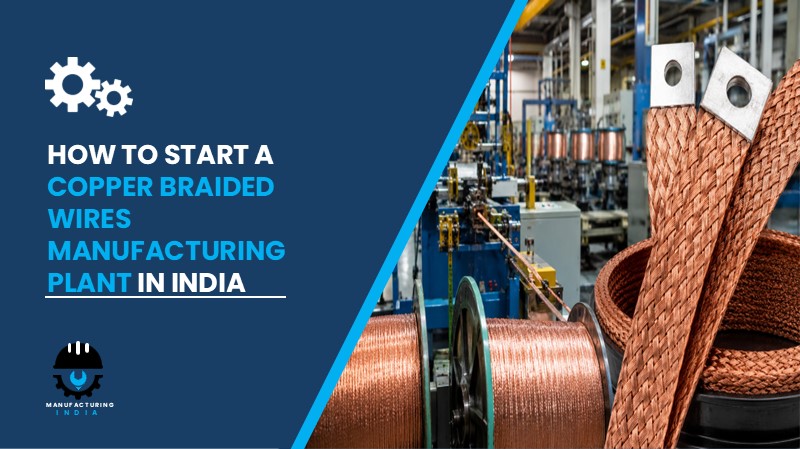
Setting up a copper braided wires manufacturing plant in India presents a compelling investment case, backed by sustained demand from electrical and electronics, automotive wiring harnesses, industrial machinery, power distribution, and renewable energy systems. These flexible copper conductors are critical to India’s economy, enabling safe, vibration-resistant electrical connections in grounding systems, EV battery interconnections, and the grid infrastructure underpinning electrification.
India’s expanding urbanisation, infrastructure growth, and the Make in India initiative create a favourable backdrop for this production segment, particularly across manufacturing-friendly states such as Gujarat and Maharashtra, where metal processing clusters and port access already exist. With rising EV production, grid modernisation, and renewable energy installations driving conductor demand, India is strategically positioned for copper braided wires manufacturing.
With policy support for domestic manufacturing, cost-competitive land and labour, and strong demand from automotive, electronics, and power distribution sectors, a copper braided wires manufacturing plant offers gross margins of 12–20% and net margins of 5–10%, making break-even achievable within a reasonable investment horizon.
What is Copper Braided Wires?
Copper braided wires are flexible electrical conductors produced by interlacing multiple fine copper strands into a tubular, flat, or rope-like braided structure. They are manufactured using high-purity electrolytic tough pitch (ETP) copper or oxygen-free (OFHC) copper, giving excellent electrical conductivity, minimal signal loss, and superior thermal performance. The braided architecture provides outstanding mechanical flexibility, fatigue resistance, and vibration absorption, and the conductors also exhibit low impedance, high current-carrying capability, and effective electromagnetic shielding. A copper braided wires manufacturing plant typically produces several variants, including tin-plated, nickel-plated, and silver-plated braids for added corrosion resistance. The production process combines wire drawing, annealing, and braiding, and the finished conductors serve electrical and electronics, automotive wiring harnesses, industrial machinery, power distribution, and renewable energy applications. This copper braided wires manufacturing process includes quality testing at each stage to maintain consistent conductivity and braid density.
Cost of Setting Up a Copper Braided Wires Manufacturing Plant in India
The cost of setting up the plant depends on capacity, technology, location, automation level, and regulatory compliance requirements.
1. Capital Expenditure (CapEx)
Land and site development form a substantial part of the overall investment, covering land registration, boundary development, and site preparation; SEZs and industrial estates can reduce acquisition timelines with infrastructure-ready plots. Civil works cover the production shed, testing laboratory, storage areas, utility zone, and the administrative and safety block. Machinery costs account for the largest share of capital expenditure in the facility. Key machinery required includes:
- Multi-draw wire drawing machines
- Annealing furnaces
- Stranding and bunching machines
- High-speed braiding machines
- Surface treatment units for tin, nickel, or silver plating
- Cutting and shaping equipment
- Quality testing and inspection instruments
- Packaging and spooling equipment
- Utility systems, including power supply, compressors, and cooling units
- Scrap collection and recycling unit
Other capital costs include effluent treatment plant (ETP) installation, pre-operative expenses, commissioning charges, and import duties on specialised machinery.
Request a Sample Report for In-Depth Market Insights: https://www.imarcgroup.com/copper-braided-wires-manufacturing-plant-project-report/requestsample
2. Operational Expenditure (OpEx)
Raw material cost is the largest component of operating expenditure, accounting for 75-85% of total OpEx. The primary raw material is electrolytic copper wire rod, often sourced as ETP copper wire rod, along with plating consumables for tin, nickel, or silver surface treatment. Investors should pursue long-term supplier contracts to hedge against copper price volatility. Utility cost, covering electricity, water, and compressed air, accounts for 4-7% of OpEx. Other operating costs include transportation, packaging, salaries, maintenance, depreciation, and taxes, with total operating costs by year five projected to rise due to inflation and supply chain disruptions.
3. Plant Capacity
A large-scale facility of this type typically operates at a capacity of 8,000-12,000 tons per year, customisable based on investor requirements. Profitability generally improves as capacity utilisation increases, since fixed costs are spread across a larger production volume.
4. Profit Margins and Financial Projections
Financial viability is assessed through net present value (NPV), internal rate of return (IRR), and payback period calculations alongside profitability ratios. Gross margins typically range between 12-20%, while net margins fall between 5-10%, a reasonably attractive return profile once the facility reaches stable utilisation.
Why Set Up a Copper Braided Wires Plant in India?
Rising EV and Renewable Energy Demand. Growing solar and wind installations require durable braided conductors for grounding, bonding, and current transfer, while EV and hybrid vehicle manufacturing uses copper braids extensively in battery interconnections, charging harnesses, and electromagnetic shielding.
Electrification and Grid Modernisation. Industrial machinery and heavy engineering rely on flexible braided connectors to minimise vibration-induced failures, while railways and metro networks increasingly deploy braided grounding straps for stable electrical continuity.
Policy and Regulatory Tailwinds. Regulatory focus on energy efficiency and safety standards is boosting demand for high-performance braided conductors, while stricter EMI compliance standards push electronics manufacturers toward braided shielding wires.
Cost-Competitive Manufacturing. Affordable industrial land, a large skilled and semi-skilled labour pool, and an established domestic metals supply chain make manufacturing in India cost-competitive against other production hubs.
Active Industry Investment. In March 2025, Adani Enterprises, through subsidiary Kutch Copper, formed a 50/50 joint venture named Praneetha Ecocables to manufacture and distribute metal products, cables, and wires. In February 2025, UltraTech Cement Limited announced plans to enter the wires and cables segment with capital expenditure of approximately INR 1,800 crore over two years.
Local Supply Chain Preference. Automotive wiring harness and industrial machinery manufacturers increasingly prefer locally sourced braided conductors to shorten lead times and cut logistics costs.
Manufacturing Process – Step by Step
The copper braided wires manufacturing process uses wire drawing and braiding as the primary production method.
- Copper Wire Drawing: High-purity copper rods are drawn through dies to the required fine wire diameter.
- Intermediate Annealing: Drawn wires are annealed to restore ductility ahead of braiding.
- Stranding: Multiple fine wires may be stranded together for flexibility and tensile strength.
- Braiding Operation: Braiding machines interlace copper strands into flat or tubular braided structures.
- Surface Treatment: Braids may undergo tin-plating, nickel-plating, or silver-plating for corrosion resistance.
- Cutting and Shaping: Braided wires are cut to customisable lengths and shaped into connectors, straps, or harnesses.
- Inspection and Testing: Electrical conductivity, tensile strength, braid density, and dimensional accuracy are evaluated.
- Packaging: Final products are coiled, spooled, or strapped before dispatch to electrical, automotive, and industrial end users.
Key Applications
Copper braided wires serve industries that depend on flexible, vibration-resistant electrical connections.
- Grounding Straps: Provide stable electrical continuity in safety-critical equipment and rail systems.
- Flexible Jumpers: Connect components subject to movement or vibration without compromising conductivity.
- Electromagnetic Shielding: Protects sensitive circuits from interference, supporting EMI compliance.
- Transformer Connections: Provide reliable, flexible links within power distribution equipment.
- Motor Leads: Deliver durable current-carrying connections in industrial machinery and automotive systems.
- High-Vibration Electrical Circuits: Maintain performance in dynamic automotive and renewable energy installations.
Leading Manufacturers
Several established companies serve the global market across electrical, automotive, and industrial applications. Key players include:
- Techflex Inc.
- MKM Mansfelder Kupfer
- Tresse Métallique J.Forissier
- Alpha Wire
- Shanghai Songjiang Jingning Electric Co.
Timeline to Start the Plant
- Feasibility study and project report preparation
- Land acquisition and site development
- Regulatory approvals and environmental clearances
- Factory licence and fire safety compliance
- Machinery procurement and installation
- Raw material supplier agreements and supply chain setup
- Trial production and quality testing
- Commercial production launch
Licences and Regulatory Requirements
Starting a copper braided wires manufacturing unit in India requires several approvals:
- Business registration (Proprietorship, LLP, or Pvt Ltd)
- Factory Licence under the Factories Act
- Environmental Clearance from State Pollution Control Board
- GST Registration
- Fire Safety NOC
- Chemical handling compliance for plating consumables (tin, nickel, silver)
- Effluent Treatment Plant (ETP) operational clearance
- Occupational Health and Safety compliance
Key Challenges to Consider
High Capital Requirements. Machinery for wire drawing, annealing, and braiding is a significant upfront investment, extending the time to reach positive cash flow.
Raw Material Price Volatility. Electrolytic copper wire rod accounts for 75-85% of operating expenditure, so copper price swings directly affect profitability.
Regulatory Compliance. Environmental clearances, factory licensing, and chemical handling approvals for plating require careful documentation and ongoing monitoring.
Technology and Innovation Pressure. Competing manufacturers are adopting high-speed braiding machines, automated wire drawing lines, and precision annealing systems, requiring continuous reinvestment.
Competition. Established global players such as Techflex Inc., MKM Mansfelder Kupfer, and Alpha Wire set strong benchmarks for quality and pricing.
Skilled Manpower. Operating wire drawing, braiding, and plating equipment requires trained technicians, and shortages can affect production consistency.
Frequently Asked Questions
1. How much does it cost to set up a copper braided wires manufacturing plant in India?
Costs vary based on capacity, machinery, automation level, and location, covering land, civil works, and other capital costs.
2. Is copper braided wires manufacturing profitable in India in 2026?
Yes, the unit typically achieves gross margins of 12-20% and net margins of 5-10%, supported by steady automotive, electronics, and power-sector demand.
3. What machinery is required for a copper braided wires plant in India?
Key machinery includes wire drawing machines, annealing furnaces, stranding and braiding machines, surface treatment units, cutting and shaping equipment, and quality testing instruments.
4. What licences and approvals are required to start a copper braided wires plant in India?
Requirements include business registration, a Factory Licence, Environmental Clearance, GST Registration, Fire Safety NOC, and ETP operational clearance.
5. What raw materials are needed for copper braided wires manufacturing?
The primary raw material is electrolytic copper wire rod, along with plating consumables for tin, nickel, or silver surface treatment.
6. What are the environmental compliance requirements for a copper braided wires plant in India?
Plants require Environmental Clearance from the State Pollution Control Board, ETP operational clearance, and compliance for chemical handling during plating.
7. What is the best location to set up a copper braided wires plant in India?
Locations with established metal processing clusters, such as Gujarat and Maharashtra, offer logistical and supply chain advantages.
8. What is the break-even period for this type of plant in India?
Break-even depends on capacity utilisation, raw material costs, and pricing, assessed through payback period and NPV calculations.
9. What government incentives are available for manufacturers in India?
Incentive availability varies by state and depends on the industrial policy applicable to the chosen location.
Key Takeaways for Investors
This investment is well positioned to serve growing demand from electrical and electronics, automotive wiring harnesses, industrial machinery, power distribution, and renewable energy sectors. Financial projections indicate viable gross margins of 12-20% and net margins of 5-10% across plant capacities of 8,000-12,000 tons per year, with profitability strengthening as utilisation increases. The global copper wire market, valued at 22.65 million tons in 2025, is projected to reach 35.91 million tons by 2034 at a CAGR of 5.3%. With electrification, EV adoption, and renewable energy installations continuing to expand, demand for this type of plant in India looks set to remain strong into the next decade.
About the Author