Setting up a flush doors manufacturing plant in India presents a compelling investment case driven by the rising adoption of flush doors across the construction and real estate industries, growing consumer preference for contemporary and minimalist interior design, increasing renovation and remodelling activity in residential and commercial properties, and the rapid expansion of e-commerce platforms making these products more accessible to a wider buyer base. Flush doors – interior or exterior doors with smooth, flat surfaces free of raised or recessed panels – have become the preferred door solution for modern residential homes, commercial buildings, offices, and hotels across India, aligning perfectly with the clean aesthetic demanded by today’s architecture and interior design trends. As India’s urban construction pipeline continues to scale under government-led housing programmes and private real estate development, the domestic demand for flush doors is structurally positioned for sustained long-term growth.
India’s structural advantages make this investment strategically compelling. The country’s rapidly expanding organised construction sector, large and growing urban housing demand, and the proliferation of modern hotels and commercial office developments across tier-1, tier-2, and tier-3 cities create a geographically distributed and large-scale institutional market for flush door producers. New buildings, homes, and infrastructure projects being constructed or renovated across India are generating escalating demand for flush doors to meet both the design and functional requirements of contemporary spaces. The Government of India’s Make in India initiative, the Pradhan Mantri Awas Yojana housing programme, and the rapid growth of organised retail and hospitality real estate are simultaneously accelerating construction activity and driving adoption of standardised, quality-compliant flush door products manufactured domestically.
India’s rapidly expanding construction and real estate sector, growing consumer preference for modern interior design, rising renovation activity, and the government’s housing push under Pradhan Mantri Awas Yojana collectively make a flush doors manufacturing plant a financially viable and structurally well-supported investment. With gross margins of 25–35% and net margins of 12–18% across a capacity of 100,000–500,000 units annually, the project delivers robust returns aligned with India’s long-term urbanisation and infrastructure growth agenda.
What are Flush Doors?
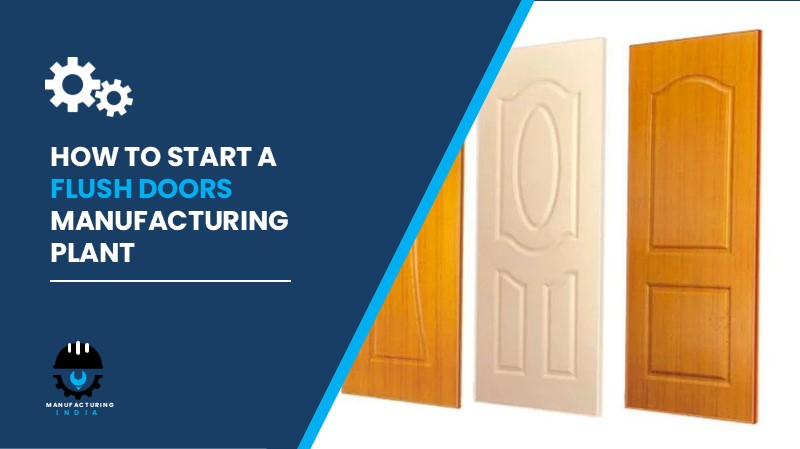
Flush doors are interior or exterior doors with a smooth and flat surface without any raised or recessed panels or designs. They are typically made from a solid core or a hollow core construction using a solid wood or composite core covered with veneers or laminates to provide a finished appearance. Flush doors are available in two primary structural variants, each serving different performance and pricing requirements.
Solid core flush doors offer better soundproofing and durability compared to hollow core alternatives – making them the preferred specification for commercial buildings, hotels, offices, and premium residential applications where acoustic performance and long-term mechanical durability are priority requirements. Hollow core flush doors are constructed with lightweight core material, such as honeycomb cardboard or synthetic foam, placed between two thin plywood or hardboard panels. They are more affordable and lighter in weight compared to solid core doors, making them ideal for cost-sensitive residential and interior partition applications. Both variants can be painted or stained in various colours to match the overall décor and style of any room or space.
The primary production method covers all unit operations from raw material preparation through core construction, facing lamination, pressing, trimming, finishing, and packaging – a multi-stage woodworking and engineered panel manufacturing process that converts timber, composite cores, veneer, and adhesive into specification-grade flush door products. End-use sectors served include residential homes, commercial buildings, offices, and hotels.
Cost of Setting Up a Flush Doors Manufacturing Plant in India
The cost of establishing this facility depends on capacity, technology selection, plant location, degree of automation, and regulatory compliance requirements.
1. Capital Expenditure (CapEx)
Total capital investment for a flush doors manufacturing plant in India covers land acquisition, site preparation, civil construction, machinery, and pre-operative expenses. The cost of land and site development – including charges for land registration, boundary development, and other related expenses – forms a substantial part of the overall investment. This allocation ensures a solid foundation for safe and efficient plant operations. Investors can reduce land acquisition costs meaningfully by locating the unit within an industrial estate, wood-based industries cluster, or Special Economic Zone (SEZ), which also provide shared utility infrastructure and potential state-level fiscal incentives aligned with India’s manufacturing development agenda.
Civil works and construction encompass the main woodworking and assembly production building, raw material storage areas for timber, composite core materials, veneers, laminates, and adhesives, a finished goods warehouse with appropriate humidity control, a quality control laboratory, and an administrative block. Given that flush door manufacturing involves adhesive application, pressing operations, and finishing with paints and lacquers, civil infrastructure must incorporate adequate ventilation, dust extraction systems, fire safety provisions, and appropriate storage for flammable finishing materials.
Machinery costs account for the largest portion of total capital expenditure. The report covers machinery requirements, costs, and suppliers in full detail as part of its comprehensive plant layout and equipment selection framework. Other capital costs include the effluent treatment plant (ETP), advanced process monitoring systems, pre-operative expenses, trial production costs, and commissioning charges. All machinery must comply with industry standards for safety, efficiency, and reliability applicable to flush door manufacturing.
Request a Sample Report for In-Depth Market Insights: https://www.imarcgroup.com/flush-doors-manufacturing-plant-project-report/requestsample
2. Operational Expenditure (OpEx)
The operating cost structure of a flush doors manufacturing plant is primarily driven by raw material consumption, which accounts for approximately 60–70% of total operating expenses (OpEx). Core materials – including solid wood, composite core materials such as honeycomb cardboard or synthetic foam, plywood, hardboard panels, veneer, laminates, and adhesives – are the dominant cost inputs. Securing long-term supply agreements with reliable timber, composite board, and veneer producers located in proximity to the plant is essential to mitigate price volatility, minimise transportation costs, and ensure consistent material quality throughout the production process.
Utility costs – comprising electricity for woodworking machinery, pressing equipment, and finishing lines, as well as water – account for 10–15% of total OpEx. Other ongoing operating costs include transportation, packaging, salaries and wages, depreciation, taxes, equipment repairs and maintenance, and other miscellaneous expenses covering quality control testing, regulatory compliance, and distribution operations.
By the fifth year of operations, the total operational cost is expected to increase substantially due to factors such as inflation, market fluctuations, and potential rises in the cost of key materials. Additional factors including supply chain disruptions, rising consumer demand, and shifts in the global economy are expected to contribute to this increase.
3. Plant Capacity
The proposed manufacturing facility is designed with an annual production capacity ranging between 100,000 and 500,000 units, enabling economies of scale while maintaining operational flexibility. Capacity can be customised per investor requirements based on target residential, commercial, or hospitality market segments, available capital, and degree of automation. Profitability improves materially with higher capacity utilisation, making domestic supply agreements with real estate developers, construction contractors, hotel chains, and modular interior fit-out companies a commercial priority from the commissioning stage.
4. Profit Margins and Financial Projections
The project demonstrates healthy profitability potential under normal operating conditions. Gross profit margins typically range between 25–35%, supported by stable demand and value-added applications. Net profit margins range between 12–18%. A comprehensive financial model covering NPV (net present value), IRR (internal rate of return), payback period, liquidity analysis, uncertainty analysis, sensitivity analysis, and a full five-year profit and loss account provides investors with a rigorous analytical framework for assessing financial viability and long-term sustainability across different capacity and pricing scenarios.
Why Set Up a Flush Doors Plant in India?
Rising Product Adoption in the Construction and Real Estate Industries. The market for flush doors is primarily driven by the rising product adoption in the construction and real estate industries. As new buildings, homes, and infrastructure projects are constructed or renovated, there has been an escalating demand for flush doors to meet the design and functional requirements of contemporary spaces. India’s large and growing urban housing pipeline – including government-funded affordable housing under Pradhan Mantri Awas Yojana and private sector residential development – creates a large and consistent institutional demand base for flush door producers.
Shifting Consumer Preferences Toward Modern Interior Design. Architectural trends and design preferences heavily influence the demand for flush doors, as the clean and minimalist aesthetic of these doors aligns with contemporary design styles and modern interior concepts. India’s rapidly expanding urban middle class, increasing exposure to international interior design standards, and growing preference for modern, uncluttered living and working environments are creating sustained and growing consumer pull for flush door products across residential, commercial, and hospitality construction applications.
Increasing Renovation and Remodelling Activity. The market is also propelled by the increasing renovation and remodelling projects in residential and commercial properties. Homeowners and business owners often opt to upgrade their doors as part of their renovation plans to achieve a modern and refreshed look – accelerating the adoption of flush doors in India’s large and growing renovation spending market, which spans both organised real estate developers and individual home improvement buyers.
Advanced Product Variants Expanding Market Reach. The introduction of advanced product variants manufactured with features that enhance energy efficiency and insulation – minimising heat transfer, improving soundproofing, and meeting energy efficiency regulations – is contributing to market growth. These functionally enhanced flush door variants command premium pricing and serve high-specification commercial and hospitality construction applications, supporting improved average selling prices and margin profiles for manufacturers with strong product development capabilities.
E-Commerce Expansion Widening Distribution Access. The growth of e-commerce platforms and online retail has expanded the availability and accessibility of flush doors. Consumers can browse a wide range of options, compare prices, and make convenient purchases – driving market growth through digital retail channels that were previously inaccessible to flush door manufacturers. For Indian producers, establishing an e-commerce distribution channel creates access to a geographically dispersed retail buyer base across both metro and non-metro markets without proportional increases in physical distribution infrastructure.
Strong Demand Across Commercial and Hospitality Sectors. Commercial buildings, offices, hotels, and other institutional spaces consistently specify flush doors due to their durability, acoustic performance, design flexibility, and ease of maintenance. India’s rapidly expanding organised retail real estate, co-working office sector, and hotel and hospitality industry are all active and growing procurement channels for flush door products – providing domestic manufacturers with a commercially attractive institutional demand base that is relatively independent of individual consumer sentiment cycles.
Manufacturing Process – Step by Step
The flush doors manufacturing process encompasses all unit operations from raw material preparation through core construction, facing lamination, pressing, trimming, finishing, and packaging. Each stage is precision-controlled to ensure dimensional accuracy, structural integrity, surface quality, and compliance with the performance and finish standards required by residential, commercial, and hospitality customers.
- Raw Material Receipt and Inspection: Timber, composite core materials (honeycomb cardboard or synthetic foam), plywood, hardboard panels, veneers, laminates, and adhesives are received at the facility and subjected to incoming quality checks for grade specification, moisture content, and dimensional compliance before entering the production line.
- Core Preparation: The structural core of the flush door is assembled according to the target specification – solid wood or composite material for solid core variants, or honeycomb cardboard or synthetic foam framed within a perimeter timber rail for hollow core variants. Core dimensions are cut and assembled to the required door size.
- Facing Material Preparation: Veneer sheets, laminates, plywood, or hardboard facing materials are cut and prepared to the required dimensions for application to both faces of the assembled door core.
- Adhesive Application and Assembly: Adhesive is applied uniformly to the core and facing surfaces. The facing materials are positioned precisely on both faces of the core and the complete door blank is assembled ready for pressing.
- Hot Pressing: The assembled door blank is pressed under controlled heat and pressure in a hot press to cure the adhesive bond between the core and facing materials, producing a dimensionally stable, void-free flush door panel.
- Trimming and Sizing: Pressed door panels are trimmed on all four edges to achieve the specified door dimensions, squareness, and edge profile specification required for installation in standard or bespoke door frames.
- Finishing: Door surfaces are sanded to the required surface smoothness and flatness specification. Painting, lacquering, or other decorative surface treatments are applied in the required colour or finish to meet customer specifications for residential, commercial, or hospitality applications.
- Quality Inspection and Testing: Finished flush doors are evaluated for dimensional compliance, surface finish quality, bonding integrity, acoustic performance (where specified), and structural strength before release for packaging and dispatch.
- Packaging and Dispatch: Approved flush doors are wrapped in protective packaging and dispatched to end-use customers across residential homes, commercial buildings, offices, and hotels through direct contractor supply, building materials distribution, and e-commerce retail channels.
Key Applications
The flush doors manufacturing plant serves a diverse and commercially significant range of end-use sectors across India’s construction and interior design economy.
- Residential Homes: Flush doors are commonly used in residential applications for interior room doors, bathroom doors, and entrance doors – where their clean surface finish, design flexibility, and competitive pricing make them the dominant door specification in both mass-market and premium housing developments.
- Commercial Buildings: Specified for office partitions, meeting room doors, and public area doors in commercial buildings – where durability, acoustic performance (solid core), and design consistency across large floor plate installations are key procurement criteria.
- Offices: Applied in individual workspaces, conference rooms, and common area partitions across co-working and corporate office environments where modern aesthetic, noise control, and ease of replacement are practical design requirements.
- Hotels and Hospitality: Used extensively across guest room doors, corridor doors, and service area doors in hotels and hospitality properties – where flush door durability, fire-rating options (solid core), and consistent surface finish across high volumes of identical installations are critical performance requirements.
- Renovation and Remodelling Projects: Flush doors are a preferred upgrade specification in residential and commercial renovation programmes where homeowners and business operators seek to modernise their spaces with minimal disruption and at competitive cost relative to panel door alternatives.
- E-Commerce and Retail Distribution: Increasingly accessible through online platforms where individual buyers, interior designers, and small contractors can browse, specify, and purchase flush doors directly – opening a new and growing retail distribution channel that is expanding the addressable market for domestic flush door producers.
Leading Manufacturers
Leading manufacturers in the global flush doors industry include several multinational companies with extensive production capacities and diverse application portfolios. Key players include:
- Greenply Industries Limited
- Century Plyboards (India) Ltd.
- Kitply Industries Limited
- Duro Ply Industries Ltd.
- Archidply Industries Ltd.
- Merino Industries Ltd.
Timeline to Start the Plant
Investors should plan for a structured pre-production and commissioning phase covering the following key stages:
- Feasibility study and project report preparation
- Land acquisition and site development
- Regulatory approvals and environmental clearances
- Factory licence and fire safety compliance
- Machinery procurement and installation
- Raw material supplier agreements and supply chain setup
- Trial production and quality testing
- Commercial production launch
Licences and Regulatory Requirements
Starting a flush doors manufacturing unit in India requires several approvals:
- Business registration (Proprietorship, LLP, or Private Limited Company)
- Factory Licence under the Factories Act
- Environmental Clearance from the State Pollution Control Board
- GST Registration
- Fire Safety NOC
- Hazardous material compliance for storage and handling of adhesives and finishing chemicals including paints and lacquers
- Effluent Treatment Plant (ETP) operational clearance
- Occupational Health and Safety compliance
Key Challenges to Consider
High Capital Requirements. Establishing a fully equipped flush doors manufacturing plant – with core preparation, hot pressing, trimming, finishing, and packaging equipment – at the 100,000–500,000 unit annual capacity range requires significant upfront capital investment. Access to MSME credit-linked subsidy schemes, wood-based industries development grants, and state government investment promotion subsidies can help bridge funding requirements.
Raw Material Price Volatility. Core materials including timber, composite boards, veneers, laminates, and adhesives – which collectively account for 60–70% of total OpEx – are subject to domestic timber supply constraints, global engineered wood panel price cycles, and adhesive resin price movements linked to petrochemical feedstocks. Long-term procurement contracts with reliable domestic timber and composite board suppliers are the primary risk mitigation measures for protecting production margins.
Regulatory Compliance. Flush door manufacturing involves the use and storage of adhesives, paints, and lacquers, which may be subject to volatile organic compound (VOC) emission regulations and fire safety requirements for flammable material storage. Dust management systems for woodworking operations and effluent treatment for finishing line wastewater are mandatory environmental compliance requirements. Maintaining continuous compliance adds to ongoing operational overhead.
Innovation and Energy Efficiency Pressure. The market is experiencing increasing consumer demand for advanced product variants with energy efficiency, improved soundproofing, and insulation features. Domestic manufacturers must invest in product development – including fire-rated, acoustic, and thermally efficient flush door variants – to remain competitive with international product specifications and capture premium pricing segments.
Competition from Domestic and Regional Players. The Indian flush doors industry includes a range of established domestic and regional producers serving organised construction and real estate developers. New entrants must compete through product quality consistency, BIS certification, competitive pricing, reliable supply for large-scale project orders, and the ability to serve both the institutional project procurement channel and the growing e-commerce retail segment simultaneously.
Skilled Manpower. Operating hot presses, CNC trimming equipment, and surface finishing lines in a wood-based manufacturing environment while maintaining quality control documentation requires trained woodworking technicians and quality assurance personnel. Recruiting, training, and retaining qualified production and quality staff is a recurring operational challenge in India’s wood-based industries sector.
Frequently Asked Questions
1. How much does it cost to set up a flush doors manufacturing plant in India?
Total setup cost depends on plant capacity, location, machinery selection, and automation level. Key cost components include land and site development, civil construction with fire safety and dust extraction provisions, machinery for core preparation, hot pressing, trimming, and finishing, and pre-operative expenses. A detailed feasibility study is recommended to generate accurate project-specific cost estimates.
2. Is flush doors manufacturing profitable in India in 2026?
Yes. The project delivers healthy financial performance, with gross margins of 25–35% and net profit margins of 12–18% under normal operating conditions. India’s rapidly expanding construction and real estate sector, rising renovation spending, and growing e-commerce distribution of building materials create a large and structurally growing domestic demand base for flush door producers.
3. What machinery is required for a flush doors plant in India?
The full machinery requirements – including equipment for core preparation, facing material processing, adhesive application, hot pressing, trimming, finishing, and packaging – are detailed in the IMARC Group project report. Request a sample for complete machinery specifications and cost breakdowns.
4. What licences and approvals are required to start a flush doors plant in India?
Required approvals include business registration, Factory Licence, Environmental Clearance from the State Pollution Control Board, GST Registration, Fire Safety NOC, compliance for adhesive and finishing chemical storage, ETP operational clearance, and Occupational Health and Safety compliance.
5. What raw materials are needed for flush doors manufacturing?
The primary raw materials include solid wood or composite core materials (honeycomb cardboard or synthetic foam), plywood or hardboard facing panels, veneers, laminates, and adhesives. These raw materials collectively account for 60–70% of total operating expenses, making procurement strategy the most critical cost management lever in flush door manufacturing.
6. What are the environmental compliance requirements for a flush doors plant in India?
The facility must obtain Environmental Clearance from the State Pollution Control Board, operate an approved ETP for finishing line effluent management, and install dust extraction and ventilation systems for woodworking operations. Compliance with VOC emission standards for adhesive and finishing chemical use, regular effluent monitoring, and fire safety documentation are mandatory throughout operations.
7. What is the best location to set up a flush doors plant in India?
Locations offering proximity to timber and composite board raw material supply chains, reliable utility infrastructure, and major construction and real estate development demand centres are preferred. States such as Maharashtra, Gujarat, Karnataka, Uttar Pradesh, and Rajasthan – which combine strong construction activity, timber supply networks, and building materials distribution infrastructure – are strong candidates for flush door plant location.
8. What is the break-even period for this type of plant in India?
The break-even period depends on plant capacity, total capital investment, product selling price, and capacity utilisation rate. A comprehensive financial analysis covering NPV, IRR, payback period, and uncertainty and sensitivity analysis is the most reliable method for generating project-specific break-even timelines.
9. What government incentives are available for manufacturers in India?
Flush door manufacturers in India can access MSME credit-linked capital subsidy schemes, state government investment promotion subsidies in wood-based industries zones, and export promotion incentives for qualifying wood products under schemes administered by the Ministry of Commerce and Industry. The Pradhan Mantri Awas Yojana housing programme and government infrastructure projects provide direct institutional procurement opportunities through public sector construction channels accessible to BIS-certified domestic producers.
Key Takeaways for Investors
A flush doors manufacturing plant in India offers a well-grounded investment opportunity anchored by growing demand across residential homes, commercial buildings, offices, and hotels – all of which are active and expanding procurement segments driven by India’s urbanisation, construction growth, and rising preference for modern interior design. The project is financially viable across the 100,000 to 500,000 unit annual capacity range, with gross margins of 25–35% and net margins of 12–18% providing a strong return framework for investors at multiple capital scales. The market is primarily driven by the rising product adoption in the construction and real estate industries, shifting consumer preferences toward contemporary minimalist design, increasing renovation and remodelling activity, and the growth of e-commerce platforms that are expanding market access for flush door producers to geographically dispersed buyers. The introduction of advanced product variants with energy efficiency and improved soundproofing features is further broadening market acceptance and creating value-added product development opportunities for technically capable Indian manufacturers. With India’s urban construction and housing pipeline continuing to grow and government-led housing programmes accelerating residential construction across tier-2 and tier-3 cities, the long-term demand sustainability for domestically produced flush doors is structurally sound across all investment planning horizons.
About the Author