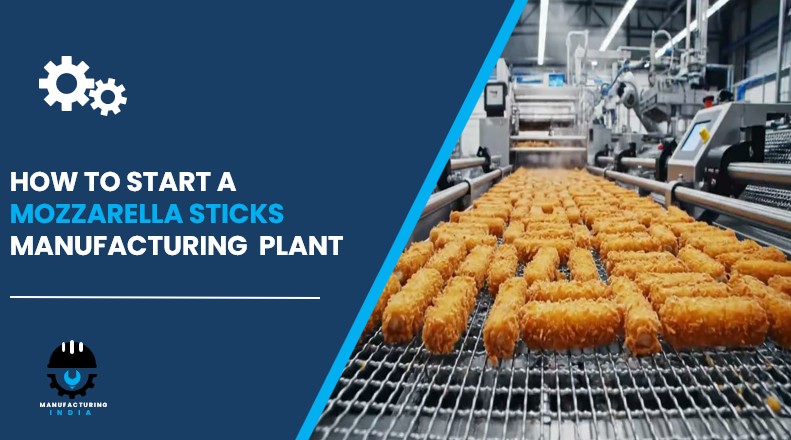
Setting up a mozzarella sticks manufacturing plant in India represents a highly attractive investment proposition underpinned by robust and structurally growing demand from the foodservice and frozen food sector, expanding adoption of convenience snack products across retail and quick-service restaurant channels, rising consumer preference for ready-to-eat and easy-to-prepare food formats, and the accelerating global shift toward indulgent yet accessible snacking experiences. As urbanisation deepens, dual-income households proliferate, and food delivery and takeaway culture continues to expand, mozzarella sticks a universally popular appetiser and snack product occupy an increasingly important position across foodservice, frozen retail, fast-food chains, and institutional catering channels. This growth trajectory, combined with the scalable nature of breaded cheese snack manufacturing, well-established processing technology, and strong brand-building potential across premium and value segments, creates a highly favourable manufacturing environment for new entrants with efficient production, cold chain, and quality systems.
What Are Mozzarella Sticks?
Mozzarella sticks are a widely consumed snack and appetiser product made from mozzarella cheese that is cut into uniform stick portions, coated with a seasoned batter and breadcrumb coating, and then either deep-fried or oven-baked to produce a crispy golden exterior encasing a molten, stretchy cheese interior. The product is served extensively across fast-food chains, casual dining restaurants, bars, and food delivery platforms as a starter or side dish and is sold through retail and e-commerce channels as a frozen ready-to-cook snack item.
The manufacturing process involves cheese selection and portioning, batter preparation and application, breadcrumb coating, pre-frying or par-baking, individually quick freezing (IQF) or blast freezing, and automated packaging for retail and foodservice formats. Mozzarella sticks occupy a premium position in the broader breaded and battered snack segment due to their high consumer recognition, strong repeat-purchase characteristics, and cross-channel versatility spanning both foodservice and retail formats.
The global mozzarella sticks market is on a sustained upward trajectory, supported by rising snack food consumption, expanding frozen food infrastructure in emerging markets, growing fast-food chain penetration, and increasing consumer demand for convenient, indulgent food products. North America currently accounts for approximately 40% of global market share, with Europe and Asia Pacific representing significant and fast-growing secondary markets.
Cost of Setting Up a Mozzarella Sticks Manufacturing Plant
The total capital investment required to establish a mozzarella sticks manufacturing plant is shaped by several key parameters: annual production capacity (typically ranging from 500 to 2,000 MT per annum), the degree of vertical integration (in-house mozzarella cheese production versus purchased cheese inputs), the level of automation across forming, battering, breading, frying, freezing, and packaging operations, facility cold storage and IQF infrastructure specification, raw material sourcing strategy, and applicable food safety and regulatory compliance requirements. Below is a structured breakdown of the major cost components.
1. Capital Expenditure (CapEx)
Total capital investment in a mozzarella sticks manufacturing plant covers the following major heads:
Land and Site Development
This encompasses land acquisition or lease, site preparation, boundary development, and utilities connectivity. Site selection should prioritise proximity to reliable mozzarella cheese supply sources either dairy processing clusters or established cheese suppliers to minimise cold-chain logistics costs for perishable raw materials. Access to reliable, uninterrupted power supply for refrigeration, IQF freezing, and processing equipment is a critical infrastructure requirement, as is access to clean process water, road connectivity for inbound raw material receipt and outbound frozen product dispatch, and an available pool of food manufacturing-trained workers. Compliance with local food processing zone regulations, food safety authority requirements, cold storage and effluent management norms, and factory act provisions must be assessed at project inception.
Civil Works and Construction
Building costs cover the main food processing facility including raw material cold storage and refrigerated receiving areas, cheese tempering and portioning rooms, batter preparation and coating areas, frying or baking lines, post-fry cooling conveyor areas, IQF or blast freezing tunnels, frozen finished goods storage warehousing, packaging hall, quality control laboratory, wastewater pre-treatment infrastructure, administrative block, and utility infrastructure including refrigeration plant rooms, electrical substations, compressed air systems, and effluent management. Construction must comply with applicable FSSAI food business operator premises standards, factory act requirements, pollution control board clearances for food processing operations, and food-grade hygienic construction standards including easy-clean wall and floor surfaces, positive air pressure in production areas, and pest exclusion design.
Machinery and Equipment
Machinery represents the single largest CapEx component. Key equipment required for a mozzarella sticks manufacturing plant includes:
- Cheese Receiving and Cold Storage Systems: Refrigerated receiving docks, temperature-monitored cold rooms for raw mozzarella cheese storage, and inventory management systems to maintain stock rotation and cold chain integrity from supplier delivery through production use.
- Cheese Tempering and Conditioning Equipment: Controlled-temperature tempering rooms or cabinets to bring mozzarella cheese to optimal cutting and forming temperature to ensure consistent cutting performance and portion quality without excessive moisture loss.
- Cheese Cutting and Portioning Lines: Automated block cheese cutters and portion-forming machines to cut mozzarella blocks into uniform stick dimensions with consistent weight, minimising trim waste and ensuring product uniformity for coating application.
- Batter Preparation Systems: Batter mixing tanks with temperature control and viscosity management systems to prepare and maintain consistent batter formulations (tempura, beer batter, or custom seasoned coatings) for uniform application across production runs.
- Battering Machines: Continuous battering conveyor systems with submerger rollers and controlled batter curtains to apply uniform batter coatings to cheese sticks, with drip recovery and batter recirculation for minimising waste.
- Breading Drums and Applicators: Rotary breading drums or conveyor-based breading applicators to apply dry breadcrumb or seasoned breading coatings evenly across all surfaces of battered cheese sticks, with breading recirculation and fresh breading top-up systems.
- Pre-Frying and Par-Frying Lines: Continuous conveyor fryers with temperature-controlled cooking oil circulation, oil filtration systems, and submersion conveyors to pre-fry or par-fry breaded mozzarella sticks, setting the coating and partially cooking the product before freezing.
- Alternatively Oven Baking Lines: Tunnel ovens with controlled temperature and air velocity profiles for baked product variants, offering reduced oil content for health-oriented product lines.
- Post-Fry Cooling Conveyors: Cooling conveyors with ambient or forced-air cooling to reduce product temperature after frying to safe levels before IQF freezing, preventing thermal shock and maintaining coating integrity.
- IQF Freezing Tunnels or Blast Freezers: Individually quick freezing tunnels or blast freezing chambers to rapidly freeze mozzarella sticks to core temperatures of -18°C or below, preserving product structure, coating crispness, and cheese texture quality through the frozen supply chain.
- Frozen Product Storage Warehousing: Temperature-controlled frozen storage rooms operating at -18°C to -22°C for finished goods inventory management prior to despatch, with FIFO stock rotation management systems.
- Automated Packaging Lines: Retail flow-wrap or pillow-pack lines, carton or box erecting and loading systems, multi-pack assembly, check weighing, metal detection, date and lot coding, and palletising systems for retail SKU formats. Industrial bulk packaging lines for foodservice formats including catering cartons and institutional packs.
- Quality Control Laboratory Equipment: Instruments for raw material and finished product quality assessment including moisture, fat, protein, coating pickup, breading adhesion, colour measurement, texture analysis, microbiological testing capability, and cold chain temperature verification.
- Oil Management and Filtration Systems: Continuous frying oil filtration and conditioning systems to maintain frying oil quality within specification, extending oil life, controlling free fatty acid levels, and ensuring consistent product colour and flavour.
- Material Handling and Intralogistics: Refrigerated conveyor systems, product transfer belts, and automated material handling between processing, freezing, and packaging stations, minimising manual product handling and temperature exposure time.
- Effluent Pre-Treatment Systems: Oil-water separators and biological effluent pre-treatment units to manage wastewater from cleaning and cheese cutting operations to required discharge standards before municipal or on-site effluent treatment.
Other Capital Costs
These include pre-operative expenses, commissioning charges, HACCP system development and validation, staff training and food safety competency development, initial raw material and packaging inventory for commissioning, regulatory compliance setup including FSSAI Food Business Operator licence, Factory Licence, pollution control board clearances, fire safety NOC, and quality management system establishment costs.
Request a Sample Report for In-Depth Market Insights: https://www.imarcgroup.com/mozzarella-sticks-manufacturing-plant-project-report/requestsample
2. Operational Expenditure (OpEx)
Raw materials principally mozzarella cheese, breading and batter ingredients, and frying oil constitute the dominant operating cost, typically representing 60–70% of total OpEx, reflecting the high cost of quality mozzarella cheese as the primary input. Utility costs, driven primarily by refrigeration power consumption for cold storage, IQF freezing, and frozen warehousing, as well as electricity for processing equipment, fryer energy, and compressed air, account for 10–15% of OpEx. Labour, maintenance, quality control, packaging materials, transportation and cold chain logistics, depreciation, taxes, and overhead costs constitute the remainder of the operating cost base.
3. Plant Capacity
The proposed mozzarella sticks manufacturing facility is designed with an annual production capacity ranging between 500–2,000 MT, enabling economies of scale while maintaining operational flexibility. This capacity range supports a diversified product portfolio across standard breaded and battered mozzarella sticks, seasoned and flavoured variants, reduced-fat or baked product lines, retail consumer packs, and institutional foodservice formats serving both domestic and export markets.
4. Profit Margins and Financial Projections
The project demonstrates healthy profitability potential under normal operating conditions, with gross profit margins typically ranging between 30–40% and net profit margins of 10–15%. Financial projections encompass capital investment, operating costs, capacity utilisation ramp-up schedule, product mix across standard, premium, and private-label formats, and forward demand outlook underpinned by growing frozen food consumption and foodservice channel expansion. A comprehensive feasibility analysis includes sensitivity analysis, Net Present Value (NPV), Internal Rate of Return (IRR), and Payback Period calculations.
Why Set Up a Mozzarella Sticks Manufacturing Plant?
Rising Demand for Convenient Snack and Appetiser Products
Accelerating urbanisation, growing dual-income household formation, expanding food delivery and takeaway culture, and increasing consumer preference for quick, indulgent, restaurant-quality snack experiences at home are driving sustained demand for convenient, ready-to-cook frozen snack products. Mozzarella sticks, with their universal consumer appeal across age groups, strong flavour profile, and versatility across cooking methods (deep frying, air frying, oven baking), are among the most consistently popular items in the frozen snack and appetiser category. This structural demand growth, underpinned by demographic and lifestyle trends with long-term momentum, creates a resilient and growing addressable market for manufacturers with efficient production and strong brand or private-label capabilities.
Expanding Frozen Foods Market and Cold Chain Infrastructure
The global frozen food market has experienced sustained expansion driven by improvements in frozen food technology, growing consumer acceptance of frozen products as quality-equivalent to fresh, expanding modern retail and e-commerce frozen food channels, and the post-pandemic acceleration of at-home cooking and meal preparation. Mozzarella sticks represent a high-growth opportunity within the frozen snack segment, with strong velocity in retail supermarkets, online grocery, club store, and convenience store channels. Investment in cold chain infrastructure across Asia Pacific, the Middle East, and Latin America is opening significant new export and distribution opportunities for frozen snack manufacturers with certified quality and cold chain capability.
Foodservice Channel Growth and Fast-Food Chain Penetration
Foodservice operators including casual dining chains, quick-service restaurants, pub and bar chains, hotel and catering groups, and stadium and entertainment venue food operators represent a large, volume-driven, and structurally growing demand channel for mozzarella sticks. The global expansion of international fast-food chains, the growth of food delivery platforms aggregating restaurant orders, and the increasing consumer preference for sharing plates and finger food formats in casual dining all drive consistent volume offtake from institutional and foodservice buyers. Developing direct supply relationships with regional and national foodservice distributors provides manufacturers with stable, predictable volume anchors alongside the higher-margin retail channel.
Healthier and Customisable Product Innovation Opportunities
Evolving consumer preferences for better-for-you snack options are creating growing market segments for lower-fat, reduced-sodium, whole-grain breading, and organic mozzarella stick variants alongside conventional products. Air-fryer-optimised coatings, gluten-free breading systems, plant-based cheese fillings, and premium artisan flavour profiles represent innovation white spaces that allow manufacturers to capture premium pricing and differentiate from commodity frozen snack competition. Product innovation capability, combined with the flexibility to produce private-label formulations for major retail and foodservice customers, is a significant competitive lever available to manufacturers investing in application development and customer partnership capabilities.
North America Market Dominance and International Export Growth
North America accounts for approximately 40% of global mozzarella sticks market share, reflecting the deep penetration of mozzarella sticks across both foodservice and retail channels in the United States and Canada. Europe, particularly the United Kingdom, Germany, and the Netherlands, represents a significant and growing secondary market for breaded cheese snacks, driven by pub and bar snacking culture and the growing popularity of North American food formats. Asia Pacific and the Middle East are rapidly emerging markets for frozen snack imports and locally produced breaded snacks, as fast-food culture, modern retail penetration, and consumer exposure to international snack formats accelerate across these regions.
Scalable Operations and Phased Investment Flexibility
The mozzarella sticks manufacturing value chain allows investors to begin operations at a moderate scale with standard breaded product lines and semi-automated processing and progressively add automation, flavour variants, premium product formats, and export-certified quality infrastructure as volumes and customer relationships develop. This phased investment approach reduces initial capital commitment while enabling market entry and customer base development, with subsequent automation and product development investments improving margin capture and operational efficiency as the business scales.
Strong Private Label and Co-Manufacturing Opportunity
Major retailers, foodservice distributors, and fast-food chains increasingly seek dedicated co-manufacturing partners for their private-label frozen snack ranges, representing a significant volume opportunity for manufacturers able to meet food safety, quality, and supply reliability standards. Co-manufacturing and private-label supply agreements provide predictable volume commitments, stable revenue visibility, and lower marketing expenditure relative to building proprietary consumer brands from inception, making them an attractive route to volume scale for new market entrants.
Manufacturing Process Overview
The mozzarella sticks manufacturing operation transforms raw mozzarella cheese inputs into breaded, coated, par-fried or baked, frozen, and packaged finished products through a sequence of receiving, portioning, battering, breading, cooking, freezing, and packaging operations. The key process stages are:
- Raw Material Receiving and Cold Storage: Mozzarella cheese blocks or loaves are received in refrigerated vehicles, inspected for temperature, weight, and quality compliance, and transferred to refrigerated raw material cold stores operating at 0–4°C. Breading, batter ingredients, seasonings, and packaging materials are received and stored in appropriate ambient or chilled conditions.
- Cheese Tempering and Conditioning: Mozzarella blocks are moved from cold storage to tempering rooms and held at controlled temperatures to bring the cheese to optimal cutting consistency firm enough for clean, accurate portioning without excessive moisture weeping, which would compromise batter adhesion and coating quality.
- Cheese Cutting and Stick Portioning: Tempered mozzarella blocks are processed through automated block cutters producing uniform stick portions of specified dimensions and weight. Cutting parameters are set to minimise trim and maximise yield. Portions are transferred directly to coating lines, maintaining cold temperature to preserve cheese integrity.
- Batter Application: Cheese sticks are conveyed through battering machines that apply a uniform layer of prepared liquid batter composed of flour, starch, leavening agents, seasonings, and water to all surfaces, with a submerger ensuring complete coverage. Excess batter is allowed to drain before breading application.
- Breading Application: Battered sticks pass through breading applicators or rotary drums where dry breadcrumbs or seasoned coatings are applied uniformly to all surfaces. Gentle tumbling ensures complete coverage and even coating thickness. A light mechanical pre-set or adhesion step may follow to ensure coating integrity through subsequent cooking and freezing.
- Pre-Frying or Par-Baking: Breaded sticks are conveyed through continuous fryers (for par-fried products) at controlled oil temperatures, setting the coating to a golden colour and partially cooking the product while maintaining a cold centre to prevent cheese melting-out. Baked product variants pass through tunnel ovens at controlled temperatures. Oil is continuously filtered and managed to maintain consistent product colour and flavour.
- Post-Cook Cooling: Cooked products are conveyed through cooling zones to reduce surface temperature and allow coating to set before IQF freezing, preventing thermal shock cracking and maintaining coating structure integrity.
- IQF Freezing or Blast Freezing: Cooled products pass through individually quick freezing tunnels where products are rapidly frozen to core temperatures of -18°C or below, preserving coating texture, cheese structure, and microbiological safety. IQF processing prevents product agglomeration and maintains individual piece separation for consumer convenience.
- Frozen Storage: Frozen products are transferred to frozen warehouses operating at -18°C to -22°C for finished goods inventory management, with FIFO stock rotation and continuous temperature monitoring.
- Quality Control: Products are tested for coating pickup, product weight, colour, external appearance, microbiological safety, metal detection compliance, and frozen core temperature before clearance for packaging and despatch.
- Packaging and Despatch: Products are packed in retail consumer formats (flow-wrap bags, folding cartons) or institutional foodservice cartons. Retail packs include printed artwork, nutritional labelling, cooking instructions, date coding, and barcode identification. Palletised loads are transferred to frozen despatch areas for distributor, retailer, and foodservice customer delivery.
Key Applications of Mozzarella Sticks
The mozzarella sticks manufacturing plant serves several major end-use segments across foodservice, retail, and institutional channels:
- Quick-Service and Fast-Food Restaurants: Mozzarella sticks are a core appetiser and side item on the menus of quick-service restaurants, fast-food chains, and casual dining operators globally, representing a high-velocity, consistent volume-demand channel that values supply reliability, product consistency, and food safety assurance above all.
- Retail Frozen Food Segment: Supermarkets, hypermarkets, club stores, and online grocery channels are primary retail distribution channels for branded and private-label frozen mozzarella sticks, with strong consumer pull driven by convenience, party food and entertaining occasions, and the growing popularity of air fryer-ready frozen snack products.
- Pub, Bar, and Entertainment Venues: The pub and bar foodservice channel, particularly in the United Kingdom, Ireland, and North American markets, drives significant volume demand for mozzarella sticks as a sharing starter and bar snack item, with operators placing consistent purchase orders through foodservice distributors.
- Hotel, Catering, and Institutional Food Service: Hotel banqueting, catering companies, school and college foodservice, hospital catering, airline catering, and stadium and arena concession operators represent volume-driven institutional buyer segments with predictable and recurring demand for frozen snack items meeting HACCP and food safety standards.
- Food Delivery and Ghost Kitchen Platforms: The rapid growth of food delivery platforms and ghost kitchens virtual restaurants operating without dine-in facilities has created a new and fast-growing demand channel for frozen snack products including mozzarella sticks, as ghost kitchen operators seek consistent, easy-to-prepare, high-margin appetiser and side items to build menu offerings.
Global Mozzarella Sticks Market Outlook
The global mozzarella sticks market is on a sustained growth trajectory, driven by multiple structural demand drivers spanning the frozen food, foodservice, snack food, and convenience food sectors. North America dominated the global market with a share of approximately 40% in 2025, reflecting the deep cultural penetration of mozzarella sticks across both restaurant and retail channels in the region. The broader snack food industry in the United States was valued at USD 51.1 billion in 2024 and is projected to reach USD 69.7 billion by 2032, growing at approximately 4.1% annually providing a large and structurally growing addressable market within which mozzarella sticks occupy a well-established and growing niche. Key structural growth drivers include:
- Rising global demand for convenient, ready-to-cook frozen snack and appetiser products driven by urbanisation, dual-income household growth, and food delivery platform expansion
- Growing foodservice channel expansion across Asia Pacific, the Middle East, and Latin America as fast-food chain penetration accelerates and consumer exposure to international snack formats increases
- Expanding retail frozen food infrastructure in emerging markets enabling distribution reach for frozen snack manufacturers beyond established North American and European markets
- Product innovation in better-for-you, gluten-free, air-fryer-optimised, and plant-based cheese snack formats creating premium market segments commanding higher retail price points
- Increasing private-label programme activity by major retailers and foodservice distributors seeking reliable co-manufacturing partners for frozen snack ranges
- Growing adoption of mozzarella sticks and breaded cheese snacks in food delivery and ghost kitchen operating models, expanding the addressable foodservice volume base beyond traditional sit-down restaurant channels
Major players in the global mozzarella sticks and breaded snack manufacturing industry include Tyson Foods, McCain Foods, Nestlé (Hot Pockets), ConAgra Foods, and Schwan’s Company, along with a growing number of regional manufacturers and private-label co-packers serving domestic and export markets.
Licenses and Regulatory Requirements
Establishing a mozzarella sticks manufacturing unit requires a range of approvals and certifications, which may vary by country and jurisdiction, including:
- Business registration and company incorporation under applicable company law
- FSSAI (Food Safety and Standards Authority of India) Food Business Operator (FBO) Licence for food manufacturing operations, with compliance to Schedule 4 hygiene and sanitation standards for food processing premises
- Factory Licence under applicable state Factories Act provisions
- Pollution Control Board Clearances Consent to Establish (CTE) and Consent to Operate (CTO) for manufacturing operations involving wastewater generation from food processing and cleaning operations
- Fire Safety No-Objection Certificate from competent fire safety authority, with specific attention to cold storage and frozen warehousing fire safety systems
- HACCP (Hazard Analysis and Critical Control Points) system certification, a fundamental requirement for foodservice and export market customers
- ISO 22000:2018 Food Safety Management System Certification, increasingly required by major foodservice and retail customers as a supply chain qualification criterion
- ISO 9001:2015 Quality Management System Certification for quality management infrastructure compliance
- BRC (British Retail Consortium) Global Standard for Food Safety or equivalent retailer audit certification for UK and European retail market access
- Export-Import Code (IEC) for international market access and export sales
- Cold chain and refrigerated transport compliance with applicable food safety cold chain regulations for product distribution
- Weights and Measures (Legal Metrology) registration for packaged commodity labelling and net quantity declaration
- Trademark and Brand Registration for proprietary branded product launch
Key Challenges to Consider
Raw Material Cost Volatility and Mozzarella Cheese Supply
Mozzarella cheese, as the primary input accounting for most raw material costs, is subject to price volatility linked to milk commodity markets, dairy supply-demand dynamics, and seasonal production patterns. Managing input cost exposure requires developing reliable long-term supply relationships with multiple cheese manufacturers or dairy processors, exploring partial backward integration into in-house cheese production for larger-scale plants, hedging raw material costs where market instruments allow, and building product pricing mechanisms that allow appropriate cost pass-through to customers in periods of sustained input cost inflation.
Cold Chain Infrastructure Investment and Operational Complexity
Operating a frozen food manufacturing facility requires sustained investment in and disciplined management of refrigerated and frozen storage infrastructure, IQF freezing capacity, temperature-monitored distribution, and cold chain compliance throughout the supply chain. Power reliability is a critical operational dependency, with backup power generation for refrigeration systems essential to prevent product loss during power outages. Cold chain operational discipline from raw material receiving through production, freezing, storage, and distribution is a non-negotiable food safety and product quality requirement that must be built into operational systems from project inception.
Food Safety and HACCP Compliance
Mozzarella sticks manufacturing involves multiple food safety critical control points, including raw cheese microbiological safety, cooking temperature validation for pathogen reduction, post-cook contamination prevention, allergen management (wheat, milk, and potentially other allergens in breading systems), and product traceability through the frozen supply chain. Building and maintaining a robust HACCP-based food safety management system, validated cooking processes, comprehensive allergen management programmes, and rigorous incoming raw material and finished product microbiological testing is essential for regulatory compliance and for retaining the trust and continued business of foodservice chain and retail customers, for whom a food safety incident at a supplier facility represents a significant reputational and operational risk.
Market Competition and Private-Label Margin Pressure
The mozzarella sticks market, particularly in mature markets such as North America, features well-established branded competitors with significant production scale, established retail distribution, and consumer brand recognition. New entrants typically gain initial traction through private-label supply to retailers and foodservice distributors, a route that provides volume access but at lower margins than branded products. Building proprietary brand equity, differentiating through product innovation, and progressively developing direct retail relationships requires sustained investment in product development, packaging, marketing, and consumer insight capability over multiple years, and must be planned as a medium-to-long-term strategic trajectory rather than an immediate revenue-driver.
Cooking Oil Management and Operational Cost Control
Frying oil represents a significant recurring operating cost and waste management challenge in mozzarella sticks manufacturing. Maintaining frying oil within quality parameters requires continuous filtration, regular replenishment, and eventual replacement, with used frying oil requiring appropriate disposal or sale to biodiesel processors. Oil quality directly affects product colour, flavour, and consumer acceptance, making disciplined oil management both an operational cost control and a product quality imperative. Optimising fryer loading, oil turnover rates, and filtration frequency to extend oil life while maintaining product quality standards is an important operational efficiency lever for managing this cost component.
Temperature Abuse and Cold Chain Distribution Risk
Frozen mozzarella sticks are highly sensitive to temperature abuse partial thawing and refreezing during distribution causes ice crystal formation, moisture migration, coating softening, and product quality deterioration that cannot be reversed in downstream cooking. Ensuring robust cold chain compliance throughout distribution, from frozen warehouse despatch through distributor cold storage and retail or foodservice freezer display, requires selecting distribution partners with verified cold chain capability, implementing clear product handling and storage specifications, and conducting periodic cold chain audits across the distribution network, particularly for export market channels where distribution chain complexity and cold chain reliability may vary.
Frequently Asked Questions (FAQs)
1. How much does it cost to set up a mozzarella sticks manufacturing plant?
The total investment depends on plant capacity (500–2,000 MT per annum), the degree of processing automation, IQF freezing infrastructure specification, facility cold storage and frozen warehousing scope, location, and target market certifications. Costs cover land, civil construction (processing halls, cold and frozen storage, quality laboratory, utilities), machinery (cheese cutters, battering and breading lines, fryers or ovens, IQF freezing tunnels, packaging lines), food safety system development, working capital, and regulatory compliance. A comprehensive feasibility study from IMARC Group provides detailed, capacity-specific cost estimates covering all CapEx and OpEx components.
2. Is mozzarella sticks manufacturing a profitable business in 2026?
Yes. Sustained and growing demand from the frozen retail food segment, foodservice channels, and food delivery platforms, combined with gross profit margins of 30–40% and net profit margins of 10–15%, make mozzarella sticks manufacturing financially attractive. Product mix optimisation through premium flavour variants, private-label co-manufacturing, and export channel development provides pathways to margin enhancement beyond commodity-grade frozen snack supply.
3. What machinery and equipment are required?
Key equipment includes cheese cutting and portioning machines, batter preparation and battering conveyor systems, breading drums and applicators, continuous conveyor fryers or tunnel ovens, post-cook cooling conveyors, IQF freezing tunnels or blast freezers, frozen product storage systems, automated retail and foodservice packaging lines, check weighers and metal detectors, and quality control laboratory equipment for microbiological, physical, and chemical product testing.
4. What licenses and approvals are required?
Required approvals include company registration, FSSAI Food Business Operator Licence, Factory Licence, Pollution Control Board CTE and CTO, Fire Safety NOC, HACCP certification, ISO 22000:2018 Food Safety Management System Certification, and Export-Import Code for international market access. BRC or equivalent retailer audit certification is typically required for UK and European retail market supply.
5. How long does it take to commission a mozzarella sticks manufacturing plant?
Typically 10–18 months from project initiation to commercial production, depending on project scale, facility construction timeline, equipment procurement lead times for IQF freezing and automated processing systems, food safety system validation, FSSAI and regulatory approval processing, and customer qualification audits for major retail or foodservice supply. Food safety certifications and customer qualification processes should be initiated in parallel with construction to avoid delays to commercial launch.
6. What are the key raw materials required?
The primary raw material is mozzarella cheese, sourced from dairy processors or cheese manufacturers in block or loaf format. Other key inputs include flour, starch, leavening agents, and seasonings for batter systems; dry breadcrumbs or seasoned coating mixes; frying oil; packaging materials including retail flow-wrap film, printed cartons, and institutional catering cartons; and cleaning and sanitation chemicals for food processing environment hygiene maintenance.
7. What is the break-even period?
The break-even period depends on capacity utilisation ramp-up trajectory, product mix across standard and premium formats, raw material cost management, and volume offtake arrangements with retail, foodservice, and export customers. Securing long-term private-label supply agreements with retail customers and volume framework agreements with foodservice distributors significantly improves revenue predictability and supports faster break-even achievement than relying solely on branded product sales from launch.
8. What are the main product forms and their applications?
Principal product formats include standard breaded and par-fried frozen mozzarella sticks for retail and foodservice; seasoned and flavoured variants (ranch, spicy, herb-coated) for premium retail segments; baked or reduced-fat variants for health-oriented consumer segments; gluten-free formats for allergen-sensitive markets; and bulk institutional packs for foodservice, catering, and distribution customers. Activated charcoal, truffle, and artisan cheese fillings represent emerging premium innovation formats for specialty retail channels.
9. What government incentives are available?
Manufacturers may benefit from food processing industry investment incentives under national food processing promotion schemes, state-level capital subsidies for food manufacturing units in agro-processing parks or food processing zones, export promotion benefits for processed food product exporters, cold chain infrastructure development support under government cold chain investment schemes, and MSME development support for small and medium-scale food manufacturing enterprises. FSSAI and state food safety department advisory support for food safety system development may also be accessible.
10. How does mozzarella sticks manufacturing compare to other frozen snack products?
Compared to other breaded frozen snack categories such as chicken nuggets or fish fingers, mozzarella sticks benefit from high consumer brand recognition, strong cross-channel relevance across both foodservice and retail formats, and consistently high consumer satisfaction and repeat purchase rates. The primary manufacturing complexity relative to other breaded snacks lies in the temperature-sensitive nature of the cheese filling which requires precise cooking temperature management to achieve melted-but-retained cheese texture and the higher raw material cost of quality mozzarella cheese relative to protein-based fillings. These characteristics require more precise process control but also support a premium product positioning and stronger consumer willingness to pay relative to commodity frozen snack categories.
Key Takeaways for Investors
The mozzarella sticks manufacturing industry represents a commercially attractive and operationally scalable investment opportunity positioned at the intersection of growing global demand for convenient frozen snack products, accelerating foodservice channel expansion across emerging markets, and the sustained consumer preference for indulgent, easy-to-prepare snacking experiences at home and in restaurants. Gross profit margins of 30–40% and net profit margins of 10–15% underpin solid financial fundamentals, while the scalable nature of breaded frozen snack manufacturing allows investors to enter at moderate capacity and progressively expand production, add product variants, and build brand or private-label customer portfolios as market presence develops.
North America’s dominance of approximately 40% of the global market, combined with structurally growing frozen food demand in Europe, Asia Pacific, and the Middle East, presents significant volume and revenue growth opportunities for manufacturers with food safety-certified products, reliable frozen supply chain infrastructure, and the product development capability to serve diverse retail and foodservice customer requirements. The phased, modular nature of mozzarella sticks processing operations allows capital deployment to be scaled in line with volume growth and customer development, managing investment risk while building long-term competitive infrastructure.
The convergence of urbanisation-driven convenience food demand, foodservice channel proliferation, food delivery platform growth, frozen food retail expansion, and consumer willingness to pay a premium for high-quality cheese snack products across multiple global markets creates a resilient, multi-channel demand base that provides meaningful protection against single-sector demand volatility. For investors seeking a commercially proven, globally recognised food product category with well-established processing technology, diversified market channels, and multiple product innovation vectors, mozzarella sticks manufacturing represents a compelling and well-timed investment proposition.
About the Author