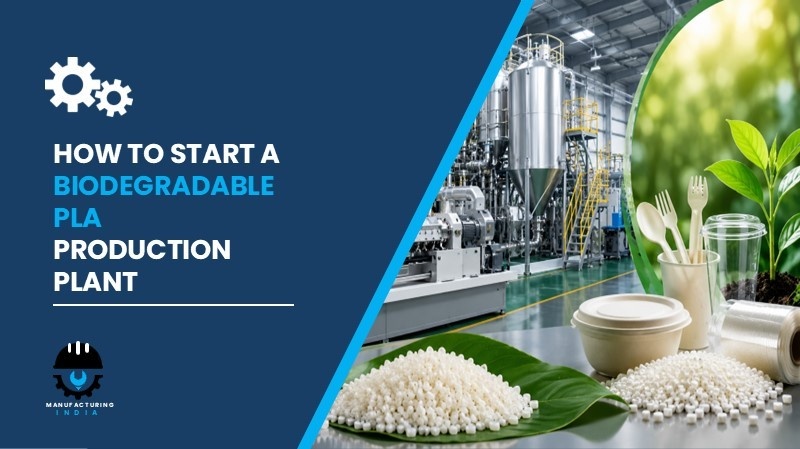
A biodegradable PLA production plant setup in India anchored in rising demand from the packaging industry, textile industry, agriculture sector, medical and healthcare industry, and 3D printing applications. As regulatory pressure to reduce single-use plastics intensifies and sustainable packaging solutions gain ground across these end-use sectors, this renewable, plant-derived material is emerging as a foundational input for industries seeking to lower their environmental footprint without compromising functional performance.
India’s emerging biobased materials ecosystem adds further weight to the investment case. In March 2026, Balrampur Chini Mills Limited’s PLA division, Balrampur Bioyug, secured its first institutional order from the Lucknow Cantonment Board for compostable garbage bags, 300 ml bottles, 3D-printed pens, and folders, supplied under the Ministry of Defence alongside IIT Kanpur initiatives and Swachhata Hi Seva participation. Developments of this nature indicate that domestic institutional procurement is beginning to favour biodegradable alternatives, positioning a new production plant to benefit from both early-mover advantage and the structural shift away from single-use plastics across packaging, textiles, agriculture, and healthcare.
India’s biodegradable PLA opportunity is built on intensifying regulatory pressure against single-use plastics, expanding demand across packaging, textile, agriculture, and healthcare applications, and gross margins of 30-40% that support viable break-even economics for a well-planned production plant.
What is Biodegradable PLA?
Biodegradable PLA (polylactic acid) is a bio-based and compostable polymer derived primarily from renewable resources such as corn starch, sugarcane, or cassava. It is produced through the fermentation of sugars into lactic acid, followed by polymerization into PLA resin. The material offers properties similar to conventional plastics, including clarity, rigidity, and processability, while retaining the advantage of being industrially compostable under controlled conditions. It is compatible with multiple processing techniques, including injection molding, extrusion, and thermoforming, which allows it to be converted into a wide range of finished formats.
The PLA production process used for this material centres on fermentation of carbohydrates to produce lactic acid, purification, polymerization through ring-opening polymerization, granulation, and packaging. Biodegradable PLA serves a broad set of end-use industries, including the packaging industry, textile industry, agriculture sector, medical and healthcare industry, and 3D printing applications, reflecting the material’s versatility across both consumer-facing and industrial use cases.
Cost of Setting Up a Biodegradable PLA Production Plant in India
The total investment required for a biodegradable PLA production plant depends on plant capacity, technology selection, location, automation level, and regulatory compliance requirements specific to India.
1. Capital Expenditure (CapEx)
Land and site development costs form a significant share of capital expenditure and include charges for land registration, boundary development, and other related expenses, alongside site preparation and necessary infrastructure. Civil works cover construction of the production shed, laboratory, storage areas, and administrative block, and together with land development costs they establish the foundation for safe and efficient plant operations.
Machinery costs represent the largest portion of total capital expenditure for this project, with the scale of production and the level of automation determining the overall cost of equipment. Key machinery required includes:
- Fermenters
- Reactors for polymerization
- Centrifuges
- Filtration systems
- Extrusion and pelletizing units
- Drying systems
- Packaging machines
Other capital costs cover effluent treatment systems needed to minimize environmental impact and ensure compliance with emission standards, along with pre-operative and commissioning expenses associated with bringing the plant into operation.
Request a Sample Report for In-Depth Market Insights: https://www.imarcgroup.com/biodegradable-pla-manufacturing-plant-project-report/requestsample
2. Operational Expenditure (OpEx)
Raw material cost is the dominant component of operating expenditure, with corn starch/lactic acid and catalyst together accounting for approximately 60-70% of total OpEx. Securing reliable suppliers and negotiating long-term contracts is essential to mitigate price volatility and ensure a steady, consistent supply of these inputs.
Utility cost, covering electricity, water, and steam, accounts for approximately 20-25% of OpEx and is closely tied to the scale and continuity of fermentation and polymerization operations. Other operating costs include transportation, packaging, salaries and wages, depreciation, taxes, and repairs and maintenance, all of which are accounted for within the first year of operations.
By the fifth year, total operational cost is expected to increase substantially due to inflation, market fluctuations, and potential rises in the cost of key materials, with supply chain disruptions, rising consumer demand, and shifts in the global economy contributing further to this increase.
3. Plant Capacity
The proposed biodegradable PLA plant is designed with an annual production capacity ranging between 20,000 and 50,000 tons, enabling economies of scale while maintaining operational flexibility. Capacity can be customized based on investor requirements, and financial projections account for production capacity utilization alongside operating costs, pricing trends, and demand outlook, indicating that profitability is closely linked to how effectively installed capacity is utilized.
4. Profit Margins and Financial Projections
Financial analysis for this type of plant covers liquidity analysis, profitability analysis, payback period, net present value (NPV), and internal rate of return (IRR), alongside the profit and loss account, uncertainty analysis, and sensitivity analysis. Gross profit margins typically range between 30-40%, supported by stable demand and value-added applications, while net profit margins range between 15-22%. These projections are developed based on realistic assumptions related to capital investment, operating costs, production capacity utilization, pricing trends, and demand outlook, providing a comprehensive view of the project’s financial viability and long-term sustainability.
Why Set Up a Biodegradable PLA Production Plant in India?
Rising Demand for Sustainable Materials: Increasing environmental awareness and tightening regulations are accelerating the shift toward biodegradable polymers such as PLA, supporting consistent offtake for new production capacity.
Strong Regulatory Support: Government policies restricting single-use plastics are creating favourable conditions for PLA adoption, a trend reinforced internationally by policy roadmaps such as China’s 2019-2025 restrictions on ultra-thin plastic bags, takeaway containers, and non-compliant packaging.
Expanding End-Use Applications: Growth across packaging, textiles, agriculture, and healthcare sectors is driving consistent demand, supported by advancements in polymer technology that are improving the mechanical and thermal properties of PLA and expanding its usability in more demanding applications.
Renewable Feedstock Advantage: Production relies on bio-based raw materials such as corn starch, sugarcane, or cassava, ensuring long-term sustainability and a reduced carbon footprint relative to conventional plastics.
High Growth and Premium Pricing: The market offers attractive margins due to the value-added nature of biodegradable materials, with gross margins of 30-40% reflecting this premium positioning.
Active Industry Investment: In March 2026, Balrampur Chini Mills Limited’s PLA division, Balrampur Bioyug, received its first institutional order from the Lucknow Cantonment Board, supplying compostable garbage bags, 300 ml bottles, 3D-printed pens, and folders under the Ministry of Defence, alongside IIT Kanpur initiatives and Swachhata Hi Seva participation – a concrete signal of growing institutional commitment to biodegradable PLA within India.
Production Process – Step by Step
The biodegradable PLA production process uses fermentation of carbohydrates to produce lactic acid, followed by purification and polymerization, as the primary production method.
- Fermentation: Carbohydrate feedstock is fermented within fermenters to convert sugars into lactic acid.
- Purification: Centrifuges and filtration systems separate impurities from the lactic acid stream ahead of polymerization, supported by mass balance checks and quality assurance criteria.
- Polymerization: Purified lactic acid undergoes ring-opening polymerization within dedicated reactors to form the PLA polymer base.
- Granulation: Extrusion and pelletizing units, supported by drying systems, convert the polymerized resin into uniform PLA granules ready for downstream processing.
- Packaging and Dispatch: The granulated PLA is packed using dedicated packaging machines and dispatched to the packaging, textile, agriculture, medical and healthcare, and 3D printing industries that rely on it as a feedstock.
Key Applications
Biodegradable PLA serves a diverse set of industries, anchored by its compostability and renewable-feedstock profile.
- Packaging Industry: Used extensively in sustainable packaging formats such as films, containers, and bottles, offering biodegradability and reduced environmental impact.
- Textile Industry: PLA fibers are used in fabric production, providing lightweight, breathable, and eco-friendly alternatives to synthetic fibers.
- Agriculture Sector: Enables production of biodegradable mulch films that reduce soil contamination and eliminate the need for removal after use.
- Medical and Healthcare Industry: Used in biodegradable sutures, implants, and drug delivery systems due to its biocompatibility.
- 3D Printing and Additive Manufacturing: Supports additive manufacturing applications, including 3D-printed products, given its processability and eco-friendly profile.
Leading Manufacturers
The global biodegradable PLA industry is led by several multinational producers with extensive production capacities and diverse application portfolios. Key players include:
- Cargill Incorporated
- PTT MCC Biochem Co., Ltd.
- Biome Technologies plc
- Plantic Technologies Limited
- BASF SE
- Total Corbion PLA
- NatureWorks LLC
Timeline to Start the Plant
- Feasibility study and project report preparation
- Land acquisition and site development
- Regulatory approvals and environmental clearances
- Factory licence and fire safety compliance
- Machinery procurement and installation
- Raw material supplier agreements and supply chain setup
- Trial production and quality testing
- Commercial production launch
Licences and Regulatory Requirements
Starting a biodegradable PLA production unit in India requires several approvals:
- Business registration (Proprietorship, LLP, or Pvt Ltd)
- Factory Licence under the Factories Act
- Environmental Clearance from State Pollution Control Board
- GST Registration
- Fire Safety NOC
- Hazardous/Chemical compliance, relevant given the fermentation and polymerization chemistry and catalyst handling involved
- Effluent Treatment Plant (ETP) operational clearance
- Occupational Health and Safety compliance
Key Challenges to Consider
High Capital Requirements: Machinery costs, comprising fermenters, polymerization reactors, centrifuges, filtration systems, extrusion and pelletizing units, drying systems, and packaging machines, account for the largest share of capital expenditure.
Raw Material Price Volatility: Corn starch/lactic acid and catalyst together make up 60-70% of operating costs, making the plant’s economics sensitive to feedstock price swings.
Regulatory Compliance: Environmental clearances, effluent treatment requirements, and emission standard compliance must be maintained continuously, alongside safety protocols and monitoring systems to detect leaks or process deviations.
Technology and Innovation Pressure: Ongoing advancements in polymer technology are improving the mechanical and thermal properties of PLA, requiring producers to continually refine the PLA production process to remain competitive in more demanding applications.
Competition: Established global producers, including Cargill Incorporated, NatureWorks LLC, Total Corbion PLA, and BASF SE, operate with extensive production capacities and diverse application portfolios.
Skilled Manpower: Human resource requirements span unit operations, quality assurance, and maintenance, with staff training needed to optimize processes and control operational costs.
Frequently Asked Questions
1. How much does it cost to set up a biodegradable PLA production plant in India?
Total cost depends on plant capacity, automation level, and location, and is driven primarily by machinery costs alongside land and site development, civil works, and other capital costs.
2. Is biodegradable PLA production profitable in India in 2026?
The project demonstrates healthy profitability potential, with gross profit margins typically ranging between 30-40% and net profit margins between 15-22%, supported by stable demand and value-added applications.
3. What machinery is required for a biodegradable PLA plant in India?
Key machinery includes fermenters, reactors for polymerization, centrifuges, filtration systems, extrusion and pelletizing units, drying systems, and packaging machines.
4. What licences and approvals are required to start a biodegradable PLA plant in India?
Requirements include business registration, a Factory Licence, Environmental Clearance from the State Pollution Control Board, GST Registration, Fire Safety NOC, hazardous/chemical compliance, ETP operational clearance, and occupational health and safety compliance.
5. What raw materials are needed for biodegradable PLA production?
The primary raw materials are corn starch/lactic acid and catalyst, which together account for approximately 60-70% of operating expenditure.
6. What are the environmental compliance requirements for a biodegradable PLA plant in India?
Plants must implement effluent treatment systems, maintain advanced monitoring systems to detect leaks or process deviations, and comply with emission standards and environmental regulations under applicable zoning and clearance requirements.
7. What is the best location to set up a biodegradable PLA plant in India?
The location should offer easy access to key raw materials such as corn starch/lactic acid and catalyst, proximity to target markets to minimize distribution costs, robust transportation and utility infrastructure, and compliance with local zoning and environmental regulations.
8. What is the break-even period for this type of plant in India?
Break-even timing is assessed through payback period, net present value (NPV), and internal rate of return (IRR) analysis as part of the project’s overall financial and profitability analysis.
9. What government incentives are available for producers in India?
The report highlights that government policies restricting single-use plastics are creating favourable regulatory conditions for PLA adoption, supporting demand for domestically produced biodegradable alternatives.
Key Takeaways for Investors
A biodegradable PLA production plant represents a credible investment opportunity in the Indian market, supported by demand from the packaging, textile, agriculture, medical and healthcare, and 3D printing industries. Financial viability holds across the proposed capacity range of 20,000-50,000 tons annually, with gross margins of 30-40% and net margins of 15-22% sustaining attractive returns. Globally, North America currently holds the largest market share at 42.3%, while regulatory tightening on single-use plastics across multiple regions continues to expand the addressable market for compostable alternatives. With institutional procurement already taking shape domestically, as seen in the Lucknow Cantonment Board order to Balrampur Bioyug, demand for biodegradable PLA in India is positioned to remain on a sustained growth trajectory.
About the Author