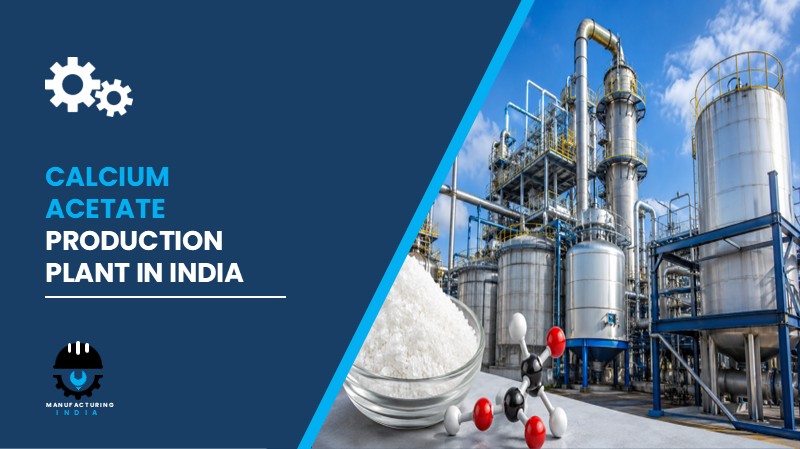
Calcium Acetate Production Plant
Setting up a calcium acetate production plant in India presents a compelling investment case at a time when the country’s pharmaceutical manufacturing sector is targeting USD 130 Billion by 2030, its food processing industry is set to more than double from USD 307 Billion in 2023 to USD 700 Billion by 2030, its water treatment infrastructure is being systematically expanded with rising urbanisation, and its specialty chemical manufacturing base is deepening under Make in India policy priorities. Calcium acetate — the white hygroscopic solid derived from acetic acid and calcium that serves simultaneously as a pharmaceutical phosphate binder for chronic kidney disease patients, a food preservative and acidity regulator, a water treatment chemical, and an industrial stabiliser — is positioned at the intersection of four of India’s most robustly growing industrial sectors simultaneously. As India’s dialysis patient population expands with rising chronic kidney disease prevalence, its organised food processing deepens, and its industrial water treatment compliance obligations tighten, the domestic requirement for consistently produced, specification-grade calcium acetate from reliable Indian producers is growing into a commercially accessible and multi-sector investment opportunity.
India’s food processing sector expansion directly validates the commercial environment for calcium acetate producers targeting this market. India’s food processing sector is set to more than double its market size from Rs. 26,60,155 crore (USD 307 Billion) in 2023 to Rs. 60,65,500 crore (USD 700 Billion) by 2030, driven by rising demand for processed products, according to the PHD Chamber of Commerce and Industry (PHDCCI). This extraordinary expansion of organised food manufacturing creates an immediate and growing institutional demand for food-grade additives including calcium acetate as a stabiliser, preservative, firming agent, and acidity regulator. Simultaneously, India’s pharmaceutical sector — one of the world’s largest generic drug manufacturing bases — serves a growing domestic patient population with chronic kidney disease that requires phosphate binder medications including calcium acetate formulations. Specialty chemical industrial estates in Gujarat and Maharashtra offer the acetic acid supply chain proximity, corrosion-resistant reactor infrastructure, analytical chemistry expertise, and regulatory frameworks that a calcium acetate production facility requires to serve both food-grade and pharmaceutical-grade customer segments from a single production base.
Investing in a calcium acetate production plant in India today aligns India’s food processing sector doubling to USD 700 Billion by 2030, pharmaceutical manufacturing targeting USD 130 Billion, growing water treatment infrastructure, and specialty chemical demand across industrial applications with a global calcium acetate market growing from USD 124.67 Million in 2025 to USD 164.10 Million by 2034 at a 3.1% CAGR. With gross profit margins of 22–30% and net profit margins of 13–19% at an annual production capacity of 8,000 MT, the unit economics are commercially sound, and the investment’s multi-sector application base supports long-term revenue diversification across India’s most structurally growing consumer and industrial sectors.
What is Calcium Acetate?
Calcium acetate is a chemical compound derived from acetic acid and calcium. Its primary medical application is as a phosphate binder for patients with chronic kidney disease. It works by binding to dietary phosphorus in the digestive tract, forming an insoluble complex that is excreted in faeces, preventing its absorption. This process helps control high blood phosphate levels, mitigating complications like bone and heart disease. Beyond its pharmaceutical role, calcium acetate serves as an antimicrobial agent, thickener, and preservative in the food industry, and functions as a stabiliser in various industrial and manufacturing processes.
Calcium acetate appears as a white, hygroscopic powder or granules with a slightly acetic odour. It is highly water-soluble, making it effective as both a food-grade additive and a pharmaceutical active ingredient in oral formulations. The compound’s dual functionality — simultaneously providing calcium as a mineral supplement while binding phosphate in the gastrointestinal tract — makes it distinctly valuable in chronic kidney disease management, where both phosphate control and calcium supplementation are often simultaneously required by dialysis patients. In food applications, it functions as an acidity regulator, preservative, firming agent, and buffering agent in processed foods, breads, and bakery products. In industrial applications, it serves as a stabiliser, catalyst intermediate, and specialty chemical precursor.
The primary production process covers neutralisation of acetic acid with calcium hydroxide, followed by filtration, concentration, crystallisation, drying, and packaging. End-use industries served include food and beverages, pharmaceuticals, chemicals, agriculture, water treatment, and laboratory chemicals. Applications span food additive and preservative, pharmaceutical excipient and phosphate binder, water treatment chemical, fertiliser additive, and specialty chemical intermediate.
Cost of Setting Up a Calcium Acetate Production Plant in India
The cost of establishing a calcium acetate production plant in India depends on production capacity, product grade mix across pharmaceutical-grade, food-grade, and industrial-grade calcium acetate, process technology for concentration and crystallisation stages, geographic location — particularly proximity to acetic acid supply and pharmaceutical or food manufacturer customers — degree of automation, and the GMP, FSSAI, and quality compliance requirements applicable to calcium acetate supplied across regulated food, pharmaceutical, and industrial market segments.
1. Capital Expenditure (CapEx)
Land and Site Development forms a foundational component of total capital investment, covering land acquisition charges, site registration, boundary development, acid-resistant drainage and containment infrastructure, and site utilities. The location must offer easy access to key raw materials such as acetic acid, calcium hydroxide, and water. Proximity to target markets will help minimise distribution costs. The site must have robust infrastructure, including reliable transportation, utilities, and waste management systems. Compliance with local zoning laws and environmental regulations must also be ensured. Specialty chemical and pharmaceutical manufacturing industrial estates in Gujarat — particularly in Ankleshwar, Vadodara, and Ahmedabad where acetic acid supply chains from domestic acetic acid producers are well-established — and Maharashtra’s Raigad and Pune pharmaceutical manufacturing districts offer the most commercially advantaged operating environments for a calcium acetate producer serving both food/pharmaceutical and industrial customer segments.
Plant Layout Optimisation is critical for a calcium acetate production facility that must simultaneously meet food-grade hygiene standards and pharmaceutical GMP requirements across shared or segregated production areas. The layout should be optimised to enhance workflow efficiency, safety, and minimise material handling. Separate areas for raw material storage for acetic acid and calcium hydroxide with appropriate corrosion-resistant containment, the neutralisation reaction area, filtration and concentration operations, crystallisation vessels, drying systems, pharmaceutical-grade or food-grade packaging areas, quality control laboratory, and finished goods storage must be designated. Space for future expansion should be incorporated to accommodate business growth.
Machinery and Equipment represent the largest single component of total CapEx for a calcium acetate production plant. Essential equipment includes:
- Reaction vessels
- Raw material storage tanks
- Dosing systems
- Filtration units
- Evaporators
- Crystallisers
- Centrifuges
- Drying systems
- Milling equipment
- Packaging machines
Other Capital Costs include effluent treatment systems to minimise environmental impact and ensure compliance with emission standards for acetic acid-containing process effluents, advanced monitoring systems to detect leaks or deviations in the process, pre-operative expenses, FSSAI and drug licence application costs, GMP certification infrastructure for pharmaceutical-grade production, commissioning charges, and import duties on specialised crystallisation or pharmaceutical-grade drying equipment not available domestically.
Request a Sample Report for In-Depth Market Insights: https://www.imarcgroup.com/calcium-acetate-manufacturing-plant-project-report/requestsample
2. Operational Expenditure (OpEx)
Raw Material Cost is the dominant operational expense, accounting for approximately 58–68% of total OpEx. The primary raw materials are acetic acid, calcium hydroxide, and water. Acetic acid — as the primary organic acid feedstock consumed in the largest value quantities in the neutralisation reaction — drives the vast majority of raw material cost and is priced in correlation with acetic acid market dynamics tied to methanol, syngas, and carbonylation process economics. India has established domestic acetic acid production from Jubilant Life Sciences and other producers, providing cost-competitive domestic supply that reduces import exposure. Calcium hydroxide (hydrated lime) is the calcium source, widely available from domestic lime producers across Rajasthan, Gujarat, and Andhra Pradesh at competitive prices. Long-term contracts with reliable suppliers for both acetic acid and calcium hydroxide are essential to stabilise pricing and ensure a steady supply.
Utility Cost is the second-largest OpEx component, representing approximately 6–10% of total operating expenses — a relatively modest utility proportion reflecting the moderate energy requirements of neutralisation, evaporation, crystallisation, and drying operations at the 8,000 MT annual capacity scale. Electricity and steam for evaporator and dryer operations constitute the primary utility inputs.
Other Operating Costs include transportation and distribution to pharmaceutical manufacturers, food and beverage companies, water treatment chemical formulators, textile processing companies, agricultural chemical companies, and laboratory chemical distributors, specialised pharmaceutical-grade and food-grade packaging materials, salaries and wages for inorganic chemists and quality control analysts, routine machinery maintenance, GMP audit and FSSAI compliance costs, depreciation on production equipment, and applicable taxes. By the fifth year, the total operational cost is expected to increase substantially due to factors such as inflation, market fluctuations, and potential rises in the cost of key materials. Additional factors, including supply chain disruptions, rising consumer demand, and shifts in the global economy, are expected to contribute to this increase.
3. Plant Capacity
The proposed production facility for calcium acetate is designed with an annual production capacity of 8,000 MT, enabling economies of scale while maintaining operational flexibility across pharmaceutical-grade calcium acetate for phosphate binder formulations, food-grade calcium acetate for processed food applications, and industrial-grade calcium acetate for water treatment, textile processing, and specialty chemical applications. Plant capacity can be customised per investor requirements and phased in line with secured customer qualification approvals across the pharmaceutical, food and beverage, and industrial chemical market segments.
4. Profit Margins and Financial Projections
The financial projections for a calcium acetate production plant demonstrate healthy profitability potential under normal operating conditions. Gross profit margins typically range between 22–30%, supported by stable demand and value-added applications across pharmaceutical, food and beverage, water treatment, and specialty chemical customer segments. Net profit margins are projected at 13–19% — commercially attractive returns reflecting the meaningful value-added conversion of acetic acid and calcium hydroxide feedstocks into a pharmaceutical and food-grade specialty chemical that commands significant premiums over its raw material inputs. A comprehensive financial analysis covering NPV, IRR, payback period, and five-year projections is essential before committing capital.
Why Set Up a Calcium Acetate Production Plant in India?
Essential Specialty Chemical Across Multiple High-Growth Indian Sectors. Calcium acetate is a widely used specialty chemical across food processing, pharmaceuticals, water treatment, chemical manufacturing, and laboratory applications, positioning it as an important product for industrial processing, preservation, and formulation requirements. This multi-sector demand profile — spanning India’s four most rapidly growing consumer and industrial sectors simultaneously — provides commercial resilience and revenue diversification that single-application chemical investments cannot match.
India’s Food Processing Sector Doubling to USD 700 Billion by 2030. India’s food processing sector is set to more than double its market size from USD 307 Billion in 2023 to USD 700 Billion by 2030, driven by rising demand for processed products. This extraordinary expansion of organised food manufacturing creates an immediate and growing institutional customer base for food-grade calcium acetate as a stabiliser, preservative, firming agent, and acidity regulator in processed foods, breads, and bakery products — a demand trajectory that directly benefits Indian calcium acetate producers with supply chain and customer service responsiveness advantages over import alternatives.
Growing Pharmaceutical Demand from Chronic Kidney Disease Patient Population. In the healthcare sector, calcium acetate is widely used as a phosphate binder for patients with chronic kidney disease, sustaining steady demand from renal care markets. India’s growing dialysis patient population — driven by rising prevalence of diabetes, hypertension, and chronic kidney disease across the country’s ageing and increasingly urbanised population — creates structural, recurring demand for phosphate binder medications including calcium acetate formulations. India’s pharmaceutical sector targeting USD 130 Billion by 2030 provides the institutional manufacturing demand for pharmaceutical-grade calcium acetate as an active ingredient and excipient.
Water Treatment Infrastructure Expansion Driving Industrial Demand. Industrial demand is further supported by applications in textiles, chemicals, and laboratory reagents. Rising environmental regulations in water treatment facilities are driving organisations to use effective treatment chemicals across phosphate removal, effluent treatment, and system stabilisation applications where calcium acetate serves as a functional treatment chemical. India’s expanding water treatment infrastructure investment — driven by Jal Jeevan Mission, Smart City water systems, and industrial effluent compliance obligations — creates growing institutional demand for water treatment chemicals including calcium acetate.
Sustainable Innovation Expanding Application Scope. In January 2026, a study published in Materials Today Communications evaluated three methods — conventional solution chemistry with magnetic stirring, ultrasonic-assisted reaction, and solvent-free mechanochemistry — to produce calcium and magnesium acetates from oil shale ash. The result concluded that mechanochemistry emerged as a rapid, sustainable method for producing acetate-based deicers with minimal reactant use, highlighting oil shale ash’s potential as a valuable resource for winter road maintenance. This research confirms ongoing innovation in calcium acetate production methodology and application scope expansion, adding de-icing and road maintenance as an emerging demand category alongside the established pharmaceutical, food, and industrial applications.
Moderate Entry Barriers Favouring Quality-Focused Manufacturers. While production technology is relatively straightforward, consistent product purity, stringent quality standards, regulatory compliance, efficient process control, and reliable raw material sourcing create entry barriers that favour manufacturers capable of delivering high-quality products at competitive costs. These barriers — particularly GMP certification for pharmaceutical supply and FSSAI compliance for food applications — reward producers who invest in quality infrastructure from the outset and create commercially defensible supply positions once customer qualifications are achieved.
Production Process — Step by Step
The calcium acetate production process uses neutralisation of acetic acid with calcium hydroxide, followed by filtration, concentration, crystallisation, drying, and packaging as the primary production method. Each stage requires precisely controlled pH, temperature, reaction time, and crystallisation conditions to produce calcium acetate of the target purity, crystal form, and moisture content required by pharmaceutical, food, and industrial customers.
- Raw Material Preparation and Dosing: Acetic acid is received from certified suppliers, quality-checked for concentration and purity, and metered in the specified stoichiometric quantity into the neutralisation reactor using dosing systems. Calcium hydroxide is slurried or dissolved in water in controlled proportions, with all process parameters confirmed before the neutralisation reaction is initiated.
- Neutralisation Reaction in Reaction Vessels: Acetic acid solution is reacted with calcium hydroxide under controlled pH and temperature conditions in reaction vessels, producing calcium acetate solution as the primary product. The pH is monitored continuously and controlled to the target endpoint that achieves complete and balanced neutralisation without excess of either reactant — critical for achieving the purity levels required by pharmaceutical and food-grade product specifications.
- Filtration: The crude calcium acetate solution is processed through filtration units to remove any undissolved calcium hydroxide, insoluble calcium compounds, and particulate impurities, producing a clear, homogeneous calcium acetate solution suitable for concentration and crystallisation.
- Evaporation and Concentration: Filtered calcium acetate solution is processed through evaporators under controlled temperature and vacuum conditions to concentrate the solution to the supersaturation level required for controlled crystallisation, with care taken to prevent premature crystallisation or colour development during concentration.
- Crystallisation: Concentrated calcium acetate solution is processed through crystallisers under controlled temperature cooling and seeding conditions to produce uniform calcium acetate crystals of the specified morphology and purity required for pharmaceutical-grade, food-grade, or industrial-grade product specifications.
- Centrifugation and Washing: Crystallised calcium acetate is separated from mother liquor through centrifuges and washed with controlled quantities of water to remove residual acetic acid, soluble impurities, and surface contaminants that would affect the purity and quality of the finished product.
- Drying: Centrifuged and washed calcium acetate is processed through drying systems at controlled temperature to reduce moisture content to specification levels — typically below 0.5% for pharmaceutical-grade products — while preventing decomposition or discolouration of the calcium acetate crystal.
- Milling and Classification: Dried calcium acetate is processed through milling equipment where required to achieve the target particle size distribution for specific end-use applications — fine powder for pharmaceutical formulation, granular for food applications, and varied sizes for industrial use.
- Quality Testing: Finished calcium acetate undergoes comprehensive quality testing covering assay purity, moisture content, heavy metal content, pH of solution, colour, and specific impurity profiles, verifying compliance with pharmacopoeial (IP/BP/USP) specifications for pharmaceutical grades or FSSAI standards for food grades before packaging.
- Packaging and Dispatch: Specification-compliant calcium acetate is packaged in pharmaceutical-grade or food-grade containers using packaging machines and dispatched to pharmaceutical manufacturers, food and beverage companies, water treatment chemical formulators, textile processors, agricultural chemical companies, and laboratory chemical distributors.
Key Applications
Calcium acetate produced in India serves a commercially diverse and structurally growing range of applications across pharmaceutical, food, industrial, and agricultural sectors:
- Food Industry: Functions as an acidity regulator, preservative, buffering agent, and firming agent in processed foods — a demand segment growing directly with India’s food processing sector expansion toward USD 700 Billion by 2030.
- Pharmaceuticals: Serves as a phosphate binder for chronic kidney disease patients, pharmaceutical excipient, and calcium supplement active ingredient, sustaining steady demand from India’s growing renal care and pharmaceutical manufacturing markets.
- Chemical Industry: Functions as a precursor for acetate salts, catalyst formulations, and laboratory reagents across India’s expanding specialty chemical and research infrastructure.
- Textile and Industrial Processing: Applied as a mordant in dyeing, buffering agent, and specialty chemical in various manufacturing processes across India’s textile and industrial chemical sectors.
Leading Producers
The global calcium acetate industry is served by a group of specialty chemical and food ingredient companies with diverse production capabilities and application portfolios. Key players in the global market include:
- The Kerry Group, LLC
- Jiangsu Kolod Food Ingredients Co., Ltd.
- Jiangsu Aolikai Food Technology Co., Ltd.
- Macco Organiques, spol. s.r.o.
Timeline to Start the Plant
Establishing a calcium acetate production plant in India involves a structured multi-phase development sequence. Investors should plan for the following phases:
- Feasibility study and project report preparation
- Land acquisition and site development
- Regulatory approvals and environmental clearances
- Factory licence and fire safety compliance
- Machinery procurement and installation
- Raw material supplier agreements and supply chain setup
- Trial production and quality testing
- Commercial production launch
Licences and Regulatory Requirements
Starting a calcium acetate production unit in India requires several approvals spanning business registration, pharmaceutical and food safety compliance, environmental, and industrial safety domains:
- Business registration (Proprietorship, LLP, or Pvt Ltd)
- Factory Licence under the Factories Act
- Environmental Clearance from the State Pollution Control Board
- GST Registration
- Fire Safety NOC
- FSSAI (Food Safety and Standards Authority of India) Central or State licence mandatory for commercial manufacture and sale of food-grade calcium acetate as a food additive
- Drug licence under the Drugs and Cosmetics Act and GMP certification under Schedule M for pharmaceutical-grade calcium acetate supply to drug manufacturers
- Effluent treatment systems operational clearance to minimise environmental impact and ensure compliance with emission standards for acetic acid-containing process effluents
- Occupational Health and Safety compliance including acetic acid vapour exposure monitoring
Key Challenges to Consider
Acetic Acid Price Volatility and Supply Management. Acetic acid accounts for approximately 58–68% of total OpEx, with pricing subject to methanol and syngas market dynamics and global acetic acid supply-demand cycles. Long-term contracts with reliable suppliers will help mitigate price volatility and ensure a consistent supply, with sustainability and supply chain risks assessed carefully given acetic acid’s dependence on methanol feedstock markets.
Multi-Sector Regulatory Compliance Complexity. Serving pharmaceutical, food, and industrial customer segments simultaneously requires maintaining separate GMP-certified pharmaceutical production protocols, FSSAI-compliant food-grade manufacturing standards, and industrial-grade quality management — each with distinct documentation requirements, testing protocols, and regulatory oversight obligations. Managing this multi-regulatory compliance environment requires dedicated quality management systems investment and experienced regulatory affairs expertise.
GMP and FSSAI Qualification Timelines. Achieving GMP certification for pharmaceutical-grade calcium acetate supply requires factory assessment, standard operating procedure documentation, and batch record validation — a process that may extend 6–12 months beyond plant commissioning. FSSAI Central licence for food-grade additive production adds parallel regulatory approval timelines. Both qualification pathways must be planned carefully to align with commercial revenue expectations.
Competition from Established Domestic and Import Suppliers. The Indian calcium acetate market is served by both domestic producers and import supply from established Chinese and European food ingredient companies including Jiangsu Kolod Food Ingredients and Macco Organiques. New producers must compete through consistent pharmaceutical and food-grade purity, reliable delivery, competitive pricing from efficient acetic acid procurement, and customer service responsiveness.
Hygroscopic Product Storage and Packaging Management. Calcium acetate is hygroscopic — absorbing atmospheric moisture upon exposure — requiring moisture-controlled storage conditions, sealed pharmaceutical or food-grade packaging, and product turnover management to prevent quality degradation during the supply chain journey from production to end-use. This physical characteristic adds packaging cost and storage management obligations beyond non-hygroscopic chemical categories.
Market Size Requiring Export Strategy for Full Capacity Utilisation. The global calcium acetate market at USD 124.67 Million in 2025 — while growing steadily — is relatively modest compared to other specialty chemical categories, meaning a single 8,000 MT Indian plant could represent a significant fraction of addressable market share. Developing export market access alongside domestic supply is important for achieving and sustaining the capacity utilisation rates that support target profitability.
Frequently Asked Questions
1. How much does it cost to set up a calcium acetate production plant in India?
The total capital investment depends on plant capacity, product grade mix, technology, and location. Equipment costs — for reaction vessels, raw material storage tanks, dosing systems, filtration units, evaporators, crystallisers, centrifuges, drying systems, milling equipment, and packaging machines — represent a significant portion of capital expenditure. GMP certification infrastructure for pharmaceutical-grade production adds additional capital requirements. A detailed project report with full CapEx and OpEx breakdowns is available on request.
2. Is calcium acetate production profitable in India in 2026?
Yes. The project demonstrates gross profit margins of 22–30% and net profit margins of 13–19% under normal operating conditions, supported by India’s food processing sector doubling to USD 700 Billion by 2030, pharmaceutical sector targeting USD 130 Billion, and growing water treatment and specialty chemical demand. The global market growing from USD 124.67 Million in 2025 to USD 164.10 Million by 2034 at a 3.1% CAGR confirms sustained commercial opportunity.
3. What machinery is required for a calcium acetate production plant in India?
Key machinery includes reaction vessels, raw material storage tanks, dosing systems, filtration units, evaporators, crystallisers, centrifuges, drying systems, milling equipment, and packaging machines. All equipment must be fabricated from corrosion-resistant materials compatible with acetic acid chemistry throughout all process contact surfaces.
4. What licences and approvals are required to start a calcium acetate production plant in India?
Required approvals include business registration, a Factory Licence under the Factories Act, Environmental Clearance from the State Pollution Control Board, GST registration, a Fire Safety NOC, FSSAI Central or State licence for food-grade additive manufacture, drug licence and GMP certification under Schedule M for pharmaceutical-grade supply, effluent treatment systems operational clearance, and Occupational Health and Safety compliance.
5. What raw materials are needed for calcium acetate production?
The primary raw materials are acetic acid, calcium hydroxide, and water. Acetic acid accounts for approximately 58–68% of total operating expenses, making acetic acid procurement strategy, supplier contracts with domestic acetic acid producers, and price risk management the most critical cost management levers for the investment.
6. What are the environmental compliance requirements for a calcium acetate production plant in India?
The unit must obtain Environmental Clearance from the State Pollution Control Board, operate effluent treatment systems to minimise environmental impact and ensure compliance with emission standards for acetic acid-containing process effluents, install advanced monitoring systems to detect leaks or deviations in the process, and maintain compliance monitoring for acetic acid vapour emissions and process water discharge.
7. What is the best location to set up a calcium acetate production plant in India?
Optimal locations offer proximity to acetic acid supply from domestic producers, calcium hydroxide from domestic lime manufacturers, reliable utilities, and access to pharmaceutical, food processing, and industrial chemical customer clusters. Specialty chemical industrial estates in Gujarat’s Ankleshwar and Vadodara corridors and Maharashtra’s Raigad and Pune pharmaceutical manufacturing districts are among the most strategically relevant options.
8. What is the break-even period for this type of plant in India?
The break-even period depends on plant capacity, product grade mix, customer qualification timelines, capacity utilisation rate, acetic acid pricing trends, and demand conditions across pharmaceutical, food, water treatment, and industrial customer segments. A detailed financial analysis including payback period, NPV, and IRR projections is included in the full project report, available via the sample request link.
9. What government incentives are available for manufacturers in India?
Government initiatives supporting food safety, pharmaceutical manufacturing, water treatment infrastructure, and domestic specialty chemical production — such as Make in India, the PLI scheme for pharmaceuticals, and chemical sector development programmes — are indirectly driving demand for calcium acetate across multiple industries and provide financial and regulatory support for production investments. Capital subsidies, power tariff concessions, and export promotion benefits under specialty chemicals categories may be applicable.
Key Takeaways for Investors
A calcium acetate production plant in India represents a commercially accessible and multi-sector diversified investment in a specialty chemical that simultaneously serves India’s four most structurally growing consumer and industrial markets — food processing doubling to USD 700 Billion by 2030, pharmaceuticals targeting USD 130 Billion by 2030, expanding water treatment infrastructure, and deepening specialty chemical manufacturing. The project demonstrates financial viability at an annual production capacity of 8,000 MT, with gross profit margins of 22–30% and net profit margins of 13–19% confirming commercially sound unit economics supported by the meaningful value-added neutralisation and crystallisation conversion of acetic acid and calcium hydroxide into pharmaceutical and food-grade specialty chemical compounds that command significant premiums over their raw material inputs. The global calcium acetate market, valued at USD 124.67 Million in 2025, is projected to reach USD 164.10 Million by 2034, growing at a CAGR of 3.1%, with India’s healthcare sector expansion, food processing growth, and water treatment compliance investment collectively sustaining a multi-vector domestic demand environment. With January 2026 research in Materials Today Communications confirming innovative sustainable production pathways expanding calcium acetate’s application scope into de-icing and road maintenance, and India’s food processing and pharmaceutical growth trajectories creating immediate domestic institutional demand, demand sustainability for India-based calcium acetate production is structurally sound and commercially compelling across the full investment horizon.
About the Author