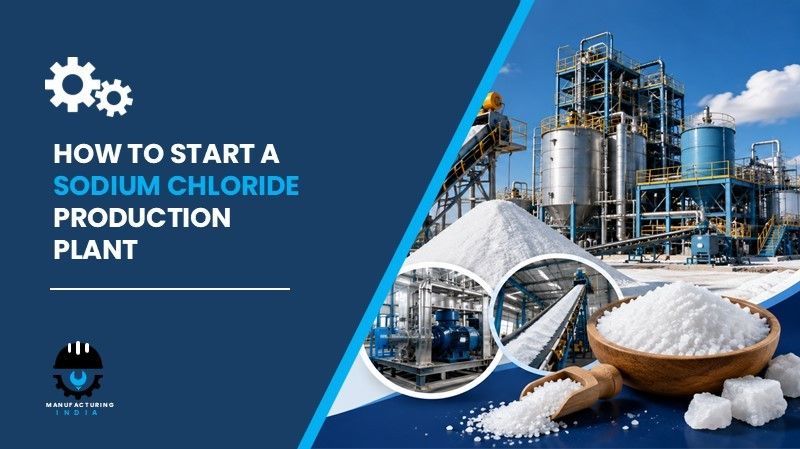
A sodium chloride production plant setup in India presents a compelling investment case for entrepreneurs, anchored in steady demand from food processing, chemical manufacturing, water treatment, and pharmaceutical formulations. Sodium chloride is a fundamental raw material across these sectors, serving as a key input in the chlor-alkali process for producing chlorine, caustic soda, and soda ash, while also supporting food preservation, de-icing, and agricultural applications. This broad-based, non-cyclical demand base makes this a resilient category for new investors.
The case is reinforced by underlying demand fundamentals: the Indian food processing market reached Rs. 30,49,800 crore (USD 354.5 Billion) in 2024 and is projected to grow to Rs. 4,584,415 crore (USD 535 Billion) by the end of FY26, per IBEF estimates. Since food-grade salt consumption is closely tied to preservation, seasoning, and curing, this growth directly benefits domestic producers. Combined with expanding chlor-alkali capacity and rising water treatment needs nationally, this investment is positioned for durable, multi-sector demand.
This is a moderately capital-intensive but sustainable entry into an essential commodity market, supported by policy and infrastructure investment across water treatment, chemicals, and pharmaceuticals. With gross margins of 22-30% and net margins of 12-18%, and a break-even period of 3 to 5 years, the case rests on stable demand, effective sourcing, and disciplined capacity utilization.
What is Sodium Chloride?
Sodium chloride is an ionic compound with the chemical formula NaCl, representing a 1:1 ratio of sodium and chlorine ions. Commonly known as table salt or halite, it is an essential mineral responsible for the saltiness of seawater. In the human body, it acts as a crucial electrolyte that regulates fluid balance, nerve impulses, and muscle contractions.
Commercial-scale output relies on a sodium chloride production process combining solution mining, evaporation, crystallization, and drying. The output serves food processing, water treatment, de-icing, chemical manufacturing, pharmaceuticals, and agriculture – a spread that insulates producers from demand shocks in any single sector.
Cost of Setting Up a Sodium Chloride Production Plant in India
The total investment required for a sodium chloride production plant depends on plant capacity, technology selection, location, automation level, and regulatory compliance requirements.
1. Capital Expenditure (CapEx)
Land and site development form a substantial part of the overall investment, covering land acquisition, land registration charges, boundary development, and site preparation. Civil works costs cover production infrastructure, storage facilities, and supporting site infrastructure needed for safe, efficient operations.
Machinery costs typically account for the largest share of total capital expenditure. Key machinery required includes:
- Crushers
- Screening units
- Washing tanks
- Vacuum pan evaporators
- Crystallizers
- Centrifuges
- Dryers
- Packaging machines
Auxiliary systems such as brine treatment units, solar evaporation ponds, pumps, conveyors, boilers, and water treatment units support these core operations. Other capital costs cover pre-operative expenses and initial working capital.
Request a Sample Report for In-Depth Market Insights: https://www.imarcgroup.com/sodium-chloride-manufacturing-plant-project-report/requestsample
2. Operational Expenditure (OpEx)
Raw material cost is the single largest component of operating expenses, accounting for approximately 35-45% of total OpEx. Core raw materials include rock salt, seawater, and brine, with lime or soda ash used as purification agents depending on the process route. Long-term supplier contracts help mitigate raw material price volatility and secure consistent supply.
Utility costs, covering electricity, water, and steam, represent 14-18% of total operating expenses. Beyond raw materials and utilities, other operating costs include transportation, packaging, salaries and wages, depreciation, taxes, and repairs and maintenance.
By the fifth year of operations, total costs are expected to rise substantially due to inflation, market fluctuations, potential increases in key raw material costs, supply chain disruptions, and shifts in the broader economy – a factor worth building into long-range planning.
3. Plant Capacity
A representative sodium chloride production plant is designed around an annual capacity of 200,000 MT, balancing scale with operational flexibility. Capacity can be customized to match investor requirements and target markets, and profitability generally improves with higher capacity utilization.
4. Profit Margins and Financial Projections
Financial viability is assessed through net present value (NPV), internal rate of return (IRR), and payback period analysis, alongside profit and loss projections. Gross profit margins typically range 22-30%, supported by stable demand and value-added applications, while net profit margins range 12-18%.
Why Set Up a Sodium Chloride Plant in India?
Essential Industrial and Consumer Commodity: This chemical serves as a fundamental raw material across chemical processing, food preservation, water treatment, pharmaceuticals, de-icing, and chlor-alkali production – an indispensable commodity supporting multiple industries at once.
Moderate but Sustainable Entry Barriers: While core technologies are well established, access to high-quality salt reserves, large-scale evaporation infrastructure, purification capabilities, and compliance with food- and industrial-grade specifications favor efficient, experienced producers over undercapitalized entrants.
Megatrend Alignment: Growing demand for chemicals, clean water solutions, processed foods, pharmaceuticals, and industrial output continues to drive consistent consumption. Expanding chlor-alkali capacity and rising water treatment requirements further strengthen long-term fundamentals.
Policy and Infrastructure Support: Investments in water treatment facilities, chemical capacity, food security initiatives, pharmaceutical output, and industrial infrastructure indirectly support demand across both industrial and consumer sectors.
Active Industry Investment: The sector continues to see product-level investment; in October 2025, B. Braun Medical Inc. launched Midazolam in 0.8% Sodium Chloride Injection in the U.S. market, offered preservative-free in two strengths and packaged without DEHP, PVC, or natural rubber latex.
Local Supply Chain Preference: Industrial users increasingly seek dependable domestic suppliers to ensure uninterrupted availability, reduce transportation costs, and mitigate disruptions – an opening for regional producers with strong distribution capabilities.
Sodium Chloride Production Process – Step by Step
This process uses solution mining, evaporation, crystallization, and drying as the primary production method, structured around the following stages:
- Sourcing of raw materials: Raw saltwater or rock salt is procured as the primary feedstock.
- Purification and clarification: Material is treated through brine treatment units, with crushers and screening units preparing rock salt feedstock, and washing tanks clarifying the solution.
- Evaporation or solar drying: Brine is processed through vacuum pan evaporators or solar evaporation ponds to concentrate the solution.
- Crystallization and drying: Crystallizers, centrifuges, and dryers convert concentrated brine into solid crystals.
- Packaging and storage: Packaging machines prepare the finished product for dispatch to food processing, chemical, water treatment, and pharmaceutical end users.
Key Applications
This compound serves a wide range of industrial and consumer applications across several major sectors.
- Food Processing: Used as a flavor enhancer, preservative, seasoning ingredient, and food-grade additive in processed foods and beverages.
- Chemical Industry: Serves as a key raw material in the chlor-alkali process for producing chlorine, caustic soda, soda ash, and other industrial chemicals.
- Water Treatment: Applied in water softening, wastewater treatment, and regeneration of ion-exchange resins.
- Pharmaceutical and Healthcare: Utilized in intravenous saline solutions, oral rehydration salts, dialysis fluids, and pharmaceutical formulations.
- De-icing and Agriculture: Used as a de-icing agent, preservative, and component of livestock feed.
Leading Sodium Chloride Manufacturers
The global industry is served by several established multinational producers with extensive capacities and diverse application portfolios. Key players include:
- China National Salt Industry Corporation
- K+S Aktiengesellschaft
- Cargill Inc.
- Compass Minerals
- Tata Chemicals
Timeline to Start the Plant
Setting up a sodium chloride production plant typically takes 12 to 36 months, depending on the production method chosen, site preparation, equipment installation, and regulatory approvals, with solar-based processes generally taking longer due to seasonal constraints. The core phases include:
- Feasibility study and project report preparation
- Land acquisition and site development
- Regulatory approvals and environmental clearances
- Factory licence and fire safety compliance
- Machinery procurement and installation
- Raw material supplier agreements and supply chain setup
- Trial production and quality testing
- Commercial production launch
Licences and Regulatory Requirements
Starting a sodium chloride production unit in India requires several approvals:
- Business registration (Proprietorship, LLP, or Pvt Ltd)
- Factory Licence under the Factories Act
- Environmental Clearance from State Pollution Control Board
- GST Registration
- Fire Safety NOC
- Effluent Treatment Plant (ETP) operational clearance
- Occupational Health and Safety compliance
- Industry-specific permits as applicable to the plant’s end products
Key Challenges to Consider
High Capital Requirements: Land acquisition, machinery procurement, installation, and pre-operative expenses require significant upfront capital before reaching commercial output.
Raw Material Price Volatility: Rock salt, seawater, and brine costs can fluctuate, and since raw materials account for 35-45% of OpEx, price swings directly affect margins.
Regulatory Compliance: Securing environmental clearances, factory licences, and industry-specific permits requires sustained coordination with state and central authorities.
Competition: Established producers such as China National Salt Industry Corporation, Cargill Inc., and Tata Chemicals compete on scale and distribution reach, requiring new entrants to differentiate on cost or service.
Skilled Manpower: Availability of trained personnel for operations, quality assurance, and safety compliance can constrain scale-up timelines.
Operational Risk Management: Ensuring consistent raw material supply and maintaining quality standards require robust operational systems from day one.
Frequently Asked Questions
1. How much does it cost to set up a sodium chloride production plant in India?
Capital requirements generally include land acquisition, construction, equipment procurement, installation, pre-operative expenses, and initial working capital. The total amount varies with plant capacity, technology, and location.
2. Is sodium chloride production profitable in India in 2026?
Profitability depends on market demand, production efficiency, pricing strategy, raw material cost management, and operational scale, with gross margins typically ranging 22-30% and net margins 12-18%. Margins usually improve with capacity expansion and higher capacity utilization.
3. What machinery is required for a sodium chloride plant in India?
Core machinery includes crushers, screening units, washing tanks, vacuum pan evaporators, crystallizers, centrifuges, dryers, and packaging machines, supported by auxiliary systems like pumps, conveyors, boilers, and water treatment units.
4. What licences and approvals are required to start a sodium chloride plant in India?
Typical requirements include business registration, environmental clearances, factory licences, fire safety certifications, and industry-specific permits, which may vary by state and local regulation.
5. What raw materials are needed for sodium chloride production?
Production requires seawater, rock salt (halite), or brine as primary feedstock, with additional purification agents such as lime or soda ash used depending on the process route.
6. What are the environmental compliance requirements for a sodium chloride plant in India?
Plants must implement effluent treatment systems to minimize environmental impact and ensure compliance with emission standards, alongside monitoring systems to detect process leaks or deviations.
7. What is the best location to set up a sodium chloride plant in India?
Site selection should prioritize easy access to raw materials such as rock salt or seawater and water, proximity to target markets to minimize distribution costs, and robust transportation, utility, and waste management infrastructure.
8. What is the break-even period for this type of plant in India?
Break-even typically ranges from 3 to 5 years, depending on production scale, energy costs, raw material availability, and market competition, with lower operating costs and bulk sales contracts helping accelerate returns.
9. What government incentives are available for producers in India?
Governments may offer capital subsidies, tax exemptions, reduced utility tariffs, export benefits, or interest subsidies to promote production under various national or regional industrial policies.
Key Takeaways for Investors
This plant taps into durable demand from food processing, chemical manufacturing, water treatment, and pharmaceutical sectors, underpinned by India’s food processing market growing from USD 354.5 Billion in 2024 toward USD 535 Billion by the end of FY26. Financial viability holds across plant capacities, with a representative 200,000 MT/year facility generating gross margins of 22-30% and net margins of 12-18%, alongside a 3-5 year break-even window. Globally, the sodium chloride market is projected to expand from USD 30.2 Billion in 2025 to USD 35.4 Billion by 2034. With demand anchored in essential, non-discretionary end uses, a well-executed sodium chloride production plant is positioned for sustained long-term relevance in India’s industrial economy.
About the Author