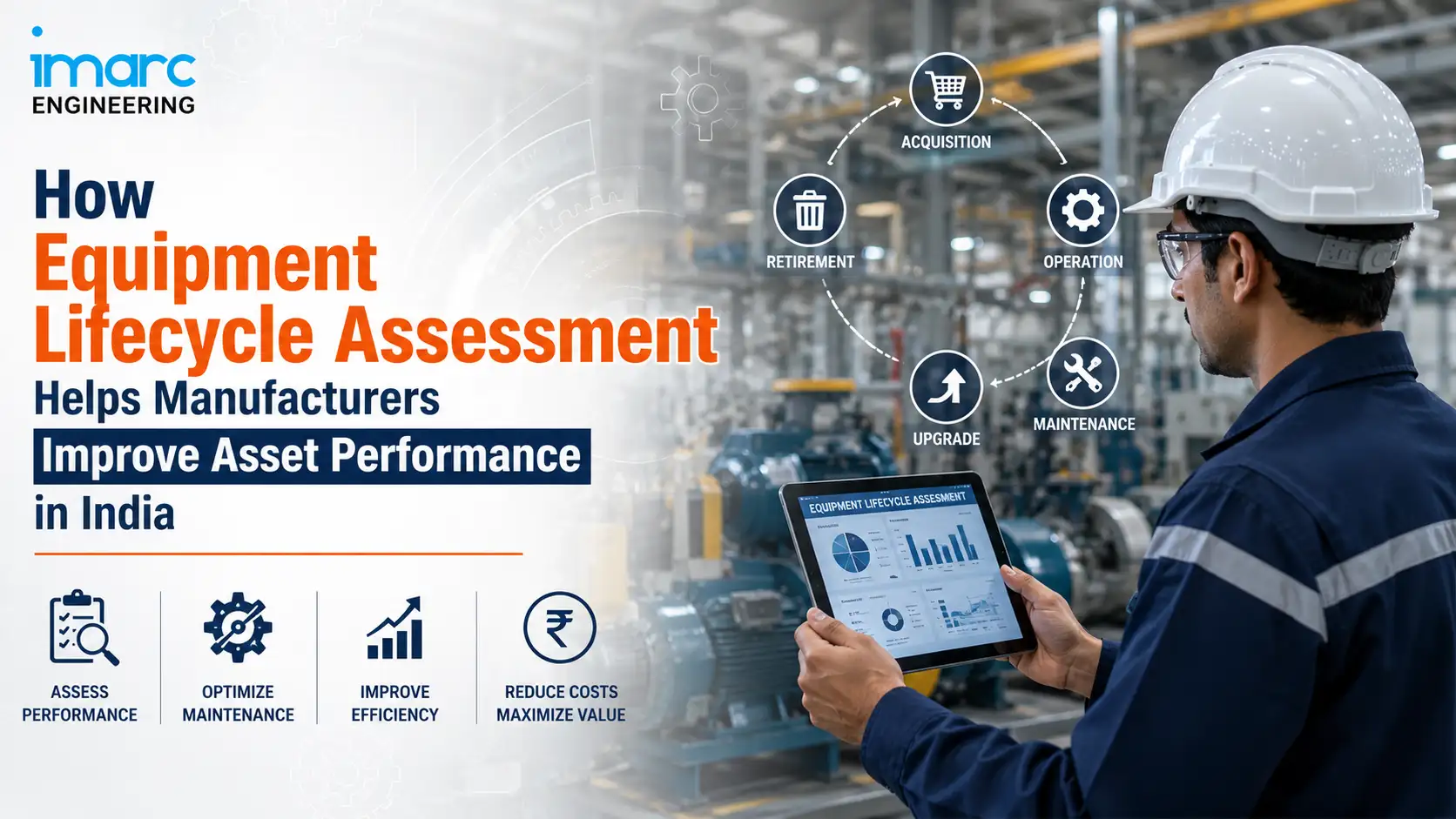
Equipment Lifecycle Assessment
Introduction
Industrial equipment is one of the largest and least monitored capital commitments a manufacturing business makes. A single press line, boiler, compressor, or packaging unit can represent crores in sunk capital, yet most businesses track it only through a maintenance log and an annual depreciation entry.
The real risks surface later: a machine running past its safe operating window without anyone flagging it, capacity that looks adequate on paper but has quietly degraded, or a replacement decision made on gut feel that turns out to be years too early or too late. An Equipment Lifecycle Assessment replaces that guesswork with evidence gathered stage by stage, from procurement through decommissioning.
An Equipment Lifecycle Assessment helps manufacturers determine the current condition, remaining useful life, maintenance requirements, compliance status, and replacement priority of every critical industrial asset using engineering-based evaluation rather than assumptions.
IMARC Engineering provides Equipment Lifecycle Assessment services for manufacturers, FMCG companies, exporters, and industrial businesses operating across India. This article explains what the assessment covers, why it matters for capital planning and safety compliance, and how a structured approach protects both output and investment.
What is Equipment Lifecycle Assessment?
Equipment Lifecycle Assessment is the systematic evaluation of industrial assets throughout their operational life—from procurement and commissioning to operation, maintenance, refurbishment, and decommissioning. The assessment combines condition monitoring, utilisation analysis, maintenance history, compliance verification, remaining useful life estimation, and total cost of ownership analysis to support informed maintenance and replacement decisions.
Why Equipment Lifecycle Assessment Is Important for Manufacturers in India (2026)
India’s capital equipment base is expanding fast, and the cost of leaving it unassessed is rising just as fast.
Capital Goods Sector Scale
The capital goods sector, which supplies the plant, machinery, and equipment used across Indian manufacturing, posted output of ₹4,29,001 crore in 2023-24, nearly doubling over the past decade.
Public and Private Capex Momentum
Public capital expenditure is budgeted to rise about 9% to ₹12.2 lakh crore in FY 2026-27, up 4.2 times since FY18, while Production Linked Incentive schemes have drawn over ₹2 lakh crore in realised investment as of September 2025, per the Economic Survey 2025-26. Every rupee of this capex adds equipment that will eventually need lifecycle evaluation.
Manufacturing Growth
Manufacturing value added grew 9.1% in Q2 FY2025-26 per MOSPI’s quarterly GDP estimates, with the sector now contributing close to 17% of India’s Gross Value Added, adding pressure on existing equipment to run at higher utilisation.
Technology Upgradation Support
The Credit Linked Capital Subsidy Scheme offers a 15% upfront capital subsidy on institutional finance of up to ₹1 crore for technology upgradation across 51 approved sub-sectors, per the Ministry of MSME, an incentive that only pays off when businesses know which equipment genuinely needs replacing.
The Safety Cost of Unassessed Machinery
Mechanically powered machinery contributed 1,231 fatal injuries, 9,386 non-fatal injuries, and 1,276 dangerous occurrences in India’s registered factories between 2014 and 2023, per DGFASLI data. India records one serious industrial accident roughly every two days in registered factories alone.
MSME Modernisation Gap
MSMEs account for 35.4% of India’s manufacturing GVA, per the MSME Ministry and Economic Survey 2025-26, yet a large share continue running on ageing plant and machinery that has never been formally assessed for remaining useful life or compliance status.
The opportunity is real. The risk is in not knowing, with evidence rather than assumption, exactly what condition your equipment is in and how long it can safely and economically keep running.
Why Unassessed Equipment Creates Risk That Compounds Over Time
Most equipment-related losses do not appear suddenly. They build up quietly across several fronts until a breakdown, an audit, or an accident forces the issue.
- Unplanned downtime: Equipment nearing end-of-life fails without warning, halting production lines and cascading into missed delivery commitments.
- Safety liability: Machinery running past its safe operating parameters without documented inspection is a leading contributor to factory injuries and regulatory exposure.
- Compliance gaps: Equipment tied to BEE energy norms, pollution control board consents, or boiler and pressure vessel regulations can fall out of compliance without anyone tracking renewal cycles.
- Capital misallocation: Without a lifecycle view, businesses either replace equipment years before it needs replacing or keep running assets well past the point where repair costs exceed replacement value.
- Insurance and warranty exposure: Claims are frequently denied when maintenance records cannot demonstrate the equipment was operated and serviced within manufacturer specifications.
- Resale and residual value erosion: Equipment sold or transferred without a documented condition history commands a lower resale price and slower buyer interest.
A structured Equipment Lifecycle Assessment surfaces these risks while there is still time to act on them, rather than after a failure forces the decision.
Improve Your Equipment Lifecycle Performance: https://www.imarcengineering.com/contact?service=equipment-lifecycle-assessment
Key Stages of Equipment Lifecycle Assessment
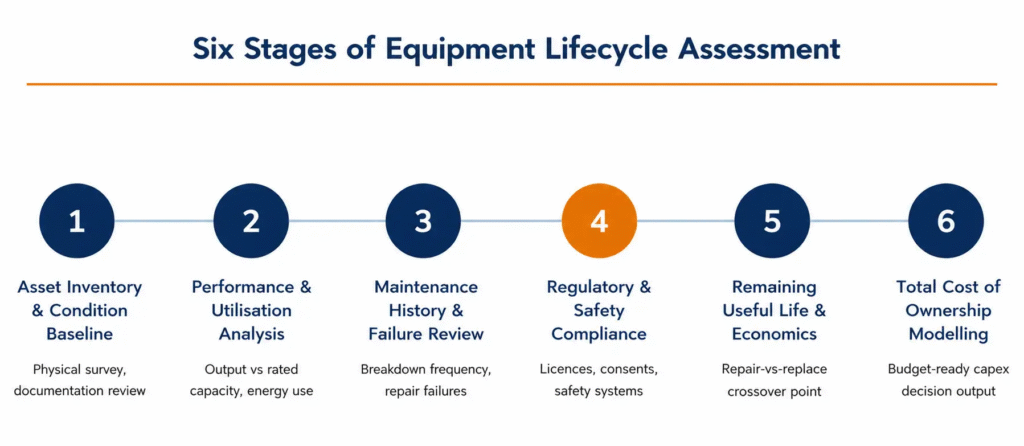
A complete assessment moves through six connected stages. Skipping any one of them leaves a gap in the evidence base that the remaining stages cannot fully compensate for.
1. Asset Inventory and Condition Baseline
- Complete physical inventory of installed equipment, cross-checked against asset registers and depreciation schedules
- Visual and instrument-based condition assessment: corrosion, wear, vibration, thermal signatures, and structural integrity
- Documentation review: original specifications, commissioning records, and prior modification history
The baseline is the reference point every later stage is measured against. Without it, degradation trends cannot be established.
2. Performance and Utilisation Analysis
- Actual output and efficiency against original equipment specifications
- Utilisation rates versus rated capacity, including idle time and unplanned stoppage patterns
- Energy consumption trends relative to BEE benchmarks for the equipment category
Equipment that looks operational on a walkthrough can still be running well below its rated efficiency, quietly inflating per-unit production cost.
3. Maintenance History and Failure Pattern Review
- Preventive maintenance compliance against the manufacturer’s recommended schedule
- Breakdown frequency, mean time between failures, and repeat-failure components
- Spare parts availability and lead time, particularly for equipment nearing obsolescence
A pattern of repeat failures on the same component is usually a stronger signal than the equipment’s chronological age.
4. Regulatory and Safety Compliance Check
- Statutory certifications: boiler and pressure vessel licences, lift and crane certifications, factory licence conditions
- Environmental and energy compliance: pollution control board consents and BEE labelling requirements where applicable
- Safety system verification: interlocks, sensors, and guarding against Factories Act and OSH Code requirements
Compliance documents are verifiable against source records. The only failure mode here is not checking them before an inspector does.
5. Remaining Useful Life and Replacement Economics
- Remaining useful life estimation based on condition data, duty cycle, and manufacturer design life
- Repair-versus-replace economics: comparing projected maintenance cost escalation against replacement capital outlay
- Technology obsolescence review, including availability of spares and vendor support timelines
This is the stage that converts engineering observations into a capital planning decision leadership can act on.
6. Total Cost of Ownership Modelling
- Consolidated cost view combining acquisition, maintenance, downtime, energy, and disposal or resale value
- Scenario modelling: continue operating, refurbish, or replace, with cost and risk implications for each path
- Budget-ready output formatted for capital expenditure approval and internal sign-off
| Assessment Stage | What It Evaluates | Business Impact |
| Asset Inventory & Condition Baseline | Physical condition, documentation, prior modifications | Accurate starting point for all further analysis |
| Performance & Utilisation | Output efficiency, capacity usage, energy trends | Identifies hidden production cost inflation |
| Maintenance History | Failure frequency, repeat components, spares availability | Predicts breakdowns before they halt production |
| Regulatory Compliance | Statutory licences, safety systems, environmental consents | Reduces safety liability and regulatory exposure |
| Remaining Useful Life | Duty cycle, design life, repair-vs-replace economics | Informed capital expenditure timing |
| Total Cost of Ownership | Full cost across acquisition to disposal | Board-ready capital planning input |
How IMARC Engineering Conducts Equipment Lifecycle Assessment
IMARC Engineering’s assessment process is built around verified field data at every stage, replacing assumption-based asset management with structured, on-the-ground evaluation.
- Site survey and asset tagging: Physical inventory and condition survey of all equipment within scope, cross-referenced against existing asset registers.
- Condition monitoring: Vibration analysis, thermal imaging, and non-destructive testing applied where equipment criticality warrants instrument-based verification, not visual inspection alone.
- Maintenance and failure data analysis: Structured review of maintenance logs, breakdown records, and spare parts consumption to identify recurring failure patterns.
- Compliance verification: Cross-checking statutory certifications, environmental consents, and safety system status against source documents, not self-declaration.
- Remaining life and TCO modelling: Engineering assessment of remaining useful life combined with a total cost of ownership model comparing continued operation, refurbishment, and replacement.
- Capital planning report: Structured documentation formatted for internal capex approval, investor due diligence, or insurance and audit requirements.
IMARC Engineering conducts equipment lifecycle assessments across pharmaceuticals, food and beverage, chemicals, electronics, auto components, and industrial manufacturing, where duty cycles, compliance requirements, and failure consequences differ significantly and a generic checklist approach is inadequate.
Common Mistakes in Equipment Lifecycle Management
- Relying on chronological age alone: A ten-year-old machine on a disciplined maintenance schedule can outperform a five-year-old machine that has been neglected. Condition data, not calendar age, should drive the decision.
- Treating maintenance logs as sufficient evidence: Logs record what was done, not what condition the equipment is actually in. Instrument-based verification catches degradation that paperwork misses.
- Deferring replacement past the economic crossover point: Repair costs escalate non-linearly as equipment ages. Deferring replacement past the point where repair cost exceeds a fair share of replacement cost is a recurring source of budget overrun.
- Skipping compliance checks during routine assessment: Statutory certifications and safety systems are often reviewed only during a regulatory inspection, by which point non-compliance has already become a liability.
- Assessing equipment in isolation from production planning: A lifecycle assessment that ignores planned volume growth risks recommending capacity that is already inadequate by the time it is approved.
- Excluding equipment from due diligence during M&A or investment review: Buyers and investors who skip equipment condition assessment inherit deferred maintenance liabilities they did not price into the transaction.
Explore Our Latest Insights: https://www.imarcengineering.com/blog/how-to-select-the-right-equipment-for-your-plant-in-india
Conclusion
India’s expanding capital goods base, rising capex, and tightening safety enforcement are together raising the cost of managing equipment on assumption rather than evidence. An Equipment Lifecycle Assessment converts scattered maintenance records and inspection notes into a single, defensible view of what each asset is worth, how long it can safely keep running, and when replacement becomes the better economic decision.
As industrial assets become more complex and capital-intensive, lifecycle assessment has become an essential planning tool rather than a periodic maintenance exercise. Manufacturers that evaluate equipment proactively are better positioned to reduce downtime, optimise capital expenditure, strengthen compliance, and maximise long-term asset performance.
Contact Us:
IMARC Engineering
Phone: +91-120-433-0800
Email: sales@imarcengineering.com
India: C-130, Sector 2, Noida, Uttar Pradesh 201301
LinkedIn: https://www.linkedin.com/showcase/imarc-engineering/
About the Author