Introduction
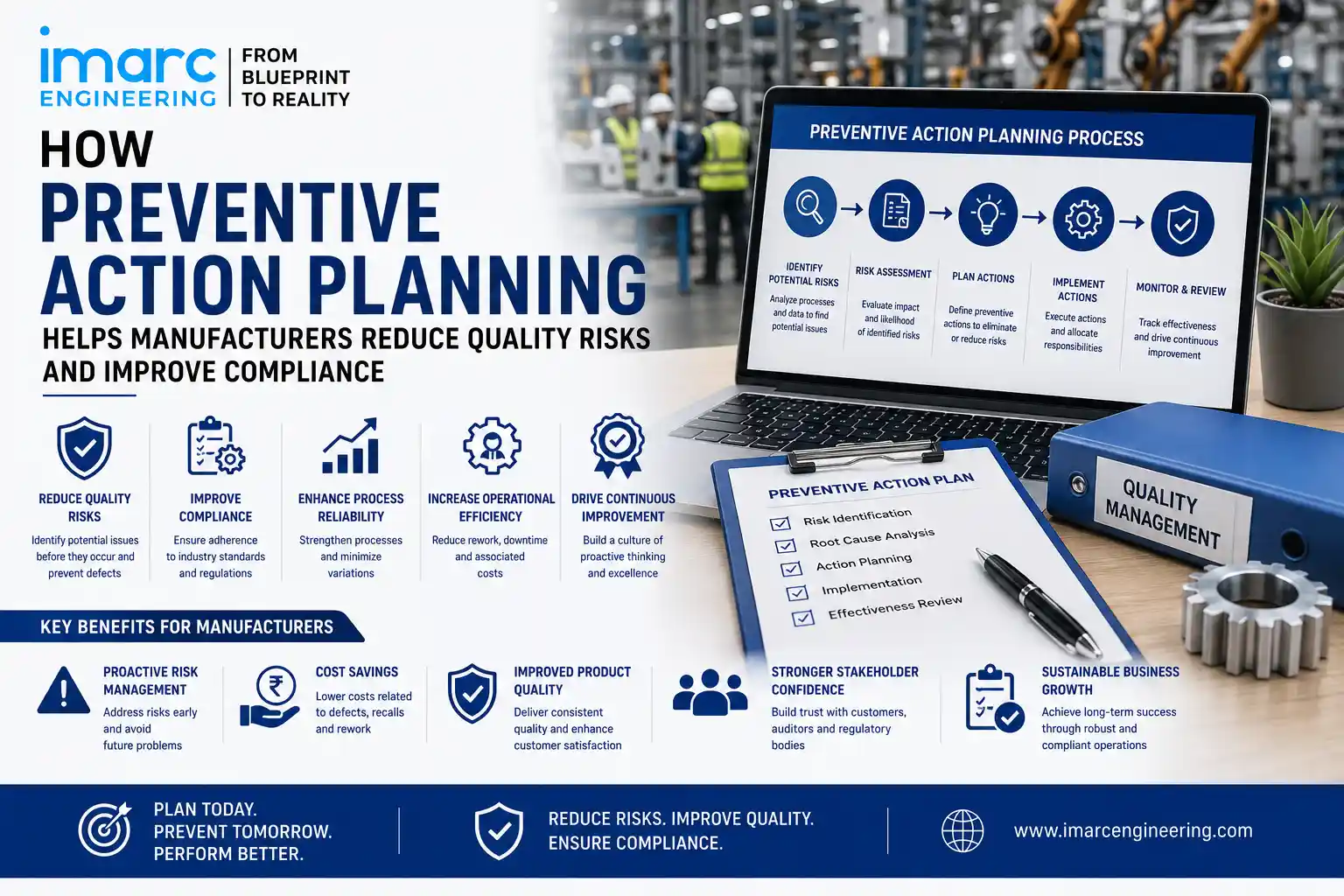
Most quality failures in manufacturing begin as small warning signs that go unnoticed until they become quality defects, compliance issues, or costly recalls. Preventive Action Planning helps manufacturers identify and eliminate these risks early while extending risk management beyond the factory floor through channel partner risk assessment.
Preventive Action Planning enables manufacturers to identify potential quality, compliance, and operational risks before they become defects, audit findings, recalls, or customer complaints. By proactively addressing root causes, organizations can improve product quality, strengthen compliance, and reduce long-term operational costs
IMARC Engineering provides Preventive Action Planning and Channel Partner Risk Assessment Services that help manufacturers strengthen quality systems, improve audit readiness, and reduce regulatory and quality risks through structured risk assessments, FMEA, trend analysis, and preventive action implementation. This article explores how manufacturers can use Preventive Action Planning and channel partner risk assessment to strengthen quality management, improve compliance, and reduce operational risks.
What is Preventive Action Planning?
Preventive Action Planning is a proactive quality management process that identifies, evaluates, and eliminates potential risks before they become quality defects, regulatory non-conformities, customer complaints, or operational failures. By combining risk assessment, trend analysis, FMEA, and documented preventive measures, manufacturers can improve compliance, reduce recurring issues, and strengthen long-term operational performance.
Modern preventive action planning also extends beyond internal manufacturing processes to include structured channel partner risk assessments, ensuring quality, compliance, and operational risks are managed across the entire product distribution network.
Why Preventive Action Planning Is Becoming Non-Negotiable for Indian Manufacturers
India’s manufacturing sector is expanding rapidly, and with greater production volumes, exports, and regulatory oversight, the cost of undetected quality risks continues to increase. Preventive Action Planning has become an essential quality management practice that helps manufacturers reduce compliance risks, protect customer relationships, and avoid costly operational disruptions. Several official data points explain why prevention now matters more than correction alone.
- Rising MSME weight in output: MSME Gross Value Added rose from 27.3% of India’s GDP in FY2020-21 to 30.1% in FY2022-23, per the Ministry of MSME – a larger share of national output now depends on MSME-grade quality systems.
- Export exposure is expanding fast: MSME exports grew from ₹3.95 lakh crore in FY2020-21 to ₹12.39 lakh crore in FY2024-25, with the number of exporting MSMEs rising from 52,849 to 1,73,350 over the same period, per PIB.
- Compliance coverage keeps widening: As of March 2025, the Bureau of Indian Standards had 187 Quality Control Orders in force, covering more than 679 product categories – up sharply from a largely voluntary regime a decade ago.
- Government-backed quality adoption is accelerating: The MSME Sustainable (ZED) Certification Scheme offers certification subsidies of up to 80% for micro enterprises, with the Ministry targeting tens of thousands of additional certifications over the coming certification cycles.
- Formal distribution channels are growing: Government e-Marketplace procurement from MSEs has crossed US$95.6 billion with over 11.9 lakh registered vendor units, per the Ministry of MSME – evidence that formal, verifiable vendor and channel networks are becoming the default, not the exception.
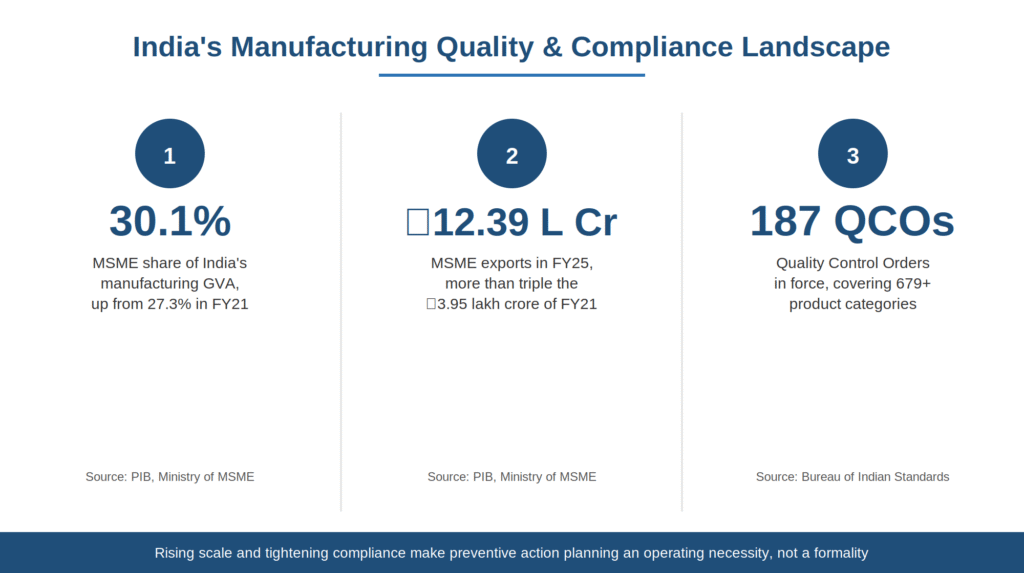
Infographic 1: India’s manufacturing quality and compliance landscape, by the numbers
Why Reactive Quality Management Keeps Failing Manufacturers
Corrective action alone treats prevention as an afterthought – something triggered only once a defect, complaint, or audit finding has already occurred. That sequencing is expensive and slow to change.
- Deviations repeat before anyone escalates them: Minor process drift is tolerated as “within range” until it compounds into a batch failure or customer rejection.
- Root causes are treated as symptoms: Fixing the immediate defect without addressing the systemic cause guarantees recurrence, often in a different product line.
- Channel-level risk goes unmonitored: Distributors and channel partners rarely undergo the same structured risk review as internal production processes, even though they carry the product to market.
- Audit findings become the trigger, not the input: Waiting for a certification or customer audit to surface a gap means the gap has already existed, unaddressed, for months.
- Documentation is retrospective: Records built to justify a corrective action after the fact rarely capture the leading indicators that would have prevented it.
This proactive approach uses data, trend analysis, and structured risk assessment to intervene before failures occur across both manufacturing operations and the channel partners that distribute the output.
What Preventive Action Planning Involves
A successful preventive action system combines four interconnected disciplines that help organizations identify risks early, implement proactive controls, verify effectiveness, and continuously improve quality management performance. Each closes a different category of risk that reactive quality management leaves open.
1. Risk Identification and Trend Analysis
- Systematic review of process data, inspection records, and near-miss reports to detect drift before it produces a defect
- Statistical process control and control-chart analysis to flag assignable-cause variation early
- Failure Mode and Effects Analysis (FMEA) applied at the design and operational stage to rank risks by severity, occurrence, and detectability
2. Preventive Action Development
- Root cause analysis carried through to systemic contributing factors, not just the immediate trigger
- Preventive measures designed to eliminate the conditions that could cause similar issues elsewhere in the operation
- Implementation plans with named ownership, timelines, and resource allocation – not general recommendations
3. Verification and Effectiveness Monitoring
- Defined verification criteria confirming the preventive action was actually implemented as planned
- Ongoing effectiveness data collection and trend monitoring to confirm the risk has not resurfaced
- Escalation triggers if leading indicators show the preventive action is not holding
4. Governance and Documentation
- Structured records aligned with ISO 9001, IATF 16949, or GMP documentation expectations for regulatory and customer audits
- Clear problem statements, evidence-based root cause findings, and preventive analysis extending to similar processes or products
- Periodic management review to keep the preventive action register a living risk tool, not an archive
Preventive Action vs. Corrective Action: A Comparison
The two disciplines are complementary, not interchangeable. Confusing them is one of the most common reasons manufacturers stay reactive.
| Aspect | Corrective Action | Preventive Action |
|---|---|---|
| Trigger | A nonconformance, complaint, or audit finding has already occurred | A trend, near-miss, or risk indicator suggests a failure could occur |
| Timing | After the event, during containment and resolution | Before the event, during planning and process design |
| Primary Focus | Eliminating the root cause of a known problem | Eliminating the conditions that could cause a similar problem |
| Typical Tools | 8D reports, root cause analysis, containment plans | FMEA, trend analysis, risk assessment, channel partner risk assessment |
| Business Impact | Limits damage and cost from an incident already underway | Avoids the incident, its cost, and its compliance exposure entirely |
Why Channel Partner Risk Assessment Is an Essential Part of Preventive Action Planning
Preventive action planning that stops at the factory gate leaves half the risk unmanaged. Distributors, dealers, and channel partners represent the same class of risk as an internal process – and deserve the same structured evaluation.
Channel partner risk assessment applies preventive action principles to the distribution network, identifying weaknesses before they surface as stockouts, non-compliant storage, mislabelled product, or reputational damage in the market.
- Quality system alignment: Verifying that channel partners handle, store, and label products in line with the manufacturer’s own quality standards, not just their own convenience
- Compliance and licensing verification: Confirming that distributors hold valid trade licences, warehousing approvals, and product-specific registrations before onboarding, not after a regulatory notice
- Financial stability review: Assessing whether a channel partner has the working capital to maintain consistent stocking levels and honour payment terms without disrupting supply
- Delivery and service performance tracking: Monitoring fill rates, damage claims, and complaint resolution time as leading indicators of channel reliability
- Data and IP handling controls: Evaluating how partners manage pricing data, customer information, and proprietary product details shared during the distribution relationship
- Contractual and governance risk: Reviewing termination clauses, exclusivity terms, and dispute-resolution mechanisms before they become live issues
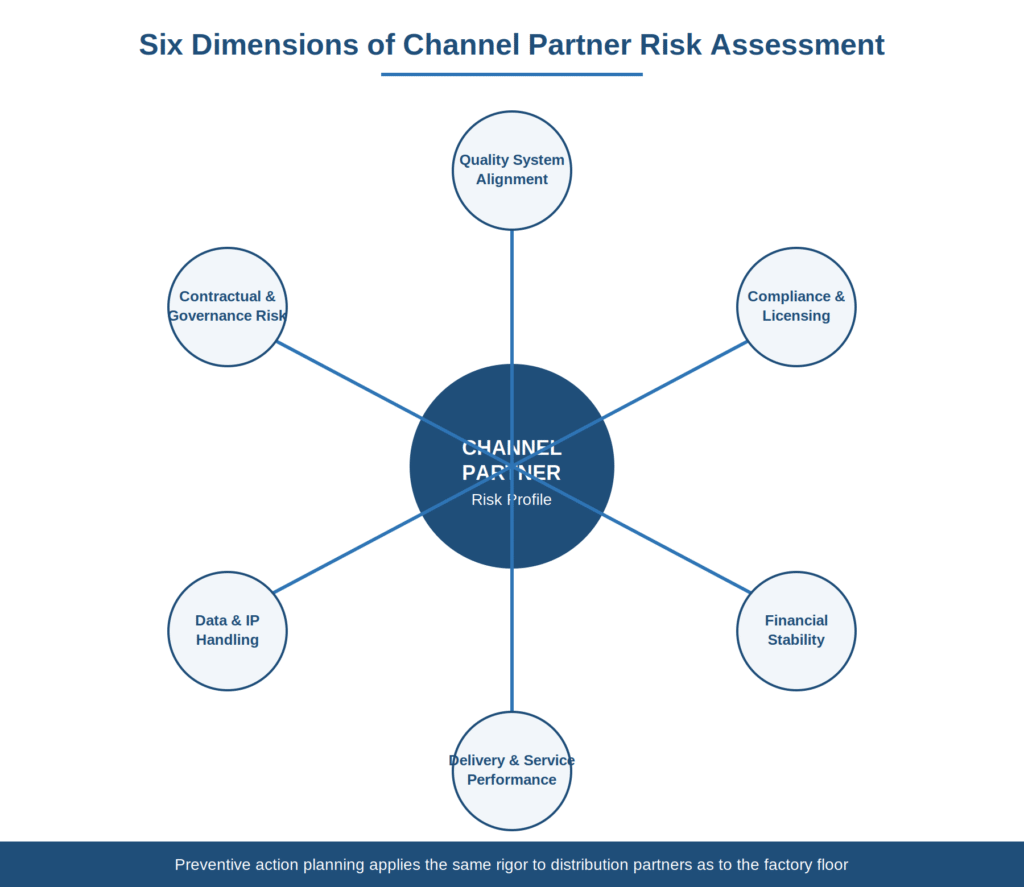
Infographic 2: The six dimensions covered in a structured channel partner risk assessment
How IMARC Engineering Implements Preventive Action Planning and Channel Partner Risk Assessment
IMARC Engineering helps manufacturers implement proactive quality management systems using structured risk assessments, FMEA, trend analysis, CAPA integration, and channel partner evaluations. Our consultants work closely with quality teams to reduce recurring quality issues, strengthen compliance, improve audit readiness, and build sustainable risk management practices across manufacturing and distribution operations.
- Risk mapping and FMEA: Structured failure mode analysis across critical processes to rank risk by severity, likelihood, and detectability before it is prioritised for action
- Preventive action system design: Building the documentation, escalation triggers, and ownership structure needed to convert risk data into implemented action
- Channel partner risk assessment: On-the-ground evaluation of distributors and channel partners against quality, compliance, financial, and service-performance criteria
- Effectiveness verification: Post-implementation monitoring to confirm preventive actions have actually reduced the targeted risk, not just closed a checklist item
- Audit and certification readiness: Preparing preventive action documentation to withstand ISO 9001, IATF 16949, GMP, or customer-led audit scrutiny
- Trend reporting for management review: Consolidated reporting that keeps preventive action planning a continuous discipline rather than a one-time project
IMARC Engineering supports clients across pharmaceuticals, food and beverage, chemicals, electronics, auto components, and industrial products – sectors where the cost of a missed preventive signal is measured in recalls, rejected shipments, or lost certification.
Strengthen your quality management system with IMARC Engineering’s Preventive Action Planning and Channel Partner Risk Assessment services. Contact our experts to schedule a consultation: https://www.imarcengineering.com/contact-us
Common Mistakes in Preventive Action Planning
- Treating preventive action as paperwork: Filling a preventive action field on a CAPA form without genuine root cause and risk analysis behind it defeats the purpose entirely.
- Skipping channel partner risk assessment: Assuming distributors will maintain quality and compliance standards without verification leaves the most visible part of the supply chain unmanaged.
- Confusing preventive action with corrective action: Logging a fix for an incident that already occurred as a preventive action creates a false sense of proactive coverage.
- No effectiveness verification: Implementing a preventive action without confirming it actually reduced the risk allows the same failure to resurface months later.
- Excessive, low-value preventive actions: Opening a preventive action for every minor observation dilutes resources away from the risks that matter most.
- Delayed initiation: Waiting for a formal audit cycle to review trend data means preventable failures accumulate in the gap between reviews.
Conclusion
India’s manufacturing sector is scaling output, exports, and compliance obligations simultaneously – and that combination raises the cost of every quality risk left unmanaged until it fails.
A structured prevention strategy, extended through systematic distribution partner evaluations, replaces guesswork with verified evidence at every stage—from the production floor to the distribution network.
Organizations that invest in proactive quality risk management are better positioned to reduce compliance risks, improve product quality, strengthen customer confidence, and maintain long-term operational excellence. Through structured risk assessments, FMEA-based analysis, CAPA integration, and comprehensive partner evaluations, IMARC Engineering helps manufacturers build proactive quality systems that prevent issues before they impact production, regulatory compliance, or business performance.
Contact Us:
IMARC Engineering
Phone: +91-120-433-0800
|Email: sales@imarcengineering.com
India: C-130, Sector 2, Noida, Uttar Pradesh 201301
LinkedIn: https://www.linkedin.com/showcase/imarc-engineering/
About the Author