A breakdown stops the line. The maintenance team traces the fault to a bearing, a sensor, or a gearbox part that isn’t on the shelf. Production waits while someone calls the supplier and prices out an air-freighted replacement. Meanwhile, in the same stores, other bins hold parts that haven’t moved in years.
This is the everyday reality behind spare parts inventory management in India plants simultaneously carry too little of what they need and too much of what they don’t. Spare availability affects uptime directly — a stocked-out critical part can idle a line regardless of how well the equipment is maintained. Excess inventory, meanwhile, ties up working capital and quietly ages into obsolescence.
Both problems share a root cause: stocking decisions made without reference to equipment criticality, failure history, or supplier lead time. Getting this right isn’t about stocking more or less — it’s about stocking the right parts, in the right quantity, based on what actually matters to production continuity.
What Is Spare Parts Inventory Management?
Spare parts inventory management is the process of identifying, stocking, tracking and replenishing maintenance parts based on equipment criticality, failure risk, usage and supplier lead time. The objective is to keep critical parts available when needed without tying up unnecessary working capital in slow-moving or obsolete stock.
Why Spare Parts Inventory Management Matters in India’s Manufacturing Operations
The secondary sector, covering manufacturing and construction, was estimated to grow by around 7.0% at constant prices in FY 2025-26, according to MoSPI’s First Advance Estimates.
Under the Production Linked Incentive (PLI) Schemes, cumulative investment had exceeded ₹2.16 lakh crore as of 31 December 2025, generating over ₹20.41 lakh crore in cumulative production and sales, per the Press Information Bureau (PIB).
More production lines and continuing capacity expansion raise the cost of unplanned downtime — making spare parts inventory management a direct contributor to operational reliability, not a back-office task.
Why Stockouts and Excess Spare Parts Exist Together
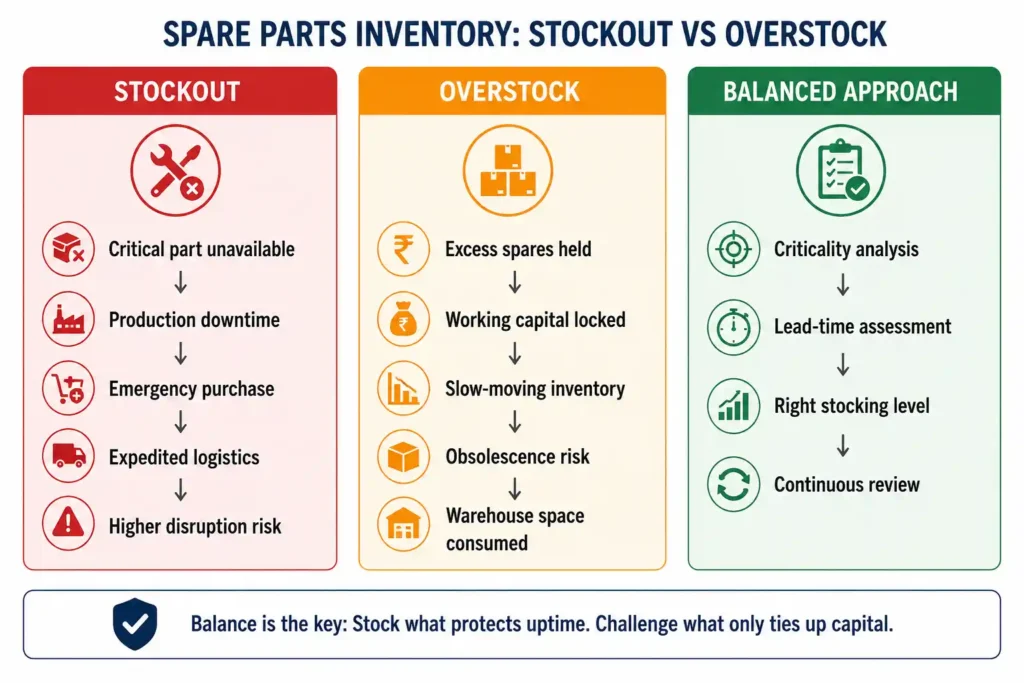
Most plants don’t choose between stockouts and excess inventory — they experience both, often for the same underlying reasons.
- Critical parts go unavailable because no one assessed which failures would actually stop production, and OEM or import lead times mean a part ordered after a failure arrives weeks late.
- Emergency procurement becomes the default response, at higher cost, with no fix to the underlying gap.
- Slow-moving and obsolete parts accumulate because nobody reviews stock after an equipment change, and duplicate item codes distort the true stock position.
- Min/max levels are set once and rarely revisited, while ERP records and physical stock drift apart — so reorder decisions rest on numbers that no longer reflect the shelf.
Spare Parts Inventory: Stockout vs Overstock
How to Classify Spare Parts by Criticality
Not every spare deserves the same stocking policy. A plant treating a ₹200 gasket like a ₹15 lakh gearbox will over-invest in one and under-protect the other.
Criticality assessment should weigh production criticality, safety and quality impact, equipment redundancy, failure consequence, repairability, lead time, and single-source dependency:
- Production criticality — does failure stop the line, a section, or have no output impact?
- Safety, quality and redundancy — could failure cause injury or affect conformance, and is there a standby unit?
- Repairability, lead time, single-source dependency — can it be fixed on-site, and is there only one supplier?
Classification frameworks can support this analysis, though none should be applied as a universal rule:
- ABC — ranks parts by consumption value, useful for cost control.
- VED — ranks parts as Vital, Essential, or Desirable, based on operational consequence.
- XYZ — ranks parts by demand variability and forecasting reliability.
- FSN — ranks parts as Fast, Slow, or Non-moving, useful for identifying obsolete stock.
The right approach usually combines two or more frameworks — for example, VED for criticality and FSN for rationalisation — rather than relying on a single classification alone.
How to Determine the Right Spare Parts Stock Level
Average consumption alone is not a reliable basis for stocking decisions where lead times are long or failure consequences are severe. A part used once in three years can still justify holding stock if its absence would stop production for weeks.
A structured spare parts planning and inventory setup approach can bring these factors together when establishing stocking levels for critical equipment.
A sound stocking decision draws on:
- Historical consumption and failure history for that specific part and equipment
- Supplier lead time and its variability — not just the average quoted delivery period — and minimum order quantity
- Safety stock sized to cover demand and lead-time uncertainty, and a reorder point that triggers a fresh purchase order
- Min/max levels reviewed periodically, and service-level requirements appropriate to the equipment’s criticality
For high-criticality, long-lead items, the stocking logic should be driven by failure consequence and lead-time risk first, with consumption data used to refine — not set — the final quantity.
Critical Spares vs Operational Spares vs Consumables
Grouping spares into three categories helps align stocking policy with actual part behaviour:
| Category | Usage Pattern | Typical Characteristics |
| Critical / Insurance Spares | Low usage, high consequence if unavailable | High-value stock, long lead time, tied to plant-stopping equipment |
| Operational Spares | Regular wear-and-tear replacement | Predictable demand, moderate lead time |
| Consumables | Routine, high-frequency usage | Low value per unit, short lead time, easy to source |
Managing Imported and Long-Lead Spare Parts
Many Indian plants run equipment sourced from overseas OEMs, adding import lead time, customs clearance, and freight cost to replacement decisions — factors that rarely apply to a locally sourced consumable.
- OEM dependency often means a single global source, with limited pricing leverage and long confirmation-to-delivery cycles, compounded by customs and freight-routing time that domestic sourcing doesn’t require.
- Identifying and qualifying approved alternatives, where technically feasible, reduces exposure to a sole supplier.
- Early procurement, timed to known lead times rather than reactive triggers, avoids last-minute air freight — and a defined buffer for critical imported spares covers lead-time variability a standard reorder point doesn’t capture.
Linking Spare Parts Inventory With Maintenance Planning
Spare parts inventory management works only when it is driven by the maintenance function, not run as a separate stores exercise. The logical sequence runs: maintenance plan → equipment failure history → criticality assessment → spare requirement (from the equipment BOM) → stocking policy.
Work orders, maintenance schedules, and equipment BOMs should feed directly into stores planning. Where maintenance and stores run as disconnected systems, stocking decisions end up disconnected from actual equipment risk.
Improving Warehouse and Inventory Accuracy
A stocking policy is only as good as the data behind it. Many plants find their real problem isn’t the policy — it’s that ERP availability and physical availability don’t match.
- Correct item coding and part identification, and bin/location control so system location matches the physical shelf
- Regular physical verification and cycle counting, not annual stock-take alone, backed by disciplined ERP transaction recording
- Quarantine handling and storage conditions suited to the part, plus periodic checks for duplicate or obsolete item codes
- ERP/CMMS integration — link equipment BOMs, maintenance work orders, spare consumption and replenishment triggers so stocking decisions reflect actual maintenance activity.
Without this discipline, even a well-designed stocking policy will misfire — triggering unnecessary orders or missing a genuine shortage.
Spare Parts Planning for Greenfield and Brownfield Plants
A new plant and an operating plant face different spare parts planning problems, and the strategy has to reflect that difference.
Greenfield Plants
- Building the spares list from the equipment BOM, then reviewing OEM recommendations against actual criticality — before commissioning, not after the first breakdown
- Separating commissioning/start-up spares from steady-state operating spares, with no consumption history to draw on
- Flagging long-lead parts early and qualifying suppliers before equipment goes live
Brownfield Plants
- Starting from existing consumption and failure history, auditing current stock against what’s actually used, and addressing obsolete inventory
- Accounting for equipment modifications that changed spare requirements since installation
- Reviewing supplier performance against actual delivery history, and assessing maintenance practices for gaps driving reactive procurement
Common Spare Parts Inventory Management Mistakes
- Applying the same stocking policy to every spare, regardless of criticality
- Skipping a formal criticality assessment, or accepting OEM spares lists without review
- Ignoring lead-time risk when setting reorder points, or relying on ERP data never reconciled against physical stock
- Never reviewing slow-moving or obsolete stock, or updating the spares list after an equipment modification
- Letting maintenance and stores operate without coordination, and letting emergency purchasing become routine
Spare Parts Problem → What to Analyse → Strategic Response
How IMARC Engineering Supports Spare Parts Inventory Management
IMARC Engineering works with manufacturing plants as an engineering-led advisory partner on spare parts planning — grounding stocking decisions in equipment data and failure risk rather than guesswork or generic OEM lists. Depending on the plant’s stage and requirement, this can include:
- Equipment criticality and failure-mode assessment, and identification of critical/insurance spares that warrant dedicated stocking
- Support in optimising stocking levels, reorder points, and safety stock for key items
- Supplier identification, including alternatives to single-source OEM dependency
- Inputs for spare parts inventory setup, codification, and ERP/inventory-system implementation
- Maintenance-linked spare parts planning for greenfield project teams and operating brownfield plants alike
This kind of structured assessment can help manufacturers evaluate where working capital is genuinely at risk in inventory, and where critical spares remain exposed to stockout risk — without relying on fixed savings targets or guaranteed outcomes.
Is your plant carrying excess spares while critical parts remain exposed to stockout risk? Discuss your spare-parts planning and inventory requirements with IMARC Engineering: https://www.imarcengineering.com/contact?service=spare-parts-planning-and-inventory-setup
Conclusion
Effective spare parts inventory management in India comes down to a few connected disciplines: knowing which equipment failures actually matter, understanding true lead time and its variability, sizing stock against failure consequence rather than average usage, and keeping ERP and physical stock aligned. A criticality assessment is only as useful as the stores data behind it, and a stocking policy is only as reliable as the maintenance plan feeding it.
The goal isn’t to eliminate risk, but to balance it deliberately — protecting uptime where it genuinely matters while releasing working capital tied up elsewhere. That balance looks different for every plant, which is why IMARC Engineering builds it around each plant’s own equipment, failure, and consumption data rather than a generic checklist.
Contact Us:
IMARC Engineering
Phone: +91-120-433-0800
Email: sales@imarcengineering.com
India: C-130, Sector 2, Noida, Uttar Pradesh 201301
LinkedIn: https://www.linkedin.com/showcase/imarc-engineering/
About the Author