Rework is one of the most expensive line items in an industrial project, and most manufacturers only recognise its true cost after construction has begun. Studies across construction and manufacturing projects show that rework can account for up to 12% of total project cost when facilities are designed using standalone 2D drawings rather than coordinated 3D models.
As more than ₹2.16 lakh crore has already been committed under India’s Production Linked Incentive (PLI) scheme across 14 manufacturing sectors (as of December 2025), mistakes in facility layout, equipment placement, or utility routing have become capital-efficiency issues—not merely engineering errors.
3D modelling and simulation shift cost discovery from the construction site—where design mistakes are expensive to correct—to the design stage, where they can be identified and resolved quickly and cost-effectively. Evidence from recent industrial and manufacturing projects consistently demonstrates that resolving issues digitally before construction begins helps manufacturers reduce rework, control project costs, and accelerate delivery.
The Real Cost of Building Without a Model First
Engineering research commonly cites a simple multiplier to describe error cost escalation: a design change costs 1x at the drawing stage, roughly 10x once it reaches construction, and close to 100x if it surfaces after handover, when equipment is already installed and production has started. This is the core economic argument for 3D modelling, and it is borne out in project data. Peer-reviewed studies published in 2025 found that Building Information Modelling reduces design errors by 50% to 60%, cuts clashes between structural, mechanical, and utility systems by around 40%, and lowers rework costs by 40% to 50% compared with traditional 2D coordination.
For industrial and process plant projects specifically, the impact on schedule is just as significant as the impact on cost. Structured 3D modelling and BIM-based coordination has been shown to speed up overall project delivery by 20% to 50%, cut rework by up to 40%, and lower total construction costs by 10% to 20%, figures that hold up consistently across manufacturing, warehousing, and process facility builds in India.
Transform your project with expert 3D Modelling services: https://www.imarcengineering.com/contact?service=3d-modelling-and-simulation
Where the Savings Actually Show Up
- Clash detection before fabrication. On a recent rail infrastructure project, coordinated 3D modelling identified more than 3,000 critical clashes between systems before construction began. Resolving them digitally, instead of on site, saved close to 12% of total construction cost on that project alone.
- Virtual commissioning cuts machine and line commissioning time. Simulating servo axes, robot paths, and conveyor interference zones before fabrication has been shown to reduce commissioning time by 30% to 50%. In one Indian FMCG packaging line project, digital twin simulation during design identified seven bottlenecks before fabrication, and the physical system was commissioned and running at full speed 40% faster than a comparable conventional project.
- Fewer on-site design changes. Across a sample of recent special-purpose machine and robotic cell projects, on-site design changes dropped by 60% to 70% compared with projects that skipped upfront 3D simulation.
- Cleaner documentation. Shop drawings and coordination drawings generated directly from a coordinated 3D model carry 65% fewer documentation errors than drawings produced through traditional CAD workflows, because the drawing and the model share a single data source.
- Lower unplanned downtime after commissioning. Manufacturers using digital twins to test process changes and identify potential failure points ahead of time have reported unplanned downtime reductions of up to 47% once the line is running.
- Less material waste from over-ordering. Quantity takeoffs pulled directly from a coordinated 3D model, instead of estimated from 2D drawings, have been shown to cut material waste by 25% to 30% by preventing the over-ordering and mismatched procurement that drives most site-level wastage.
These gains are not isolated from each other either. The same model that catches a clash also feeds the quantity takeoff, and the same model used for virtual commissioning becomes the fabrication reference later, so the savings compound across a single build instead of requiring a separate tool for each stage.
Traditional Build vs. 3D Modelling-Led Build: Project Outcomes
| Project Parameter | Traditional 2D-Led Approach | With 3D Modelling / Digital Twin |
|---|---|---|
| Rework as share of project cost | Up to 12% | Reduced by 40% to 50% |
| Design and clash errors | Baseline | Reduced by 50% to 60% |
| Machine or line commissioning time | Baseline schedule | 30% to 50% faster |
| On-site design changes | Baseline | Reduced by 60% to 70% |
| Shop drawing documentation errors | Baseline | Reduced by 65% |
| Overall project delivery timeline | Baseline | 20% to 50% faster |
Figures compiled from published BIM and digital twin performance studies and recent industrial project deployments; actual outcomes vary by facility complexity and model detail level.
The pattern across all six parameters is the same: every gain comes from resolving a problem digitally before it becomes a physical one. A clash caught in a federated 3D model on a Tuesday afternoon costs an engineer an hour to fix. The same clash caught after a foundation is poured or a conveyor is fabricated costs weeks of site delay, wasted material, and, in many cases, a change order negotiation with the contractor. For manufacturers running on tight commissioning windows tied to production targets or PLI disbursement milestones, that difference compounds fast.
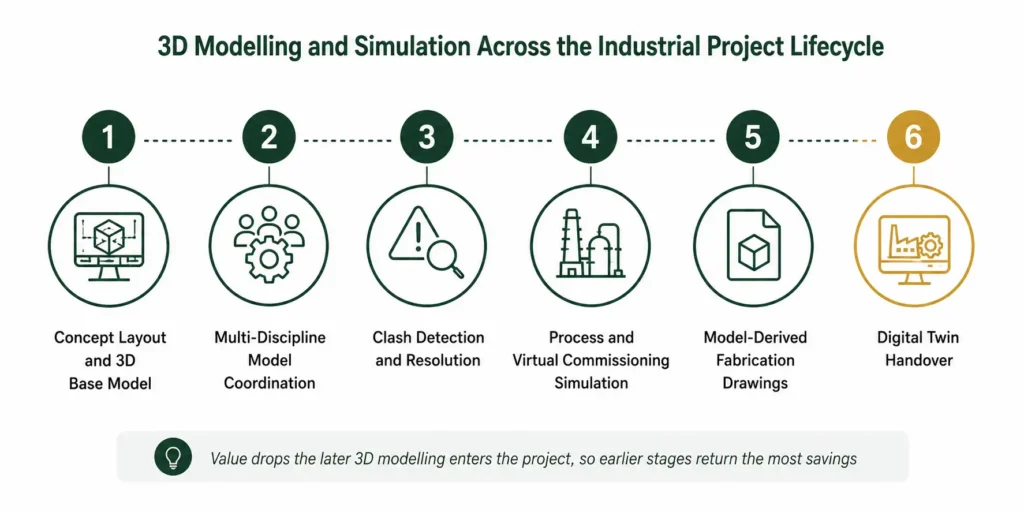
The sequence in which 3D modelling and simulation gets applied matters as much as the tools themselves. A model built after equipment procurement is already locked in captures far less value than one built during concept design, when layout, utility routing, and equipment placement are still open to change. The stages below reflect the order in which 3D modelling typically delivers the most value across an industrial project.
Turning Model Data Into a Reliable Handover Asset
The value of a 3D model does not end at commissioning. A model built with equipment specifications, utility routing, and structural data intact becomes the foundation of a digital twin that plant teams can use for maintenance planning, layout changes, and future expansion, without re-surveying the facility from scratch. This is the layer covered by IMARC Engineering’s 3D modelling and simulation services, which combine coordinated multi-discipline modelling, clash detection, and process simulation to help manufacturers catch design and layout issues before they reach the shop floor, across both greenfield and brownfield industrial projects in India.
For plants already in operation, the same model can be extended into predictive maintenance planning. Manufacturers running digital twins alongside asset monitoring typically report ROI within 15% to 30% in the first few years, with payback periods on targeted pilot projects often under 24 months, well within a single capital planning cycle for most industrial facilities.
Conclusion
The gap between a facility designed on paper and one designed inside a coordinated 3D model shows up exactly where it hurts most, in commissioning delays, rework bills, and unplanned downtime once production starts. With rework alone capable of consuming up to 12% of project cost, and digital coordination cutting that by up to half, the return on modelling investment is no longer a design department decision. It is a project economics decision that manufacturers can no longer afford to skip.
Contact Us:
IMARC Engineering
Phone: +91-120-433-0800
Email: sales@imarcengineering.com
India: C-130, Sector 2, Noida, Uttar Pradesh 201301
LinkedIn: https://www.linkedin.com/showcase/imarc-engineering/
About the Author