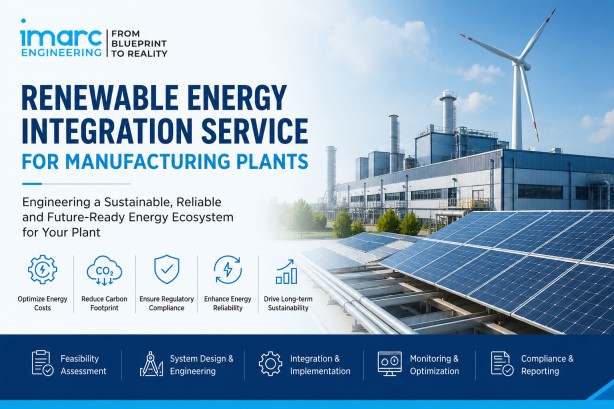
Renewable Energy Integration Services
Rising industrial electricity costs, evolving renewable energy regulations, and increasing ESG expectations are forcing Indian manufacturers to rethink how they source power. Grid tariffs for industrial consumers at 33 kV now run between INR 6 and INR 8 per unit in several states, while solar open access power is available at INR 3 to 5 per unit, a gap wide enough to reshape plant-level cost structures within a single procurement cycle .
At the same time, regulatory obligations, buyer-side ESG scrutiny, and grid reliability concerns are converging to make Renewable Energy Integration Services for Manufacturing Plants a structural priority. Most plants still approach this as a rooftop-sizing exercise. It should instead be approached as a structured engineering exercise comprising five stages, aligned with process demand and rigorously stress-tested against evolving regulatory shifts that procurement teams often fail to anticipate until they encounter compliance or cost barriers.
Renewable energy integration is no longer limited to installing rooftop solar panels. Manufacturers must evaluate electricity demand profiles, procurement models, energy storage, regulatory obligations, and long-term operating costs before selecting the appropriate renewable energy mix.
Why Renewable Energy Integration Has Become a Priority
Three forces are pushing manufacturers toward structured renewable adoption.
- First, the Ministry of Power’s Renewable Consumption Obligation trajectory requires designated consumers, including captive and open access users, to source 35.95% of consumption from renewables in FY 2026-27, rising to 43.33% by FY 2029-30 (Ministry of Power / RESI India, 2026).
- Second, export-facing manufacturers supplying European and North American buyers face Scope 2 emissions disclosure requirements that open access renewable energy certificates can satisfy without capital-heavy captive builds (Heaven Designs, 2026).
- Third, India’s open access solar capacity surged 160% year-on-year to 2.7 GW in Q1 2026 alone, taking cumulative capacity past 32.9 GW, evidence that procurement infrastructure has matured enough to de-risk large industrial commitments (Industrial Info Resources, 2026).
Step-by-Step Renewable Energy Integration Strategy
Step 1: Conduct an Energy Baseline Audit and Feasibility Assessment
Before selecting any technology, plants need a granular baseline: load curves by shift, thermal versus electrical demand split, existing diesel backup dependency, and site constraints such as available rooftop area or land for captive generation. This audit should also map current DISCOM tariff exposure against applicable open access charges, since banking and wheeling rules now vary meaningfully by state. Maharashtra’s same-slot banking rule under MERC’s 2025 order, for instance, removes the ability to offset nighttime consumption with daytime solar credits, materially changing the economics for continuous-process plants
- Segment energy demand by process line, not just facility-level totals
- Identify peak-load windows that drive demand charges, since these often justify storage before generation capacity
- Flag high-thermal-load operations suited to waste heat recovery or cogeneration rather than electrical renewables alone
Step 2: Match the Procurement Model to Load Profile, Not Convenience
The procurement model a plant defaults to is usually the one its EPC vendor sells, not the one its load profile actually needs. Use load shape as the primary filter before evaluating cost:
| Load Profile | Best-Fit Model | Key Trade-Off |
| Daytime-heavy, single shift | Rooftop solar | Capital-intensive, limited by roof area |
| Steady multi-shift, moderate capital appetite | Open access PPA | Zero CAPEX, exposed to state banking rule changes |
| Continuous / 24×7 process load | Hybrid (solar + wind) with BESS | Highest reliability, longest contract lead time |
Open access PPAs deliver 30-50% savings over HT industrial tariffs without upfront capital, governed by CEA Connectivity Regulations and the Electricity Act, 2003 . Hybrid group-captive structures are gaining ground specifically because standalone solar cannot address night-shift demand, and lenders are now underwriting storage-backed PPAs more readily than they did two years ago.
Step 3: Size the Technology Mix to the Process, Not the Rooftop
A common design error is sizing renewable capacity to available rooftop space rather than actual process demand. Energy-intensive segments such as metals, cement, and chemicals should evaluate waste heat recovery and cogeneration alongside solar, since these processes generate recoverable thermal energy that direct electrification cannot capture.
For continuous operations, battery storage is increasingly a default design input rather than an add on: India’s Central Electricity Authority projects a requirement of 336-411 GWh of storage capacity by 2030-32 to support renewable integration at grid scale, a signal that plant-level storage economics will keep improving as manufacturing and cell costs fall .
Step 4: Structure Financing and Pressure-Test the Payback Math
CFOs should model three financing paths: outright CAPEX ownership, OPEX-based PPAs with zero upfront cost, and group-captive structures requiring partial equity participation. A useful discipline before signing any PPA: recalculate projected savings using the lowest plausible open access tariff differential in your state, not the vendor’s headline number, since banking and wheeling charges are actively being revised.
Recent hybrid deals illustrate achievable benchmarks; a Gujarat hybrid solar-wind-BESS project was contracted at INR 5.95 per kWh under a 25-year PPA . Rajasthan now requires captive plants exceeding 100% of contract demand to install BESS for at least 20% of the additional capacity, a mandate finance teams should model into ROI even where it does not yet apply in their state, given the direction RPO policy is moving.
- Stress-test savings under at least two banking-charge scenarios, not one static tariff
- Treat REC or I-REC purchases as a lower-CAPEX compliance bridge while captive capacity is built out
- Build storage costs into ROI models proactively rather than reactively
Step 5: Build the Compliance and Reporting Layer
A renewable integration strategy is incomplete without a reporting mechanism tied to RPO compliance and BRSR disclosure. Designated consumers must file annual compliance reports with their State Electricity Regulatory Commission documenting procurement, self-generation, and REC purchases.
Align this reporting cadence with BRSR filing cycles so procurement data feeds directly into disclosure documentation instead of being reconciled separately each year, which is where most sustainability teams lose weeks during audit season.
Sector-Specific Considerations
- Metals and heavy engineering: solar-plus-waste-heat-recovery combinations offer the most cost-effective entry point
- Cement and building materials: kiln and grinding loads favor waste heat recovery paired with solar hybrid systems
- Chemicals and petrochemicals: continuous processes benefit from cogeneration and firm renewable-plus-storage contracts
- Pharmaceuticals and life sciences: cleanroom HVAC loads make rooftop solar and efficiency retrofits immediately viable
- Textiles and apparel: high steam demand favors solar thermal alongside rooftop electrical solar
- Automotive and auto components: consistent shift-based demand suits solar plus storage and smart load management
- Electronics and semiconductors: power quality sensitivity requires renewable integration paired with monitoring systems
- Food and beverage processing: refrigeration and packaging loads suit solar, biomass, and thermal energy combinations
- FMCG and consumer goods: distributed units favor scalable, phased rollouts tied to ESG targets
- Oil and gas downstream units: hybrid systems support auxiliary power and emissions reduction without disrupting core reliability
A Readiness Checklist Before You Approach Vendors
- Load data segmented by process line, not just monthly DISCOM bills
- Current and projected RPO obligation calculated for your consumer category
- State-specific banking and wheeling charge rules reviewed for the last 12 months of amendments
- Storage requirement modeled even if not currently mandated
- BRSR and RPO reporting cadences mapped against each other
Common Pitfalls That Undermine Integration Strategies
- Plants frequently under-invest in the feasibility and metering stage, sign PPAs without stress-testing state-level banking rule changes, or size storage as an afterthought.
- Only a fraction of India’s tendered battery storage capacity is currently operational against a much larger pipeline under construction, so integration timelines should build a buffer for execution delays across the value chain (IEEFA, 2026).
- O&M teams should also be looped in during design, not after commissioning, since decisions made purely at procurement stage often create downstream maintenance and uptime complications.
How IMARC Engineering Can Help
IMARC Engineering supports manufacturing plants through the full renewable integration lifecycle, from energy baseline audits and technology feasibility studies to procurement structuring, PPA evaluation, and RPO/BRSR compliance alignment. Our engineering and EPCM teams work across metals, cement, chemicals, pharmaceuticals, textiles, automotive, and process industries to design integration strategies sized to actual plant demand, helping clients convert renewable adoption from a cost center into a measurable operational advantage.
Conclusion
Renewable energy integration has evolved from a sustainability initiative into a strategic operational decision for manufacturers. Rising electricity prices, evolving renewable energy obligations, and increasing customer expectations require manufacturers to adopt structured energy planning rather than isolated technology investments. A well-designed integration strategy helps reduce operating costs, improve energy resilience, strengthen ESG performance, and support long-term manufacturing competitiveness.
Speak With An Expert: https://www.imarcengineering.com/contact?service=utility-cost-energy-efficiency-audits
Contact Us:
IMARC Engineering
Phone: +91-120-433-0800
Email: sales@imarcengineering.com
India: C-130, Sector 2, Noida, Uttar Pradesh 201301
LinkedIn: https://www.linkedin.com/showcase/imarc-engineering/
About the Author